Article

Different Paths to a High Corporate Return on Equity

The ultimate goal of investors is to earn a high return on our investments without taking undue risks.

Publicly traded companies are stewards of their investors’ capital.

The Board of directors and management of every publicly traded company have a responsibility to attempt to make a good return on the money that its owners have entrusted to the company.

This return is best measured by return on equity. This is their-bottom line after-tax profit divided by the owner’s equity on their balance sheet.

This short article explores the return on equity of the companies that I am tracking.

The table below  ranks these companies from highest to lowest ROE and explains the three key factors that drove their achieved ROE.

Not surprisingly, some high ROE companies and industries rely on a high profit level as a percent of sales revenue. Apple Inc. is an example as is lululemon. But some companies achieve a high ROE despite a very low level of profit as a percent of sales revenue. Costco achieves an ROE of about 30% despite a very low profit on sales margin of about 3%. And some companies end up with a relatively low return on equity despite having a high profit on sales margin. RioCan Real Estate Investment Trust is an example. Its profits are very high in relation to its revenue but are relatively low in relation to its very large investment in assets and to the owner’s equity invested in those assets.

In “translating” profit over sales revenue into return on equity the other two key drivers are asset turnover (the number of dollars invested in assets for each dollar of sales revenue) and financial leverage (how many dollars of assets for each dollar of owner’s equity).

The following table ranks the ROE of a wide variety of companies and explains how the three drivers of ROE come together to result in the ROE in each case.

The formula used here is known as the “DuPont Formula”. It was developed back in the 1920s by Donaldson Brown, a finance executive at DuPont Corporation.

Company ROE  = Profit/Sales  x Sales/Assets  x Assets/Equity Explanation of ROE
Apple Inc. 153% = 26% x           1.17  x           4.97 The Trifecta! High profits on sales, asset light, and high leverage
Constellation Software Inc. 69% = 14% x           0.82  x           5.99 The Trifecta! High profits on sales, asset light, and high leverage
VISA Inc. 50% = 57% x           0.38  x           2.29 Massive profits over sales revenue explains this
lululemon athletica inc. 44% = 17% x           1.44  x           1.77 High profits on sales, relatively asset light with modest leverage
American Express Company 33% = 15% x           0.23  x           9.74 Massive equity leverage explains this despite low asset turnover
Costco 32% = 3% x           3.74  x           3.12 Very high asset turnover and leverage overcome the low profits on sales
Restaurant Brands International Inc. 30% = 20% x           0.30  x           5.02 High profits on sales and high equity leverage overcome low asset turnover
Canadian National Railway Company 24% = 27% x           0.31  x           2.80 Very high profits over sales are key here
Canadian Natural Resources 22% = 24% x           0.48  x           1.92 Very high profits over sales are key here
Alimentation Couche-Tard Inc. 21% = 4% x           1.87  x           2.80 High asset turnover and leverage overcome the low profits on sales
TFI International Inc. 20% = 7% x           1.08  x           2.83 Good profit over sales, good asset turnover and high equity leverage
Company ROE  = Profit/Sales  x Sales/Assets  x Assets/Equity Explanation of ROE
Toll Brothers Inc. 19% = 13% x           0.81  x           1.74 High profits over sales are key here
Stantec Inc. 17% = 7% x           1.03  x           2.54 Good profit over sales, good asset turnover and high equity leverage
Shopify Inc. 15% = 17% x           0.68  x           1.24 The high profits over sale are key here plus it is asset light
Metro Inc. 15% = 5% x           1.49  x           2.06 High asset turnover and leverage overcome the low profits on sales
Royal Bank of Canada 14% = 30% x           0.03  x          18.12 High profits over sales and massive leverage overcome the extremely low asset turnover
WSP Global Inc. 14% = 6% x           0.91  x           2.47 Good profit over sales plus leverage and relatively high asset turnover
Canadian Tire 11% = 4% x           0.75  x           3.86 High equity leverage is key here
Linamar Corporation 11% = 6% x           0.93  x           2.00 Good profit over sales plus leverage and good asset turnover
Enbridge Inc. 10% = 12% x           0.24  x           3.49 Strong profits over sales and high leverage overcome the low asset turnover
Canadian Western Bank 10% = 30% x           0.03  x          11.87 High profits over sales and massive leverage overcome the extremely low asset turnover
Fortis Inc. 7% = 13% x           0.17  x           3.29 High profits over sales and high leverage overcome the very low asset turnover
Company ROE  = Profit/Sales  x Sales/Assets  x Assets/Equity Explanation of ROE
RioCan Real Estate Investment Trust 7% = 45% x           0.08  x           2.03 Very high profits over sales are not enough to overcome the very low asset turnover
Berkshire Hathaway Inc 7% = 11% x           0.32  x           1.82 Low asset turnover but this ROE excludes gains on investment
Melcor Developments Ltd. 6% = 22% x           0.16  x           1.68 High profits on sales and modest leverage are not enough to offset the very low asset turnover
Melcor Real Estate Investment Trust 6% = 21% x           0.11  x           2.63 High profits on sales and high leverage are not enough to offset the very low asset turnover
Cameco Corporation 5% = 11% x           0.27  x           1.55 The low asset turnover and modest leverage lead to low ROE
Andrew Peller Limited 3% = 2% x           0.70  x           2.29 Low profits on sales with somewhat low asset turnover are problematic
LightSpeed  Commerce Inc. 0% = 3% x           0.11  x           1.07 Negative Trifecta! low profits on sales, Low asset turnover, and limited leverage
West Fraser Timber Co. Ltd. -1% = -2% x           0.68  x           1.30 Negative profits on sales currently in this cyclic business
AutoCanada Inc. -3% = 0% x          19.41  x           0.63 Negative profits on sales currently in this cyclic business
Aecon Group Inc. -10% = -2% x           1.26  x           3.42 Negative profits on sales currently in this cyclic business
Company ROE  = Profit/Sales  x Sales/Assets  x Assets/Equity Explanation of ROE

A high ROE company will not necessarily be a good investment especially in the short run. But it’s a great place to look for good investment  prospects.

End

Shawn Allen

InvestorsFriend Inc.
December 27, 2024


First Home Savings Account

Attention potential first-time home buyers (and their parents or grandparents). 

You can deduct up to $8,000 per year from your taxable income by opening a “First Home Savings Account”. But you will lose the ability to deduct anything for 2025 if you don’t have an account open by December 31. And if you do open an account by then and contribute even just $100 you will be able to carry forward the remaining $7,900 of unused 2025 FHSA “room” to 2026 meaning you could deduct almost $16,000 in 2026. And it’s double these amounts for a couple.

All Canadian adults (except seniors) who expect to be first-time home buyers within the next 15 years should open a First Home Savings Account by December 31 if they have not done so already.

If you or your spouse are already homeowners then this account is not for you. But perhaps you have adult children or adult grandchildren that could benefit from this new account but may not be aware of the details and/or the benefits of opening one by the end of this year.

Opening an account and depositing even $100 this year will allow any unused 2025 contribution room to be carried forward to 2026 and any amount contributed up to the $8,000 maximum is tax deductible for the 2025 tax year. The income tax savings amount to “free money” if a qualifying first home is ultimately purchased.

If you already opened an account in 2023 or 2024 and did not contribute the maximum for 2024, then you should top it up to the maximum by the end of 2025 if you can otherwise you cannot carry forward the unused portion. The maximum allowed in 2025 depends when you opened the account and how much was previously deposited. If you opened the account in 2023 but contributed nothing in 2024 then you would be allowed to contribute up to $16,000 in 2025 per account holder. Check with your bank on the allowed amount and be careful not to over-contribute. Also check with your tax preparer about how and when to deduct the contributions and the maximum deduction allowed.

Those who have not owned a home at any time in 2025 or in the preceding four calendar years also qualify as “first-time” home buyers for this purpose. Unfortunately, if your spouse does not qualify then neither do you.

The fundamental attraction and benefit of the new FHSA is that it will typically generate income tax savings of about $1,600 to $3,200 annually if the account is maximized at $8,000 per year for five years. Alternatively, the account can be funded over a longer period of up to 15 years. Either way, that’s a total income tax saving of about $8,000 to $16,000, generated by the maximum $40,000 in contributions. In addition, the growth of the money invested in the account is not taxed. These amounts are double in the case of couples, since each partner can have their own FHSA.  None of the income tax savings are repayable if a qualifying first home purchase is made within 15 years of first opening the account.

This new account can also be combined with the RRSP Home Buyer’s Plan on the same qualifying home purchase.

There are various rules about exactly who qualifies to open an account and how to make a qualifying home purchase. Seniors over the age of 72 are not eligible to open an FHSA, and any account opened must be closed by the end of the year that the account holder turns 71. Full details are available on the Canada Revenue web site.

Those with lower taxable incomes or who expect to be in a higher bracket in future years should check with their tax preparer. It may be significantly more advantageous to carry forward your allowed tax deductions on contributions to the FHSA to deduct in future years at higher income levels. Tax deductions can even be carried forward beyond the year that a qualifying home purchase is made if that is advantageous. But keep in mind that contribution room that is not used in a year can only be carried forward one year.

The bottom line is that this new FHSA provides substantial income tax savings to potential first-time home buyers. Opening an account and contributing even $100 by December 31 will allow the unused contribution to be carried forward. No contribution room is generated to be carried forward if an account is not opened. And only one-year of contribution ($8000) can be carried forward. If you hope to buy a first home within five years, you should fund the account at $8000 per year to maximise the tax benefits. The higher your income, the more valuable are the allowed tax deductions.

Those for whom this is applicable should talk to their financial institution very soon about opening an account.

For potential first-time home buyers there is NOTHING to lose by opening a First Home Savings Account by December 31 and you can contribute just a few dollars or up to $8000. If you can only contribute a few dollars you will at least create unused contribution room to carry forward. But only a maximum $8000 can be carried forward so you will need to make significant contributions over the years.

This FHSA has existed since 2023. A couple who each opened an account in 2023 and bought a house in 2025 could have deducted $24,000 each from taxable income for a total of $48,000 and income tax savings of as much as about half that or $24,000. This example would apply to a higher income couple in a 50% tax bracket who had the ability to make those large contributions. Even with lower contributions and a lower tax bracket, the opportunity for free money via tax savings should not be ignored if it is applicable to your situation or that of someone else in your family or circle of friends.

END

Shawn Allen

InvestorsFriend Inc.

November 2023 (plus edits to August 15, 2025)

Investment Account Choices for Canadians

Which account type should new investors choose to invest in? And which account type should experienced investors choose to prioritise? This article can help you make that choice.

Canadian investors can choose to invest via a variety of different accounts. These include:  Tax Free Savings Accounts (TFSA), Registered Retirement Savings Accounts (RRSP), Registered Education Savings Accounts (RESP), traditional taxable investment accounts and the new First Home Savings Account (FHSA).

Which of these you should start with or add to depends greatly on your income level because that determines your marginal income tax rate and it depends on whether you will be a first-time home buyer, whether you have children under the age of 18, whether you have a work-place pension and other factors.

Here’s some guidance for Canadian investors:

If you plan to buy a house within the next 15 years and if you will qualify as a first-time home buyer then the FHSA should probably be your top priority.

RRSPs Tax Trap or Ultimate Wealth Builder?

RRSPs: Tax Trap or Ultimate Wealth Builder?

Depending on who you believe, RRSPs are either a “tax-trap” or “The Ultimate Wealth Builder”.

An RRSP contribution reduces your current income tax but the resulting investment, while it grows tax free, is taxable when withdrawn.

The tax savings from an RRSP contribution vary by province and vary greatly by income. For most Canadians with a taxable income between about $55,000 and about $100,000, the marginal income tax rate is about 30%. The following example using a typical 30% marginal tax rate illustrates the advantage of RRSP investing.

At a 30% marginal tax rate, a $5,000 RRSP contribution results in income tax savings of $1,500. Therefore, your net cost of the contribution is $3,500 but you have added $5,000 to your RRSP account. This results in the popular misconception that an RRSP contribution increases your net worth. That’s false because if you withdraw that $5,000 in the future and if your marginal tax rate remains 30% you will pay $1,500 in income tax and net $3,500.

That looks discouraging but there’s much more to the story.

If that $5,000 earns an average 7% return it will grow to $50,000 in 34 years. If you then withdrew the $50,000 at the same 30% marginal tax rate you would pay $15,000 in income tax and net $35,000 after tax.

Those who view an RRSP as a tax trap would argue that you saved $1,500 in taxes at the outset and are now paying $15,000 in tax and so it’s a very bad deal. They would say you would have been better off to invest the $5,000 in a taxable account where the lower tax rates on dividends and capital gains would result in a tax bill well under $15,000.

But that argument ignores the fact that the original investment only cost you $3,500 after tax. Therefore, a fair comparison would be to investing only $3,500 in a taxable account. And at 7% that would only grow to $35,000 before tax in the same 34 years. The RRSP netting $35,000 after tax easily beats the taxable account with $35,000 before tax, especially considering that income tax would have been payable every year on realized earnings in the taxable account.

The best way to think about this RRSP is that it was initially funded 70% by your own contribution and 30% by the income tax savings. It became a pre-tax pot of money. As it grows, think of it as being about 70% your money and 30% the “taxman’s” money. When it reached $50,000 it amounted to your 70% share having grown tax-free to $35,000. Think of the $15,000 tax as the taxman simply taking back “his” 30% share of “your” RRSP. He has not touched your 70% share even as it grew ten-fold.

But not all situations work out the same.

Some retirees will end up in, say, a 50% marginal income tax bracket. In that case the tax paid on the $50,000 withdrawal would be $25,000. Think of this as $15,000 representing the taxman’s 30% funded share of the RRSP plus an additional $10,000. Your net after-tax gain would be $25,000 minus $3,500 or $21,500. And that $10,000 tax would amount to a tax rate of 46.5%. In this scenario you would likely have been better off investing in a taxable account.

Most Canadians can expect to retire in a lower marginal income tax bracket and therefore the tax paid on RRSP withdrawals will represent less than the taxman’s percentage funded share of the RRSP. Believe it or not, this means that their own net cost of the RRSP has grown at a negative income tax rate. For example, if a contribution made at a 50% marginal tax rate can be withdrawn at a 35% marginal tax rate, the tax is less than the taxman’s funded portion of the original contribution.

The bottom line of this story is that the tax on RRSP withdrawals is usually not nearly as bad as it seems. If you had invested the lower after-tax dollars in a taxable account or even in a TFSA it never would have grown as large as the higher pre-tax amount has grown in the RRSP.

While an RRSP contribution can work out well as explained above, there are other investment choices that are even better for most Canadians.

In most cases, maximising TFSAs and (if applicable) RESPs and First Home Savings Accounts should take priority. RRSP contributions are now most applicable to those with higher incomes.

Unused RRSP room can also be very useful in the event of an unusually large taxable income in a particular year such as a large severance payment or a large taxable capital gain. And a spousal RRSP can be very beneficial for single income couples.

As indicated above, marginal income tax rates vary greatly by province and by income level. You can check the marginal income tax rate at your income level for your province at https://www.taxtips.ca/marginal-tax-rates-in-canada.htm

An RRSP contribution or withdrawal can also impact various income-tested benefits as well as the old age security clawback.

With the increased choices of tax-advantaged investment vehicles and the complexity of the income tax system, it’s becoming increasingly important to consult a tax accountant to help make your decisions.

END

Shawn Allen, CFA, CPA, MBA, P.Eng.
President, InvestorsFriend Inc.

Note: This article was originally published in the Internet Wealth Builder Newsletter dated February 19, 2024


Preferred Shares October 28, 2023

PREFERRED SHARES – PERPETUAL AND RATE RESET

As of late October 2023, preferred shares are probably a very good choice for Canadian investors.

Higher interest rates have pushed their prices down and their yields up. The price drops have been painful for those holding these shares. But now that interest rates are predicted to be near their peaks and to start moving lower within a year or two, these shares could provide not only attractive yields but also possible capital gains. With inflation coming down their yields can reasonably be expected to exceed inflation going forward. And perhaps to significantly exceed inflation.

For Canadian investors in taxable accounts they also offer the added benefit of lower income taxes (compared to interest income and REIT distributions) due to the dividend tax credit. For taxable accounts they offer  significantly lower tax rates especially for those with lower incomes.

In Canada, there are two main categories of Preferred shares. These are Perpetuals and Rate Resets.

I address the two types separately below.

I’ve listed some specific preferred share names and trading symbols  for investors to consider.

When buying or selling preferred shares, be aware that they usually have low trading liquidity which can lead to wide bid-ask spreads. Therefore, use limit orders and and attempt to buy at or near the last traded price or lower rather than accepting the higher offer price. For thinly traded stocks, using a lower price and some patience can often be rewarded with a modest discount.

PERPETUAL PREFFERED SHARES ARE NOW RIPE FOR INVESTMENT

Perpetual preferred shares are one of the simplest investments available. They simply pay a fixed quarterly dividend that never changes. The dividend depends mostly on the level of long-term interest rates on the date these shares are issued. It also depends partly on the credit rating of the issuing company. But for the most part only companies with relatively high credit ratings issue these shares. They are almost always issued at a price of $25. The issuing company almost always has the right to buy them back at about $25 to $26 and that can happen if interest rates fall significantly. This does limit and cap the potential capital gain upside from these shares.

As long as the credit rating of the issuing company remains strong, these shares fluctuate mostly with changes in long-term interest rates. In general, they never rise much above about $26 or $27 because, in that case, the issuing company could typically redeem them and issue new ones at a lower dividend that would be issued at $25. These shares fall in price when long-term interest rates rise and that’s usually also associated with higher inflation. Since the dividend is fixed in nominal dollars, these shares do not protect against unexpectedly higher inflation. They also tend to fall in price during times of stock market panics.

They can be expected to be good investments when the yield is at least a couple of percentage points above expected inflation so that they then provide a positive real return. If purchased at a significant discount to their $25 issue price they can also offer capital gains.

These perpetual preferred shares have been poor investments when interest rates have risen and pushed down their prices. For example, a perpetual that initially pays 4.5% on a $25 issue price is doomed to fall in price if interest rates rise such that the market required yield on similar preferred prices rises to a noticeably higher level such as 6.5%.

Interest rates have of course risen dramatically since the in the last 20 months. And so perpetual preferred shares have declined significantly in price. But now it appears that interest rate are at or near their peak level and they are likely to soon stabilise before probably declining after a year or two.

As documented below, high quality perpetual preferred shares are now yielding about 7%. Because most of them were issued at lower yields their prices have declined noticeably in order for them to yield today’s market-required yield of about 7%.

If interest rates do now stabilize at about their current levels and if inflation moderates down to about 3% or lower, as expected, then these approximate 7% yields will prove to be have been a good investment. And if interest rates do start to decline after a year or so then they will also offer capital gains.

Nothing is guaranteed but it does appear to be a very good time to accumulate a position in these shares.

I would rate all of the following as Buys. The best approach would be to choose several in order to diversify across industries and perhaps across the different credit ratings. In interpreting the credit ratings note that PFD1 is a higher rating than PFD2 and that I have listed the shares in the order of highest credit rating to lowest. As noted above be cautious with the bid / ask spreads and enter limit orders as opposed to market orders. Using the dividend levels indicated in the table you can easily calculate the annual yield at the current market price.

Issuing Company Symbol  Current Price Dividend Current Yield Credit Rating
Royal Bank RBC RY.PR.N  $19.35  $1.225 6.33% PFD1L
Great West Life GWO.PR.Y  $15.42  $1.125 7.30% PFD-2H
Power Financial Corporation PWF.PR.G  $19.93  $1.475 7.40% PFD-2H
Intact Financial IFC.PR.E  $18.61  $1.300 6.99% PFD-2
Canadian Utilities CU.PR.E  $17.50  $1.225 7.00% PFD-2
Fortis Inc. FTS.PR.F  $18.10  $1.225 6.77% PFD-2L
Emera EMA.PR.E  $15.25  $1.125 7.38% PFD-3H

RATE RESETS ALSO LOOK ATTRACTIVE 

If you’re looking for attractive dividend yields, it’s time to think about rate reset preferred shares. Their yields are now more attractive and in many cases their dividends will soon reset to even higher levels. I’ll provide details and specific recommendations below. I’ll also explain their poor past performance and how these shares work.

 Why is now the time to invest in rate reset preferred shares?

The most obvious reason is that their yields have increased to attractive levels. Many strong credit issues are yielding about 6% to 8%.  Lower-credit-quality issues are yielding even more, but the risk is higher.

On average, these preferreds are currently about as low in price as they ever have been. For example, TD.PF.A, issued in 2014, is currently trading at close to the lows it made in early 2016 and late 2019. The only time it was much cheaper was briefly during the extreme depths of the “Pandemic Panic” in March 2020. After previous low points it went on to make substantial gains.

Any rate reset share that is resetting soon will move to a substantially higher dividend. And any that are resetting in the next 18 months will also reset at substantially higher dividend levels unless the five-year Canada bond yield plunges in the interim. That’s because their current dividends were set based on a five-year government of Canada bond yield in the range of 1.3% to 2.5%, while the current yield on that bond is about 4.1%.

If interest rates do start to decline, as some expect, then rate resets with relatively high dividend levels, and where the reset date is several years in the future, will be more attractive and should provide capital gains. If interest rates do stay high, it’s hard to imagine that earning 6% or more on a rate reset share is going to be a bad investment.

Understanding rate reset dividends and share price fluctuations.

The dividend on rate reset preferred shares consists of two components. The first is set at the prevailing market yield on the five-year government of Canada bond. This resets every five years. The second component is a market-required “spread” that is set at the level required to entice investors to pay the initial $25 issue price. This component is fixed and does not reset.

Both components have varied greatly over time. For example, in March of 2015, with the five-year bond yield at a low 0.81%, TD.PF.D was issued with a spread of 2.79% and a total yield of just 3.60%, paying just $0.90 per year. Just ten months later in January 2016, the government bond yield was even lower at just 0.66% but the market required spread was dramatically higher at 4.84% as TD issued TD.PF.G at 5.5% paying $1.375.

TD.PF.D, with its lower spread, has often traded below $25 and is currently at about $17. In contrast, TD.PF.G, with its higher initial dividend and far higher reset spread, always traded above $25 (with a brief exception during the Pandemic Panic) and was redeemed at $25 on its first reset date in April 2021.

Unfortunately, most rate reset preferred shares have often traded below their $25 issue price, and sometimes well below, for several reasons. First, when the market interest rate on the five-year government bond has increased, the reset date to reflect that was up to five years in the future.

Second, and this is the biggest reason, the market required spread has often increased versus the issue date, (and increases dramatically during times of market panic) but this component is fixed and will never reset to reflect a higher required spread. When the yield on the five-year bond decreased, the market required spread usually increased, which pushed down the price of existing rate resets with their lower and fixed spreads.

Third, as investors learned that rate reset shares could trade substantially lower despite their reset feature, they became unpopular, which further increased the market required spread.

Fourth, in the case of lower-credit-quality issuers, credit concerns can send the price down.

For all these reasons, rate reset preferred shares have mostly been poor investments due to their unexpected capital losses. The exception to that has been for those who bought near the low points and then sold after the subsequent substantial recoveries.

There was a low point and buying opportunity in early 2016 and a subsequent very significant recovery that peaked around October 2018. That was followed by a long downtrend that ultimately bottomed sharply with the Pandemic Panic in March of 2020. The subsequent very sharp and full recovery finally peaked near the end of 2021 and prices have trended down sharply since then. Only astute traders will have done well on that price action.

 Action now: Rate reset shares are once again mostly trading at low prices, well below their $25 issue prices. They are now offering not only attractive dividends but probable capital gains. Stick with high quality issues from banks, other large financial institutions, and large utilities.

All the following issues are Buys based on their dividends and their low prices, which provide the potential for capital gains. The potential reset yields below are based on the current price and an assumed 3.5% five-year Canada bond yield. This 3.5% is likely conservative for those resetting in the next six months but beyond that it’s anyone’s guess what that yield will be.

Issuing Company Symbol  Current Price Current Yield Spread Reset Date Reset yield if 3.5% Canada Credit Rating
Canadian Western Bank CWB.PR.B  $            17.30 6.2% 2.76% 30-Apr-24 9.0% PFD-3
Enbridge Inc. ENB.PF.A  $            15.18 6.7% 2.66% 01-Dec-24 10.1% PFD-3 (high)
TD Bank TD.PF.A  $            16.92 5.4% 2.24% 31-Oct-24 8.5% PFD-2 (high)
Intact Financial Corporation IFC.PR.G  $            19.20 7.8% 2.55% 30-Jun-28 7.9% PFD-2
Royal Bank RY.PR.S  $            20.24 5.9% 2.38% 24-Feb-24 7.3% PFD-1 (low)
Emera EMA.PR.H  $            18.75 8.4% 2.54% 15-Aug-28 8.1% PFD-3 (high

Closing Comments

If your main goal is to lock in an income stream for the long term then the perpetuals are probably the best bet. The rate resets are subject to changing dividends at each reset date. In the near term many will reset to higher dividends but then the next reset five years later will be at a lower dividends if interest rates decline as expected.

It appears that both types of preferred shares offer the potential for capital gains but that is not guaranteed.

Again, the bid ask spreads are wide and so investors should look at the recent price action and enter limit orders somewhat below the ask price in most cases.

END

Shawn Allen, CFA, CPA, MBA, P.Eng.

President, InvestorsFriend Inc.

October 28, 2023

An earlier version of this article from July 2023 turned out to be somewhat early.

Historic Investment Returns by Asset Allocation

HISTORICAL REAL RETURNS IN THE MARKET STOCKS vs. LONG GOVERNMENT
BONDS vs. T-BILLS

Update in Progress

What returns, after deducting inflation, have investors actually made over various holding periods such as 30 years, or ten years? This article shows those returns for stocks (based on the S&P 500 index), bonds (based on 20-year U.S treasury bonds and cash (30-day Treasury bills). We also show the data for balanced portfolios holding a combinations of stocks, bonds and cash. Was the best approach to go 100% stocks or to use a balanced approach?

This is all U.S. data. The data used here was purchased but similar data for Canada or other counties is not readily available even for purchase.

The results here are for one-time investments at the start of 30, 15 or 10 year holding periods. We have other articles that explore the results from making equal annual investments.

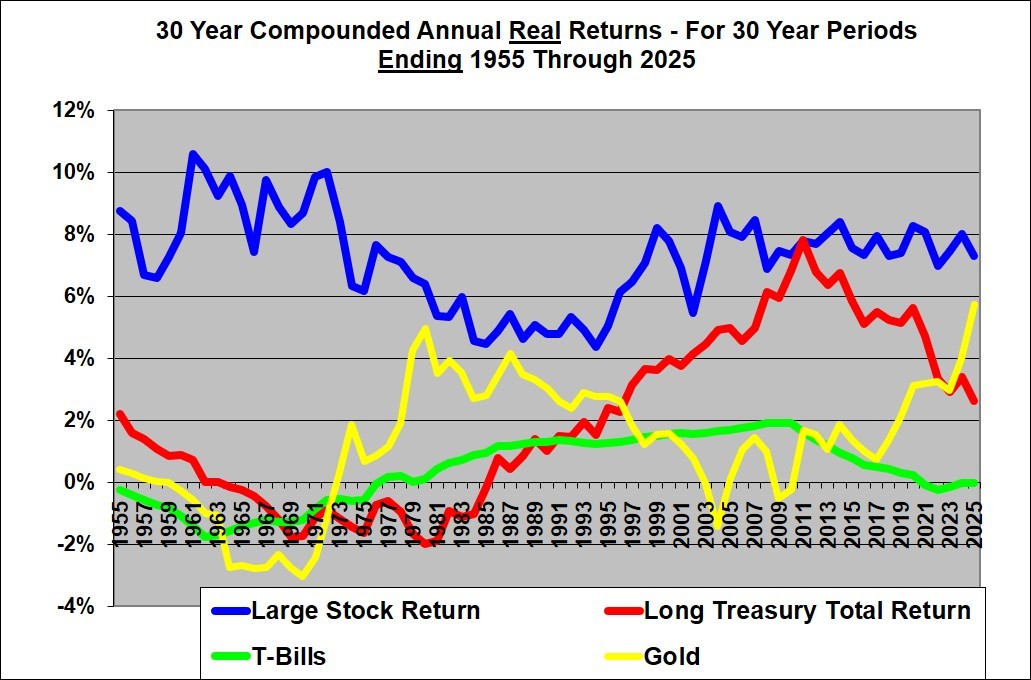
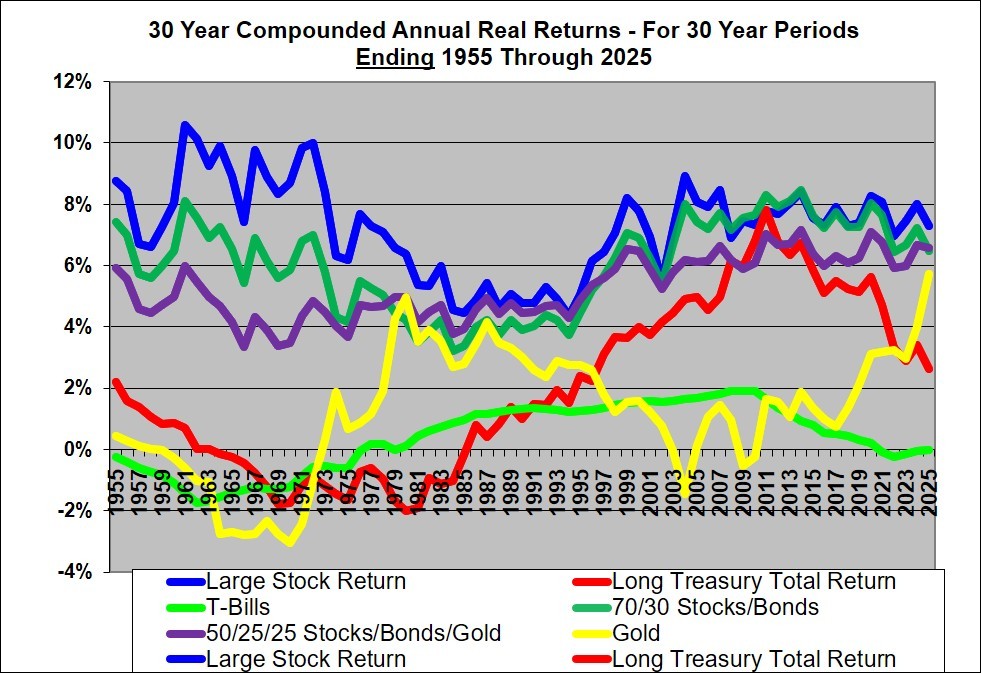
The above graph  needs a bit of explaining. Each point on the above graph shows the compounded annual real return (after deducting inflation) from holding each asset class for 30 year periods ended at the end of the year shown on the “X” axis.

For example, the leftmost points on the blue (stocks) line indicates that the average compounded return from holding stocks (the S&P 500 index stocks) for the 30 year period started January 1,1926 and ending December 31, 1955 was about 8.5% while the red (bonds) line shows that holding the U.S. twenty year treasury bond (and selling the bond at the end of each year to purchase the latest 20 year bond to maintain a constant maturity of 20 years) earned about a compounded 2.1% and holding 30-day treasury bills for that 30 year period earned just less than 0.0%. In all cases the returns are after deducting inflation, omit taxes, omit trading costs and assume reinvestment of all dividend and interest income.

Stock (S&P 500 total return index) real returns for 30-year holding periods ranged from a compounded return of a minimum 4.4% per year (which turns a dollar into $3.64 after inflation) to a maximum compounded return of 10.6% (which turs a dolalr into $20.53), with an average of 7.2% ($8.05) across the 69 different 30-year holding periods. These are attractive returns. A 7.2% real return compounded for 30 years increases purchasing power by eight times.


XXX

T-Bills which are supposed to be safe are almost a guarantee that your return will at best barely outpace inflation in the long run. Treasury Bills always returned less than a compounded 2% (after inflation) over the 67 different 30 year periods, and often returned less than 0.0% as T-Bills failed to even compensate for inflation. The real T-Bill return for the 67 different 30-year investment periods ranged from minus 1.8% compounded to positive 1.9% with an average of 0.4%. A 0.4% real return compounded for 30 years increases purchasing power by only 13%.

20-year Treasury Bond real returns for 30-year holding periods ranged from a compounded return of minus 2.0% per year to a maximum compounded return of 7.8%, with an average of 1.9% across the 67 different 30-year holding periods.

Treasury bonds have provided unusually high compound average real returns over 4% in the 30-year periods that ended after 2000. These were for time periods that started from 1970 to 1992 and held for 30 years. This was mostly due to the high interest rates that prevailed in the late 1970’s and the 1980’s and also partly due to the huge drop in interest rates over those 30 year periods which provided capital gains in addition to the interest income.

The above graph shows that for the 67 different 30 calendar year rolling investment periods ranging from 1926 through 1955, all the way to 1992 – 2021, real (after inflation) stock returns were higher at the end of 30-year holding periods than 20-year government bonds (Except for the 30 year period started in 1982 and ending 2011 where it was a virtual tie with bonds edging out stocks). In most of the 30-year periods, stock returns were very significantly higher.

Note that the one time that bond returns matched the stock returns, the stocks actually still had a very good return for the 30 years. The bond return was unusually high for the years ending around 2011 because bond interest rates were high at the start of those periods and fell over the periods providing strong interest income as well as capital gains.

Note that stock portfolios that were set up in 1928, just before the massive stock crash of 1929 – 1932, and ending in 1957, still beat bonds – and by a huge amount. And these are for one-time investments at the start of the 30-year period.

Shorter time periods

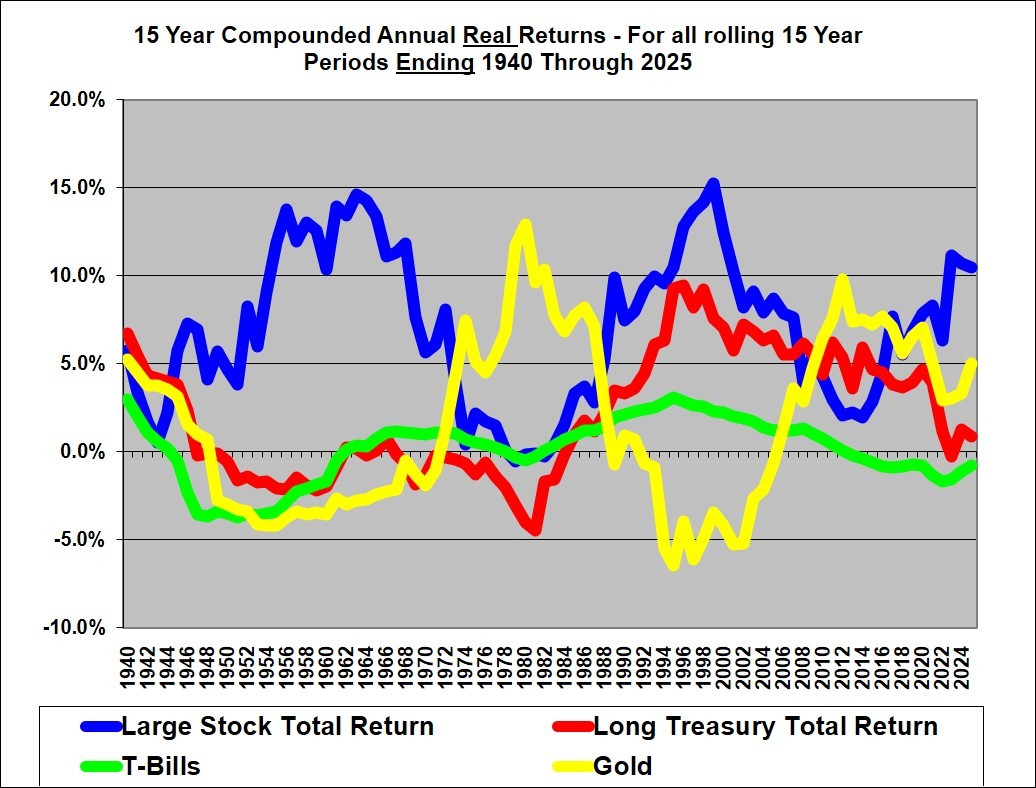
Stocks held for the 82 different 15 calendar year holding periods mostly did very well with a maximum compounded real return of 15.3% and an average of 6.9%. But it may be sobering to see that there were occasions where stocks (the S&P 500) gave no return over a 15 year period. The lowest return was minus 0.6% for the 15 years ending December 31, 1979. In fact stocks performed so poorly over the 1970’s that Business Week magazine famously declared the Death of Equities as inflation was destroying the stock market. That proved to be spectacularly wrong after the FED managed to slay inflation through the  early 1980’s by choking the economy with massively high interest rates.

The 20-year bond index (the red line) over the 82 rolling 15 year holding periods performed quite poorly over all the periods ending from about 1946 to 1987. But then bonds performed strongly for all the 15 year periods ending after 1987. The highest compounded return was a real return of 9.4% for the 15 years ended December 31, 1996. With this divergent track record it is somewhat meaningless to look at the average. Twenty year U.S. treasury bonds currently yield less than 2% and likely nothing after inflation.

For 15-year holding periods there are a few periods where bonds beat out stocks. Stock portfolios began in the late 20’s (and ending 1940 to 1944) or that began at the end of 1993 through the year 2000 (and ending 2008 to 2016)  did not out-perform long-term government Bonds over the next 15 years.

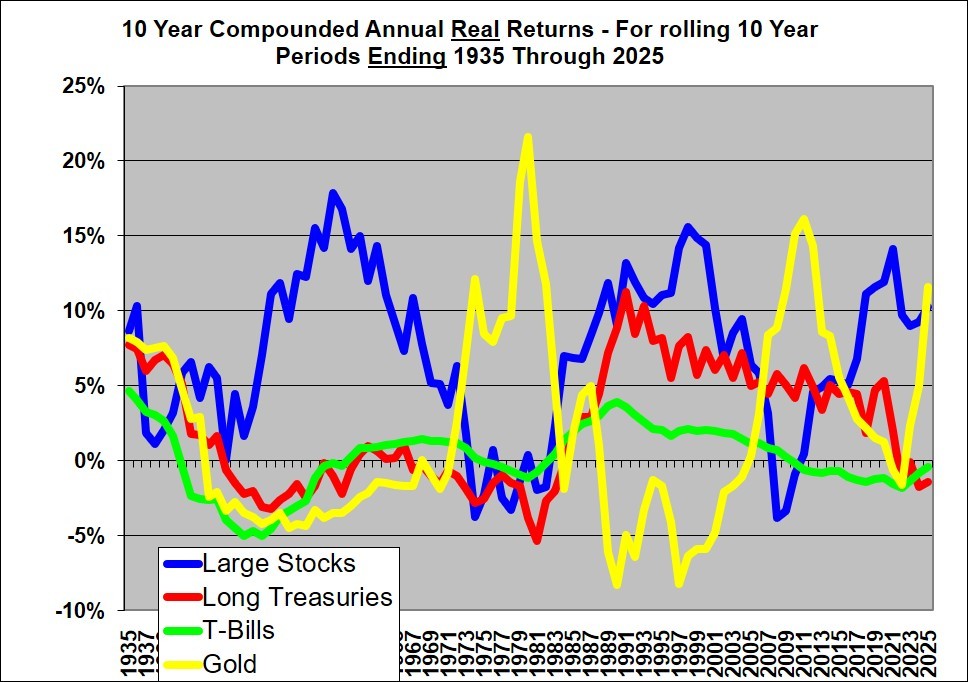
For 10-year holding periods there are still not very many periods where bonds beat out stocks. However, we do see that in the five 10-year periods ending 2008 through 2012, bonds did beat stocks by a significant amount. The range of real, after inflation, bond returns was relatively large from minus 5% compounded for ten years to over 10% compounded per year. It is apparent that the average return from stocks over many of the 10-year holding periods was significantly higher than the return from bonds. Interestingly, the worst case scenario for stocks was not quite as bad as the worst bond scenario.

Balanced Portfolios

Most investment advice advocates holding a balanced portfolio of stocks, bonds and cash. It is sometimes claimed that due to dollar cost averaging balanced portfolios can provide both higher returns and lower risks. So let’s take a look at the average returns over 30-year periods using balanced portfolios.

The above graph illustrates that over the 67 rolling 30 year periods ending in 1955 through 2021, Balanced portfolios noticeably under-performed 100% stock portfolios in the earlier decades. However for time periods ended in recent decades, the balanced 70% stocks / 30% bonds portfolio (the yellow line) often marginally beat the 100% stock portfolio and never lagged stocks by much.

One thing that stands out here is that holding a constant 25% cash in a balanced portfolio (the purple line) is detrimental. It never beats the 70/30 stocks/bonds portfolio.

The strong performance of the balanced approach in the more recent 30-year holding periods leads many to conclude that this result is to be expected in future. That’s probably not so. Balanced portfolios nearly kept pace with (or even beat) stocks in more recent 30 year periods because of high interest rates in the early years of those periods and becasue of the dramatic drop in interest rates that provided capital gains. Now that interest rates are at historic lows, that situation will almost certainly not occur for 30 year periods that are starting now.

Proponents of Balanced Portfolios often argue that you will only give up a small amount of return and will get lower annual volatility. But note that a $100,000 stock portfolio growing at say 8% (after inflation) grows to $1,006,300 in 30 years, while a Balanced portfolio growing at say 6.0% grows to only $574,300. So, the stock portfolio in this case is worth a hefty 75% more. So much for giving up a “small” amount of return!

Balanced approaches, however may be advantageous for shorter periods, as the following illustrates.

The above graph illustrates exactly what would have happened to an investor following a partly balanced approach of 70% stocks and 30% bonds (the yellow line) or following a more fully balanced 50%, 25%, 25% stocks, bonds and cash (bills) allocation (the purple line). This assumes U.S. data and that stocks are represented by the S&P 500 index stocks, bonds by 20-year U.S. government bonds and cash by 30-day U.S. government Treasury bill investments. This assumes annual re-balancing to maintain the balanced allocation and to maintain the 20-year maturity of the bonds. There is no speculation in this data, only historical reality. Note though that this is for a one-time investment at the start of each 15 year period.

The result is that the partially balanced portfolio significantly under-performs a 100% stock portfolio in many of the 82 different rolling 15 year periods.  The partially balanced approach was superior only for 17 periods which were those that that started in 1926 through 1931 and ending in 1940 through 1945 and as well in the 15 year periods ended 2002 and in 2007 through 2016 and the period ended 2018 (so a lot of recent periods). And the yellow 70/30 portfolio does not trail the 100% stocks portfolio by very much most of the time.

One thing that the graph illustrates is that for 15 year holding periods, all of the asset classes gave poor real returns for the 15 year periods ending approximately 1975 through 1986. And being balanced among three poorly performing asset classes was of no help.

Overall, the graph above provides good support for the notion that a balanced portfolio such as 70% stocks, 30% bonds is a good approach for investment periods of around 15 years.


The balanced 70% stocks / 30% bonds portfolio sometimes outperforms the 100% stocks approach over these ten year holding periods – especially in the more recent periods. And it rarely trails the 100% stocks approach by much. The 50% Stocks, 25% bonds, 25% cash portfolio appears to consistently under perform the 70% stocks approach. It would be reasonable to conclude from this graph that the 70% stocks approach is a good approach compared to 100% stocks for ten year holding periods.

Summary

In regards to stocks, this discussion deals only with the performance of the large stocks comprising the S&P 500 index as a group it does not deal with the risks of investing in a non-diversified portfolio of stocks.

For shorter-term investments the stock market is very risky compared to Bonds and short term treasury Bills. The average return from stocks has been consistently higher over long periods but over shorter periods (anything under 10 to 15 years) the results from stocks are hugely uncertain. It would be most unwise indeed to invest money needed next month or next year or even prior to about 10 to 15 years in 100% stocks

As the time horizon lengthens, we reach a point where stock returns are almost (but never quite) certain to exceed Bond and Bill returns – at least based on historical calendar year U.S. results from 1926 through 2021. For time horizons exceeding 15 years it seems quite unlikely that stocks will under perform Bonds and virtually certain that they will out perform Bills. With a 30 year time horizon it seems virtually certain (based on history) that stocks will outperform Bonds. A 100% (diversified) stock portfolio seems virtually certain to outperform, over 30 year periods, portfolios with any portion of the funds allocated to Bonds or Cash. And the case for stocks is all the stronger if you consider that people don’t typically invest a single lump sum for 30 years. Rather they invest on an annual basis which greatly reduces the exposure if one is unlucky enough to run into the odd period where stocks do trail bonds over a 30 year holding period.

This analysis was based on making an initial investment and letting it grow over time.

Of course, if one is capable of expertly timing the markets then it would be possible to beat the 100% stock approach in the long-term by “simply” being in the highest returning asset class each year. This will be attractive perhaps to psychics and clairvoyants. Mere mortals investing for 15 years or longer might wish to consider the 100% stock approach. However, investors that are uncomfortable with short-term volatility should use a balanced approach. And it may be realistic for long-term investors to move some money out of stocks if stock prices are in an obvious bubble.

Virtual certainty is not quite 100% certainty there is always some small chance that Bonds will outperform even in a 30 year time horizon.

You don’t have to agree with my conclusions. You can also study the graphs above and draw your own conclusions.

Self-described long-term investors need to be sure that they really have a long time horizon before they act accordingly. For many investors, there is a chance that they will need to cash out their investments early. This could be caused by illness, job loss, disability, legal problems and other reasons. But, if an investor is virtually certain that they have a very long time horizon then it certainly appears that stocks (based on a U.S. large stock index) are not riskier than bonds, in terms of achieving the highest ending portfolio value.

More Analysis:

The above analysis shows that stocks tend to significantly outperform bonds and balanced portfolios as of the end of a 30-year holding period.

But what about the volatility along the way? And what about for more realistic scenarios like saving so much per year for 30 years rather than just making a one-time deposit and waiting 30 years. And what about retirement scenarios?

We have all of that covered in two related articles:

The first article shows what happened to portfolios for all the possible 30-year savings periods from 1926 to 1955 all the way to 1982 through 2011 invested in either 1. 100% U.S. stocks (S&P 500 index fund in non-taxable account) or 2. Invested 60% in stocks, 35% in corporate bonds and 5% in cash.

The second article shows what happened to one million dollar portfolios for all the possible 30-year retirement periods from 1926 to 1955 all the way to 1982 through 2011 invested in either 1. 100% U.S. stocks (S&P 500 index fund in non-taxable account) or 2. Invested 60% in stocks, 35% in corporate bonds and 5% in cash.

END

Shawn Allen, CFA, CMA, MBA, P.Eng.
President, InvestorsFriend Inc.
Article originally created in June 2001 and last updated November 9, 2021

Money Printing by Government, Central banks and Commercial Banks

The Mystery of  Money and its Creation

Should we be worried about the value of our money and the possibility of rampant inflation? Are central banks “printing” excessive amounts of money? Are governments “printing” money instead of borrowing it? Are banks and fractional-reserve banking basically evil and dangerous and can they create and lend money from thin air?

Let’s explore some of these things. Maybe even with an open mind. 

But first: What do we mean by “money”?

Money certainly includes its traditional paper form which is issued by central banks. But it’s increasingly clear that most of our “money” consists of deposits in banks. Our pay cheques mostly flow electronically from our employer’s bank accounts into our bank accounts. Then we “spend” our money by transferring it to various retailers using our debit cards, or transferring it to other people using online e-transfers, or through online bill payments including pre-authorized automatic utility bill payments, or by using a credit card which we later typically pay through an online bill payment. And, although it is becoming less common, we spend our money by writing cheques, which also ultimately results in a transfer of our money to the deposit account of whoever we wrote the cheque to. 

As another example: I run a small online business. In over 20 years of its existence that business has never collected a dollar in “paper” money form. Its monetary transfers include various electronic flows as well as cheques. But no paper money as such.

These days then, money consists largely (In Canada it’s about 95%! of M2) of bank deposits but also includes the total paper money and coins in circulation. Given this, anything that increases the level of bank deposits (with the exception of deposits of existing paper money) or that increases the total amount of (paper and coin) currency in circulation increases the supply of money. 

A very interesting thing about money in the form of bank deposits is that the money one person or company spends ends up in the bank account of wherever they spent the money or sent it to.  Some money comes out in the form of paper money but even that tends to soon get deposited back into a bank account, for example when spent at a retail store. So, it’s a whack-a-mole situation. The result is that, these days, the great majority of money tends to stay in banks although it is constantly flowing from one bank account to another, usually at a different bank, in millions of transactions each day. To borrow a phrase: What’s created in banks, (mostly) stays in banks.

The three key functions of money are that money is:

  1. A medium of exchange
  2. A store of value, and 
  3. A unit of account.

As discussed above, money is constantly flowing from one person or corporation or even government to another. Its function as a medium of exchange is its reason for existing. In order to be highly useful as a medium of exchange it has to have a reasonably stable stored value in terms of its purchasing power – at least in the short term. And it has to be numerically quantifiable. Given those, characteristics it then constitutes a unit of account. We can count or account for the value of all the goods and services money can purchase in terms of units of money. A house is not money, but we can say that a house has a value of $600,000 for example. 

Money is an intangible concept that (as is becoming more and more apparent) has no need to exist in a physical form. Money is a value concept that allows us to trade our labours and efforts or whatever product or value we produce for any other good or service produced in the economy or to store that value for later.  Warren Buffett has described money as being a “claim check” on the goods ands services and assets of the economy. 

Who or what “backs” the value of our money?

At one time the value of money was pegged to some physical quantity of gold or silver. But that has not been the case for many years. So what “backs” our money and how can we have faith in its value?

The value of a dollar is in what it will purchase. It is the (mostly) free market that sets the prices for goods and services. Supply and demand and competition in the market place determine the purchasing power of a dollar in terms of goods and services. The number of dollars needed to purchase some things (such as houses) is also heavily influenced by interest rates. Central banks try to control the overall rate of inflation by controlling short-term interest rates and at times by purchasing bonds to control longer term interest rates.

At the end of the day, the value of our money is not “backed” by anyone or anything specifically but it retains its purchasing power fairly well in short term mostly as a result of the invisible hand of the markets and by the efforts of central banks to control inflation. The Bank of Canada targets an inflation rate of about 2% annually. Therefore it is targeting a reduction in purchasing power of a dollar of about 2% annually. 

Most people will gladly accept money in payment for goods and services and will trust that its value will largely be retained in the short term. Money does lose value over the longer term due to inflation. For the most part, that can be overcome through investing. While it appears that most people do trust in the value and utility of our money, each of us is free to trust or not to trust and to act accordingly.

Where does money come from?

The central bank creates (and prints or authorizes the printing of) a certain amount of physical paper money each year. Commercial banks have deposits (called reserves) at the central bank and they can take out some of those deposits in the form of paper money to meet any demand from their customers for paper money that is in excess of the paper money constantly flowing back into the bank such as from retailers. (In addition the banks can constantly turn in any worn out or damaged paper money and have it destroyed and replaced with new bills by the central bank, but that does not count as creating new money.)

But, as noted above, the vast majority of money (M2) consists of bank deposits and is not in the form of paper money. Today, one of the main ways money is created is when people and businesses take out bank loans, or when the government borrows from a bank by selling it a government bond and then spends that money where it ends up in personal or corporate deposit accounts.. The lending bank creates an asset on its balance sheet being a loan receivable from the borrower and simultaneously adds that amount as a deposit in the borrower’s deposit account which is a liability on its balance sheet. The bank’s net worth is unchanged and the borrower’s net worth is unchanged. The bank has taken on an asset (the loan) and a liability (the deposit). For the borrower, the deposit is their asset and the loan payable to the bank is their liability. This does add to the (M2) money supply and is in essence the creation of money (but not wealth) “out of thin air”. 

The opposite side of the above process is that when a loan is repaid the level of deposits in the banking system declines and money effectively disappears back into the thin air from whence it was created.

To understand the nature of bank lending and deposits it is necessary to be able to picture a simplified bank balance sheet. I have a short article that shows and explains the balance sheet of a small lending and deposit bank.

It may sound like this “money from thin air” process is a terrible and evil thing and amounts to the banks taking advantage of people and charging interest on money that did not cost the bank anything and seems likely to cause inflation. 

But consider the following:

1. There are limits on the “money from thin air” process including the following:

  • The total amount of loans is limited to a certain (admittedly large) multiple of the bank’s owners’ invested capital such as 12 times (which amounts to a minimum capital ratio of about 8%).

  • The bank is usually fully at risk if the borrower spends the deposited loan amount but fails to repay the loan. (Residential mortgage loans are usually an exception because the bank is covered by loan insurance.) The banks do face loan-loss risks and therefore try hard to lend only in cases where the borrower is very likely to be able to pay it back. This may be the biggest reason that lending and money creation does not usually balloon out of control.

  • The bank needs to keep some of its assets in cash or as deposits (reserves) at the central bank (as opposed to loans) in case some borrowers withdraw their deposits. (Although the bank can easily borrow from other banks or even the central bank if needed and so this is probably no longer an important constraint although it used to be years ago.)

  • The money was borrowed for the purpose of spending and it will usually quickly be spent which will usually result in that deposit leaving the bank that created it “from thin air” and landing in a different bank. Because of this banks do have to compete to attract and retain deposits.

  • Central banks have some control over interest rates and use that and other regulatory tools to influence how much lending (and consequently money creation) banks engage in.

2. The “created from thin air” money does not belong to the bank. It strictly belongs to the borrower, in exchange for the pledge to pay it back.

3. It is the borrower, and not the bank, that typically initiates the process. It is the borrower who needed money. So, if this money creation process were evil (it’s not) then we should blame borrowers just as much as the banks.

4. This creation of money as customers borrow from banks presumably is a contributor to inflation. But it also facilitates all forms of business and the growth of the economy. If the economy and the therefore the amount of goods and services produced grows at about the same rate as the quantity of money grows then perhaps the process is not inflationary. In any case, central banks manipulate short-term interest rates with a specific goal of keeping inflation at or near a targeted level such as 2% annually. 

Money created by government spending and borrowing

The federal government keeps its main deposit (or chequing) account at the central bank. Somewhat counterintuitively, these funds are not considered money in the definition of M2 because this money is not in the hands of the public private sector.

When the government makes payments to individuals and corporations this increases the deposit accounts of people and corporations and therefor adds to the M2 money supply. Conversely when individuals and corporations make payments to the government such as for income taxes, this reduces the bank deposit accounts of individuals and corporations and reduces the M2 money supply. In a balanced budget situation these two items would even out and not cause a net change in the money supply. When governments run deficits the net impact is an increase in the M2 money supply. Governemnts running deficits can probably be considered to be “printing” money. But the same is true when individuals and corporations borrow from banks.

The federal governments funds its deficit by issuing bonds and treasury bills.

When the government sells a newly issued bond to a commercial bank the governments deposit at the central bank is increased and the banks deposit (reserves) at the central bank is decreased. This does not immediately change the M2 money supply. But it allows the government to spend more money as described just above which does increase the M2 money supply.

Central banks sometimes buy newly issued bonds directly from federal governments. The federal government has a large deposit account at the central bank. When it buys a bond the central bank credits (increases) the deposit account of the federal government which therefore has more money to spend. And it adds the same amount as an asset and so the central bank’s balance sheet grows. When the government spends from its central banks deposit account this creates money “from thin air” (also called printing money) just the same way the commercial banking system creates money. One difference is that central banks do not need to have any equity capital and so there is little or no limit on the amount of money a central banks can create by lending to the federal government. However, central banks have a prime responsibility to keep inflation at low levels and therefore a responsible central bank will not abuse this money creation process.

But, the government borrowing money by issuing  bonds does not always create new money. If any corporation, pension fund or individual buys a newly issued government bond using “cash” (money) that they have in an existing bank deposit account, then their deposit goes down and the government’s deposit at the central bank (which does not count as part of M2) increases and no new money is created. In fact M2 would temporarily go down but then the government would “spend” that money (which is why they borrowed it) and M2 would be unchanged in the net.

How central banks buying government bonds “injects liquidity” into the system:

When the central bank buys back government bonds that are held by commercial banks that would increase the selling bank’s cash “reserves” on deposit at the central bank. This is exactly what happened in Canada as the central bank bought government bonds starting in April 2020. Central bank deposits held by banks (members of Payments Canada) soared over 1000 fold from $250 million to $390 billion one year later. That figure has since dropped dramatically to $72 billion as of July 23, 2025.

The banks may have used that cash on deposit at the central bank to invest in, for example, corporate bonds. A bank buying a corporate bond is effectively making a loan to a corporation and that does create money just as any other new loan does as described above. The added cash central bank reserves could also have encouraged the banks to make more loans. As explained above, a bank does not immediately need cash to extend new loans. But a bank would be reluctant to make new loans if its cash on hand or deposit reserves at the central bank was too low since the deposit that it would create for the borrower could soon be “spent” and transferred to a different bank and the originating lending bank would need to transfer cash to that other bank as the customer’s cheque was deposited at the other bank. However, most of the time banks are probably not “cash constrained” or do not have trouble attracting new deposits to replace departing deposits and so it is not clear that this kind of bond buying by central banks did actually result in additional loans and therefore additional money in the hands of businesses and individuals. Given that banks do not seem to be cash constrained most of the time, and given that in the case of Canada early in the pandemic the created deposits remained at the central bank and only reduced over several years, I am not clear that this injecting of liquidity (cash) onto bank balance sheets had much direct impact.

When the central bank buys back existing government bonds from pension funds, corporations and individuals that would put the money into the deposit accounts of those that are selling the existing bonds. That increases the cash money of the selling party. The central bank issues a cheque to the seller which they cash into their bank account and which ends up as an additional cash deposit of the bank in its central bank account. This would seem to be more stimulative than the central bank buying bonds from a bank because both increase the bank’s cash balance at the central banks (which does not appear to be stimulative) but this one increases the corporation’s cash as well. 

Perhaps the biggest impact of central banks buying bonds from commercial banks is not due to injecting cash onto commercial bank balance sheets but rather is the impact of lowering long-term interest rates. Lower interest rates stimulate more borrowing which, as explained above, increases the money supply. Lower interest rates are also indisputably inflationary for the prices of many assets including houses, land and equity stocks.

In summary, money is created when:

  1. People, corporations or other entities borrow from banks
  2. A bank buys a newly issued government bond. In effect this is the same as number 1, it is the government borrowing from a bank. This does not create new M2 money until the government “spends” the money borrowed – which they quickly will.
  3. The central bank buys a newly issued bond directly from government. This is the government borrowing from the central bank. The government then spends the reserves created at the central bank which adds to the deposits of people or corporations which increases M2 money supply.
  4. The central bank buys existing government bonds from people, companies or other entities (NOT including banks).

Money is not created when:

  1.  People, corporations or other non-bank entities buy newly issued bonds from government. (Existing deposit amounts merely get transferred to government, no new deposits are created.)
  2. The Central Bank buys an existing bond from a bank. The commercial bank gets reserves at the central bank but those are not counted as part of the money supply. This does count as injecting liquidity since the bank has added ability to make loans. But especially if the bank was not constrained in its loan making this does not directly cause the bank to make new loans and create money.

Should we worry about hyper inflation:

It seems clear that the massive government borrowing by governments during the pandemic did creat HIGH (although not hyper) inflation. Since then deficits have returned to more modest levels. The current levels of growth in the M2 money supply are probably consistent with inflation in the 3% range. Potentially huge U.S. deficits due to recent tax cuts could push U.S. inflation to somewhat higher levels but well short of hyper inflation levels.

The best that most individuals can do about this is to seek to have their wages keep up with or surpass inflation and should invest longer-term savings mostly in equities that will outpace inflation while also maintaining some cash and fixed income for stability and risk management purposes.

END

Shawn Allen
InvestorsFriend Inc.
Originally written February 25, 2021 and revised August 1, 2025 


How to Lose Weight

How to lose weight 

Having lost about 40 pounds dropping down from close to 200 pounds to about 160 pounds and having kept that weight off for over five years now, I wanted to share my methods and thoughts with anyone interested. Key aspects of my approach are to make weight loss basically your top priority every single day and to weigh yourself daily.

The quick summary version of my approach to losing weight is:

  1. You first need to truly and fully commit to a weight loss goal.
  2. You need to focus on your weight loss goal every day and even virtually all day long and every time you consume or consider consuming anything.
  3. Weigh yourself every day. Progress must be measured and is your reward.
  4. Eat moderately and eat healthy meals and snacks. (This does NOT mean starving yourself to the point of misery at all!)
  5. Keep restaurants and dinner parties and other social eating events to a bare minimum.
  6. Increase exercise (but this is not strictly necessary).

The Details:

The first and most important step in losing any significant amount of weight is that you will have to focus on it and make it a top priority every day. Achieving any important goal in life almost always takes focus and commitment. You can’t just hope to lose weight or want to lose weight, you have to plan to lose weight and commit to that plan.

If you are going to truly commit to losing a significant amount of weigh then it will help a lot if you have a strong reason for achieving this goal. Do you need to lose weight for health reasons? to look better? to feel better? to fit into your cloths?

It will also help a lot if you have a certain date in mind by which you want to lose a certain amount of weight. For example your high school reunion is coming up. Or you are planning a beach or a pool-side vacation. Or any important event where you would like to show off a slimmer you.

So if you really want to lose weight and have a strong reason for wanting to do so and are ready to really commit to it and focus on it, here are my suggestions:

Weigh Yourself Every Morning

Weigh yourself every morning. Be sure to use a good quality digital scale that measures to an accuracy of 0.2 or 0.1 pounds and that gives consistent readings. The usual advice is to weigh yourself only weekly since daily weight can fluctuate several pounds which can be misleading and sometimes depressing.

But a daily weigh-in will help keep you focused on your weight loss goal each and every day. 

Weight gain and loss is very incremental. We all need to eat. You don’t need to go on anything like a starvation diet. You can eat your three meals a day and also some snacks and liquid calories beyond that. But it’s a fact that every extra bite we take in is incrementally going in the direction of higher weight. On a very temporary basis there is the physical weight of the food or drink that we take in. And, much more importantly, with the exception of water and other zero calorie items there is a longer term incremental impact from everything we consume.

My approach to weight loss (and later weight maintenance) was and is very much day by day. But also meal by meal and snack by snack. I kept it in mind that everything I consumed was going against my goal. More importantly though, everything that I thought about consuming but resisted the urge to consume was helping me towards my goal.

And I wanted almost immediate feedback and reward. I was able to resist most evening snacking because I knew it would add to my weight the very next morning. My reward for not snacking would be weighing less the next morning than if I consumed a snack. If I was not going to weigh myself until say Saturday there would be less motivation to have the discipline to resist snacking on say Monday night. 

And sure, the initial incremental weight loss in the morning from avoiding as opposed to consuming a snack on a particular evening would simply be the physical weight of the food. But even over a couple of days it would soon lead to incrementally fewer calories absorbed by the body.

Some morning weigh-ins will be depressing as you may gain two pounds seemingly randomly or possibly because of an over-indulgence. Even if that can be blamed on a temporary increase in water retention or whatever I firmly believe it is best to know. If your morning weigh-in shows you have gained say two pounds then you can try a little harder that day to minimize your consumption and perhaps add some additional exercise. If it turns out that was just an almost random fluctuation upward well then all the better because as that random fluctuation reverses and your extra effort kicks in you just might be 2.2 pounds lighter the next morning. But if the two pounds gain was more “real” then why would you want to wait a week before knowing about and trying to reverse it?

Conversely some of your morning weigh-ins will show a surprising amount of loss which may indeed be due to a temporary fluctuation. But why not celebrate the loss and resolve to try to make it permanent by making an extra effort to consume less and exercise more that day? If you can achieve a lower weight for any reason including less water retention then tell yourself that you can make that more permanent and also reach an even lower number with effort and focus. And you can.   

What foods should you eat?

I don’t have much knowledge in this area. But I would certainly say eat a balanced diet. For example, I found no need to avoid carbohydrates. I ate a sandwich for lunch almost everyday while losing weight. But more recently I found that avoiding carbohydrates was beneficial.

Be aware of the calorie and sugar content in what uou eat and especially in packaged foods. Many items in the “chips” isle have a shocking amount of calories listed for a shockingly small serving. For cereals I recommend the all-bran cereal and I noticed that shredded wheat (including the spoon size option) is one of the very very few breakfast cereals that have no sugar content.

My approach was to eat three normal and varied meals a day. Beyond that I snacked between meals but only when hungry and I concentrated on healthy snacks such as bananas, grapes and fruit of all kinds. Also, I consumed mostly only low or no calorie beverages. The easiest way to avoid unhealthy snacking is of course not to buy them in the first place. Avoid that potato chip aisle!

I minimized restaurant meals. In theory a healthy restaurant meal while skipping the appetizer and desert should be fine. But in my experience and based on daily weigh ins, eating at a restaurant almost always instantly led to incremental weight gain. An occasional restaurant meal is fine but recognize it will usually go against your goal.

Dinner party type situations are great fun and it is wonderful to have a social life that includes these. But sadly these events should be minimized. You know how these events go. Your host (including you if you are the host) wants to be generous and for every one to have a good time. At a dinner party it usually feels quite impolite to insist on small portions or to refuse the appetizers and deserts and the drinks. We all need a social life and need to enjoy these get togethers occasionally. But the reality is that these situations will work against our weight loss / weight control goals and do need to be minimized. It might help to be clear to your friends that you are a weight-loss and later a weight-maintenance plan and ask that they not “lead you into temptation”.

I am not a fan of the idea of eating small meals say five times a day as advocated by some. It may work for others but was not my approach. My view is that you can eat a healthy between meal snack. But I would never advocate having a snack at all if you feel you can simply resist the urge and wait until your next meal. Sorry, but every bite is always a step in the wrong direction. Resist if you can. I am not talking about making yourself miserable. But if you can resist a snack without much stress, go ahead and do that.

And go ahead and skip a meal when you can. Most days I am absolutely ready to eat at meal times. But if it occasionally happens that you are busy and your mind is not on even on eating then take the opportunity to skip that meal. The very next morning you will weigh less than you otherwise would have. 

In my experience “eating begats eating”. Our stomachs seem to get used to a given level of food. If we are always sort of topping up our stomach then it seems to get used to that and want that. On the other hand I found that when I cut back, my stomach seemed to eventually get used to that. I simply had less cravings for between meal and after dinner snacks. And I have always found that having one evening snack seems to often lead to an appetite for more. It may be easier to simply resist the urge to snack as opposed to trying to have a modest evening snack which may only whet your appetite for a lot more.

What about Exercise?

We should all be getting exercise since it is so beneficial. And it will help with weight loss. But added exercise is neither a necessary nor a sufficient component of weight loss. That is, you can lose weight even without adding exercise. And you will not likely lose weight by simply exercising while not controlling your eating. The old saying is “you can’t outrun your fork”. But adding a lot more exercise while focusing on reduced calorie consumption will certainly accelerate the weight loss progress. 

Other advice

Sleep more. If you have been in the habit of staying up watching television then simply try to go bed earlier. When you are not awake, you are not eating. And your body will burn almost as many calories per hour while sleeping at is does while sitting watching television or surfing the internet.

Drink plenty of water.

Counting calories or the equivalent is not required in my experience. If you stick to modest portions and a healthy balanced diet and stick to healthier snacks you don’t need to count calories. Actually your daily weigh in takes the place of that. If you are losing weight most days then your calories must be sufficiently low.

As far as alcohol goes I was surprised to find that moderate beer consumption did not have any big impact. Beer certainly has calories so it must have some negative effect on weight but it simply did not seem to have a big impact. But I would be the first to admit that abstaining from or minimising alcohol is an even better idea for lots of reasons.

Because weight is affected by what you eat and do every day, this is a goal that you have to be focused on virtually every day. Sure, you can take the odd day or even a couple of weeks off and not think about it. But in general you will need to be working on your goal of weight loss or maintaining your lower weight virtually every day. The hard truth is, it will need to be on your mind at every meal and every time you consume or even consider consuming anything.

Enjoy the feeling of satisfaction. You are going to feel good about your accomplishment of weight loss and about the will power you displayed. Enjoy that feeling; you earned it.

To modify a saying from Warren Buffett (see there is an investment connection here after all!) – “Weight loss is simple but not easy”. And losing weight and keeping it off may turn out to be among the best investments you will ever make. 

Best wishes to anyone who is actively attempting to lose weight. In my experience the rewards in both health and satisfaction with appearance will be well worth the sacrifice and effort. Before too long the mirror will be your friend rather than something to be avoided.


Final thoughts:

I’m no expert. Many approaches can work. But let’s face it; most people fail at weight loss. And so I just wanted to document and share what has worked for me. 

END

Shawn Allen

October 15, 2020 with a few edits on January 31, 2023


How to Quickly Set Up A Diversified Low-Fee ETF Investment Portfolio

How Canadians Can Instantly Achieve a Low-Cost Diversified Investment Portfolio Using Exchange Traded Funds

Would you or anyone you know like to establish a prudent diversified investment portfolio using just one low-fee investment? This article explains how. AND the investments recommended have performed wonderfully in recent years as the market rose.

This short article provides a specific portfolio of low-cost Exchange-Traded Funds (ETFs) that can be used to almost instantly create a diversified portfolio. This can solve the problem of how to get started investing or how to achieve a diversified portfolio.

The information will also be useful in reviewing and making adjustments to an existing investment portfolio.

The easiest and most instant way to establish a fully diversified portfolio that includes Canadian, U.S. and global equity (stock) exposure as well safer fixed income investments is to buy a single ETF that provides all of that in just one security. The following table provides the ETF symbols. These are diversified Exchange-Traded Funds that trade on the Toronto Stock Exchange. Similar products are available for U.S. investors of course. And I give symbols for that as well.

The ETFs here, especially the more balanced ones could put some financial advisors out of business since they  provides instant diversification and constant rebalancing at a FAR lower fee. Nevertheless, advisors usually provide additional services and they play an important role in encouraging people to invest and making it easy to do so.

Vanguard and iShares are two ETF providers that that provide Canadian ETFs that consist of a fully diversified and balanced portfolio in a single ETF. In both cases you can vary the Fixed Income component from 0% (which would not be considered balanced) to as high as 60% (Vanguard) or 80% (iShares). Both offer a 40% Fixed Income option which is the traditional “fully balanced” level. The geographic diversification is relatively similar between the two providers. There is no sort of traditional agreed upon ideal geographic diversification and so the level of geographic diversification here may or may not be considered ideal. The biggest difference between the two providers is that iShares does not hedge any currency risk while Vanguard hedges the currency risk on the fixed income portion. Financial theory would suggest that NOT hedging provides better diversification. But that’s a debatable point. Currency fluctuations are a risk but also could benefit the portfolio.

For American investors a 40% fixed income and 60% world-diversified equities Trades as AOR. And a safter 60 /40 version trades as AOM.

The ETF prices below have been updated as of January 12, 2026 but, by nature, they tend to be good choices at any time for diversification.

Name Symbol Fee MER Price & Chart Canadian Balanced ETF Description 
Vanguard Conservative ETF portfolio VCNS 0.25% $31.96 40% equities (16% U.S., 12% Canada, 9% rest of developed world, 3% emerging markets). 60% fixed income (35% Canadian, 14% global ex-U.S., 11% U.S.)  For the fixed income portion only, the currency risk is hedged.
Vanguard Balanced ETF Portfolio  VBAL 0.25% $37.69 60% equities (24% U.S., 18% Canada, 14% rest of developed world, 4% emerging markets), 40% fixed income (24% Canada, 9% Global ex-U.S., 7% U.S.). For the fixed income portion only, the currency risk is hedged.
Vanguard Growth ETF Portfolio VGRO 0.25% $44.23 80% equities (32% U.S., 24% Canada, 18% rest of developed world, 6% emerging markets) 20% fixed income (12% Canadian, 5% global ex U.S. 4% U.S.) For the fixed income portion only, the currency risk is hedged.
Note: The equity portion of all of the above three funds is 40% U.S., 30% Canada, 23% rest of developed world, and 7% emerging markets. The fixed income portion is 58% Canadian, 24% global ex-U.S. CAD hedged, and 18% U.S. CAD hedged). The difference between the three funds is simply in the exposure to equity versus fixed income. The Fixed Income component consists of bonds with an average maturity of about 11 years.
Vanguard All-Equity ETF Portfolio VEQT 0.25% $55.74 Similar to above but with no allocation to fixed income. Therefore 40% U.S., 30% Canada, 23% rest of developed world, and 7% emerging markets. None of the currency risk is hedged since there is no fixed income portion.
iShares ETFs
iShares Core Conservative Balanced ETF Portfolio XCNS 0.20% $25.69 80% Fixed Income (64% Canadian, 16% U.S), 20% Equities (9% U.S., 5% Canada, 5% Europe / Asia, 1% Emerging market.). None of the currency risk is hedged.
iShares Core Balanced ETF Portfolio XBAL 0.20% $34.15 59% equities (26% U.S., 15% Canada, 15% Europe/Asia, 3% emerging markets) 41% fixed income (27% broad Canada, 7% short term Canada, 4% U.S. government and 4% U.S. corporate). None of the currency risk is hedged.
iShares Core Growth ETF Portfolio XGRO 0.20% $35.94 80% Equities (36% U.S., 20% Canada, 20% Europe/Asia, 4% emerging market) 20% Fixed Income (16% Canada, 4% U.S). None of the currency risk is hedged.
Note: For the above three ETFs the average bond maturity in the fixed income component is approximately ten years.
iShares Core Equity Growth ETF Portfolio XEQT 0.20% $41.41 100% Equities (45% U.S., 25% Europe/Asia, 25% Canada, 5% emerging market). None of the currency risk is hedged.

For American investors a 40% fixed income and 60% world-diversified equities Trades as AOR. And a safter 60 /40 version trades as AOM. Click on the links here to find the geographic diversification.

Investing and holding VBAL or XBAL for the long term is not about timing the market but about participating in the markets in a prudent lower stress way over the years.

Click the links in the table above for additional information.

For those who feel that they are ready to construct their own basic investment portfolio using low-cost Exchange-Traded Funds (or make changes to their existing portfolio), rather than just simply use the single symbol approach above, I have put together the following table.

This table is intended for Canadians who have already set up (or will set up) a self-directed investment account. For those who will stick with mutual funds the table may be useful to start a discussion with your advisor who should be able to do something similar with mutual funds.

A new investment portfolio could be very quickly set up using the following table as guidance. The appropriate allocations to each major asset category, the sub-categories and the regions of the world will differ greatly based on individual circumstances. I have provided some rough allocation percentage ranges that might be applicable to a “typical” investor but which may or may not be applicable to your particular circumstances.

The yield figures below have been updated as of January 12, 2026.

Major Asset Class Sub-class Country Toronto Symbol Fee /MER January 2026  Yield  Risk Typical Allocation Comment
CASH (Interest is fully taxed like wages) Actual cash in the investment account Canadian none none About 0% in the big bank self-directed avvounts no risk Hold “cash” in deposit accounts and not directly in the investment account. The allocation is normally 5 to 15% There is no real substitute for cash in terms of lack of volatility and instant access when needed
Deposit accounts within the investment account Canadian Example TDB8150

RBF2010

 none  1.8% no risk
FIXED INCOME (Interest is fully taxed like wages) Guaranteed Investment Certificates Canadian  none  none  Currently  about 2.9% for a 1 year term and about 3.0% for a 5 year term. Smaller banks and credit unions may be higher.  very low to no risk Normally 15 to 50% divided equally between short, medium and long term. Short-term bonds could be used in place of GICs. But GICs can be a good choice also.
Short term Bonds 1-5 years Canadian  VSC  0.11%  3.2% yield to maturity  very low
 Medium Term Bonds Canadian VCB  0.19%  3.7% yield to maturity  low
 Long Term Bonds (Average maturity about 23 years) Canadian  XLB  0.20%  4.5% yield to maturity  medium Higher risk of loss in value if interest rates rise
      EQUITIES (These are generally tax advantaged since the capital gains can largely be deferred and is the taxed at half the full rate applicable to wages) Canadian Common Canadian  XIC  0.06% (super low fee)  2.2%  high 10 to 40% Broad Toronto stock index
 U.S.A. Common United States  IVV (New York) or XSP hedged to Canadian dollars  0.04% or 0.11%  1.0% high  5 to 20% S&P 500, the largest American publicly traded companies
Rest of Developed  World Common Rest of World ex North America  VIU or VI hedged to Canadian dollars  0.23%  2.4%  high 0 to 15% Equities excluding U.S.A and Canada
Preferred shares (can be very tax efficient in many cases) Canadian  CPD  0.50% (high fee)  5.0%  medium 0 to 15% Consider using in taxable accounts in place of some fixed income
High dividend (can be very tax efficient in many cases) Canadian VDY  0.25%  3.5%  medium 0 to 15%
 REIT (Distributions are fully taxed like wages) Canadian  VRE  0.39%  2.7%

This yield seems unusually low for REITS.

 medium. 0 to 15%  Consider placing in non taxable accounts

There are hundreds of Exchange-Traded-Funds to choose from. The above table provides a possible basic diversified low-cost Balanced Exchanged Traded Fund portfolio for Canadians. This approach implicitly trusts that markets are efficient and does not reflect any judgement regarding the relative attractiveness of any particular country or asset class or any judgement regarding the timing of when to invest. (And if you invest monthly during your working career, timing is really not an issue.)

I have provided some brief comments on tax efficiency as well. Higher taxed categories could be placed in the TFDSA and RRSP and lower-taxed categories could be favored for taxable accounts.

In a separate article we have a broader list of Canadian ETFs and Global ETFs where we comment on attractiveness of each ETF at the time those articles were updated.

More Information on Getting Started

Before putting together an investment portfolio, you should first know something about where and how to get started investing including having a basic understanding of the main types of investments (“asset classes”) and the different types of advisers and do-it-yourself services. And if you are going to include individual stocks and bonds and Exchange-Traded Funds (instead of or in addition to deposit accounts, Guaranteed Investment Certificates and mutual funds) then you need to have some knowledge of those investments.

We have two articles that cover the basics:

1. Where and How to Invest – Defines the major asset classes, discusses considerations in dividing investments across the major asset classes and across the world, discusses the types of advice available, and discusses active versus passive index investing.

2. How to Get Started Investing in Individual Stocks and ETFs – Discusses how to open a self-directed investment account, explains how investing in stocks differs from investing in mutual funds, explains how much money is needed to get started, and discusses the advice that is available.

This article was originally created on September 27, 2017. Most recently updated and edited January 12, 2026

If you made it this far and are interested and have questions, email me at shawn@investorsfriend.com I’d be glad to help out although ultimately all investments are at your own risk.

And is you got some use out of this reference article, you can consider subscribing to our stock picks and brief daily comments which hundreds of Canadian Investors have found very useful. And we have some content for American investors as well. The cost is just $15 per month or $150 per year but will soon increase to $20 and $200. Existing continuous subscribers NEVER face an increase.

Shawn Allen, CFA, CMA, MBA, P.Eng

President, InvestorFriend Inc.


Memories of Expo ’67

On the occasion of Canada’s 150th birthday I wanted to document my memories of Canada’s 100th birthday and of  Expo ’67.

The 100th birthday of Canada was a VERY big deal. I vividly remember the centennial money with different animals on each coin. A bird on the penny. Without looking it up, I think there was a rabbit on one coin (nickle?) and maybe a leopard on another (the quarter?) I can’t picture what was on the dime and don’t want to disturb my memories by looking it up. (P.S. after sleeping on it, I am pretty sure it was a fish on the dime.) Many many people collected the coins.

This 100th birthday occurring when I was just seven years old really shaped my sense of patriotism and being a Canadian. It was part of the reason that I had to be a Montreal Canadians fan even when the Boston Bruins became the popular team in the early 1970’s.

I attended Expo for a number of days that Summer. We were a family of two parents and five kids ranging in age from 3 to 11. We traveled by car from Cape Breton Nova Scotia to the Expo site pulling a travel trailer ans stayed in a trailer park. Traveling with us, in a separate car, towing their own trailer was my Mother’s sister and her husband with three kids aged about 5 to 10 as well as a grandmother.

I don’t have a lot of memories, but a few are quite vivid. There were two mono-rails to get around the site. I think us kids found the monorails to be a real high-light. One on these went through the American pavilion, the big silver and glass geodesic dome.

I remember it was crowded and we lined up to get into the various county pavilions.

I recall a souvenir shop where some carved wooden flutes were bought for the older boys. My Mother still has some drinking glasses with the centennial logo in her cabinet.

One day my family stopped at some tables and I kept going, following the grandmother’s grey bun of hair. She brought me back to the tables.

There was an amusement park and I recall riding on a giant Ferris Wheel where a whole family could sit in seats that were like bowls. It seems to me that for some reason there was not much of a line up which seems odd.

I clearly remember on our last day we were handed pamphlets about the next World Expo taking place in Japan in 1970. And what I recall is thinking how very far in the future that was!

I was briefly back to the Expo site with my parents and siblings in either 1971 or 1972 and the amusement park remained and I don’t think much else. The America Geodesic dome was still there.

I was again back to the site with my own kids around 2005. We rode the subway out to the site. I was extremely disappointed to see that, as far as I could tell, there was not a single sign in English to indicate I was at the old Expo site. I believe the amusement park was still there. Also I saw the remnants, a concrete floor, from a couple of the old pavilions. The Swedish one I believe.

I also recall that at age seven I thought it might be nice to come back for the 200th centennial a 100 years in the future at my age 107! That is probably extremely unlikely. But if I do make it, perhaps this documentation of my memories will come in handy.

Should You Ever Buy a Mature Company at a P/E of 30?

A number of very large mature companies are presently trading at price/earnings (P/E) ratios in the range of  30.

Costco trades at 31 times trailing earnings and Visa at 28 times. This compares to the S&P 500 which is trading at 23 times trailing GAAP earnings and 21 times trailing operating earnings. It also compares to the S&P 500’s historic long-term average trailing GAAP P/E of 16.

Costco and Visa are both exceptionally strong companies with tremendous competitive advantages. It seems a safe bet that both will continue to grow their earnings over the next ten and twenty years.

But the question arises as to whether it makes sense to pay as much as 30 times earnings for the likes of Costco and VISA or other high-quality large mature companies.

An analysis of Costco’s potential returns:

Let’s take a look at the the potential returns that might result from from buying Costco at 31 times earnings and holding it for the longer term.

Costco is unquestionably a wonderful business. Its return on equity has been steady at about 20% for the past four years. It has very significant cost advantages over competitors. Its revenue per share growth in the past ten years has averaged 7.8% annually and earnings per share have grown at an average of 8.7% annually. Costco is in a predictable non-cyclic business. Costco has the ability to continue to add stores internationally. Given its stability and cost advantages it seems reasonable to conclude that Costco will continue to grow and prosper over the years. Nevertheless, its P/E ratio of 31 presents challenges to investors expecting to make an attractive return by buying and holding Costco’s shares. Costco currently pays out a reasonably generous 33% of its earnings but this translates into a dividend yield of only 1.1% because the stock trades at 31 times earnings.

Here are some scenarios:

Imagine that Costco continues to grow earnings per share at 9% annually. In this case, if the P/E remains at 31 then an investor’s return, over any period of time, would be about 10% annually (9% from capital gains and about 1% from dividends). A 10% annual return is very attractive given today’s low inflation and interest rates. An investor can grow quite wealthy over a lifetime based on a 10% return.

However, given that Costco’s P/E seems likely to regress toward the market average in the long term, this 10% compounded annual return is arguably at the very high end of what could be expected from a long-term investment in Costco.

Imagine that the P/E falls to 20 over a twenty year holding period. The decline in the P/E means that the final price will be 35% lower than in the P/E 31 scenario. In this case while the earnings still grew at 9% annually, the 460% gain in earnings becomes only a 261% gain in the stock price. The stock price would only have compounded up at an average of 6.6% annually. The dividend yield would rise to about 1.7% at year twenty (due to the lower price) and the total return would be about 8.0% annually. That is still a good return but not nearly as good as a 10% return when compounded over 20 years. The lesson here is that a significant P/E decline has a fairly substantial impact on the annual return even it occurs over a very long holding period such as 20 years (and this assumes the earnings growth remains unchanged).

And imagine instead that the P/E falls to 20 over a shorter ten year holding period. The ending price would again 35% lower than in the P/E 31 scenario. In this case while the earnings would still grow 9% annually, the stock price would only compound up at an average of 4.3% annually. The dividend yield would rise to about 1.7% at year ten and the total return would be about 5.7% annually. That is not such a bad return but it is far less attractive than a 10% annual return.

And imagine if the P/E fell to the market average of 16 over a ten year period. In that case the 9% annual earnings growth would result in only a 2.0% average compounded increase in the stock price. With the P/E falling by almost half, most of the earnings growth is offset by the P/E decline.

The lesson here is that a significant decline in the P/E ratio over a period of ten years can very significantly lower the achieved return. And, if a P/E decline occurs over a very short period of time it can of course result in a decline in the share price, and a negative return, despite robust earnings growth.

A realistic scenario for a company like Costco is that over say a ten or twenty year period its earnings per share growth will decline from the 9% range to something lower, such as 5%. This would almost certainly be accompanied by a decline in the P/E ratio.

Imagine that the earnings growth averages 6% over the next ten years and that the P/E declines to 18. In this case the earnings would grow by 79% over the ten years. But the P/E decline, in isolation, would lop 42% off the stock price for a total stock price gain of just (1.791 times 18/31 = 1.041) 0.4% per year. In this case the dividend payout ratio might also increase as the growth slowed and so perhaps the total return might be 2.5% per year.

The lesson from all of the above is that a stock like Costco at a P/E of 31 is pricing in a continuation of fairly robust earnings growth. There are a lot of scenarios that would result in only poor to modest returns from Costco going forward. There are some scenarios where an investment in Costco could return about 10% per year for five to ten years. But there are probably no scenarios where Costco could realistically provide an exceptional return such as 15% over the the next ten to twenty years.

My conclusion is that Costco, despite being a wonderful business, (and probably most large mature companies) are not very attractive investments when their P/E is near the 30 level. That is likely no surprise. But the math above demonstrates why this is the case.

When it comes to high PE stocks, it is sobering to realise that a decline in the P/E ratio by one third (say from 30 to 20) would entirely offset a 50% gain in earnings.

END

Shawn Allen

InvestorsFriend Inc.

February 6, 2017


Our Jobless Future

The Jobs Economy versus The Post-Jobs (Jobless) Economy

Once upon a time, there was no such thing as “a job”. And maybe that will be the case in the future as well.

Humans have always had to work hard for a living. But our present economy – and indeed our society – that revolves around the concept of “jobs” is a relatively recent development. And our “jobs economy” may eventually become obsolete. If so, our leaders need to begin thinking about how a post-jobs (jobless) economy and society would work.

For some 2.5 million years humans existed in small groups of hunter-gatherers. It was only about ten thousand years ago, with the agricultural revolution, that humans began to cultivate plants and domesticate animals. This allowed humans to settle in more permanent villages and allowed small towns and cities to develop. Agriculture allowed for a population explosion and also allowed for a hierarchical society with a small pampered elite at the top (the original 1%!). The vast majority of people worked the land, tended animals, and continued to hunt and gather and did not have “jobs” as we use that term today.

The earliest paid “jobs”, were likely in ancient cities including Rome about two thousand years ago and mostly involved working long hours in return for compensation that included and/or purchased nothing more than a basic level of subsistence and survival. At that time and up until perhaps 300 years ago most humans continued to work the land and did not have paid jobs as such.

Today, the great majority of adults expect to have a paid job of some kind for most of their working age years.

Today’s concept of a job – and certainly of a good job – is to work perhaps 40 hours per week in return for compensation that provides much more than a basic subsistence. We expect a job to provide us with much more than the essential food, shelter and clothing. We expect a good job to allow the purchase of a home and a car. We are entitled to a minimum two weeks of vacation but expect more. With good jobs we expect health and retirement benefits. We expect to be able to afford a reasonable amount of entertainment and recreation and travel. We expect a good job to provide us with a reasonable amount of discretionary income. In short, we expect a good job to provide for what would be considered a middle class lifestyle.

Today’s concept of a job – and certainly a good job – is also that it is relatively permanent. A good job is one where (absent quite poor behavior or performance) the employment will most likely continue indefinitely until the employee decides to leave. And a good career is one where the employee is able move to a different employer from time to time to pursue better opportunities or in the event of job loss or a move to a different part of the country.

The precise point in history at which paid “jobs” became the center piece of the economy and the center piece of the lives of the great majority of working-age adults is debatable. But certainly, in the “western world”, this has been the case for at least the past 150 years. Within the last 50 years or so it became normal for both partners in a marriage to work at paid jobs outside the home.

And just how central is their “job” to the lives of most adults in western countries today? Well, it determines their living standard. It largely determines their very identity in society. It often determines their sense of self-worth and happiness. It fills about half of their waking hours. It partly determines their attractiveness to potential mates. In short their job is absolutely central to the lives of most working-age adults.

And the job (if applicable) held by their spouse (if applicable) is also absolutely central to the lives of most adults. And certainly the job(s) held by their parents is central to the lives that different children experience.

In our economy, the great majority of working-age adults strive to prepare for and obtain and hang onto a “good job” or a series of good jobs within a good career. It can be argued that nothing is more central to their lives.

Governments also rely on people having jobs. Income taxes collected on wages are the main source of government revenues. A population with low unemployment rates is also more likely to be a contented and peaceful population.

Businesses are also highly dependent on the existence of the jobs economy. Businesses require workers and they benefit from a stable workforce that is employed for an indefinite period.

The fact that the majority of working age adults have relatively permanent or replaceable jobs is also extremely central to the functioning of our credit economy. Credit (or debt) is very much the grease that allows the economy to go around and to grow. If jobs were not relatively permanent (or were not generally replaceable) it would not be possible to borrow money for a house with a repayment term of 25 years. Almost all personal lending is dependent on the borrower having a job to facilitate repayment of the loan. If most jobs were not expected to be relatively permanent, or at least replaceable, then lenders would not be anywhere near so willing to lend.

The fact that labour is organized into various specialized jobs in our economy vastly increases the total level of goods and services that are produced. Jobs are central to the production of food, clothing and shelter, and to the provision of healthcare, education and policing. If everyone stopped doing their jobs tomorrow we would immediately face shortages of all goods and services and would soon descend into anarchy.

Our jobs-centered economy produces a prodigious and growing amount of goods and services and real wealth each year. And it is their job that primarily determines the share of the economy’s output that each working adult can receive. A significant portion of the output of the economy is also distributed to the owners of productive land and capital through rent and corporate profits. And a very significant portion is redistributed by government to the elderly and the needy. But for the vast majority of working-age adults, their share of the output of the economy, and therefore their standard of living, is determined by the wages they earn from their job (and/or that of their spouse).

But the question arises: Does our jobs economy, along with the rents and profits to owners of land and businesses combined with income taxes that fund various government payments to individuals, distribute the output of the economy in a reasonably fair manner? Are the wages that various jobs pay inherently fair because they are (supposedly) set in an open competitive market?

Increasingly, those at the bottom and even those near the middle of the wage scale argue that the outputs of the economy are not distributed fairly.

Let’s examine some jobs and consider whether the wages seem to be set in an open competitive manner.

The government worker who is earning $50 to $75 per hour (or $70 to $100 with benefits, and, believe me, there are lots of these jobs on the sunshine lists) tends to believe this is fair compensation set in the open competitive market. But is that really how that government wage was set? Does that government worker get a pay cut when the economy is bad and there is an excess of qualified people around? Is that government worker ever required to sort of rebid for their job in an open competition? Is that wage supported partly because the next level of management wants to be paid even more than that? Is that high wage supported partly because it is not coming out of the pocket of those setting that wage?

Are government wages that make no adjustment for the difference in the cost of living between large cities and smaller towns really set in an open competitive manner?

The dentist who charges fees that amount to $500 or $1000 per hour might be convinced that this price has been set in the open competitive markets. But do people shop around for dental services especially when most patients are covered by benefit plans? Do dentists even post their prices? (In some or most provinces of Canada, dentists are actually prohibited from advertising their prices by their self-regulated professional associations!) Does the dentist profession limit the number of dentists entering dental schools and make it hard for foreign-trained dentists to come in? Does the dental profession discourage or even prohibit competition on price?

Are many wages higher than a competitive level due to union negotiations? Is that a bad thing?

Some employees find themselves subject to relatively brutal competition. Store clerks can’t demand $25 per hour when there are many qualified people willing to work for less. When such people clamor for a $20 per hour minimum wage they often face sanctimonious criticism from people making five times that level whose wages and jobs are not subject to open competition.

The wages of Chief Executive Officers of large companies are set by consultants – paid by the corporation. And are set by comparison to wages of other CEOs in a manner that results in a race to the top. Meanwhile workers on the shop floor are told of the need to compete with lower wage companies in what seems more like a race to the bottom.

Overall, I would conclude that there are many imperfections in the way our current jobs economy sets wages and therefore distributes the output of the economy. An increasingly large proportion of the population believes that the current jobs-based economy is treating them unfairly or excluding them altogether. They may be right.

Are actions warranted to address some of these imperfections? Should income tax rates be more progressive with even higher taxes on the highest incomes and perhaps income tax credits for the lowest wage earners?

And, is the jobs-based economy going to become obsolete in any case?

For hundreds of years, workers have feared that automation would eliminate jobs. But new jobs have appeared to take up the slack. Standards of living rose exponentially for several hundred years due to automation and the specialization of labour.

But now, figures show that on average real wages have not increased for perhaps 20 years or more. Those people with the highest wages have seen their standards of living continue to rise exponentially. Those in the middle and below perceive that their standards of living have stagnated.

For the middle class, good permanent jobs with health and retirement benefits and attractive wages are undeniably harder to find than in many of the decades of the 20th century.

Many highly educated young people find themselves in a “gig economy” in which temporary positions are common and organizations contract with independent workers for short-term engagements. These “gigs” lack the stability and benefits that a traditional “job” provides.

Experts, almost always safely ensconced in good jobs themselves, argue that education and training is the solution. But education and training levels and the years spent in school have continued to increase rapidly and yet a large proportion of young college graduates are unemployed or under-employed or temporarily employed. They even face the indignity and abuse of unpaid internships.

What if artificial intelligence, automation and technology is going to eventually reach the point where essentially all goods and services are produced without any requirement for human labour of either the physical or even the intellectual form? Is it possible that as we head towards such a point that well-paying jobs will become harder and harder to find and eventually become obsolete?

Such a jobless world will produce even more goods and services than today’s system. But how will the output be distributed? What kind of construct could or should replace their job as the thing which gives meaning, definition and stability to people’s lives?

It seems clear it will involve increased levels of government entitlements such as a basic income system paid without the need to work.

We may very well be headed towards this type of post-jobs jobless economy and society. In the western world, people, especially older people, have an ingrained level of contempt for such socialist notions. But technology and automation may be taking us there.

Our thought leaders might be well advised to turn their attention to how such a jobless economy and society would function.

End

Shawn Allen

InvestorsFriend Inc.

December 1, 2016 (with minor edits to August 18, 2025)

P.S. In reviewing this article nine years after it was written I found almost nothing that I needed to change except I added a mention of artificial intelligence. That was certainly not on my radar in 2016. The elite of society had very little sympathy as automation eliminates manufacturing jobs. But it’s going to be a different story as AI eliminates the jobs of vast numbers of lawyers, accountants and other professionals.


Warren Buffett Letters

Key Points and Extracts from Warren Buffett's Letters 1957 - 1984 Warren Buffett's 55 (and counting) annual letters collectively constitute arguably "The Best Investment Book [N]ever Written" Warren Buffett started his Investment Partnerships in Omah...


Members only content

The content on this page is for members only. If you are a member, log in below. If you are not a member, please Register.

Money

Money, Money, Money…

We all want money. We all have some understanding of money. But there are a lot of mysteries around exactly how money is created in the economy. You don’t have to look very hard to find people arguing that paper money not backed by gold is a scam and that that our monetary system is destined to collapse into hyper inflation at some point. All money is debt they warn.

This article attempts provide some answers, and some reassurance, regarding money.

What is Paper Money and how is it created

What is electronic money and how is it created


What are the historical origins of “money” and what exactly is “money”?

Money is most often said to have originated as a convenient medium of exchange arising out of barter economies. However, historical research has not been able to find evidence that such a barter society ever existed. Instead, it seems that primitive societies were based primarily on sharing and gifting and not barter.

Conventional theory holds that money is a thing – a commodity chosen to serve as a medium of exchange to facilitate the swapping of goods and services. It is also commonly supposed that credit and debts were “invented” sometime after the invention and use of money.

In reality, the essence of money is to keep track of debts.

Rather than barter, the first commercial exchanges may have been in the form of debt as when one “cave man” said to another. “Your hunt today was most successfull, while mine yielded nothing. Lend me two of those rabbits you caught and I will replace it with three when my hunt is successful tomorrow”.

Money has long been said to posses three characteristics


A medium of excanhe

A store of value

A unit of measure

It may be the last that is the most important.

Money is a special type of credit or debt. Monetary exchange is the clearing or settling of debt.

paper currency money is tokens that represent an underlying credit relationship.

Conventional wisdom is that credit is the lending out of the money commodity.


Defined Benefit Pension Plans Are Flawed

I like Defined Benefit Pension Plans. I have one. I wish everyone could have one. They have many advantages.

But, I have reluctantly come to the conclusion that they suffer from a major flaw.

To understand the major flaw of defined benefit pension plans, consider the following scenario.

Imagine that you own a successful and growing business that now has 100 employees, with an average age of 30, earning an average of $50,000 each. You have just finished another year of record profits and growth. You announce to the employees that you are willing to fund a pension plan by contributing 10% of wages over and above their $50,000 average wage.

You and the employees now set out to discuss the benefits of the pension and how the plan should work.

The employees want to know how much the pension might pay out. You calculate that if the money can earn a real return of 2% and based on 35 years service from age 30 to 65, the pot of money for such an employee will amount to $255,000 at age 65 and will fund a pension of $12,800 per year until age 90. And, that is in real 2016 dollars. And you emphasise that a 2% real return can be pretty much locked in with safe investments so the employees will be able to count on the funds growing enough to support that $12,800 per year pension.

Still, the employees are not too impressed. They ask what return could be expected from a more typical balanced investment approach with about 60% of the investments going into equity stocks. You reply that an expected real return of 4% would be reasonable but is not guaranteed. You inform the employees that at that return they could expect to fund a pension of $23,600 per year after age 65 and lasting until age 90. But, you point out that this is only an expectation and that if the real return varies much from 4.0% on average over the 60 years until they are age 90 then the pension amount that the money can fund could be far lower or far higher than $23,600.

The employees decide that they really like the expected $23,600 pension amount from the balanced portfolio a lot more than the $12,800 from the safe fixed income investments.

The employees then ask if you the employer could guarantee them the $23,600. That way, they could access the higher returns associated with equity investments but they would not face any risk. You laugh and say, no, you are asking for the far higher returns of equities but you don’t want to take any of the risk. You want guarantees like you were 100% invested in government bonds and at the same time you want the higher returns expected from equities.

The employees say, yes, that is how Defined Benefit plan pensions work. The pension is based on the expected return from a balanced investment pool consisting usually of about 60% in equities. But the pension amount is guaranteed.

You realise at that point that the typical Defined Benefit pension plan is deeply flawed in that the pensioners are being guaranteed amounts based on the expected return from risky investments without taking any of the risk. If the employer pays all of the contributions then the employer takes all the risk. If the contributions are split between the employer and the employees, which is often the case, then the active employees and the employer share the risk of inadequate returns. If the returns are lower than expected then the contributions must rise. Once an employee is retired on a defined benefit pension then they face no further risk as long as the pension plan remains solvent. Pensioners on a defined benefit pension plan are never expected to face a decline in their pension even if the plan’s returns are lower than expected.

Defined Benefit plans have many good features. But placing all the risk with the employer is too onerous. Sharing the risks between the employer and the active employees has also turned out to be too generous to the pensioners. Defined Benefit plans that share some of the risk with pensioners are more realistic.

I have addressed the feature of a more realistic and sustainable pension plan in a separate article.

End

Shawn Allen

September 18, 2016


Should You Invest Like a Bank?

Banks make money by taking in deposits and then lending out the deposits at a higher rate of interest. The gross profit or “spread” on such lending is relatively small such as 2 to 3%. After accounting for all of its costs a bank often makes a net profit on each dollar loaned out of about 1% per year.

This 1% return on assets is then typically increased to a return on share owner equity of 10 to 20% through the use of leverage. Banks typically have common equity of only 5 to 10% of their assets. In the simplest cases the assets consist almost entirely of loans receivable. Share owner money funds only 5 to 10% of the loans. The remaining 90 to 95% of the money loaned out is funded largely by deposits from the banks customers and to a small degree by bank preferred share and debt investors. I explain this and how banks make money in more detail in a related article.

Leveraging an investment 10 to 20 times, as banks do, could be very dangerous and could easily result in a total loss of the equity investment or even losses well beyond the equity investment. Banks are able to operate with very high leverage because they are very careful about how they lend out their money. Much of their lending is insured residential mortgage lending where government guarantees protect the bank against loan losses. The remaining lending often has security pledged against the loan. In addition, banks carefully consider the credit rating and the earnings level and stability of each borrower. Also, the most that bank common share owners can lose is their total equity investment. Any losses beyond that would be suffered by preferred share investors, debt investors, government deposit guarantee funds and uninsured depositors.

The question arises as to whether an individual investor could emulate a bank by borrowing money at a low rate and investing the money into a relatively safe asset that pays a higher interest rate. This article explores that question.

Many individuals have access to a secured line of credit at an interest rate in the range of 3.2%. Investment margin accounts are available for use at 3.0%. Mortgage money can be borrowed on a five-year variable rate basis at 2.0% or a three year fixed rate at 2.14% or a five year fixed rate at 2.42%. These interest rates are applicable as I write this article but are subject to change.

Meanwhile, there are many  securities that pay cash yields that are higher than these borrowing costs which results in a positive “spread” that can be accessed by investors. For example, bank perpetual preferred shares yield 5.0 to 5.5%

Consider the option of taking out a five-year fixed rate mortgage at 2.42% and investing in a bank perpetual preferred share at about 5.4%. The spread would be about 3.0%. With such a small spread it takes a large investment to result in a meaningful annual cash flow. For example, if you had the equity available, a $400,000 mortgage could be used in this manner to generate $12,000 per year or $1000 per month.

While $12,000 per year is nothing to sneeze at, it does not strike me as sufficient incentive for taking out such a very large mortgage. Also there would be a risk that the bank preferred shares would decline in value and not recover. The $12,000 would be about $10,720 after tax based on Ontario tax rates for someone with a $100,000 taxable income. Strangely enough, the $12,000 would increase to $13,490 after tax in Ontario for a taxable income of $50,000. This is because the tax credit on the interest would exceed the tax paid on the dividends due to the very low tax rate on eligible dividends that applies at lower levels of taxable income.

It would be safer to undertake this spread strategy with a bond investment it it were feasible to do so. A high-grade bond of say 5 years or less duration could be counted on to mature at a set amount to repay the loan. Unfortunately, such corporate bonds generally yield under 3.0% (except for riskier issues) and therefore offer little to no spread over available borrowing costs. For example, there is a Bank of Nova Scotia bond that matures in five years that yields only 2.1% based on the ask yield at TD Direct.

It may be possible to find reasonably safe dividend yields as high as 7.0%. In this case our spread over the five-year fixed mortgage rises to 4.6%. A $400,000 mortgage could then generate a more motivating net cash flow of $18,400 per year before tax. In Ontario, with a $100,000 taxable income this would be about $16,440 after tax. Keep in mind that this amount of dividends would add substantially to taxable income.

Perhaps at spreads of 4.0% and higher this borrowing-to-invest strategy may be worthy of consideration for some investors. However, this would not come without risks. Any investment that is yielding in the range of 7% or more is risky. It can drop in value. It could perhaps even become worthless. The dividend could be cut or eliminated. The debt meanwhile would still exist. Spreading the investment over several securities would reduce the risk but not eliminate it.

Even if the investment works out as planned the investor has used up some or most of their borrowing capacity. That borrowing capacity would not be available for other needs or better investment opportunities that might arise.

On of the problems with borrowing to invest is that mortgages and most lines of credit require more than an interest-only payment.

Using a margin account for some or all of borrowing can be convenient because the payments will be interest-only and the payments will be deducted automatically by the bank. Keep in mind that margin debt is usually personally guaranteed. Even if the investments became worthless you would still owe the margin loan. And margin loan principle has to be partially repaid immediately if the securities have been fully margined and then drop in value.

Rather than borrow and invest at a yield spread like a bank does another strategy would be to borrow and invest in bank common shares.

Royal Bank has a dividend of 4.2%. That’s enough to cover the borrowing interest costs with a little left over. And due to the Bank’s profitability, driven by the Bank’s high leverage, the share price is likely to increase over the years. But a share price increase is in no way guaranteed. Under certain senearios there could be major losses on the bank shares and the dividend could be cut or eliminated.

Borrowing to invest is risky. It’s certainly not something that everyone should consider. But for some investors it is worth considering. A 3 or 4% yield on your own money may not be exciting, but as banks are well aware, earning 3 or 4% on someone else’s money is another matter.

Another possibility when it comes to banks is to simply invest in their shares without leverage. This is far less risky and is likely to work out satisfactorily over the years.

END

Shawn Allen

InvestorsFriend Inc.

November 30, 2015


Capital Allocation as a management skill

Capital allocation here refers to how a company’s management invests the funds they raise from investors and that they acquire through earnings.

Warren Buffett has often written about the crucial importance of capital allocation skills.

For example, in his “owners manual” for owners of Berkshire Hathaway shares he indicates that investors should assess management’s skill in that regard and he notes that capital allocation and the care and feeding of key managers is what he mainly attends to in managing Berkshire.

Buffett pointed out that even for large long-established companies each new CEO should be skilled at capital allocation. In his 1987 letter he pointed out the perhaps surprising fact that that “After ten years on the job, a CEO whose company annually retains earnings equal to 10% of net worth will have been responsible for the deployment of more than 60% of all the capital at work in the business.” (10% growth compounded for ten years increases capital to 259% of the original amount and the 159% gain is 61% of the resulting total.)

In his 2010 letter, Buffett explained that calculating the intrinsic value of Berkshire involved an examination of its assets and earnings. In regards to capital allocation he then stated:

There is a third, more subjective, element to an intrinsic value calculation that can be either positive or negative: the efficacy with which retained earnings will be deployed in the future. We, as well as many other businesses, are likely to retain earnings over the next decade that will equal, or even exceed, the capital we presently employ. Some companies will turn these retained dollars into fifty-cent pieces, others into two-dollar bills.

This “what-will-they-do-with-the-money” factor must always be evaluated along with the “what-do-we-have-now” calculation in order for us, or anybody, to arrive at a sensible estimate of a company’s intrinsic value. That’s because an outside investor stands by helplessly as management reinvests his share of the company’s earnings. If a CEO can be expected to do this job well, the reinvestment prospects add to the company’s current value; if the CEO’s talents or motives are suspect, today’s value must be discounted. The difference in outcome can be huge. A dollar of then-value in the hands of Sears Roebuck’s or Montgomery Ward’s CEOs in the late 1960s had a far different destiny than did a dollar entrusted to Sam Walton.

Given the importance of capital allocation skills, the InvestorsFriend analysis process for each company specifically comments on management’s apparent skills in capital allocation.

The four main categories of capital allocation or use of cash generated are: 1. To invest in the company’s assets to grow or maintain the business; 2. To use to make a corporate acquisition to grow the business; 3. To pay a dividend or; 4. To repurchase shares.

When it comes to choosing how to spend money within the existing business, almost all companies will undertake an analysis of the return on capital and will choose projects which appear to have the best return. However, few companies will explicitly compare that option to the alternative of repurchasing shares.

If capital was used to repurchase shares we comment, in each of our reports, on whether or not that appears to have been a wise use of funds. (It has turned out to be unwise if the share price has subsequently declined by a material amount).

We consider whether capital additions made to maintain or expand the business appear to have been wise.

We consider whether the company has made wise decisions if it has made acquisitions. Purchasing businesses that provide poor returns is unwise and even purchasing wonderful businesses can be unwise if the purchase price was too high.

The payment of dividends is not always wise if there were better uses for the money, or particularly if the payment is effectively being made from borrowed funds, and we consider if the dividend policy was rational.

In conclusion, the capital allocation skills of management can be the most important factor in determining the long term returns of a company. Before investing, it is important to consider if the management of the company has displayed good skills in allocating its capital.

END

Shawn Allen

InvestorsFriend Inc.

November 30, 2015 (edited on December 1, 2015)


How Banks Make Money

Banking Profits and Bank Capital Requirements

Many of us own shares of banks and it’s pretty safe to say that all of us are bank customers. Let’s take a look at how a bank makes money by lending money.

The following is a simplified balance sheet for a small bank that takes in deposits and makes loans.

Assets ($ millions) Liabilities and Equity ($ millions)
Cash on hand   $40 Customer Deposits  $900
Government T-bills and Bonds (this is money loaned to the government)   $200 Bonds Issued Capital $20
Loans & Mortgages owed by Customers  $760 Preferred Shares  Capital $10
Share Holders’ Common Equity Capital  $70
Total Assets  $1000 Total Liabilities & Equity   $1000

The bank, of course, makes money by loaning out money.

It’s also strange but true that it is bank lending that creates the deposits in the first place. That’s not relevant to the discussion here but is explained in our article about money creation.

Let’s think about how, for example, the bank can make money lending out mortgage money. Today, the going rate on a Canadian mortgage is under 2.0%.

Despite such low lending rates, banks often manage to make more like a 14% return on their share holders’ equity capital. They do this through leverage.

The bank illustrated above has $1000 million dollars of interest-earning assets and yet its share owners have only invested $70 million dollars of equity capital. This bank is not primary lending out its own share owners’ money. Instead, it is primarily loaning out its depositors’ money as well as a small mount of money it raised by issuing bonds and by issuing preferred shares. In the example here, the bank has leveraged the investment of its common share owners by 1000 / 70 or 14.3 times.

A key fact that allows banks to make high returns while lending mortgage money at just 2.0% or even less is the fact that they currently pay little or nothing on much of their deposits. In addition, most of their mortgage lending results in zero loan losses because most mortgages are insured against default by a government mortgage default insurance company or program. And, the customer and not the bank pays the insurance premium through an upfront fee added to the mortgage amount.

Banks are able to attract deposit money while paying little or no interest on the deposits for reasons that include the fact that every adult and every corporation requires one or more bank accounts. The great majority of economic activity by consumers takes place by transferring money from a consumer’s bank account to the bank account of some corporation or other. Much of this occurs electronically. Banks can attract deposits at low rates because it is convenient end even necessary for consumers and businesses to hold money in bank accounts. It’s also safe since most bank deposits are insured against bank failures by a government Deposit Insurance Corporation.

It’s easy to see that if you can take in money that is not your own at 0% and lend it out at even just 2.0%, then a lot of money can be made. The difference between the lending rate and the amount paid on deposits is known as the “spread” or Net Interest Margin (NIM) and in this case it is 2.0% minus 0%, or 2.0%. In this scenario, the bank’s gross profit would be limited mostly by its ability to attract and keep deposits and to find credit-worthy customers willing to borrow money.

In this government-insured mortgage lending business the bank’s leverage is more than the 14.3 times mentioned just above. In fact, bank regulations allow very high, even unlimited leverage, on government-insured mortgage loans. There are also regulations regarding the overall leverage of the bank. The same rules and very high or even unlimited leverage apply to investing in government debt (which is effectively lending to government) and which typically earns the bank far less than even 2.0%.

Banks also have the ability to earn a higher spread, or Net Interest Margin, by lending for things such as automobiles or for credit card purchases or by lending to businesses. However, there is no default insurance available for lending other than for residential mortgage lending. For these loans the bank faces default risk. Typically, some small percentage of borrowers will default on their loans. Even after collection efforts and seizing any collateral, banks usually face some small percentage of loan losses on their non-insured lending.

In this non-insured type of lending a prudent bank management will not allow the leverage to get too high. And bank regulations also limit the leverage. See below for a real-life  example of the allowed leverage for Canadian Western Bank.

Bank capital (leverage) regulations are designed to protect depositors’ money. The extent that a bank can leverage its owners’ capital by lending out depositor’s money is regulated and also depends on the types of assets, such as loans, in which the bank invests its customers’ deposits and its owners’ capital. The assets are risk-weighted. Some assets including some government insured mortgages and some government debt are considered risk-free and are weighted at a factor of zero. Some other assets are weighted at figures considerably higher than 1.

Bank capital or leverage regulations usually prevent banks from engaging in risks (loans, investments and leverage) that could threaten their ability to protect depositors’ money. Normally the risk to preferred share and bond investors is also very low. The risk that a bank will become insolvent causing a loss of share owner capital is generally very low but is not zero. And bank capital regulations certainly do not prevent banks from incurring losses in certain years or from generating inadequate profits over a period of years.

If a bank runs into financial trouble it is common share owners who should expect to incur losses. Only in the event that common shareholders are “wiped out” in a bank failure should bond and preferred share investors expect to incur a loss in that situation. If the financial troubles were so severe that all investor capital was “wiped out” then depositor money could also be lost, except that government deposit guarantee programs would protect most depositors up to certain limits. Bank capital leverage and risk-weighted asset rules are designed such that severe financial distress and failure for banks should not occur. But the rules cannot totally protect against all scenarios. Also, even while bankruptcies of banks may be rare, the market value of bank common shares and also (to a lesser extent) preferred shares and bank debt can fluctuate greatly in the market.

So, banks make money for their share owners by highly leveraging their common equity capital. But the leverage is limited by prudency and by regulation.

The manner in which each dollar of equity capital is leveraged and loaned out determines the banks gross profitability before considering its losses to bad loans and its operating costs. As a hypothetical example, a dollar loaned on an insured mortgage loan with a spread of 2.0% leveraged 20 times results in a higher gross profit on equity (40% before internal costs and income taxes) than a business loan with a spread of 3.0% leveraged ten times (30% before loan losses, operating costs and income tax).

The above discussion is meant to illustrate some of the workings of how a pure lending bank makes money. Large banks have non-lending operations including wealth management and assisting large companies to issue bonds and stocks. Those operations are not included in the simple example above.  It is meant to be a simplified explanation of the overall manner in which banks leverage owners’ equity capital to (usually) make high returns on equity for their owners. And many of us are those owners or can become owners.

END

October 25, 2015 (with minor edits to December 13, 2020)

Shawn C. Allen, CFA
President, InvestorsFriend Inc.

A real life example:

Below are some facts and figures from Canadian Western Bank as of its October 31, 2020 year end. CWB is largely a pure lending bank although it also has some wealth management and Trust operations.

CWB paid an average of 1.9% on its deposits in 2020. It’s average interest rate on loans was 3.8% for personal loans and 4.8% for commercial loans. Its overall average interest rate on loans was 4.6%. This leads to a net interest margin of 2.7%. Overall when accounting for its cash and securities assets and accounting for its equity capital upon which it does not pay interest, CWB’s overall net interest margin was 2.45%. Note that the great majority of its personal loans are mortgages and are categorized as Alternative mortgages and are not the type of mortgages that have rates below 2%.

CWB had physical cash and non-interest bearing deposits in other financial institutions of $114 million. This amounts to just 0.4% of its total deposits. Since this includes deposits with other financial institutions, it’s interesting to consider what a very tiny percentage indeed of customer deposits exist as physical cash in the bank’s various vaults. CWB earns no interest on this cash and is therefore incented to minimize it.

In addition it had $254 million of interest bearing deposits with other financial institutions for a total of $368 million of total cash resources. This amounted to only 1.3% of total deposits. Clearly, CWB is confident that only a very tiny portion of its customers’ deposits will be withdrawn in the very near term. But just in case there was ever a large outflow of deposits CWB also has an additional $3,225 million invested in highly liquid bonds that can be converted almost instantly to cash. This amounted to 11.8% of deposits. The total cash and liquid assets amounted to 13.2% of total deposits.

Banks strive to make double digit ROEs on loans and assets that mostly earn low single-digit returns. They do this through leverage. That is, they try to make loans with or buy bonds with a maximum amount of depositor money and a minimum amount of their own investor’s equity and bond capital. The result is that they treat their owners’ capital as a scarce resource. In order to protect depositors, bank regulators set some limits on the minimum amount of owner capital that the banks must invest in various categories of loans and other bonds and assets on their balance sheet.

Canadian Western Bank is subject to having a minimum overall common equity ratio of 7.0% of risk-weighted assets and total owner capital (including bonds and preferred shares issued by CWB) of 10.5%.

The fact that assets are risk-weighted is very important as the following demonstrates.

Most of CWB’s bonds that are issued by Canada or the provinces are rated at 0% risk. A modest portion of CWB’s residential mortgages (presumably fully insured by CMHC or equivalent) are also rated at 0% risk. CWB can issue these mortgages and purchase these bonds and fund them strictly with depositor money without using up any of their own owner’s capital. The bond assets likely earn no more than 1.5% and the highest quality mortgages may only earn about 2% (especially after paying broker commissions on origination) but if they can be funded entirely by the lowest cost deposits then CWB can still earn a positive spread. And there would be very little administrative or other costs associated with investing in the government bonds.

Most of CWB’s residential mortgages are risk-rated at 35%. This means that CWB must effectively fund these with a minimum of 7% x 0.35 = 2.45% common equity and 10.5% x 0.35 = 3.675% total owner’s capital with the rest funded by deposits. In this way a 1% spread over the cost of deposits can be leveraged up to a 1%/0.0245 = 41% return on common equity – before the cost of bad loans and all administrative and other non-interest costs and taxes.

About 80% of CWB’s loans are commercial as opposed to personal loans and these represent about 60% of CWB’s assets and are risk-rated at 100%. That means that CWB must fund these loans with a minimum of 7% common equity and 10.5% total capital and the remaining 89.5% can be funded with deposits. If CWB wants to make say a 21% return on equity on these loans before the cost of bad loans and before administrative costs and all other non-interest costs and taxes then it must charge 3.0% more than its costs of deposits.

The above illustrates why banks must charge higher interest rates to commercial borrowers. It’s because the risks are higher and therefore less leverage is appropriate and allowed.

InvestorsFriend Inc.

December 13, 2020


Business Hall of Shame

formInvestorsFriend’s Canadian Business Hall of Shame

The following are some companies that I am metaphorically inducting into a “Hall of Shame”. These are companies that I judge to have been exceedingly poorly managed and which deserve some “recognition” in that respect.

TransAlta Corporation

Here is a link to TransAlta’s stock price chart going back as far as Yahoo Finance has the data.

As I write this on July 11, 2015, TransAlta’s stock price is $9.44 which is the lowest price on the chart. The oldest data on the chart is January 1995 when TransAlta traded at $13.63. It subsequently rose to about $24 in 1999. It fell to about $14 in early 2000. It then quickly rose to almost $30 in 2001 but then slid back to about $16 in the Summer of 2004. It then rose steadily for four years reaching its all time high of about $37 in August 2008. In the seven years since then it has fallen all the way back under $10.

When a stock has managed to fall 30% over a 20 year period, that would seem to call into question the ability of its management.

TransAlta is a utility company headquartered in Calgary Alberta. In 1995 its assets were mostly in regulated power generation, transmission and distribution. 86% of its assets were in Canada while 14% were invested in New Zealand, Australia and South America.

Subsequently, TransAlta appears to have made poor decisions in capital allocation.

In the year 2000 TransAlta opted not to participate in an auction to buy 20 year contracts on the output of Alberta electric generation plants as Alberta deregulated electricity generation. The companies that did participate in the auction have made excellent returns on those investments.

Also in the year 2000, TranAlta sold its Alberta regulated distribution assets to an American utility. Several years later these same assets were purchased by Fortis Inc. of Newfoundland and have subsequently provided excellent returns and growth for Fortis.

In 2002, TransAlta sold its regulated electric transmission assets to AltaLink which enjoyed years of strong returns and growth and then sold the assets to Berkshire Hathaway in late 2014 at a large gain.

TransAlta apparently invested the proceeds mostly into unregulated generation assets in Argentina, Australia, New Zealand, the United States and Mexico. Given the stock price performance, it does not appear that much of that was wise.

Partly mitigating the terrible share price performance over the past twenty years is the fact that TransAlta has paid a quarterly dividend . The dividend of 98 cents per share per year was increased to $1.00 per share and to as high as $1.16 per share. However it was cut to 72 cents per share in early 2014.

In my view, this dividend mitigates but in no way makes up for the terrible share price performance.

It seems remarkable that this poor performance was achieved by an Alberta-headquartered utility in the past twenty years, a period over which the Alberta economy has done extremely well.

To my knowledge, TransAlta’s share owners did not receive any proceeds from various asset sales such as special dividends or shares in any entities that were “spun-off”.

Many other Alberta utilities including TransCanada, Canadian Utilities Ltd, Enbridge and AltaGas have done very well over this period of time.

My conclusion is that TransAlta’s poor performance indicates poor management. In my view, its Board of directors have also performed very poorly by not ensuring that competent management was in place. Share owners are also to blame to some degree for not voting in new directors.

Since this is a Management Hall of Shame, it seems appropriate to “recognize” the CEOs of TransAlta over this period of time.

Steve Snyder was  the President and CEO of TransAlta Corporation for a 15 year term from 1996 to 2011. During that 15 year period the share price started at about $15 and finished at about $21. Steve Snyder presided over many of the capital allocation decisions that have apparently worked out so badly. Long-time employee Dawn Farrell was named CEO in January 2012. So, far she does not appear to have been able to correct the situation and the stock price has fallen by over 50% during her tenure.

In summary, I believe that TransAlta and its top management and Board members over these last twenty years are well qualified to be “recognized” in my Canadian Business Hall of Shame.

Shawn Allen, President of InvestorsFriend Inc. July 11, 2015

Additional companies to be added over time. (Spots are reserved for Bombardier and for Barrick Gold in particular.)


The Secrets of Warren Buffett’s Phenomenal Success with Berkshire Hathaway

Just How Successful has Warren Buffett been with Berkshire Hathaway?
It’s difficult to grasp the sheer magnitude of Warren Buffett’s success in growing the value of Berkshire Hathaway. The returns, on a per share basis, over the last 50 years, have compounded up to numbers that are so far outside the normal range of experience and expectation as to almost defy comprehension.

In the 50.25 years since October 1, 1964, Warren Buffett has increased Berkshire Hathaway’s book value per share from $19.46 to $146,186. This is an absolutely staggering gain of 751,113%. Amazingly, this represents a compounded return of “only” about 19.4% per year.  This is probably the best result world-wide over 50 years for any company that started out with any significant assets. Berkshire was already a fairly large company when Buffett took it over in 1965. It then had book equity of $22 million and 2,300 employees.  

Berkshire’s market price per share has risen even faster than its book value and has risen over one million percent in these 50 years. A $1000 investment in early 1965 would be worth over $15 million today.

Return on Equity and the impact of retaining all earnings instead of paying out a portion of earnings as a dividend each year

Berkshire’s annual return on equity (counting capital gains as earnings) is approximately equal to its average compounded increase in book value per share of approximately 19.4% per year over these 50 years. This is the case for Berkshire because there were no dividends (save, ironically enough, one thin dime per share paid out in 1967) and because there was only a minor issuance of shares (in association with certain merger and purchase transactions), and then not at very high multiples of book value. Issuing shares at a high multiple of book value increases the book value per share in a manner unrelated to earnings or return on equity. This was not the case to any material extent at Berkshire which has never even traded at a particularly high multiple of book value. The increase in Berkshire’s book value per share came almost entirely from earnings.

It’s one thing for a company earn an ROE of almost 20% in any given year. It’s another thing for a company to manage to earn an average ROE of almost 20% for 50 years or even for several decades. But it’s unique and stunning for Berkshire to have compounded its equity per share at almost 20% for 50 years.

Most companies that earn double digit ROEs dividend out a large part of their earnings annually or use the earnings to buy back their own stock. If they were to retain all of these earnings they would quickly run out of lucrative double digit ROE projects to invest the retained earnings in and their ROE would quickly decline.

Consider the following examples:

  • If a company matched Berkshire’s 19.4% ROE for 50 years but paid out half the earnings as a dividend and if the investor could only earn 10% by reinvesting the dividends received in other stocks, that investor would have compounded her money at “only” 13.6%. In that case the investment would have grown by 58,587% in 50 years. That would be phenomenal, but still far short of Berkshire’s book value per share gain of 751,113%. And the company itself would have grown its book value per share by “only” 10,141%
  • Even if Berkshire had paid a dividend of just 30% of earnings each year, and if investors had earned an average of 10% when they reinvested their dividends on their own, their gain would have been 133,691%. Again, phenomenal but far short of 743,783%. And Berkshire’s book value per share would have increased by “only” 58,123%.
  • If all of Berkshire’s earnings had been paid out as dividends each year and if the investors earned an average of 10% by reinvesting those dividends elsewhere then those investors would have seen gains of 22,580% in 50 years. In this case Berkshire’s wonderful 19.4% ROE would have remained applicable only to its original 1964 equity level of $19.46 per share. 

Buffett’s success with Berkshire was achieved in part by earning (counting capital gains) an average of almost 20% on equity for 50 years. But the real key was the fact that all earnings were retained and that Buffett somehow found ways to earn that average 19.4% ROE despite the fact that the capital with which he was working was growing at an average of 19.4% annually which is nothing short of explosive exponential growth. The retaining of all earnings combined with the 19.4% ROE allowed the original capital per share  to continue to compound at an average of 19.4% for 50 years. It seems likely, that no other company that started with over $20 million in equity has ever managed to compound that equity on per share basis at 19.4% for 50 years. 

In his 2012 letter, Buffett himself explained that paying out a dividend would have greatly hurt Berkshire’s investors.

Berkshire’s high ROE was not primarily due to leverage.

One way to generate an ROE of 20% would be with massive leverage. With financial leverage the assets become significantly larger than the equity. Banks, for example, typically leverage their equity  at least 10 times. Before the 2008 financial crisis many large U.S. banks were leveraged about 20 times. With 20 times leverage a 1% return on assets translates into a 20% ROE.

Some sources have attributed Berkshire’s success to leverage. But the facts say otherwise. 

One academic paper claimed that leverage was a major contributor to Berkshire’s success. But then it noted that the leverage had averaged 1.6 to 1. The problem with that claim is that 1.6 to 1 is not a high leverage level for a typical operating business. It implies equity of 62.5% of assets which  would not be high leverage for most companies and is in fact unusually low leverage for a publicly traded company heavily involved in the insurance business. Allstate, for example had shareholder equity of just 17% of assets at the end of 2013. That is leverage of 5.9 to 1. In Canada, one of the largest property insurance companies is Intact Financial and it had equity of just 25% of assets at the end of 2013, resulting in leverage of 4.0 to 1. The academics attempted to explain Buffett’s success in comparison to un-leveraged stock funds. But they did not compare his returns with Berkshire to other corporations. They also did not address the income tax disadvantage that Buffett faced when investing in stocks through a corporation rather than through a partnership or mutual fund.

Berkshire does leverage its equity. But it has used far less leverage than most publicly traded insurance companies and its leverage is not high even compared to most non-financial companies.

Suggestions that Buffett’s success with Berkshire has been due to an unusually high level of leverage simply do not stand up to scrutiny. 

Berkshire’s high ROE was boosted by its unusually low cost for the modest leverage that it did employ.

The normal way to achieve leverage is through debt. But debt costs money for interest payments. For much of the time that Buffett has controlled Berkshire, interest rates on even high quality corporate debt were high. If Berkshire had used long-term debt for leverage it would have had to pay interest rates of 8% or even well into double digits in many years. 

However, as demonstrated below, Berkshire used little or no debt in its insurance and investing operation. (It did use debt in its small lending operation and in recent years in its utility and railroad businesses.) Berkshire’s two main sources of financial leverage were insurance “float” and deferred income taxes.

Insurance “float” was a large and low-cost form of leverage for Berkshire over most of the last 50 years. Float represents money ear-marked for future insurance claim payments that meanwhile can be invested. In 2013, for example, Berkshire made an underwriting profit on insurance that amounted to 4% of its float. This meant that the float, in 2013, was effectively a form of leverage with a cost equivalent to a negative 4% interest rate. Most insurance companies face a positive cost of float. Berkshire has had a negative “cost” of float in more years than not.

In addition, Berkshire used deferred income taxes as an interest-free form of leveraging. Berkshire had an unusually large amount of deferred income taxes over much of the past 50 years. This was due in large part to the fact that it maintained large unrealized gain positions in many stocks. 

The lower-than-debt cost of leverage provided by float and deferred income taxes boosted Berkshire’s ROE by an average of perhaps 2% per year. That may not seem like a lot but consider that money compounding at 19.4% for 50 years grows to an amount that is more than double the amount that money compounding at 17.4% grows to – 133% higher to be precise. Such is the power of compounding. A little higher rate of compounding goes a very long way when you talking about 50 years.

Berkshire achieved a high return on assets

In the absence of high leverage, the way to achieve a high return on equity is to achieve a high return on assets. It is therefore clear that Buffett and Berkshire Hathaway achieved a relatively high return on assets compared to most companies and that its return on assets was far higher than that of most insurance companies (which had far lower ROEs despite their much higher leverage).

The nature of Berkshire’s activities and assets and how they were funded

Berkshire’s core activity since shortly after Buffett took control in 1965 has been to operate a property and casualty insurance operation which invests in stocks, bonds and non-insurance subsidiary businesses with these assets and  investments funded by, in order of importance: common equity, insurance float, accounts payable, “other” which includes deferred taxes, and a very modest amount of debt.

This operation differed from most other insurance companies in at least three major ways:

1. Financial leverage (including debt and insurance float) was and is unusually low and the common equity ratio unusually high.

2. Investments were and are concentrated in equities and even the ownership of entire businesses rather than in bonds.

3. The insurance operation was and is unusually profitable (or had unusually small losses) even before considering profits from investments.

To illustrate, here is a simplified view of Berkshire Hathaway’s Insurance and investment assets, on a percentage basis and how they were financed as at the end of 2013. This excludes the railroad and utilities segments as well as the finance segment. Those two excluded segments do use a lot of debt leverage. The rail and utility sectors are more recent additions to Berkshire and are excluded because they do not reflect its core insurance and investing operation. The finance sector is excluded because it also does not reflect the core operation and is, in any case, quite small.


Berkshire Hathaway Insurance and Other Segment — Year End 2013
Assets       Liabilities and Owners Equity  
 Cash and cash equivalents                    14%    Insurance liabilities (float)    28%
 Investments – fixed maturity                  9%    Accounts Payable and other  7%
 Investments – equities and other          45%    Debt                                      4%
 Business assets including goodwill     33%    Owner’s Equity                        61%
 Total                                                   100%    Total                                 100%

Some notable characteristics of this condensed balance sheet include:  

A very high level of equity (which is composed largely of retained earnings)
Very little debt
A significant but not over-whelming level of insurance float liabilities
The famously high allocation to cash
Only a modest level of investments in fixed maturity investments (bonds). 
A very high level of investments in equities
Substantial investments in subsidiary non-insurance operating businesses including purchased goodwill of these businesses and of the insurance businesses.   

The oldest balance sheet available on Berkshire’s web site is from 1995. The following is the full consolidated balance sheet from the end of 1995 on a percentage basis:


Berkshire Hathaway — Year End 1995
Assets    Liabilities and Owners Equity 
 Cash and cash equivalents                       9%    Insurance liabilities (float)  14%
 Investments – fixed maturity                      5%    Accounts Payable and other  4%
 Investments – equities  73%    Finance business debt        2%
 Finance Assets    3%    Other debt                            4%
 Business assets including goodwill   9%    Deferred Income Tax         17%
       Owner’s Equity                    59%
Total             100%    Total 100%

Back in 1995, the liability side of the balance sheet was supported 59% by equity, similar to 2013. Insurance float was a smaller percentage of the liabilities and deferred taxes supported 17% of the assets. Debt was very low, similar to 2013. On the asset side of the balance sheet, there was a significant allocation to cash. The allocation to fixed maturity investments (bonds) was quite low. Almost three quarters of the assets were invested in equities. (In part this is because the equities were marked to market while business assets were not.) The percentage of assets devoted to subsidiary businesses and goodwill were much lower than in 2013.

Summary

To be concise; Buffett entered the insurance business and achieved negative cost float through wise management and discipline and invested the float extremely wisely in high returning stocks and businesses and retained all earnings to grow the insurance, investment and business assets.

Additional Details and Keys to Warren Buffett’s Success:

The material above documented the level of success achieved and has demonstrated that it was achieved by earning unusually high returns on assets accompanied by some use of unusually low-cost insurance float and zero-cost deferred tax leverage and by a very modest amount of debt leverage. The sections below provide a number of factors which further explain Buffett’s extraordinary success with Berkshire Hathaway.

Setting a growth per share goal and sticking to it

From the start, Buffett’s goal was to grow the per share  intrinsic value of Berkshire Hathaway at a rate well above the average annual returns of the S&P 500. As an approximate but imperfect measure of this he used the growth in Berkshire’s book value per share. He has never wavered from this goal and this measuring stick. 

Relentlessly doing what was good for shareholders

Buffett always acted according to what was good and rational for shareholders. Investments that would reduce reported earnings temporarily were pursued if they made sense in the longer term. A dividend would have been popular but was not introduced because it would ultimately diminish shareholder wealth.  Growth was never pursued for the sake of growth if it would hurt shareholder wealth.

Retaining all earnings

As documented above, Berkshire’s phenomenal growth in value per share would have been severely reduced if it had paid out even a modest dividend over the years. By retaining all earnings and by continuing to find investments that would earn an average of almost 20% per year, Buffett accomplished the compounding of his starting book value per share at almost 20% per year as of 2014. If all of the earnings were not retained then the original book value per share would not have compounded at anything close to 20% even with the near 20% average ROE achieved at Berkshire.

A high level of equity and low debt and ample cash in the insurance companies allowed investing in equities

Most insurance companies invest primarily in bonds rather than equities.  This reduces the risk of earnings volatility but also reduces long-term returns. Buffett very much targeted equities. By initially funding his insurance companies with high levels of equity and little or no debt and by then retaining all or substantially all insurance and investment earnings within the insurance companies he always had equity levels that were multiples larger than the minimums required by insurance regulators. It appears that debt was totally avoided in the insurance operations. The modest debt shown in the balance sheets above is likely associated with its non-insurance subsidiaries and (in the 1995 balance sheet) its finance operations. 

Since financial risk amplifies the risks associated with assets, the lower level of financial leverage or financial risk allowed higher risks on the investment side including a heavy allocation to equities.  

By maintaining a high cash level Buffett was never forced to sell investments at inopportune times in order to fund, for example, an unexpectedly high level of insurance payouts. The maintenances of ample cash also likely contributed to the ability to take higher risks  with the remaining assets.

Equities are perceived by regulators as higher risk, though Buffett did not see his stock selections as risky.

Finding High Return Investments for the retained earnings 

A huge part of Buffett’s success with Berkshire was in continually finding equities and businesses, to invest retained earnings in, that provided high returns. If Buffett had retained all of Berkshire’s earnings but invested in assets that resulted in returns on equity of 10% rather than in the order of 20% then the growth in Berkshire’s book value per share would have been about 11,739% after 50 years or (astoundingly) just 1.6% of the actual 743,783% that has been achieved. Continuously finding additional ways to average about 20% returns on equity despite an equity level that was compounding up at that average rate per share was a huge and necessary component of Berkshire’s success.

Those “ways” included investing extremely selectively in high quality companies whether through the stock market or by purchasing them outright. There were  also superior investments in bonds and arbitrage positions over the years. The following contributed to accumulation of high-return assets.

Superior Stock Picking –

It is well-recognized that Buffett exhibited superior stock picks skills. Somewhat bizarrely, the academics mentioned above “explained” this by noting that he favored low-risk, high-quality companies. This appears to “explain” away his stock picking skill by noting that he “merely” picked the type of stocks that tend to do the best. Buffett has noted that at Charlie Munger’s urging he focused on businesses with exceptional brand strength. He bought wonderful businesses at fair (or better) prices rather than fair businesses at wonderful prices.

Superior Business Acquisition Strategies

It is clear that Buffett made many extremely successful business acquisitions. The focus was on buying the best businesses with the best predictable long-term growth prospects.

Rarely Issuing Shares for Acquisitions

Buffett has explained that, given that Berkshire itself was growing its net worth per share rapidly it was rarely ever the case that the shares were under-valued in the market. It almost always made sense to acquire for cash rather than shares. Berkshire’s growth per share would have been much lower if the share count had been allowed to increase more than the modest amount that it did.

Superior Business Management

Through some combination of choosing the best managers and providing the right working environment and incentives and rewards (both financial and emotional – as in public praise), Buffett was able to get extraordinary performance out of most of his subsidiary companies most of the time.

Becoming the Buyer of Choice

At some point, based on his reputation and way of doing things, Buffett and Berkshire became the “buyer of choice” for many large and successful family-controlled businesses. This led to some excellent acquisitions more or less falling into his lap and led to good prices for those acquisitions.

Achieving profit on insurance operations

Buffett has often explained how most insurance companies do not make an operating or underwriting profit on their insurance operations before considering the profit on investments. In contrast, Berkshire managed to make a profit most years on its insurance operations even before considering the profits from investing the insurance float.

The use of Insurance float and deferred taxes to fund assets

Buffett has explained that using insurance float to fund investment assets can be very beneficial but only if the insurance companies operate with a cost of float that is lower than the cost of using debt. Most insurance companies lose money on their insurance operations but make a profit overall by investing their insurance float. Most insurance companies face a high cost of float, usually not consistently lower, if any, than the cost of debt. Buffett and Berkshire however have managed to achieve a cost of float that has been below zero on average. This meant that the leverage that was provided by float, while it was not a large amount of leverage came at a “cost” less than zero. This boosted the return on assets by lowering the cost of funding the assets.

Another advantage of funding assets with float rather than debt was that float did not have a maturity date. As long as the insurance operations were growing the float would grow. Insurance claims would be paid out each year but the incoming premiums, after operating expenses, would usually exceed the payments and the float would grow.

Deferred income taxes represented mostly the income tax that would be due if the stock investments which had appreciated greatly in value were sold.  This is not a legal liability until and unless the shares are sold and the capital gain realized. This source of funding has no interest rate cost. In addition, this source of funding would tend to grow over the years as Berkshire grew and as Buffett tended not to sell and not to realize gains on his largest equity positions.

Together, float and deferred taxes provided a low or even negative cost way to leverage the equity return by allowing assets to be larger than equity. Again, however, Buffett’s use of leverage was modest in comparison to other insurance companies.  The advantage was in the low cost of this leverage.

Discipline and patience

It is difficult to do justice in describing the level of discipline and patience that Buffett exercised. At times he severely curtailed the level of business in his insurance operations when he judged market insurance rates to be too low. He studied hundreds of investment opportunities each year but had the discipline to select only those very few that were the very best he could find. In the 1970’s he had the patience and discipline to buy a very large position in GEICO only after its price had fallen some 95%. This was despite the fact that he had known and admired the company for two decades prior to that. He always had the discipline to restrict his investments to fit a strict criteria which excluded many industries.

Focus

Buffett exhibited a laser-like focus on his goal of increasing the value of Berkshire on a per share basis.

Ignoring the Stock Price

Buffett focused on growing the value per share and the earnings per share. He let the stock price basically take care of itself.

Speed

Buffett has taken pride over the years in describing the extreme speed at which he was able to make deals and acquire companies. In each annual letter he has stated that he can provide a preliminary indication of his interest in a potential acquisition, “customarily within five minutes”.

Buffett also used speed in his huge reinsurance operation. He has described how the top manager of that business is able to give a same-day commitment on an insurance contract in the hundreds of millions of dollars. He indicated that no other reinsurance company operates at close to that speed.

Keeping it Lean

Head office staff was remarkably lean at about  11 to 14 for many years. In recent years it has “bloated” up to around 24. The extremely lean head office staff meant that there were fewer distractions from managing staff. It also set a great example of frugality that no-doubt influenced the managers of his subsidiary companies.

Running a Highly Concentrated Equity Portfolio

One certainly cannot beat the stock market averages by holding a diversified portfolio that mimics the market. Finding  a handful of stocks that beat the market substantially allowed Buffett to beat the market. A concentrated portfolio in no way guarantees beating the market. But mimicking the market with a widely diversified portfolio would have precluded beating the market by any material amount.

Time Management

Buffett has described how he set up his operation in a way that allowed him to spend most of his time on the all-important functions of finding the best investments. As Berkshire grew, it would have been natural to have spent most of his time on administration and management. Buffett did not allow that to happen. His letter indicate the ability also to drop everything and focus immediately on an acquisition or other matter of great importance whenever that was required. 

Placing Trust in managers and giving them full authority and autonomy

Buffett has described how he placed the utmost trust in the management of his various subsidiaries. He ceded full control and autonomy  over operations to these managers. It seem clear that the managers responded to this trust by working very hard to earn it. This was also part of his strategy of freeing up his own time to focus on the investment process.

Providing managers with appropriate financial incentives

Managers were given simple and relevant financial incentives. Their pay was linked tightly to achieving a higher than normal return on the capital that they worked with. 

Heaping public praise and encouragement on his best managers

Buffett has always used his annual letter to heap extremely lavish praise on his top managers. It has got to be very motivating for managers to be praised in such a widely-read public letter.

Keeping tabs on his companies and investments

While managers are left alone to run “their” subsidiary businesses, they must file frequent detailed reports to Buffett. These reports focus on weekly and daily sales volumes and on costs. The reports allowed Buffett to keep close tabs on operations and profitability.

Rationality

Buffett was constantly aware of the mathematics of making returns. He always focused on making rational decisions. He never priced his insurance below a reasonable level just because others were doing it. He never did anything simply because others were doing it . He always acted in ways that he thought to be rational.

Investing in businesses as well as securities

Owning businesses outright provided some tax advantages as compared to owning stocks and earning returns through dividends. Buffett also found that at some times businesses were the better bargain and at other time stocks in the market were the better bargain. Being willing to choose from the two options assisted in the maximization of return on assets. He also chose bonds when those were the best option. And there was no fixed allocation to bonds and equities. The allocations changed depending on the relative attractiveness of each category at any point in time.

Separating the Insurance Business Into Two Parts

In each insurance operation he made management responsible for the underwriting profit and the growth of float and gave them no responsibility for the investment process. He expected his insurance managers to achieve an under-writing profit or at least a lower-than-average cost of float with no reliance on investment returns. By taking the management of investments out of their hands he assured that their attention was 100% focused on under writing profitability and profitable growth.

Controlling large capital expenditures at the top

Berkshire’s conglomerate nature allowed excess capital generated in one business to be used to grow another. By controlling the bigger capital expenditure decisions from the top, Buffett insured that mangers did not pour capital into their particular business when better opportunities were available elsewhere in Berkshire including by investing in stocks or bonds.

Confidence

Buffett always had a huge amount of confidence in his own analysis. The fact that his approach was unconventional or unpopular never bothered him.

The ability to transfer earnings of subsidiary companies to other companies tax free

When Berkshire received dividends and interest from marketable securities there was income tax to pay. However, dividends from one subsidiary could be received and invested in another subsidiary without incurring income tax.

Wise consideration of income tax

Buffett has said that minimizing income tax was never the primary goal. But he certainly did defer income taxes and structure transactions in tax efficient ways when it made sense to do so. However, it should be noted that he was by no means aggressive in avoiding income tax. For example, unlike (as I understand it) most insurance companies he did not set up captive reinsurance operations located in tax havens to flow profits to those low-tax jurisdictions. I have never seen any commentator give Berkshire or Buffett credit for that.

Toughness

Warren Buffett’s son Howard has said that people don’t understand just how tough Warren Buffett is. He did not like to do it, but he fired managers when he had to. He is an extremely tough negotiator. He tends to name a price and stick with it.

An immense will to win and be the best

Buffett has always displayed an enormous will to win. He made sure to measure how his companies stacked up. For example, he knew that Nebraska Furniture Mart had the highest single store sales in the U.S. and he was very proud of it. He has noted several times when his two pipelines ended up at the very top of the customer satisfaction rankings for pipelines. He is proud of the high returns his companies make and is proud when they can offer the lowest prices and still make the highest profits. Buffett has won many things. One was a Pulitzer prize for his tiny Sun newspaper, in the early 1970’s, for an article he suggested and helped write. He is a famously skilled and competitive Bridge player. You just don’t win as often and as big as Buffett has without having an enormous will to win.

A photographic memory

It’s my observation that Buffett has a photographic memory. I have witnessed him pull detailed facts and figures out of the air in answering hundreds of random questions.  He has described how he had basically memorized Benjamin’s Graham’s book Security Analysis and knew the book better than Graham when he was taking classes from Graham. 

Loyalty

Buffett has displayed great loyalty to his oldest friends and associates. Carol Loomis, for example has been editing his annual letter since 1977 and was a friend before that. He was enormously loyal to Katherine Graham at the Washington Post. He calls long-time business associate and Berkshire Board member and later former CEO of Capital Cities (which Berkshire owned a huge and hugely profitable  stake in), Tom Murphy, “overall the greatest business manager I’ve ever met”. He has frequently done business repeatedly with the same executives. When he has gained great trust and has great admiration for someone he very rationally chooses to continue to do business and associate with that person.

A total lack of pandering to Wall Street

Buffett has never played the Wall Street game of attempting to meet or beat the earnings expectations of analysts. He considers that a waste of time and considers that it would offer an unfair information advantage to analysts. Berkshire may be alone among S&P 500 companies in not doing quarterly or even annual analyst conference calls. This avoids a distraction and a demand on his time.

Constantly Reading, Learning and Thinking

Buffett has said that he often read 500 pages per day. He reads widely. He reads or goes through five newspapers per day. When he was young he studied every page of the Standard and Poors and Moodys summary reports on companies. His partner, Charlie Munger calls him a learning machine.

Unique Mathematical Analysis Abilities

Buffett has said that he posses “certain mathematical gifts”. He can calculate in his head what others need a computer to calculate. He has an ability to take a few numbers and relate them in uniquely insightful,  useful and memorable ways. For example, he related the number of households being formed to the number of houses being built before during and after the U.S. housing bust. He calculated that all the gold in  the world would form a cube only about 68 feet per side which he said could rest comfortably inside a baseball infield. He then noted that the market value of this imaginary gold cube was equal to 16 Exxon Mobils, all the cropland in the United States plus a trillion dollars. These kind of simple but powerful relationships give him a unique and fast insight into many things.

Consistency

Although he has learned and adapted over the years, Buffett has also been remarkably consistent. In 2013 he included in the annual report a letter about pensions that he had written in 1975. Presumably his opinions had not changed. Reading his earliest letters (from the late 50’s and the 1960’s) one can see that his most basic views have not changed.

Conclusion

All of the above explains how Warren Buffett was able achieve such staggering growth per share at Berkshire. It’s interesting that while he has hundreds of thousands of fans so few people have truly tried to emulate his methods. Business schools rarely teach his methods. Other CEOs rarely seem to copy him. You now have the information you need to do so.

END

Shawn Allen, CFA, CMA. MBA, P.Eng.

February, 2015 (latest edit March 1, 2015)


How Warren Buffett Achieved Such Phenomenal Success with Berkshire Hathaway

How Warren Buffett Achieved Such Phenomenal Success with Berkshire Hathaway

Just How Successful has Warren Buffett been with Berkshire Hathaway?

It’s difficult to grasp the sheer magnitude of Warren Buffett’s success in growing the value of Berkshire Hathaway. The returns, on a per share basis, over the last 50 years, have compounded up to numbers that are so far outside the normal range of experience and expectation as to almost defy comprehension.

In his 50 years of controlling Berkshire Hathaway, Warren Buffett has increased its book value per share from $19.46 to $144,565 as of September 30, 2014. This is an absolutely staggering gain of 742,783%. Amazingly, this represents a compounded return of “only” about 19.5% per year. This is probably the best result world-wide over 50 years for any company that started out with any significant assets. Berkshire was already a fairly large company when Buffett took over. At the start of fiscal 1965 it had book equity of $22 million and had 2,300 employees.

Berkshire’s market price per share has risen even faster than its book value and has risen over one million percent in these 50 years. A $1000 investment in early 1965 would be worth over $15 million today.

Return on Equity and the impact of retaining all earnings instead of paying out a portion of earnings as a dividend each year

Berkshire’s annual return on equity (counting after-tax realised capital gains as earnings) has also averaged approximately 19.5% over these 50 years. This is the case for Berkshire because there were no dividends (save, ironically enough, one thin dime per share paid out in 1967) and because there was only a minor issuance of shares (in association with certain merger and purchase transactions), and those issuances were not at very high multiples of book value.

It’s one thing for a company to earn an ROE of almost 20% in any given year. It’s another thing for a company to manage to earn an average ROE of almost 20% for 50 years or even for several decades. But it’s unique and stunning for Berkshire to have compounded its equity per share at almost 20% for 50 years.

Most companies that earn double digit ROEs dividend out a large part of their earnings annually or use the earnings to buy back their own stock. If they were to retain all of these earnings they would quickly run out of lucrative double digit ROE projects to invest the retained earnings in and their ROE would quickly decline.

If a company matched Berkshire’s 19.5% ROE for 50 years but paid out half the earnings as a dividend and if the investor could only earn 10% by reinvesting the dividends received in other stocks, that investor would have compounded her money at “only” 13.6%. In that case the investment would have grown by 59,608% in 50 years. That would be phenomenal, but still far short of Berkshire’s book value per share gain of 742,783%. And the company itself would have grown its book value per share by “only” 10,377%

Even if Berkshire had paid a dividend of just 30% of earnings each year, and if investors had earned an average of 10% when they reinvested their dividends on their own, their gain would have been 137,365%. Again, phenomenal but far short of 742,783%. And Berkshire’s book value per share would have increased by “only” 59,944%.

If all of Berkshire’s earnings had been paid out as dividends each year and if the investors earned an average of 10% by reinvesting those dividends elsewhere then those investors would have seen gains of 22,696% in 50 years. In this case Berkshire’s wonderful 19.5% ROE would have remained applicable only to its original 1965 equity level of $19.46 per share.

Buffett’s success with Berkshire was achieved in part by earning (counting after-tax realised capital gains) an average of almost 20% on equity for 50 years. But the real key was the fact that all earnings were retained and that Buffett somehow found ways to earn that average 19.5% ROE despite the fact that the capital with which he was working was growing at an average of 19.5% annually which is nothing short of explosive exponential growth. The retaining of all earnings combined with the 19.5% ROE allowed the original capital per share to continue to compound at an average of 19.5% for 50 years. It seems likely, that no other company that started with over $20 million in equity has ever managed to compound that equity on a per share basis at 19.5% for 50 years.

Berkshire’s high ROE was not primarily due to leverage.

One way to generate an ROE of 20% would be with massive leverage. With financial leverage the assets become significantly larger than the equity. Banks, for example, typically leverage their equity at least 10 times. Before the 2008 financial crisis many large banks were leveraged about 20 times. With 20 times leverage a 1% return on assets translates into a 20% ROE.

Some sources have attributed Berkshire’s success to leverage. But the facts say otherwise.

One academic paper claimed that leverage was a major contributor to Berkshire’s success. But then it noted that the leverage had averaged 1.6 to 1. The problem with that claim is that 1.6 to 1 is not a high leverage level for a typical operating business. It implies equity of 62.5% of assets which would not be high leverage for most companies and is in fact unusually low leverage for a publicly traded company heavily involved in the insurance business. Allstate, for example, had shareholder equity of just 17% of assets at the end of 2013. That is leverage of 5.9 to 1. In Canada, one of the largest property insurance companies is Intact Financial and it had equity of just 25% of assets at the end of 2013, resulting in leverage of 4.0 to 1. The academics attempt to explain Buffett’s success in comparison to un-leveraged stock funds. But they don’t compare his returns with Berkshire to other corporations. They also do not address the income tax disadvantage that Buffett faced when investing in stocks through a corporation rather than through a partnership or mutual fund.

Berkshire does leverage its equity. But it has used far less leverage than most publicly traded insurance companies and its leverage is not high even compared to most non-financial companies.

Suggestions that Buffett’s success with Berkshire has been due to an unusually high level of leverage simply do not stand up to scrutiny.

Berkshire’s high ROE was boosted by its unusually low cost for the modest leverage that it did employ.

The normal way to achieve leverage is through debt. But debt costs money for interest payments. For much of the time that Buffett has controlled Berkshire, interest rates on even high quality corporate debt were high. If Berkshire had used long-term debt for leverage it would have had to pay interest rates of 8% or even well into double digits in many years.

However, as demonstrated below, Berkshire used little or no debt in its insurance and investing operation. (It did use debt in its small lending operation and in recent years in its utility and railroad businesses.) Berkshire’s two main sources of financial leverage were insurance “float” and deferred income taxes.

Insurance “float” was a large and low-cost form of leverage for Berkshire over most of the last 50 years. Float represents money ear-marked for future insurance claim payments that meanwhile can be invested. In 2013, for example, Berkshire made an underwriting profit on insurance that amounted to 4% of its float. This meant that the float, in 2013, was effectively a form of leverage with a cost equivalent to a negative 4% interest rate. Most insurance companies face a positive cost of float. Berkshire has had a negative “cost” of float in more years than not.

In addition, Berkshire used deferred income taxes as an interest-free form of leveraging. Berkshire had an unusually large amount of deferred income taxes over much of the past 50 years. This was due in large part to the fact that it maintained large unrealized gain positions in many stocks.

The lower-than-debt cost of leverage provided by float and deferred income taxes boosted Berkshire’s ROE by an average of perhaps 2% per year. That may not seem like a lot but consider that money compounding at 19.5% for 50 years grows to an amount that is more than double the amount that money compounding at 17.5% grows to – 133% higher to be precise. Such is the power of compounding. A little higher rate of compounding goes a very long way when you talking about 50 years.

Berkshire achieved a high return on assets

In the absence of high leverage, the way to achieve a high return on equity is to achieve a high return on assets. It is therefore clear that Buffett and Berkshire Hathaway achieved a relatively high return on assets compared to most companies and that its return on assets was far higher than that of most insurance companies (which had far lower ROEs despite the use of high leverage).

The nature of Berkshire’s activities and assets and how they were funded

Berkshire’s core activity since shortly after Buffett took control in 1965 has been to operate a property and casualty insurance operation which invests in stocks, bonds and non-insurance subsidiary businesses with these assets and investments funded by, in order of importance, common equity, insurance float, accounts payable and other including deferred taxes, and a very modest amount of debt.

This operation differed from most other insurance companies in at least three major ways:

  1. Financial leverage (including debt and insurance float) was and is unusually low and the common equity ratio unusually high.
  2. Investments were and are concentrated in equities and even the ownership of entire businesses rather than in bonds.
  3. The insurance operation was and is unusually profitable (or had unusually small losses) even before considering profits from investments.

To illustrate, here is a simplified view of Berkshire Hathaway’s Insurance and investment assets, on a percentage basis and how they were financed as at the end of 2013. This excludes the railroad and utilities segments as well as the finance segment. Those two excluded segments do use a lot of debt leverage. The rail and utility sectors are more recent additions to Berkshire and are excluded because they do not reflect its core insurance and investing operation. The finance sector is excluded because it also does not reflect the core operation and is, in any case, quite small.

Berkshire Hathaway Insurance and Other Segment — Year End 2013
Assets Liabilities and Owners Equity
Cash and cash equivalents 14% Insurance liabilities(float) 28%
Investments – fixed maturity 9% Accounts Payable and other 7%
Investments – equities and other 45% Debt 4%
Business assets including goodwill 33% Owner’s Equity 61%
Total 100% Total 100%

Some notable characteristics of this condensed balance sheet include:

  • A very high level of equity (which is composed largely of retained earnings)
  • Very little debt
  • A significant but not over-whelming level of insurance float liabilities
  • The famously high allocation to cash
  • Only a modest level of investments in fixed maturity investments(bonds).
  • A very high level of investments in equities
  • Substantial investments in subsidiary non-insurance operating businesses including purchased goodwill of these businesses and of the insurance businesses.

The oldest balance sheet that I have available is from 1995. The following is the full consolidated balance sheet from the end of 1995 on a percentage basis:

Berkshire Hathaway for the Year End 1995
Assets Liabilities and Owners Equity
Cash and cash equivalents 9% Insurance liabilities(float) 14%
Investments – fixed maturity 5% Accounts Payable and other 4%
Investments – equities and other 73% Finance business debt 2%
Finance Assets 3% Other Debt 4%
Business assets including goodwill 9% Deffered Income Tax 17%
Owner’s Equity 59%
Total 100% Total 100%

Back in 1995, the liability side of the balance sheet was supported 59% by equity, similar to 2013. Insurance float was a smaller percentage of the liabilities and deferred taxes supported 17% of the assets. Debt was very low, similar to 2013. On the asset side of the balance sheet, there was a significant allocation to cash. The allocation to fixed maturity investments (bonds) was quite low. Almost three quarters of the assets were invested in equities. (In part this is because the equities were marked to market while business assets were not.) The percentage of assets devoted to subsidiary businesses and goodwill were much lower than in 2013.

Keys to Warren Buffett’s Success:

The material above documented the level of success achieved and has demonstrated that it was achieved by earning unusually high returns on assets accompanied by some use of unusually low-cost insurance float and zero-cost deferred tax leverage and by a very modest amount of debt leverage. The sections below provide a number of factors which further explain Buffett’s extraordinary success with Berkshire Hathaway.

Setting a growth per share goal and sticking to it

From the start, Buffett’s goal was to grow the per share value of Berkshire Hathaway at a rate well above the average annual returns of the S&P 500. As an approximate but imperfect measure of this he used the growth in Berkshire’s book value per share. He has never wavered from this goal and this measuring stick.

Retaining all earnings

As documented above, Berkshire’s phenomenal growth in value per share would have been severely reduced if it had paid out even a modest dividend over the years. By retaining all earnings and by continuing to find investments that would earn an average of almost 20% per year, Buffett accomplished the compounding of his starting book value per share at almost 20% per year as of 2014. If all of the earnings were not retained then the original book value per share would not have compounded at anything close to 20% even with the near 20% average ROE achieved at Berkshire.

A high level of equity and low debt and ample cash in the insurance companies allowed investing in equities

Most insurance companies invest primarily in bonds rather than equities. This reduces risk but also reduces return. Buffett very much targeted equities. By initially funding his insurance companies with high levels of equity and little or no debt and by then retaining all or substantially all insurance and investment earnings within the insurance companies he always had equity levels that were multiples larger than the minimums required by insurance regulators. It appears that debt was totally avoided in the insurance operations. The modest debt shown in the balance sheets above is likely associated with its non-insurance subsidiaries and, in the 1995 example, its finance operations.

Since financial risk amplifies the risks associated with assets, the lower level of financial leverage or financial risk allowed higher risks on the investment side including a heavy allocation to equities.

By maintaining a high cash level Buffett was never forced to sell investments at inopportune times in order to fund, for example, an unexpectedly high level of insurance payouts. The maintenances of ample cash also likely contributed to the ability to take higher risks with the remaining assets.

Equities are perceived by regulators as higher risk, though Buffett did not see his stock selections as risky.

Finding High Return Investments for the retained earnings

A huge part of Buffett’s success with Berkshire was in finding equities and businesses to invest in that provided high returns. If Buffett had retained all of Berkshire’s earnings but invested in assets that resulted in returns on equity of 10% rather than in the order of 20% then the growth in Berkshire’s book value per share would have been about 11,739% after 50 years or (amazingly enough) just 1.6% of the actual 742,783% that has been achieved. Continuously finding additional ways to average about 20% returns on equity despite an equity level that was compounding up at that average rate per share was a huge and necessary component of Berkshire’s success.

Those “ways” included investing extremely selectively in high quality companies whether through the stock market or by purchasing them outright. It also included many superior investments in bonds and arbitrage positions over the years.

Superior Stock Picking

It is well-recognized that Buffett exhibited superior stock picks skills. Somewhat bizarrely, the academics mentioned above “explained” this by noting that he favored low-risk, high-quality companies. This appears to “explain” away his stock picking skill by noting that he merely picked the type of stocks that tend to do the best.

Superior Business Acquisition Strategies

It is clear that Buffett made many extremely successful business acquisitions. He bought the right type of businesses, which usually came with the right kind of top manager and he did not over-pay. He avoided bidding wars.

Superior Business Management and motivation of managers

Through some combination of choosing the best managers and providing the right working environment and incentives and rewards (both financial and emotional – as in praise), Buffett was able to get extraordinary performance out of most of his subsidiary companies most of the time. I addressed this in detail in an article about Buffett’s management and motivation skills.

Becoming the Buyer of Choice

At some point, based on his reputation and way of doing things, Buffett and Berkshire became the “buyer of choice” for many large and successful family-controlled businesses. This led to some excellent acquisitions more or less falling into his lap and led to good prices for those acquisitions.

Achieved profit on insurance operations

Buffett has often explained how most insurance companies do not make an operating or underwriting profit on their insurance operations before considering the profit on investments. In contrast, Berkshire managed to make a profit most years on its insurance operations even before considering the profits from investing the insurance float.

The use of Insurance float and deferred taxes to fund assets

Buffett has explained that using insurance float to fund investment assets can be very beneficial but only if the insurance companies operate with a cost of float that is lower than the cost of using debt. Most insurance companies lose money on their insurance operations but make a profit overall by investing their insurance float. Most insurance companies face a high cost of float, usually not consistently lower, if any, than the cost of debt. Buffett and Berkshire however have managed to achieve a cost of float that has been below zero on average. This meant that the leverage that was provided by float, while it was not a large amount of leverage came at a “cost” less than zero. This boosted the return on assets by lowering the cost of funding the assets.

Another advantage of funding assets with float rather than debt was that float did not have a maturity date. As long as the insurance operations were growing the float would grow. Insurance claims would be paid out each year but the incoming premiums, after operating expenses, would usually exceed the payments and the float would grow.

Deferred income taxes represented mostly the income tax that would be due if the stock investments which had appreciated greatly in value were sold. This is not a legal liability until and unless the shares are sold and the capital gain realized. This source of funding has no interest rate cost. In addition this source of funding would tend to grow over the years as Berkshire grew and as Buffett tended not to sell and not to realize gains on his largest equity positions.

Together, float and deferred taxes provided a low or even negative cost way to leverage the equity return by allowing assets to be larger than equity. Again, however, Buffett’s use of leverage was modest in comparison to other insurance companies. The advantage was in the low cost of this leverage.

Discipline and patience

It is difficult to do justice in describing the level of discipline and patience that Buffett exercised. At times he severely curtailed the level of business in his insurance operations when he judged market insurance rates to be too low. He studied hundreds of investment opportunities each year but had the discipline to select only those very few that were the very best he could find. In the 1970’s he had the patience and discipline to buy a very large position in GEICO only after its price had fallen some 95%. This was despite the fact that he had known and admired the company for two decades prior to that. He always had the discipline to restrict his investments to fit a strict criteria which excluded many industries.

Focus

Buffett exhibited a laser-like focus on his goal of increasing the value of Berkshire on a per share basis.

Speed

Buffett has taken pride over the years in describing the extreme speed at which he was able to make deals and acquire companies. In each annual letter he has stated that he can provide a preliminary indication of his interest in a potential acquisition, “customarily within five minutes”.

Buffett also used speed in his huge reinsurance operation. He has described how the top manager of that business is able to give a same-day commitment on an insurance contract in the hundreds of millions of dollars. He indicated that no other reinsurance company operates at close to that speed.

Keeping it Lean

Head office staff was remarkably lean at about 11 to 14 for many years. In recent years it has “bloated” up to around 24. The extremely lean head office staff meant that there were fewer distractions from managing staff. It also set a great example of frugality that no-doubt influenced the managers of his subsidiary companies.

Running a Highly Concentrated Equity Portfolio

One certainly cannot beat the stock market averages by holding a diversified portfolio that mimics the market. Finding a handful of stocks that beat the market substantially allowed Buffett to beat the market. A concentrated portfolio in no way guarantees beating the market. But mimicking the market with a widely diversified portfolio would have precluded beating the market by any material amount.

Time Management

Buffett has described how he set up his operation in a way that allowed him to spend most of his time on the all-important functions of finding the best investments. As Berkshire grew, it would have been natural to have spent most of his time on administration and management. Buffett did not allow that to happen. His letters indicate the ability to drop everything and focus immediately on an acquisition or other matter of great importance whenever that was required.

Placing Trust in managers and giving them full authority and autonomy

Buffett has described how he placed the utmost trust in the management of his various subsidiaries. He ceded full control and autonomy over operations to these managers. It seems clear that the managers responded to this trust by working very hard to earn it. This was also part of his strategy of freeing up his own time to focus on the investment process.

Providing managers with appropriate financial incentives

Managers were given simple and relevant financial incentives. Their pay was linked tightly to achieving a higher than normal return on the capital that they worked with.

Heaping public praise and encouragement on his best managers

Buffett has always used his annual letter to heap extremely lavish praise on his top managers. It has got to be very motivating for managers to be praised in such a widely-read public letter.

Keeping tabs on his companies and investments

While managers are left alone to run “their” subsidiary businesses, they must file frequent detailed reports to Buffett. These reports focus on weekly and daily sales volumes and on costs. The reports allowed Buffett to keep close tabs on operations and profitability.

Rationality

Buffett was constantly aware of the mathematics of making returns. He always focused on making rational decisions. He never priced his insurance below a reasonable level just because others were doing it. He never did anything simply because others were doing it . He always acted in ways that he thought to be rational.

Investing in businesses as well as securities

Owning businesses outright provided some tax advantages as compared to owning stocks and earning returns through dividends. Buffett also found that at some times businesses were the better bargain and at other time stocks in the market were the better bargain. Being willing to choose from the two options assisted in the maximization of return on assets. He also chose bonds when those were the best option. And there was no fixed allocation to bonds and equities. The allocations changed depending on the relative attractiveness of each category at any point in time.

Separating the Insurance Business Into Two Parts

In each insurance operation he made management responsible for the underwriting profit and the growth of float and gave them no responsibility for the investment process. He expected his insurance managers to achieve an under-writing profit or at least a lower-than-average cost of float with no reliance on investment returns. By taking the management of investments out of their hands he assured that their attention was 100% focused on under writing profitability and profitable growth.

Controlling large capital expenditures at the top

Berkshire’s conglomerate nature allowed excess capital generated in one business to be used to grow another. By controlling the bigger capital expenditure decisions from the top, Buffett insured that mangers did not pour capital into their particular business when better opportunities were available elsewhere in Berkshire including by investing in stocks.

Confidence

Buffet always had a huge amount of confidence in his own analysis. The fact that his approach was unconventional or unpopular never bothered him.

The ability to transfer earnings of subsidiary companies to other companies tax free

When Berkshire received dividends and interest from marketable securities there was income tax to pay. However, dividends from one subsidiary could be received and invested in another subsidiary without incurring income tax.

Wise consideration of income tax

Buffett has said that minimizing income tax was never the primary goal. But he certainly did defer income taxes and structure transactions in tax efficient ways when it made sense to do so. However, it should be noted that he was by no means aggressive in avoiding income tax. For example, unlike (as I understand it) most insurance companies he did not set up captive reinsurance operations located in tax havens to flow profits to those low-tax jurisdictions. I have never seen any commentator give Berkshire and Buffett credit for that.

Toughness

Warren Buffett’s son Howard has said that people don’t understand just how tough Warren Buffett is. He did not like to do it, but he fired managers when he had to. He is an extremely tough negotiator. He tends to name a price and stick with it.

An immense will to win and be the best

Buffett has always displayed an enormous will to win. He made sure to measure how his companies stacked up. For example, he knew that Nebraska Furniture Mart had the highest single store sales in the U.S. and he was very proud of it. He has noted several times when his two pipelines ended up at the very top of the customer satisfaction rankings for pipelines. He is proud of the high returns his companies make and is proud when they can offer the lowest prices. Buffett has won many things. One was a Pulitzer prize for his tiny Sun newspaper, in the early 1970’s, for an article he suggested and helped write. He is a famously skilled and competitive Bridge player. You just don’t win as often and as big as Buffett has without having an enormous will to win.

A photographic memory

It’s my observation that Buffett has a photographic memory. I have witnessed him pull detailed facts and figures out of the air in answering hundreds of random questions. He has described how he had basically memorized Benjamin’s Graham’s book Security Analysis and knew the book better than Graham when he was taking classes from Graham.

Loyalty

Buffett has displayed great loyalty to his oldest friends and associates. Carol Loomis, for example has been editing his annual letter since 1977 and was a friend before that. He was enormously loyal to Katherine Graham at the Washington Post. He has frequently done business repeatedly with the same executives. When he has gained great trust and has great admiration for someone he very rationally chooses to continue to do business and associate with that person.

A total lack of pandering to Wall Street

Buffett has never played the Wall Street game of attempting to meet or beat the earnings expectations of analysts. He considers that a waste of time and considers that it would offer an unfair information advantage to analysts. Berkshire may be alone among S&P 500 companies in not doing quarterly or even annual analyst conference calls. This avoids a distraction and a demand on his time.

Constantly Reading, Learning and Thinking

Buffett has said that he reads 500 pages per day. He reads widely. He reads or goes through five newspapers per day. When he was young he studied every page of the Standard and Poors and Moodys summary reports on companies. His partner, Charlie Munger calls him a learning machine.

Unique Analysis Abilities

I have often witnessed Buffett’s ability to take a few numbers and relate them in uniquely insightful, useful and memorable ways. For example, he related the number of households being formed to the number of houses being built before during and after the U.S. housing bust. He calculated that all the gold in the world would form a cube only about 68 feet per side which he said could rest comfortably inside a baseball infield. He then noted that the market value of this imaginary gold cube was equal to 16 Exxon Mobils, all the cropland in the United States plus a trillion dollars. These kind of simple but powerful relationships give him a unique and fast insight into many things.

Consistency

Although he has learned and adapted over the years, Buffett has also been remarkably consistent. In 2013 he included in the annual report a letter about pensions that he had written in 1975. Presumably his opinions had not changed. Reading his earliest letters one can see that his most basic views have not changed.

Conclusion

All of the above explains how he was able achieve such staggering growth per share at Berkshire. It’s interesting that while he has hundreds of thousands of fans so few people have truly tried to emulate his methods.

END

Shawn Allen, CFA, CMA. MBA, P.Eng.
February 3, 2015 (with minor edits to October 15, 2017)

Where and how to invest?

The eternal question for investors is: How and where should they invest their money?

For example, how should they divide their investments between equities, fixed income, and cash? Regarding stocks, should they focus on dividend stocks? Should they invest strictly in their home country or should they diversify internationally? Where can they find trustworthy advice? How much risk is appropriate? Can stock picking and frequent trading beat buy and hold index investing?

To fully answer all of these questions would likely require a thick book and perhaps a book customized for each individual. Nevertheless I can offer some brief basic guidance on these questions.

To lay the groundwork, let’s start with a few basic definitions. My definitions may or may not precisely match textbook definitions but are intended to provide an accurate and basic understanding.

Definitions:

Equities represent ownership shares in corporations. Investors can directly purchase shares in individual corporations whose shares trade on various stock exchanges around the world. Another way to invest in equities is through equity mutual funds. Equity mutual funds purchase shares in a relatively large number of companies and then sell units of the fund to investors. This can provide a convenient way to invest in a broadly diversified fashion without having to buy shares in many individual companies. However not all equity mutual funds are broadly diversified. Many of them target only very specific types of companies. Others target, for example, only European companies, or even, as an extreme example, only small companies in South Africa. Equity mutual funds charge fees ranging from about 1% to about 3% annually. The annual fees are taken out of the fund and investors may not be aware of them. These fees go to the fund managers and a portion usually goes to the individual investment advisors who encourage their clients to purchase a particular mutual fund. There are some mutual funds that strictly emulate a broad index such as the S&P 500 index and which do not pay fees to advisors and which therefore have much lower annual fees. A third way to invest in equities is to purchase exchange traded funds (ETFs). These usually have (much) lower annual fees than mutual funds. Like mutual funds there are ETFs that emulate broad market indexes and also ETFs that invest strictly in extremely specific companies such as only in mining companies in Australia.

Fixed Income refers to investments that “promise” to return a fixed amount of dollars per year and which usually also return the original investment at a known future date. Two broad categories of fixed income are government and non-government (corporate). Another way to categorize fixed income investments would be those issued in the currency of your home country versus those issued in other (foreign) currencies. Yet another way to categorize fixed income is short-term versus medium- and long-term. Common types of fixed income investments include individual corporate and government bonds, bond mutual founds, bond ETFs and bank guaranteed certificates of deposit (GICs). Fees apply for bond mutual funds and bond ETFs. Not all promises associated with fixed income investment are created equal. Government bonds of “first world” countries are usually considered risk free in terms of delivering the promised cash flows. The risk associated with corporate bonds depends on the current and future financial strength of the corporation and ranges from extremely low risk to extremely high risk in terms of delivering the promised cash flows. The risk associated with bond mutual funds and bond ETFs depends on the underlying investments they hold.

In addition to the risks associated with delivering the promised cash flows, many fixed income investments also subject investors to the risk of price declines. These can be associated with changes in interest rates and changes in the credit worthiness of the issuer.

Cash refers to investments in cash deposit accounts or in near-cash investments such as a 30-day government treasury bills (government bonds of less than one year maturity are usually referred to as treasury bills). Money market mutual funds are also usually considered to be classified as “cash”. Short-term corporate “commercial paper” is effectively a very short term loan to a corporation and may be considered to be “cash”. In general, an investment should only be considered to be “cash” if it can be converted to actual cash on very short notice and if it is virtually risk-free. Investors hold cash in investment accounts for various reasons such as to provide stability to a portfolio, for upcoming spending needs, or to provide the ability to make investments if an attractive opportunity arises.

The Asset Allocation Decision

The division of your investments between the three broad categories of equities, fixed income and cash is referred to as the asset allocation decision. The appropriate allocations differ greatly for different individuals. In rare cases it might be appropriate to hold 100% of the the investments (assets) in cash. This might be the case if the investments are shortly going to be spent to buy a house for example. In the case of a young person just starting out investing and who who is prepared to accept volatility a 100% allocation to equities could be appropriate. For an elderly person who is relying on the income stream from the investments and who also has a very low emotional tolerance for risk it may not be appropriate to include any allocation to equities.

Equities are generally expected to provide the highest return in the long run but can be extremely volatile in the short term. For example, a 50% decline in the value of even a very diversified index such as the S&P 500 may be rare but is never out of the question. 10% declines occur frequently enough that they should really not even be newsworthy. Individual stocks can fall to zero in the event of bankruptcy.

Fixed Income is generally expected to provide a lower long-term return than equities while being less volatile. However, long-term fixed income investments can decline precipitously in value if interest rates soar. But, such a decline will usually be recovered by the time the investment matures. Also an individual corporate fixed income investment can fall to zero in the event of bankruptcy of the issuing corporation.

Often, fixed income investments will not fall at the same time as a decline in equities and this provides diversification and stability to a portfolio. But sometimes both equities and fixed income investments can fall at the same time.

Cash, often provides just a modest return. But it also remains perfectly stable in monetary value and therefore provides stability to portfolios. An allocation to cash also makes available cash for spending or to quickly make investments if an attractive opportunity arises.

It is risk tolerance that has the largest impact on an appropriate asset allocation. A higher risk tolerance argues for a higher allocation to equities. Risk tolerance is often thought of as purely a matter of emotion and temperament. However, I would divide risk tolerance into financial risk capacity and emotional risk tolerance. A person with a very secure job, an employed spouse, a company pension plan and a paid-for house and who is some years from retirement has a high financial risk capacity in regards to their retirement investments. And this is true no matter what their emotional tolerance for risk. Emotional risk tolerance refers to how one feels about and reacts to losses in the market. It is not a good idea to be heavily weighted to equities if your reaction to a stock market decline is likely to be to sell the equities. It is my belief that many people can and do learn to increase their emotional tolerance to risk over time as they gain experience. It is also true however that people often over estimate their ability to be calm during market corrections. That is, they have a high emotional tolerance for market declines until it actually happens and then suddenly they realize they actually have very little emotional risk tolerance.

One of the main factors that influences financial risk capacity is the length of time before any or all of the money is needed for spending. A longer investment time horizon increases the financial (though not necessarily the emotional) tolerance for short-term volatility in the portfolio and therefore allows a higher allocation to equities. Age is often used as a proxy for the time horizon but it is not always an accurate proxy. Most elderly people would be considered to have a short investment time horizon. However, a wealthy person of age 95 who has a large portfolio that is intended to be left for a foundation to make charitable donations for decades to come actually has a very long investment time horizon.

The fact that investors’ financial and emotional risk capacities and tolerances can vary widely and that they are not easy to identify is why registered investment advisors are required to explore and document these matters for each individual client.

Advisor Based or Do-it-Yourself Investing?

Almost all beginning investors and even most experienced investors need and appreciate help with their investments and will choose to use some type of advisor. There are those that will argue that all financial advisors are basically unneeded parasites sucking fees from client accounts and not adding any value. They are wrong. In fact, many investors would never even have got started investing if some advisor had not encouraged them to do so or at least facilitated the process.

The following are some of the main types of financial advisors:

Mutual Fund Advisors – This includes junior investment advisors at bank branches, and advisors from InvestorsGroup (there may be other large outfits like this but I can’t think of any), it also includes many independent mutual fund advisors. These advisors are typically licensed only to sell mutual funds and cannot put your investments into individual stocks or ETFs. This category would also include various independent insurance brokers and financial planners who are licensed to sell mutual funds. These advisors usually have access to software that will assist in the asset allocation decision. They can usually provide financial plans. These advisors are often the best choice for beginning investors who will usually start out with a small amount and add to that monthly or annually. The fees may be relatively high as a percentage of assets but tend to be low in terms of absolute dollars paid because the portfolios tend to be smaller. In some cases it is reasonable to remain with these advisors even as the portfolio grows large especially if a reduction in the fee percentage applies.

Advisors Licensed to Sell Stocks – Full service brokers and some senior bank advisors are licensed to invest clients in individuals stocks and, importantly, ETFs. These advisors are more suited to those with larger portfolios and could lead to lower fees.

Portfolio Managers – These advisors are licensed to make discretionary trades in a client’s account. They may charge a 0.75% to 1.5% flat fee and then basically take care of everything and just report to each client periodically how things are going. They will typically accept only those with large portfolios.

Fee-Only Advisors. – These are relatively rare. These are independent licensed advisors who will complete a financial plan for you and or will meet periodically with clients on a flat fee basis. They will not invest money for clients but provide advise only.

Do-it-yourself investors, as the term implies, basically do not rely on advice. These investors use a discount broker (there are many choices and all of the large banks offer a discount broker service). These investors can easily access stocks, ETFs bonds and mutual funds through their discount broker. They are on their own as far as developing a financial plan and determining an asset allocation and deciding which investments to make. However, they may also get be able to get a financial plan and a suggested asset allocation free from a bank financial advisor. Do it yourself investors typically source investment ideas from many places including reading the financial news, watching financial television shows, and/or subscribing to various investment newsletters and magazines. Ultimately they are on their own as to the individual investments selected. This can be a good approach for some people. Others however may unfortunately ultimately end up feeling that in acting as as their own advisor, they have a fool for a client.

Country and Regional Allocations

Some investors will choose to invest in companies (and in fixed income and cash) strictly in their own country. Others will include one or even many other countries. Most Canadians will invest part of their funds in United States companies and some invest globally.

Investing outside of your own country provides diversification of the performance because in any given year the stock markets of various countries perform differently. And in general it is not the same countries that out perform each year. It also can provide diversification of investment choices. This is true for Canadians because the Canadian stock market is lacking in certain segments such as large consumer product brand name companies and is lacking in, for example, large pharmaceutical companies. It can also provide the opportunity to invest in high growth countries such as China or in emerging markets.

Investing outside of your own country also necessarily introduces currency risk (although for mutual fund and ETF investors it is often possible to choose funds which hedge away the currency risk). Accepting currency risk may be beneficial if the currency of your home country tends to fall relative to foreign currencies over time.

Canadian investors often have a natural hedge when it comes to U.S. currency investments since most will at some point wish to spend time and money in the U.S.

Most investors achieve country diversification through broad mutual funds and ETFs rather than by attempting to select individual stocks in foreign countries.

In regards to fixed income it is generally not important to diversify by country. The main reason to do so would be if one suspected that the currency of the home country was going to fall relative to foreign currencies.

Index investing versus selecting individual stocks or specialized mutual funds and ETFs

All investors, including those invested strictly in mutual funds, should consider whether they wish to be passive index investors or instead wish to skew their investments towards certain segments of the market or (except for mutual fund and ETF investors) to certain individual stocks and bonds. Skewing your investments away from the broad indexes is known as active investing. Many investors have made this choice without really thinking about it or their advisors have made the choice for them.

By “index” I refer to broad indexes such as the S&P 500, the Toronto stock exchange index or a world equity index. These equity indexes measure the average return from investing in the stock market of a particular country, a region of the world or even of the entire world. There are also indexes that measure the average performance of fixed income investors in a particular country or the world. When I refer to investors beating the indexes, I refer to an investor’s return being better than a strategy of passively investing in broad indexes with the same asset and regional allocations. Anyone attempting to beat the indexes is by definition, to some degree, an active investor.

In thinking about this choice between passive and active investing consider the following:

It is a mathematical fact that the average passive index investor will make the same return (before fees) as the average active investor. This is so because the index is by definition the average of all investors, and if passive investors earn the index amount then, on average, so must the remaining investors, the active investors. Since active investing involves higher fees, the average active investor will under perform the average passive index investor. And this is true over every time period – every minute, every day and every decade.

It is also a mathematical fact that the top achieving individual investors over every time period will always be active investors. There are always some people beating the index. Equally, however, there are always some active investors trailing the index. Most active investors will tend to beat the index some years and trail it other years. On average, active investors experience more volatility in their portfolios than do passive index investors. There is some debate as to whether anyone ever beats the index in the long term except by luck. I happen to be of the view that some people can beat the index in the long run through skill in market timing and skill in selecting (and selling) individual investments. However, I do recognize that it is difficult to do and that only a small percentage of active investors will succeed in beating the indexes over the long term.

Beating the index, if it can be done, is very rewarding in the long term. Consider that $100,000 compounded at 7% for 35 years grows to just under $1.1 million. But at 10% it would grow to $2.8 million.

My conclusion based on the two mathematical facts above is that most people should choose to be passive index investors. This will lower their investment fees and reduce the volatility of their portfolios. Only those who are convinced that they have the personal skill and knowledge, or the access to superior advice, that results in a rational expectation of beating the market indexes over the long term should consider deviating much if at all from a strategy of passive index investing.

It is true that investing in individual stocks is simply more interesting and exciting than passive index investing. There can be a certain psychological joy or benefit in, for example, owning shares in some of the businesses where you shop or that you hear about in the news. For that reason many investors may decide to allocate a certain small proportion of their portfolio to active investing even if they have no good reason to expect to beat the indexes.

Dividend versus non-dividend stocks

Some investors elect to favor or even to invest exclusively in dividend paying companies. Investors should be aware that this is implicitly an active strategy that attempts to beat the equity index.

In some cases, this is done because investors believe that capital gains on stocks are somewhat arbitrary and do not represent “real” returns. In fact the stocks of profitable companies tend to rise, albeit very irregularly, over time as they retain and invest part or all of their earnings for growth.

These dividend-stock-only investors should also keep in mind that even dividend paying stocks can fluctuate greatly in value. The fact that a stock paid a 3% dividend will provide cold comfort if it declines by 50%.

Dividends provide cash for withdrawals. But a non-dividend paying stock can also be sold at any time to provide cash.

Dividend paying stocks have their place. But investors should be cautious about avoiding all non-dividends paying stocks simply on the basis of incorrect but common statements such as “only dividend returns are real”.

Conclusion

This article has provided general information about how and where to invest. For those do-it-yourself investors that are looking for individual investment ideas, (despite my indication that beating the indexes is difficult) we have a service that rates selected Canadian and U.S. stocks and some Canadian fixed income choices as Buys or Sells and provides our full and detailed reasons behind the ratings, Click the link for more information about this product.

END

January 12, 2015 (with minor edits to September 26, 2017 and additional very minor edits on September 3, 2024)

Shawn Allen, President

InvestorsFriend Inc.

Investing in Long-Term Bonds

Are Long Term Bonds a Good Investment Now? (Late November 2024)

Yes, long term bonds are arguably a good investment now. The yield on a 20-year U.S. treasury bond has risen from lows of well under 2% in 2020 to a recent 4.5%. That’s arguably a reasonable return on an asset that is risk-free in nominal dollars if held to maturity. And it’s quite possible that this bond will offer capital gains in the short term.

There three reasons that investors might be attracted to long-term government bonds:

  1. For the secure and fixed annual interest. (And today’s rates are arguably reasonable although not highly attractive.)
  2. For potential short term capital gains as interest rates fall. (And that’s possible but by no means assured at this time.)
  3. For the the interest plus the certainty of the eventual return of capital in nominal dollars .

At this time investors could buy long-term government bonds in the hopes for a short term capital gain and failing that (and there could be a capital loss) the bond could be held for the interest and safe in the knowledge that it will eventually mature at par value. Note that interest income is best suited for non-taxable accounts.

Long-term bonds proved to be excellent investments most years all the way from 1980 to 2019 as interest rates fell steadily. Bonds offered what turned out to be attractive interest plus capital gains. But they were terrible investment in 2020 and 2021 because their yields were then so low and because long-term interest rates subsequently rose causing capital value losses on bond holdings. Now that long-term bond interest yields are higher and generally expected to decline, long term bonds may once again be a good investment.

A long term government bond, even though it will mature at precisely its issue price can be surprisingly volatile over its life.

Consider a 20-year U.S. treasury bond issued at $1000 at today’s 4.5% yield. If interest rates drop to 3.5% after one year, the bond is then worth $1137 for a capital gain of 13.7% and that’s in addition to the 4.5% interest received. But it’s a certainty that over its remaining 19 year life the capital gain will reverse and the bond will mature at $1000. And if interest rates instead rise to 5.5% in the year after the purchase then the bond would be worth only $884 for a temporary  capital loss of 11.6%. With this kind of volatility in a fixed income investment that will mature with no capital gain or loss, it can be difficult to interpret the performance of long-term bonds.

Looking at past performance, long-term (20-year) bonds purchased from about 1980 to the year 2000, and held until they ultimately matured at par turned out to be very good to good investments strictly because their interest rate yields turned out to be attractive in relation to subsequent inflation. An investment in an index fund that continuously sells and buys bonds to maintain a 20-year maturity did even better because it was capturing capital gains most years as interest rates continued to decline.

Long-term (20-year) bonds purchased from 2012 to 2019, and which are not yet near maturity, had, as of 2020, provided very good returns in spite of their low yields (under 3% in most cases). Capital gains had greatly boosted their returns. But those capital gains were subsequently wiped out as interest rates recently rose significantly. As of their ultimate maturity those bonds will have provided poor returns strictly because of their low yields at the date of issuance.

The analysis here is based on U.S. data for stocks (S&P 500 index) and bonds (20-year U.S. government treasury bonds) from 1926 through October 2024. The data source is a well-known reference book called “Stocks, Bonds, Bills and Inflation”. The formerly annual reference book has sadly been discontinued. But, as a Chartered Financial Analyst, I have access to the updated data.

Zero-coupon or Strip Bonds

It is important to understand that the return on a long-term zero-coupon government bond that will be held to maturity is precisely known at the purchase date.

To analyze historic bond returns or expected future bond returns it is best to start with the simplest type of bond which is a bond that only pays off at maturity. These are called zero-coupon bonds because there are no annual interest payments. Bond interest is sometimes referred to as coupon payments since bonds used to have detachable physical interest “coupons” attached. Zero-coupon bonds are also known as “strip bonds” because they can be created by “stripping” the interest payments or notional “coupons” from regular bonds. Zero-coupon twenty-year bonds, for example, represent a lump sum to be received in 20 years. The lack of annual interest payments simplifies the analysis. Long-term zero-coupon bonds are purchased at a large discount to their face value and the interest is effectively received all at once when the bond eventually matures at its much higher face value.

From 1980 to 2020, long-term zero-coupon bonds provided excellent returns. A zero-coupon twenty-year U.S. government bond purchased in 1982 and held to maturity in 2002 ultimately returned precisely its initial yield which was about 14%. A zero-coupon twenty-year U.S. government bond purchased in December 2000 and held to maturity in December 2020 returned precisely its initial yield which was about 5.6%.

Regular bonds, in contrast, pay annual annual or semi-annual interest. A regular bond issued in 1982 and paying 14% annually ended up returning something less than 14% over its life since the annual interest payments (of $140 per $1000 bond) would have been reinvested each year at prevailing interest rates that turned out to be below 14%.

A new zero-coupon twenty-year U.S. government bond purchased today and held to its maturity in November 2044 will return precisely its initial yield which is currently about 4.5%. A regular 20-year bond paying annual interest will return something different than  a 4.5% yield over its life depending on the future interest rates that the annual interest payments can be re-invested at.

Historic one-year annual return of long-term bonds.

Despite the fact that they will mature at par, long-term bonds returns on an annual basis are quite volatile due to their temporary capital gains and losses as interest rates change over the life of a bond.

The above chart shows the return on a new 20-year zero-coupon bond purchased at the start of each year. Returns were very high in many of the years from 1982 to 2020 as interest rates fell most years. In 2022 there was a significant loss on such a bond as interest rates rose sharply.

Historic results for all 20 calendar year holding periods

The following graph shows the rolling 20-year returns from a 20-year bond index fund for all 20 (calendar) year periods ending 1945 through 2024 – note that 2024 uses data through October. (So a series of 20-year periods beginning at the start of each year from 1926 through 2005.) Note that a 20-year bond index fund would sell the bonds annually (for a capital gain or loss) and reinvest in new 20 year bonds in order to maintain a constant approximate 20 year maturity. The graph also includes what the 20-year bond interest rate was at the start of those periods. We also already know the interest rate at the start of the 20 year periods that will end in 2025 through 2044. And we graph that because the returns from the bond index are likely to track that beginning interest rate fairly closely.


To interpret this graph, we can start from the left side. An investment in a 20-year U.S. government bond index at the start of 1926 and held until the of 1945 provided a compounded return of 4.7% over the 20 years.

Prospective long -term bond investors should be aware of the low bond returns for all the 20 year periods stated in the 1940’s and ended in the 1960’s.

In the 20 year periods that ended in 2001 through 2020, investing in a 20-year U.S. bond index fund would have provided a return that was very similar to and occasionally higher than the return from stocks over the same 20 years.

It seems quite likely that when the returns from holding stocks for 20 years starting at the beginning of all the years from 2002 through to 2022 (and ending 2021 through 2041) are ultimately known, we will likely see the return from the 20-year bond index fund track down because the starting bond yields were so much lower. And then for 20-year bond investments started at the beginning of 2023 or 2024 and ending 2042 and 2043, we will see the bond returns recover to above 4%.

Why did 20-year long-term government bonds provide unexpectedly good returns for most investment periods starting since about 1982?

Several years ago investors were pointing out that a long term investment in U.S. treasury bonds had provided returns similar to the S&P 500 for 20 -year periods ending 2001 to 2020 and at far less risk. However that was a situation that was destined to end.

Long-term government bonds can provide good returns for two possible reasons. But one of the reasons is always only temporary.

The first and most important reason why a long term bond may provide a good return is that the initial interest rate paid by the bond turns out to be an attractive rate over the life of the bond.

20-year U.S. bonds issued in 1982 at 14% provided an excellent return (of precisely 14% annually for zero-coupon bonds and about 11% for regular bonds due to the reinvestment of annual interest payments at lower interest rates) if held through to their maturity in 2002 solely because that 14% was, in retrospect, a good return. Had we had hyper-inflation (as some feared at the time) then 14% might not have been a poor return. But the 1982 (zero-coupon) bond provided a 14% return simply because that was what it paid. And we now know, in retrospect, that this was a good return over the 20 years from 1982 to 2002.

The second but temporary reason that bonds can provide a good return also came (temporarily) into play for the 1982 bond.

In 1983 the market interest rate on 20-year government bonds dropped to about 11% (from 14% in 1982). This provided a significant (23%!) but temporary boost in the market value of the 1982 bond. The 1982 bond would have traded at a premium over much of its life as long-term interest rates declined significantly over the years. But in 2002 the bond matured at exactly its par value. The capital gain on the value of the 1982 bond was temporary and eventually the bond value declined to precisely its initial par value.

Over its full life the 14% return on the 14% 1982 zero coupon government bond was entirely driven by its contractual 14% interest rate. The decline in interest rates initially boosted its value but that was only a temporary impact. The fact that interest rates on 20-year bonds in 2002 had declined to 5.9% had no impact at all on the ultimate return at maturity in 2002 provided by the 1982 bond.

The situation for a 20-year bond index fund that continually sells bonds annually and buys new 20 year bonds to maintain a constant maturity of approximately 20 years is somewhat different. The capital gain in a falling rate environment would persist until some time after rates reversed and moved higher.

Bond Temporary Capital Appreciation

The temporary nature of market value gains on long-term government bonds is illustrated in the next graph which shows an index of the capital appreciation value of a 20-year government bonds index fund since 1926.

The blue line, plotted on the left scale, shows the capital appreciation on an index of 20-year U.S. government bonds starting at 1.00 at the start of 1926. The index had risen slightly above 1.0 by the end of 1926, the first point on the graph. The index then rose significantly to 1.40 in the mid 1940’s. This meant that an investment permanently maintained in 20 year government bonds through annual rollovers to new 20 year bonds and originally made in 1926 had appreciated in capital value by 40%. This excludes the value of the annual interest payments. This 40% is significant but keep in mind that it was built up over 20 years and therefore amounted to an average compounded amount of 1.7% per year.

This 40% capital value increase was driven by long-term interest rates (shown on the red line plotted on the right scale) dropping from 4% at the start of 1926 down to 2.0% in the mid 1940’s. But this capital appreciation value gain eventually evaporated as the index returned to 1.0 when interest rates returned to 4% around 1959. And the bond capital value index slumped to about 0.50 in 1982 as long-term interest rates rose to 14%. This meant that the capital portion (which totally excludes the interest payments) of an investment in long-term government bonds made in 1926 (or at anytime the capital value line was at 1.0) was worth only about 50% of the initial invested amount! The index then rose steadily all the way back to (not coincidently) about 1.40 as interest rates recently declined all the way back close to about the the 2% level of 1926 and the mid 1940’s. And the index has peaked at about 1.75 at the end of 2020 as the interest rate on a 20-year bond fell below 2.0% and a record low. The Capital appreciation index then plummeted as interest rates rose sharply in 2022 but the index remains above 1.0.

The red line, plotted on the right scale also shows the initial interest rate which is also the return that would have been made by those investing in and holding to maturity a 20-year zero coupon bond in each year from 1926 to 2020. An investor in 1932 would have made 4%. An investor  in the 1940’s would have made barely over 2%, An investor at the peak in the early 80’s would have made 14% and today’s (November 28, 2024) investor in a 20-year zero coupon U.S. government bond held to maturity will, of a certainty, make a compounded annual return of 4.5% to maturity in 2044. Regular bonds are not zero coupon and therefore investors in regular bonds would have experienced somewhat different returns by reinvesting the annual interest payments. And investors in a 20-year bond index fund make a return generally quite similar to the starting interest rate as illustrated in other graphs further above.

What Return can we now expect from 20-year bonds?

A 20-year U.S. zero-coupon government bond purchased today should be expected, over its full life, to return its current yield of about 4.5% per year. If 20-year interest rates soon decline then the bond will provide a temporary gain in market value. If interest rates increase it will suffer a temporary loss in market value. But over its life this bond will return only and precisely its promised yield to maturity of 4.5%.

Should we invest in long-term government bonds?

The data appears to suggest that the answer is no. Not unless you are satisfied with an expected return on the order of 1.8% for 20-year government bonds. And long-term higher rated corporate bonds also will return no more than about 2.8% if held to maturity, since that is their approximate current yield. However, if you wish to speculate and bet that interest rates will fall then in that case a 20-year bond could be used to make that speculative bet. In that case you would be planning or hoping to sell the bond for a capital gain in the relatively short term.

END

Shawn Allen, President

InvestorsFriend Inc.

November 28, 2024

The original version of this article was written in 2012 when 20-year U.S. bond interest rates were 2.4%. As of today following the advice of that article to avoid long-term bonds at that time would have worked out well. And an update in February 2021 when the yield was 1.8% was correct in saying to avoid long-term bonds at that time.


How Warren Buffett Picks Stocks

Warren Buffett is acknowledged as one of the very best stock investors ever.

It should go without saying that every investor from beginner to seasoned expert can benefit by closely reading and studying Warren Buffett’s thoughts on how to pick stocks.

As an investor can you really afford not to study how Warren Buffett picks stocks?

The great man unfortunately has not written an investment book. But he has written extensively in annual letters to his shareholders and in a number of published articles. And many books have been written about Warren Buffett. The best insight to his methods comes from reading his own words. A number of the books written about him quote his own words extensively.

Here is how Warren Buffett described in his February 29, 2008 letter to shareholders what he looks for in a company to buy.

In Warren Buffett’s own words:

Let’s take a look at what kind of businesses turn us on. And while we’re at it, let’s also discuss what we wish to avoid.

Charlie and I look for companies that have a) a business we understand; b) favorable long-term economics; c) able and trustworthy management; and d) a sensible price tag. We like to buy the whole business or, if management is our partner, at least 80%. When control-type purchases of quality aren’t available, though, we are also happy to simply buy small portions of great businesses by way of stock market purchases. It’s better to have a part interest in the Hope Diamond than to own all of a rhinestone.

A truly great business must have an enduring moat that protects excellent returns on invested capital. The dynamics of capitalism guarantee that competitors will repeatedly assault any business castle that is earning high returns. Therefore a formidable barrier such as a company’s being the low cost producer (GEICO, Costco) or possessing a powerful world-wide brand (Coca-Cola, Gillette, American Express) is essential for sustained success. Business history is filled with Roman Candles, companies whose moats proved illusory and were soon crossed.

Our criterion of enduring causes us to rule out companies in industries prone to rapid and continuous change. Though capitalism’s creative destruction is highly beneficial for society, it precludes investment certainty. A moat that must be continuously rebuilt will eventually be no moat at all.

Additionally, this criterion eliminates the business whose success depends on having a great manager. Of course, a terrific CEO is a huge asset for any enterprise, and at Berkshire we have an abundance of these managers. Their abilities have created billions of dollars of value that would never have materialized if typical CEOs had been running their businesses.

But if a business requires a superstar to produce great results, the business itself cannot be deemed great. A medical partnership led by your area’s premier brain surgeon may enjoy outsized and growing earnings, but that tells little about its future. The partnership’s moat will go when the surgeon goes. You can count, though, on the moat of the Mayo Clinic to endure, even though you can’t name its CEO.

Long-term competitive advantage in a stable industry is what we seek in a business. If that comes with rapid organic growth, great. But even without organic growth, such a business is rewarding. We will simply take the lush earnings of the business and use them to buy similar businesses elsewhere. There’s no rule that you have to invest money where you’ve earned it. Indeed, it’s often a mistake to do so: Truly great businesses, earning huge returns on tangible assets, can’t for any extended period reinvest a large portion of their earnings internally at high rates of return.

So there you have how Warren Buffett picks stocks in his own words.

More recently in his 2013 letter to shareholders, warren Buffett said:

When Charlie and I buy stocks – which we think of as small portions of businesses – our analysis is very similar to that which we use in buying entire businesses. We first have to decide whether we can sensibly estimate an earnings range for five years out, or more. If the answer is yes, we will buy the stock (or business) if it sells at a reasonable price in relation to the bottom boundary of our estimate. If, however, we lack the ability to estimate future earnings – which is usually the case – we simply move on to other prospects. In the 54 years we have worked together, we have never foregone an attractive purchase because of the macro or political environment, or the views of other people. In fact, these subjects never come up when we make decisions. 

It’s vital, however, that we recognize the perimeter of our circle of competence and stay well inside of it. Even then, we will make some mistakes, both with stocks and businesses. But they will not be the disasters that occur, for example, when a long-rising market induces purchases that are based on anticipated price behavior and a desire to be where the action is.

In that 2013 letter, Buffett provided additional thoughts about investing, see pages 17 to 20.

Earlier he had described buying common stocks this way in his 1987 letter:
See http://www.berkshirehathaway.com/letters/1987.html

Whenever Charlie and I buy common stocks for Berkshire… we approach the transaction as if we were buying into a private business. We look at the economic prospects of the business, the people in charge of running it, and the price we must pay. We do not have in mind any time or price for sale. Indeed, we are willing to hold a stock indefinitely so long as we expect the business to increase in intrinsic value at a satisfactory rate. When investing, we view ourselves as business analysts – not as market analysts, not as macroeconomic analysts, and not even as security analysts.

Our approach makes an active trading market useful, since it periodically presents us with mouth-watering opportunities. But by no means is it essential: a prolonged suspension of trading in the securities we hold would not bother us any more than does the lack of daily quotations on [our subsidiary companies that do not trade on the stock exchange]. Eventually, our economic fate will be determined by the economic fate of the business we own, whether our ownership is partial or total.

….

In my opinion, investment success will not be produced by arcane formulae, computer programs or signals flashed by the price behavior of stocks and markets. Rather an investor will succeed by coupling good business judgment with an ability to insulate his thoughts and behavior from the super-contagious emotions that swirl about the marketplace.

Charlie and I let our marketable equities tell us by their operating results – not by their daily, or even yearly, price quotations – whether our investments are successful. The market may ignore business success for a while, but eventually will confirm it. As Ben [Graham] said: “In the short run, the market is a voting machine but in the long run it is a weighing machine.” The speed at which a business’s success is recognized, furthermore, is not that important as long as the company’s intrinsic value is increasing at a satisfactory rate. In fact, delayed recognition can be an advantage: It may give us the chance to buy more of a good thing at a bargain price.

Sometimes, of course, the market may judge a business to be more valuable than the underlying facts would indicate it is. In such a case, we will sell our holdings. Sometimes, also, we will sell a security that is fairly valued or even undervalued because we require funds for a still more undervalued investment or one we believe we understand better.

We need to emphasize, however, that we do not sell holdings just because they have appreciated or because we have held them for a long time. (Of Wall Street maxims the most foolish may be “You can’t go broke taking a profit.”) We are quite content to hold any security indefinitely, so long as the prospective return on equity capital of the underlying business is satisfactory, management is competent and honest, and the market does not overvalue the business.

We really don’t see many fundamental differences between the purchase of a controlled business and the purchase of marketable holdings such as [GEICO, The Washington Post & Capital Cities / ABC]. In each case we try to buy into businesses with favorable long-term economics. Our goal is to find an outstanding business at a sensible price, not a mediocre business at a bargain price. Charlie and I have found that making silk purses out of silk is the best that we can do; with sow’s ears, we fail.

In making both control purchases and stock purchases, we try to buy not only good businesses, but ones run by high-grade, talented and likeable managers.

Many commentators, however, have drawn an incorrect conclusion upon observing recent events: They are fond of saying that the small investor has no chance in a market now dominated by the erratic behavior of the big boys. This conclusion is dead wrong: Such markets are ideal for any investor – small or large – so long as he sticks to his investment knitting. Volatility caused by money managers who speculate irrationally with huge sums will offer the true investor more chances to make intelligent investment moves. He can be hurt by such volatility only if he is forced, by either financial or psychological pressures, to sell at untoward times.

In his 1996 annual letter, Buffett described the education that was needed to invest successfully and explained what knowledge was not needed:

To invest successfully, you need not understand beta, efficient markets, modern portfolio theory, option pricing or emerging markets. You may, in fact, be better off knowing nothing of these. That, of course, is not the prevailing view at most business schools, whose finance curriculum tends to be dominated by such subjects. In our view, though, investment students need only two well-taught courses – How to Value a Business, and How to Think About Market Prices.

In his 1997 annual letter, Buffett described how to think about market prices:

If you expect to be a net saver during the next five years, should you hope for a higher or lower stock market during that period? Many investors get this one wrong. Even though they are going to be net buyers of stocks for many years to come, they are elated when stock prices rise and depressed when they fall. In effect, they rejoice because prices have risen for the “hamburgers” they will soon be buying. This reaction makes no sense. Only those who will be sellers of equities in the near future should be happy at seeing stocks rise. Prospective purchasers should much prefer sinking prices.

You can read all of Warren Buffett’s annual letters to shareholders back to 1977 at www.berkshirehathaway.com

END

Shawn C. Allen
Last Updated: October 28, 2014 (with minor additional edits to October 15, 2017)

S&P 500 Valuation P/E September 2004

IS THE S&P 500 (“S&P”) INDEX FAIRLY VALUED AT THIS TIME?

(This article is dated September 8, 2004, for a current version, click here)

This question can be answered by looking at the current level of earnings and dividends of the S&P stocks, projecting the future rate of earnings and dividend growth and by considering the minimum return required by investors. Analysts, including myself, often apply valuation techniques to individual stocks. It is actually far easier to apply these calculations to a stock index since an index constitutes a portfolio and therefore eliminates most of the random noise of unexpected events through diversification. The index remains vulnerable to changes in interest rates and to growth in the economy but is largely insulated from the numerous random events that can impact an individual stock.

As of  August 31, 2004, the S&P index was at 1104 and had a Price Earnings Ratio (“P/E”) of 19.7 based on trailing earnings and 18.73 based on projected 2004 earnings and had a Dividend yield of 1.80%. (Source:http://www2.standardandpoors.com/spf/xls/index/SP500EPSEST.XLS). I will focus on S&P’s projected level of 18.73 based on estimated 2004 calendar year earnings.

The S&P 500 represents a portfolio of 500 stocks. For each $1104 (the index value)   purchased, the underlying companies in the portfolio are therefore currently projected to earn $1104/18.73 = $59 in 2004 and pay a dividend of $1104 * 0.0180 = $19.90 in 2004.

When we Buy the S&P index, we can therefore think of it as being an investment or “stock” that (as of August 31, 2004) costs $1104 and currently earns $59 per year and pays a current dividend of $19.90 per year. It is worth thinking about whether or not this “stock” is a good investment at or around its recent level of $1104.

We know that the S&P index was at 1104 on August 31, 2004. We can estimate what the S&P “should” have been trading at based on the value of its current earnings and dividends and the projected growth in those earnings and dividends. This intrinsic value approach calculates the value of the projected earnings and dividends for a ten year period and then assumes that the index is sold at a projected future P/E.

In addition to the beginning earnings and dividend level, three additional factors are required to calculate the fair value at which the S&P should be trading at. These are, 1. The forecast average compound growth rate in earnings and dividends over the next ten years. 2. The forecast P/E ratio at which the S&P index will be trading in ten years time. 3. The estimated rate of return required by investors.

The S&P portfolio average earnings should grow at a rate close to the growth rate of the U.S. economy in nominal (after inflation) terms. I believe a prudent estimate for this growth rate is  4% to 6% and I would focus on 5%.

The average P/E for the S&P 500 since 1935 is 15.6. However the Justifiable P/E changes with earnings expectations and the market’s required return on equities. I have conservatively calculated that the current Justifiable P/E is in the range of only 12.5 to 14.3, even with today’s low interest rates. This conservative calculation of the justifiable P/E assumes that, on average, the S&P 500 companies will only earn, on new investments,  the 7 to 8% minimum ROEs required by investors in today’s low-interest rate environment. If companies can earn more than ROE required by investors, then it is possible to justify a P/E in the 16 range. The more optimistic we are about the level of the P/E in ten years time, the higher is the justifiable fair value level of the S&P index today.

I would estimate that a minimum (pre-tax) return required by stock investors is in the range of 7% to 9%. The higher return required by investors then the lower the price or level that investors should be willing to pay for the index today, all else being equal.

The following table calculates the value that the S&P should be trading at given prudent assumptions about earnings growth, the P/E ratio that will exist in ten years and the rate of return that investors require.

S&P Forecast Current Annual Earnings S&P Current Annual Dividends Earnings and Dividend Growth forecast P/E forecast in 10 years  Resulting S&P in 10 years Required Return Resulting S&P Fair Value Today
59 20 4% 14 1,222 7% 792
59 20 4% 16 1,396 7% 880
59 20 4% 18 1,571 7% 969
59 20 4% 14 1,222 9% 671
59 20 4% 16 1,396 9% 745
59 20 4% 18 1,571 9% 818
59 20 5% 14 1,344 7% 863
59 20 5% 16 1,537 7% 961
59 20 5% 18 1,729 7% 1,058
59 20 5% 14 1,344 9% 731
59 20 5% 16 1,537 9% 812
59 20 5% 18 1,729 9% 893
59 20 6% 14 1,478 7% 940
59 20 6% 16 1,689 7% 1,048
59 20 6% 18 1,900 7% 1,155
59 20 6% 14 1,478 9% 795
59 20 6% 16 1,689 9% 885
59 20 6% 18 1,900 9% 974

Conclusions

By changing the expected earnings growth rate, the return required by the investor and the assumed P/E ratio that will apply in ten years I can calculate that today’s S&P index should be anywhere from 671 to 1155.

My own fair-value estimate is highlighted in yellow and is 961. This assumes that investors require a minimum 7% return, that the S&P earnings and dividend will grow at 5%  (3% GDP growth plus 2% inflation) and that the long run S&P P/E is 16. Higher S&P index values are implicitly assuming that earnings growth will exceed 5% annually, that the justifiable long-run P/E exceeds 16, and/or that investors require less than a 7% (pre-tax) return.

Since the S&P is currently about 1104, I conclude that it is likely overvalued.

The table illustrates quite a wide range for a reasonable fair value of the S&P. Investors should be sobered by the fact that if investors require a 9% rate of return and if the earnings only grow at 5% (say 3% GDP plus 2% inflation) and if the S&P commands a P/E of only 14 in ten years then the fair value of the S&P today is calculated as only 731, which is 34% below the current value!

(Note the high light on the above paragraph was added only in August 2009, just to point out that this article in the past did indicate that the S&P could be considered high)

Most investors would probably not admit to being happy with a 7% return, but the level of the S&P suggests that investors have bid stocks up to the point where no more than 7% is a realistic long-term return. However the return should be higher than 7 to 8% if earnings growth is significantly higher than my assumed 5%.

My overall conclusion is that at its current level of about 1104, the S&P is probably somewhat overvalued and priced to return no more than about 7% annually.

However, given the current relatively optimistic outlook for earnings I would rate the S&P as a Hold rather than a Sell.

It is impossible to predict where the S&P 500 index will go in the next year. But it is relatively easy to calculate whether or not it is currently overvalued based on reasonable growth expectations. Caution is warranted because the S&P can sometimes spend years in an over-valued or an under-valued-state. But ultimately, as we have recently seen, valuation does correct itself.

The good news is that although the S&P is no screaming bargain, it is currently at a better price in relation to trailing year earnings than it has been since 1997. The last time that the S&P 500 P/E was below 20 was in early 1997.

Readers should see also a similar article on the Dow Jones Industrial Average which paints a more optimistic picture. See IS THE DOW JONES INDUSTRIAL AVERAGE (“DJIA”) INDEX OVERVALUED?

Shawn C. Allen,
Editor
InvestorsFriend.com

S&P 500 P/E Ratio and Valuation Analysis June 2008

DOES THE S&P 500 P/E RATIO AND INDEX VALUE REPRESENT A GOOD INVESTMENT AT THIS TIME? (June 1, 2008)

(For the latest version of this article, click here)

Should you believe those who claim that stocks are cheap because (they claim) the P/E ratio on the S&P 500 index is low at 12.9? But wait a minute, they are not talking about the actual P/E of 23.2 based on actual achieved earnings in the last 12 months. Many analysts will point out that the actual trailing P/E of 23.2 is distorted upwards by “unusual” and “one-time” write offs at the likes of General Motors and at many big financial institutions. These optimistic analysts prefer to focus on “operating earnings” which ignores one-time items. (But the funny thing is over 500 stocks we will always have some one-time items, and they always seem to be negative in the aggregate, and can we really ignore these?). Optimistic analysts will also point out that stock valuation depends on future earnings and direct us to the forecast operating earnings in 2009.

The forecast operating earnings for 2009 on a “bottom up” basis adding up the forecast for the 500 companies results in an attractive looking P/E of 12.9. But on a “top-down” basis the forecast operating earnings for 2009 result in a much less attractive P/E of 18.4. Meanwhile the forecast for actual reported GAAP earnings in 2009 results in a P/E of 20.4, which is not attractive.

I believe it is very dangerous to focus on the the optimistic operating earnings figure for 2009 resulting in the attractive looking P/E of 12.9. I believe it is irresponsible and misleading to state that the S&P 500 P/E is 12.9 without pointing out that this is based on forecast 2009 operating earnings and is not based on actual achieved historical GAAP earnings. Based on the forecast GAAP P/E of 20.4 times forecast 2009 earnings, the S&P 500 index is clearly expensive and does not appear to represent good value at this time.

Below we delve into this issue in more detail.

The attractiveness of the S&P 500 index level can be judged by looking at the current level of earnings and dividends of the S&P 500 index stocks, projecting the future rate of earnings and dividend growth and by considering the minimum return required by investors. Analysts often apply valuation techniques to individual stocks. It is actually far easier to apply these calculations to a stock index since an index constitutes a portfolio and therefore eliminates most of the random noise of unexpected events through diversification. The index remains vulnerable to changes in interest rates and to growth in the economy but is usually largely insulated from the numerous random events that can impact an individual stock.

As of  June 1, 2008, the S&P 500 index was at 1400 and had a Price Earnings Ratio (“P/E”) of 23.2 based on actual trailing reported earnings and a current Dividend yield of 2.07%. The trailing P/E based on operating earnings (eliminates unusual one-time items) was 18.2.  The forward S&P 500 P/E ratio based on projected reported GAAP earnings in the next 12 months was 19.9. Source: http://www2.standardandpoors.com/spf/xls/index/SP500EPSEST.XLS. The forward P/E based on forecast operating earnings in the next 12 months (eliminates unusual one-time items) is much more attractive at 14.4.

Given that projected earnings tend to be optimistic, I normally prefer to use the actual trailing P/E. At this point in time both the trailing and forward P/Es based on actual and forecast reported earnings have been driven higher due to an extremely large unusual loss at General Motors and another at Sprint Nextel and numerous large losses at financial institutions. Normally I would use the actual trailing P/E. In this case the the unusual losses were very large and so I will use the average of the trailing actual P/E and the trailing operating P/E. This creates an adjusted trailing P/E of 20.7. (At this time the P/E ratio is less meaningful than normal due to the large difference between the actual earnings and the operating earnings.)

The S&P 500 index represents a portfolio of 500 stocks. For each $1400 (the index value) purchased, the underlying companies in the portfolio have earned $1400/20.7 = $68 (this is based on our adjusted trailing P/E ratio of 20.7)  in the last 12 months (to March 31, 2008) and currently pays an annualized dividend of $1400 * 0.0207 = $29.

When we Buy the S&P 500 index, we can therefore think of it as being an investment or “stock” that (as of June 1, 2008) costs $1400 and currently earns $68 per year and pays a current dividend of $29 per year. It is worth thinking about whether or not this “stock” is a good investment at or around its recent level of $1400.

We know that the S&P 500 index was at 1400 on June 1, 2008. We can estimate what the S&P theoretically “should” have been trading at based on the value of its current earnings and dividends and the projected growth in those earnings and dividends. This intrinsic value approach calculates the value of the projected earnings and dividends for a ten year period and then assumes that the index is sold at some projected future P/E ratio.

In addition to the beginning earnings and dividend level, three additional factors are required to calculate the fair value at which the S&P 500 should be trading at. These are, 1. The forecast average annual growth rate in earnings and dividends over the next ten years. 2. The forecast P/E ratio at which the S&P index will be trading in ten years time. 3. The estimated rate of return required by investors.

The S&P 500 portfolio average earnings should (in the longer term) grow at a rate close to the growth rate of the U.S. economy in nominal (after inflation) terms. I believe a prudent estimate for this growth rate is  4% to 6% and I would focus on 5%.  We have articles that both explain why (quoting Warren Buffett) and also demonstrate that earnings tend to grow at about the same rate as nominal GDP growth in the long run.

The average for the S&P 500 P/E ratio since 1935 is 15.6. But the average since 1988 has been 23.15. However the Justifiable P/E changes with earnings expectations and the market’s required return on equities. I have conservatively calculated that the current Justifiable P/E is in the range of only 12.5 to 14.3, even with today’s low interest rates. However, I have given some weight to the much higher historical figure since 1988.

I would estimate that a minimum (pre-tax) return required by stock investors is in the range of 7% to 9%. The higher return required by investors then the lower the price or level that investors should be willing to pay for the index today, all else being equal.

The following table calculates the value that the S&P 500  will be  at in ten years given various forecasts for the earnings growth and given various scenarios for the forecast P/E ratio that will apply at that time. The last column of the table then shows the fair or present value that we should be willing to pay today for the cash flows that would result from ten years of dividends plus the assumed cash from selling the index in ten years time. The present value is calculated based on various scenarios for the required return or discount rate.

S&P 500 Current Annual Earnings S&P 500 Current Annual Dividends Earnings and Dividend Growth forecast S&P 500 P/E forecast in 10 years Resulting S&P 500 in 10 years Required Return Resulting S&P 500 Fair Value Today
68 29 4% 14 1,402 7% 961
68 29 4% 16 1,602 7% 1,063
68 29 4% 18 1,802 7% 1,165
68 29 4% 14 1,402 9% 818
68 29 4% 16 1,602 9% 903
68 29 4% 18 1,802 9% 987
68 29 5% 14         1,542 7%       1,046
68 29 5% 16 1,763 7% 1,158
68 29 5% 18 1,983 7% 1,270
68 29 5% 14 1,542 9% 889
68 29 5% 16 1,763 9% 982
68 29 5% 18 1,983 9% 1,075
68 29 6% 14 1,696 7% 1,137
68 29 6% 16 1,938 7% 1,260
68 29 6% 18 2,180 7% 1,384
68 29 6% 14 1,696 9% 966
68 29 6% 16 1,938 9% 1,068
68 29 6% 18 2,180 9% 1,170

Conclusions

By changing the expected earnings growth rate, the return required by the investor and the assumed P/E ratio that will apply in ten years I can calculate that today’s S&P 500 index should be anywhere from 818 (assumes market P/E falls to 14, earnings grow at only 4% annually and equity investors require an expectation of making 9%) to 1,384 (assumes terminal market P/E of18, earnings grow at 6% and investors only require an expectation of earning 7% on equities).

My own fair-value estimate is highlighted in yellow and is 1158. This assumes that investors require only a minimum 7% expected return, that the S&P earnings and dividend will grow at 5%  (3% GDP growth plus 2% inflation) and that the long run S&P 500 P/E ratio is 16. Higher S&P 500 index values are implicitly assuming that earnings growth will exceed 5% annually, that the justifiable long-run P/E exceeds 16, and/or that investors require less than a 7% (pre-tax) return.

Since the S&P 500 index is currently  about 1400, I conclude that it appears to be about 20% over-valued.

The table illustrates quite a wide range for a reasonable fair value of the S&P 500. Investors should be sobered by the fact that if investors require a 9% rate of return and if the earnings only grow at 5% (say 3% GDP plus 2% inflation) and if the S&P commands a P/E of only 14 in ten years then the fair value of the S&P today is calculated as only 818, which is a sickening 42% below the current value!

(Note the high light on the above paragraph was added August 2009, just to point out that this article in the past did indicate that the S&P could be considered high)

Most investors would probably not admit to being happy with a 7% return, but the level of the S&P suggests that investors have bid stocks up to the point where probably no more than about 7% is a realistic long-term return. This is attractive compared to the recent 10-year U.S. government bond yield of about 4.1%.

My overall conclusion is that at its current level of about 1400, the S&P 500 index is perhaps 20% overvalued and will result in a return expected to be in the 5% range in the long-term. Buying the S&P 500 index today should be expected (but certainly not guaranteed) to result in an average return of about 5% per year if held for the next 10 years.  The expected standard deviation around this expected 5% is also large so that the actual return over the next 10 years might be expected to fall within a range of say 3% to 7% per year with some chance of being outside that range. And in any given year, the return could certainly be negative.

If we expect the trailing S&P 500 P/E ratio to trend back from 20.7 to 16.0 over ten years (a 23% reduction, or 2.3% per year) then the amount we we should expect to earn by investing in the S&P 500 index is equal to our earnings growth assumption plus the dividend yield less a reduction of about 2.3% per year for the P/E regression. Thus with a 5% earnings growth assumption, plus 2.1% for dividends less the 2.3% for P/E regression we could expect to earn about 4.8% per year.

I note that the reported S&P 500 P/E ratio was well above 20 for most of the last 8 years. Either the earnings were distorted (downward) or the index was overvalued. Hindsight suggests that the index was overvalued for much of the period from 1997 to 2003.

It is impossible to predict where the S&P 500 index will go in the next year. But it is relatively easy to calculate whether or not it is currently overvalued based on reasonable growth expectations and a reasonable expectation around the P/E ratio. Caution is warranted because the S&P 500 can sometimes spend years in an over-valued or an under-valued-state. But ultimately, as we have seen in the early 2000’s crash, valuation does correct itself.

Readers should see also a similar article on the Dow Jones Industrial Average.

Shawn C. Allen, CFA, CMA, MBA, P.Eng.

President, InvestorsFriend Inc.

Updated June 1, 2008

I first applied this analysis to the S&P 500 index on September 8, 2004. At that time (3.5 years ago) I concluded the index was probably somewhat overvalued at 1104 and priced to return no more than 7% per year on average (actually since the analysis indicated the S&P 500 index was over-valued, the analysis at that time indicated the S&P 500 was priced to return less than the required 7% per year) was. With a current index level of 1400 it has returned an annualized average (but very lumpy) capital gain of 7.0% per year plus a dividend of about 1.8% for a total return of 8.8% which is somewhat higher than expected. Earnings growth until recently was significantly higher than the expected 5%. However with the recent earnings declines the earnings growth has now averaged only 4.1% per year.  The better-than-expected return is explained by the fact that the P/E ratio (now at 20.7) did not decline to 16 as expected. (Actually the P/E ratio did decline to about 16 but has now risen as earnings evaporate). Earnings growth tends to match the growth in nominal GDP over the long-run.

Warren Buffett Articles

S&P 500 P/E Ratio, Earnings and Valuation Analysis

IS THE S&P 500 INDEX A GOOD INVESTMENT AT THIS TIME?

This is a lengthy and detailed article but the first few paragraphs give you to conclusions.

What Return Can You Reasonably Expect From Investing today in the S&P 500 Index?

This article is your One-Stop Page to Understand The S&P 500 Earnings and Dividend Yield and how these relate to The Fair Value of The S&P 500 Index.

This article (which draws on Warren Buffett’s teachings1) provides:

  1. Calculations of the current  fair value of the S&P 500 index based on several scenarios
  2. The Expected next 10-year average Return per Year from the S&P 500 based on earnings growth and terminal P/E Assumptions.
  3. The S&P 500 index  P/E ratio (based on trailing and forward earnings)
  4. Earnings and earnings yield on the S&P 500 index (GAAP, operating and forward earnings)
  5. Dividend Yield on the S&P 500 index
  6. A link to the source for all the S&P 500 data on the the Standard and Poors web site
  7. The Exchange Traded Fund (ETF) symbols to use to invest in the S&P 500 index

Mathematically, the Fair Value of the S&P 500 Index can be calculated based on just four things: the return that investors require, the current earnings and dividend level, the expected growth in earnings and dividends, and the probable P/E ratio that the index can be expected to be sold for at the end of a reasonable holding period of say 10 years.

This article provides a range of values depending on the scenario chosen. I believe that the analysis indicates that the fair value for the S&P 500 Index is about 5,745 as a point estimate. And so it appears to be over-valued at its recent value of 6843. My assumption for this estimate is that the S&P normalized earnings and dividend will grow at about 7.0% per year (which might be ambitious on top of all the recent earnings growth) and sell at a P/E of 20 in ten years (which is somewhat above its long-term average P/E of 17.9 but is below the 30 year average of 24.2) and that investors require a minimum expected return of 7.0%.

You can compare my fair value estimate of 5475 to the current S&P 500 level which is available here.

This analysis is as of February 17, 2026. However the calculated fair value of the S&P 500 index is not affected by the precise date of the analysis and my fair value estimate of 5745 will not change until at least after the next set of actual and/or forecast quarterly earnings numbers becomes available, and even then will not change much. As of February 17, 2026, the S&P 500 index at 6,843 appeared to me to be over-valued at 19% above my point estimate of fair value and based on a long-term investment and based on reasonable assumptions.

To be notified when we next update this article, simply join the list for our free investment newsletter. The sign-up link is at the top of every page on this site. If you don’t find our newsletter valuable, every issue provides a link to get off of our email list.

ANALYSIS

A quick indication of whether or not the S&P 500 index is fairly valued can be provided by simply looking at its trailing and forward P/E ratio.  As of  February 17, 2026, the S&P 500 was at 6843 and had a 2025 trailing year actual reported earnings P/E ratio of 27.5 and a forward P/E ratio (based on expected GAAP earnings in the next four quarters to September 30, 2025) of 24.1.

The trailing P/E of 27.5 is 53% higher than the historical average trailing year P/E ratio of 18 and it’s 20% above the 30 year average of 23. The forward P/E of 24.1 is 34% higher than the historical average trailing year P/E ratio of 18 and is 5% above the 30 year trailing P/E average. Note that analyst forward earnings estimates are usually considered to be biased high.

Overall, the quick indication is that the S&P 500 index is probably somewhat or even significantly over-valued,  at this time at 6,843 However this might be jumping to conclusions. We have to consider whether the forecast earnings level on the index is a reasonable estimate and at a sustainable level and what the outlook is.

This article explores the question of the estimated fair value of the S&P 500 index in much more detail below.

Importantly, an analysis of the fair value of the S&P 500 index will not likely provide a short-term indicator of market direction but it should provide a long-term indicator of the expected return from investing in the S&P 500 index at this time.

The attractiveness of the S&P 500 index level can be judged by looking at the current level of earnings and dividends of the S&P 500 index stocks, projecting the future rate of earnings and dividend growth and by considering the minimum return required by investors. Analysts often apply valuation techniques to individual stocks. It is  actually far easier to apply these calculations to a stock index since an index constitutes a portfolio and therefore its diversification eliminates much or most of the random noise of unexpected events that affect individual companies. Still, many challenges remain in applying this analysis and its results, while providing some indication for the long-term, can offer no insight for the short-term. The index remains vulnerable to changes in interest rates and the growth rate of the economy but is usually largely insulated from the numerous random events that can impact an individual stock.

It is perhaps worth noting that top 5 stocks in the S&P 500 represent 26% of its value and the top 10 represent 35%. This concentration could make the index less predictable.

What is the Earnings and P/E ratio on the S&P 500 index right now? (February 17, 2026 with the index at 6843)?

Data from Standards and Poors itself provides no less than four quite different answers to the above question based on different views of the earnings on the S&P 500 index.

S&P 500 Index Earnings Type Annual Earnings on Index P/E Ratio at S&P index 6843 Earnings Yield (Not dividend yield!)
Actual latest year (trailing four quarters to December 31, 2025) GAAP earnings (as reported to February 17, 2026) $249 27.5 3.6%
 Latest year “operating” earnings (removes certain “unusual” items) $265 25.8 3.9%
 Forecast forward GAAP earnings for the next year (2026 estimates summed by individual company) $284 24.1 4.2%
Forecast forward operating earnings for the next year ( 2026 estimates summed by individual company) $307 22.3 4.5%
For Comparison here are the S&P 500 Actual GAAP Earnings in prior years: Earnings Historical Year End P/E Historical Earnings Yield
2024 Actual GAAP Earnings, S&P ended at 5882 $210.17 28.0 3.6%
2023 Actual GAAP Earnings, S&P ended at 4770 $192.43 24.8 4.0%
2022 Actual GAAP Earnings, S&P ended at 3840 $172.75 22.2 4.5%
2021 Actual GAAP Earnings, S&P ended at 4766 $197.87 24.1 4.2%
2020 Actual GAAP Earnings, S&P ended at 3756 $94.13 39.9 (Anomalous low earnings – pandemic) 2.5%
2019 Actual GAAP Earnings, S&P ended at 3231 $139.47 23.2 4.3%
2018 Actual GAAP Earnings, S&P ended at 2507 $132.39 18.9 5.3%
2017 Actual GAAP Earnings, S&P ended at 2674 $109.88 24.3 4.1%
2016 Actual GAAP Earnings, S&P ended at 2239 $94.55 23.7 4.2%
2015 Actual GAAP Earnings, S&P ended at 2044 $86.53  23.6  4.2%
2014 Actual GAAP Earnings, S&P ended at 2059 $102.31 20.5 4.9%
2013 Actual GAAP Earnings, S&P ended at 1848 $100.20 18.4 5.4%
2012 Actual GAAP Earnings, S&P ended at 1426 $86.51 16.5 6.1%
2011 Actual GAAP Earnings, S&P ended at 1258 $86.95 14.5 6.9%
2010 Actual GAAP Earnings, S&P ended at 1258 $77.35 16.3 6.1%
2009 Actual GAAP Earnings, S&P ended at 1115 $50.97 21.9 4.6%
2008 Actual GAAP Earnings, S&P ended at 903 $14.88 60.7 (anomalous low earnings – financial crisis) 1.6%
2007 Actual GAAP Earnings, S&P ended at 1468 $66.18 22.2 4.5%
2006 Actual GAAP Earnings, S&P ended at 1418 $81.51 17.4 5.7%
2005 Actual GAAP Earnings, S&P ended at  1248 $69.93 17.8 5.6%
2004 Actual GAAP Earnings, S&P ended at 1212 $58.55 20.7 4.8%
2003 Actual GAAP Earnings, S&P ended at 1112 $48.74 22.8 4.4%
2002 Actual GAAP Earnings, S&P ended at 880 $27.59 31.9 3.1%
2001 Actual GAAP Earnings, S&P ended at 1148 $24.69 46.1 (anomalous low earnings – tech wreck) 2.2%
2000 Actual GAAP Earnings, S&P ended at 1320 $50.00 26.4 3.8%
1999 Actual GAAP Earnings, S&P ended at 1469 $48.17 30.5 3.3%
1998 Actual GAAP Earnings, S&P ended at 1229 $37.71 32.6 3.1%

When you ask the “simple” question of “what is the earnings on the S&P 500 index?” or “what is its P/E ratio?” you are given a number of quite different answers. We can help you better understand the different answers.

Most analysts focus on the forecast year (called forward) “operating” earnings scenario, summed by individual company which is usually the highest earnings number and lowest P/E forecast. I find that to be overly aggressive as it ignores all unusual losses. (Surely on a group of 500 companies a certain amount of so-called “unusual” losses is to be expected every year and should not be ignored?)

As of February 17, 2026, the S&P 500 index was at 6843 and had a trailing Price Earnings Ratio (“P/E”) of 27.5 (note that the long-term historical average is 18 but the 30 year average is higher at 23) based on actual trailing reported earnings and had a current dividend yield of 1.17%  The trailing P/E based on the past 12 months reported  operating earnings (eliminates unusual one-time items) was 25.8.  The forward S&P 500 P/E ratio based on projected reported actual accounting GAAP earnings was at 24.1 (based on an expected increase in earnings of 15%). The forward P/E based on a forecast or forward operating earnings (eliminates all forecast unusual company-specific one-time items) was at 22.3 (based on the weighted sum of individual company forecasts). The forecast calls for an increase in operating earnings of 16%. This seems like an ambitious forecast of earnings growth on top of all the recent increases but maybe the magnificent seven can provide that.

Most analysts might focus on forecast operating earnings for the index (P/E of 22.3) as the best estimate since it eliminates company-specific unusual gains and losses and is future oriented.

Given that projected earnings tend to be optimistic and also ignore all “unusual” losses, I normally prefer to simply use the actual trailing P/E, or equivalently the actual trailing GAAP earnings level.  This figure is $246, for a P/E of 27.5. It is important to understand that this starting earnings level is a very major determinant in my calculation of the fair value of the S&P 500 index and that it can be a difficult number to estimate if the actual trailing earnings is not judged to be at a “normal” level. At this time, the trailing year earnings are somewhat above the trend line (see graph below). For that reason, it might be best to use something a little lower and closer to the trend line of earnings. But I also note that analysts expect reported earnings to grow to $284 in the next year. I will use the actual trailing year earnings of $246 as my starting point. It’s not totally clear if the earnings are above the trendline. Earnings are a higher percent of GDP. But perhaps it is reasonable that the 500 largest companies become a larger portion of the stock market and the economy.

The S&P 500 index represents a portfolio of 500 stocks. For each $6843 (the index value)  purchased, the underlying companies in the portfolio were recently earning about $246 per year and currently paying an annualized dividend of about $80 (1.17%).

When we buy the S&P 500 index, we can therefore think of it as being an investment that (as of February 17, 2026) costs $6843 and currently earns about $246 per year and pays a current dividend of $80 (1.17%) per year. It’s worth thinking about whether or not this portfolio of businesses is a good investment at or around its recent level of $6843.

We know that the S&P 500 index was at 6,843 on February 17, 2026. We can estimate what the S&P theoretically “should” be trading at based on the value of its current earnings and dividends and the projected growth in those earnings and dividends. This intrinsic value approach calculates the value of the projected earnings and dividends for a ten year period and then assumes that the index is sold at some projected future P/E ratio.

In addition to the beginning earnings and dividend level, three additional factors are required to calculate the fair value at which the S&P 500 should be trading at. These are, 1. The forecast average annual growth rate in earnings and dividends over the next ten years. 2. The forecast P/E ratio at which the S&P index will be trading in ten years time. 3. The estimated rate of return required by investors.

The S&P 500 portfolio average earnings arguably should (in the longer term) grow at a rate close to the growth rate of the U.S. economy in nominal (including longer-term expected inflation) terms. I believe a prudent estimate for this nominal earnings long-term growth rate is no higher than 6% to 8% and I would focus on about 7.0%. This 6% to 8% earnings and and nominal GDP growth could occur with real GDP growth of about 4% (which may be ambitious) and inflation of 2% to 4%. We have a short article that both explains why (quoting Warren Buffett) and also demonstrates that historically the S&P 500 earnings have tended to grow at about the same rate as nominal GDP growth in the long run.

Is my assumption of S&P 500 earnings growth of only 6 to 8% and nominal GDP growth of 6 to 8% too low? Afterall, The S&P earnings growth rate since 2015 has been 11.1% compounded annually. But that  has been unusually high. The S&P 500 earnings growth rate since 2013 has been 7.8%, since 1990 has been 7.2%, since 1980 – 6.1%, since 1960 – 7.07%. So, no, my 6 to 8% growth assumption is not too low by historical standards. Possibly growth in the next 10 years will be more like 10% annually driven by new technologies, lower income taxes and and/or less competition. This is just the earnings growth which drives the S&P 500 index level. I have also accounted for dividends which do add to the total return.

The following graph illustrates that the S&P 500 earnings have trended up at about the same rate as GDP growth over the long-term, although certainly with substantial volatility around the trend in individual years and over short periods of years.

This graph also clearly illustrates that the U.S. GDP (In nominal dollars, not inflation adjusted dollars)  has trended up steadily and has never failed to grow over say a three year period, except in the case of the 1930’s depression.

Note that we use a logarithmic scale on this chart. Logarithmic scales should always be used, on data that grows over time, when the time period is more than about 30 years because otherwise the lines will rise up exponentially (will “hockey stick”). A constant percentage historic growth rate plots as a straight line on a logarithmic chart. Note also that the left and right scales are consistent in that each rises exactly 10,000 fold from bottom to top and each point on the right GDP scale is exactly 100 times higher than the corresponding point on the left S&P earnings scale. Many analysts improperly present data with inconsistent scales.

The S&P 500 earnings (the red line) plunged with the financial crisis in 2007 and 2008 after reaching a peak in 2006. This graph shows that there is volatility in the relationship of S&P earnings to GDP. Earnings recovered as of 2011 and have grown VERY strongly since then with the exception of the pandemic in 2020. The Trump Income tax cut of 2018 has boosted earnings since then.

The GDP figure is showing a small dip in 2009 with a full recovery by 2010 and then continued growth until the minor decline with the pandemic in 2020.  The pandemic decline has been followed by strong growth in U.S. GDP since 2020. Note that the GDP figures here are in nominal dollars, whereas reports of GDP growth percentages almost always refer to real, inflation-adjusted dollars.

Having determined and discussed the earnings level on the S&P 500 index we also need to make an assumption about the P/E level that is likely to apply to the index in the longer term.

The average for the S&P 500 P/E ratio since 1949 is 17.8 (this eliminates from the average any P/E greater than 50 which only occurred in 2008 when the earnings plunged to abnormally low levels). The average (again eliminating the outlier 60.7 of 2008) in the past 30 years has been 23.3. The Justifiable P/E changes with earnings expectations and the market’s required return on equities.

The linked article states “I have conservatively calculated that the current Justifiable P/E is about 14.3 assuming that with today’s low interest rates investors require about a 7% expected return and assuming that competition will drive available returns down to the required 7% level.” The article also indicates that if companies can deliver in perpetuity an 8% ROE when investors only require 7% (perhaps due to a lack of corporate competition) then a P/E of 21.4 can be justified but we considered that to violate equilibrium conditions.   However, it does appear that companies have been able to earn ROEs higher than the required return and to do so consistently which does justify a higher P/E.  The long-run P/E range used in our table below is 17 to 23. I had historically used a lower range such as 15 to 19 but the persistently high P/E levels arguably support a higher range

I would estimate that a minimum (pre-tax) expected return required by stock investors (given today’s interest rates -which are expected to moderate somewhat) is in the range of 6% to 8%. The higher return required by investors then the lower the price or level that investors should be willing to pay for the index today, all else being equal.

The following table calculates the value that the S&P 500  will be  at in ten years given various forecasts for the earnings growth and given various scenarios for the forecast P/E ratio that will apply at that time. The second last column of the table then shows the fair or present value that we should be willing to pay today for the cash flows that would result from ten years of dividends plus the assumed cash from selling the index in ten years time. The present value is calculated based on various scenarios for the required return or discount rate.

The last column in the table indicates the average annual return that would be made if the S&P 500 is purchased at its recent level of 4559 and if earnings and dividends grow at the indicated rate and the index trades at the indicated P/E ratio in ten years time.

S&P 500 Current Annual Earnings Estimate S&P 500 Current Annual Dividends Earnings and Dividend Growth forecast S&P 500 P/E forecast in 10 years Resulting S&P 500 index in 10 years Required Return Resulting S&P 500 index Fair Value Today Resulting Fair P/E today Return per Year Buying at S&P 6843
 $             246  $              80 6.0% 17           7,489 6%       4,982        20.3 2.5%
 $             246  $              80 6.0% 20           8,811 6%       5,720        23.3 4.0%
 $             246  $              80 6.0% 23         10,133 6%       6,458        26.3 5.4%
 $             246  $              80 6.0% 17           7,489 8%       4,192        17.0 2.5%
 $             246  $              80 6.0% 20           8,811 8%       4,804        19.5 4.0%
 $             246  $              80 6.0% 23         10,133 8%       5,416        22.0 5.4%
 $             246  $              80 7.0% 17           8,227 6%       5,463        22.1 3.4%
 $             246  $              80 7.0% 20           9,678 6%       6,247        25.4 5.0%
 $             246  $              80 7.0% 23         11,130 6%       7,058        28.7 6.3%
 $             246  $              80 7.0% 17           8,227 8%       4,571        18.6 3.4%
 $             246  $              80 7.0% 20           9,678 8%       5,243        21.3 5.0%
 $             246  $              80 7.0% 23         11,130 8%       5,916        24.0 6.3%
 $             246  $              80 8.0% 17           9,029 6%       5,929        24.1 4.4%
 $             246  $              80 8.0% 20         10,622 6%       6,819        27.7 6.0%
 $             246  $              80 8.0% 23         12,215 6%       7,709        31.3 7.3%
 $             246  $              80 8.0% 17           9,029 8%       4,982        20.3 4.4%
 $             246  $              80 8.0% 20         10,622 8%       5,720        23.3 6.0%
 $             246  $              80 8.0% 23         12,215 8%       6,458        26.3 7.3%

Conclusions

Given the current trailing-year earnings level of $246 and the current dividend of $80, a range of expected earnings growth rates, the return required by investors and the assumed P/E ratio that will apply in ten years I can calculate that today’s S&P 500 index should be anywhere from as low as 4192 (assumes that our starting adjusted earnings level of $246 is reflective of a normalized starting point, that the market P/E falls to 17, earnings grow at 6% annually and equity investors require an expectation of making 8%) to as high as 7709 (assumes our starting adjusted trailing year earnings level of $246 is reasonable, a terminal market P/E of 23 will apply in ten years, earnings will grow at 6% per year and investors only require an expectation of earning 6% on equities).

My own fair-value point estimate is 5745. It’s based on the average of the two bolded rows. This assumes that equity investors require a minimum 7.0% expected return, that the S&P earnings and dividend will grow at 7.0% and that the long run S&P 500 P/E ratio is 20.  Higher S&P 500  index values are implicitly assuming that the current normalized starting earnings level is higher than $246,  or, more likely, that earnings growth will exceed 7.0% annually, that the justifiable long-run P/E exceeds 20, and/or that investors require less than a 7.0% (pre-tax) return. Or some combination of these factors.

My range of investor required expected returns of 6% to 8%, although low by historic standards, is attractive compared to the recent 10-year U.S. government bond yield of about 4.1%. It also represents an attractive real return of 4% to 6% after an expected 2% to 3% long-term inflation rate. But the long-term inflation rate that investors should expect is currently quite uncertain.

The last column in the table shows that under the indicated assumptions, if money is invested today in the S&P 500 and held for ten years and if the earnings and dividends grow at the rate indicated and the P/E ratio in ten years is as indicated then the average returns per year would range from 2.5% to 7.3% per year. With the 10-year treasury bond currently yielding about 4.1% these estimated returns are mostly not attractive. Of course the earnings growth on the S&P 500 could be lower than an average 6% per year and the terminal P/E ratio could be lower than 17, in which cases a lower (and negative) return could result. It’s also possible that the P/E ratio will remain above 23 and/or that earnings will grow faster than 8% per year.

One can always come up with losing scenarios, or winning scenarios but based on historical earnings growth and P/E ratios it would appear that over this next ten year holding period, the S&P 500 is not very likely to provide attractive returns.

The overall conclusion is that a fair value of the S&P 500 index based on its  trailing GAAP earnings is probably about 5745 as a point estimate. Since this is based on many assumptions it should be taken as a rough indication and certainly not as an exact determination.

My point estimate (the average of the two bolded rows) is that the S&P 500 in ten years will be at about 9,678 (assumes 7.0% annual earnings growth from $246 and a final P/E ratio of 20). Buying the S&P 500 index when it is at about 6843 (the level when this article was written) would, on that basis, be expected (but certainly not guaranteed) to result in a forecast return of about 5.0% per year if held for the next 10 years.  The expected standard deviation around this expected 5.0% is also large so that the actual return over the next 10 years might be expected to fall within a range of about 0% to 10% per year with some chance of being outside that range. And that return includes dividends and is before trading costs and personal taxes. And in any given year, the return will range wildly and should most definitely be expected to be negative in some years.

It is impossible to predict where the S&P 500 index will go in the next year. But it is possible to estimate its fair value and therefore whether or not it is currently over-valued based on reasonable growth expectations and a reasonable expectation around the initial earnings (or equivalently the  initial P/E level) and around the terminal P/E ratio. Caution is warranted because the S&P 500 can sometimes spend years in an over-valued or an under-valued-state. But ultimately, as we have seen in the early 2000’s crash, and the crash of 2008 and early 2009, valuation does correct itself.  (And sometimes over-corrects to the downside such as we saw in March of 2020).

You can easily invest in the S&P 500 index by buying the ishares S&P 500 index Exchange Traded Fund under symbol IVV on the New York Stock Exchange. And if you are really bullish you can buy the double bull Proshares Ultra S&P 500 symbol SSO. Or if you are bearish there is the single bear ETF, Proshares short S&P 500 symbol SH, or the double bear Proshares Ultrashort S&P 500 symbol SDS. Be cautious and understand what you are buying.

Shawn C. Allen, CFA, CMA, MBA, P.Eng.
President, InvestorsFriend Inc.

Updated February 17, 2026

Past Results from this Analysis.

Before placing any weight on the analysis above, you may be interested to review a summary of the fair values that we calculated in the past and whether or not our long-term analysis provided any hint of the 2008 market crash (Arguably the June 1, 2008 analysis provided some hint, especially for investors that felt that a 9% return was required for which we indicated a fair value of the S&P 500 index was 982 in that case and the index was sitting at 1400).

Keep in mind that with the past analysis we also provided a range of valuations and readers were free to select a different fair valuation from our table above.

The table below shows that our analysis appears to have mostly been too conservative.  The ONLY time our analysis saw the S&P 500 as under-valued was near its major low in the Spring of 2009. And indeed, over the following ten years an investor buying the S&P 500 made an abnormally high return (a 13.7% compounded annual gain not counting dividends!).

In general, based on where the S&P 500 is today, this past analysis now looks like it has been too cautious. It usually found the market to be over-valued when in fact investing at the dates indicated  for the ten-year period or, if ten years has not passed, until today (February 17, 2026) has provided a decent return in almost all  cases. Investing and holding at the dates shown from 2004 through 2007 provided, over the following ten years acceptable but unspectacular returns. Investing and holding at any of the dates since 2009 has provided very good returns – except for November  10, 2021.

 Date of prior calculations  S&P Level at that Date  Fair Value we Calculated Market appeared: 10 Year or to date Average Capital Gain Per Year (annualized)  Our apparent performance as of February 17, ’26 with the Index at 6843, or after ten years
13-Oct-24 5815 Significantly Over-valued 12.8% Wrong, too conservative
26-Nov-23 4559 4234 moderately over-valued 20.0% Wrong, too conservative
27-Nov-22 4026 3872 about fair-valued 17.9% Wrong, too conservative
10-Nov-21 4674 3788 over-valued 9.3% Wrong, too conservative
20-Jan-21 3848 2828 over-valued 12.0% Wrong, too conservative
24-Nov-18 2633 2241 over-valued 14.1% Wrong, too conservative
25-Mar-18 2588 2078 over-valued 13.1% Wrong, too conservative
26-Nov-17 2602 1871 over-valued 12.5% Wrong, too conservative
02-Mar-17 2382 1692 over-valued 12.5% Wrong, too conservative
12-Mar-16 2022 1539 over-valued 13.0% Wrong, too conservative
24-Mar-15 2100 1820 over-valued 11.4% Wrong, too conservative
05-Apr-14 1865 1676 over-valued 10.7% Wrong, too conservative
14-Nov-13 1791 1513 over-valued 9.6% Wrong, too conservative
18-May-13 1667 1396 over-valued 9.7% Wrong, too conservative
24-Feb-13 1557 1396 over-valued 9.8% Wrong, too conservative
08-Sep-12 1438 1387 about fair-valued 10.8% Wrong, too conservative
25-Feb-12 1366 1340 about fair-valued 12.1% Wrong, too conservative
25-Aug-11 1159 1188 about fair-valued 14.5% Wrong, too conservative
26-Feb-11 1320 1165 over-valued 11.2% Wrong, too conservative
15-May-10 1136 944 over-valued 9.6% Wrong, too conservative
05-Aug-09 1003 886 over-valued 11.0% Wrong, too conservative
20-Feb-09 770 896 under-valued 13.7%  It appears we were correct, the index was very much under-valued on Feb 20, 2009
05-Oct-08 1099 991 over-valued 10.1% It appears we were wrong the market has delivered a good ten-year  return to those buying in October 2008
01-Jun-08 1400 1158 over-valued 6.9%  It appears that we were moderately too conservative
25-Mar-08 1358 1221 over-valued 6.7%  It appears that we were moderately too conservative
10-Feb-08 1331 1388 about fair-valued 7.0%  It appears that we were correct
19-Aug-07 1446 1373 over-valued 5.3% correct given that investors likely expected 6% from capital gains
10-Feb-07 1438 1295 over-valued 4.8% correct given that investors likely expected 6% from capital gains
09-Sep-06 1299 1189 over-valued 5.3% correct given that investors likely expected 6% from capital gains
07-Apr-06 1295 1215 over-valued 4.8% correct given that investors likely expected 6% from capital gains
28-Feb-05 1191 925 over-valued 5.9%  It appears that we were moderately too conservative
04-Sep-04 1104 961 over-valued 6.1%  It appears that we were moderately too conservative


This analysis attempts to look forward ten years. That’s always difficult to do and subject to much error. The oldest analysis is our September 2004 analysis. At that time we were projecting that the S&P 500 index in September 2014 would be at 1,537 based on a P/E of 16 and that its earnings would grow 5% per year from $59 to $96 and that the dividend would grow from $20 to $33. The projection was intended to be reasonably conservative. The index ended September 2014 at 1,972 which was 28% higher than our projection. The earnings at about $100 turned out be reasonably close while the dividend was then running about 21% higher than predicted. The P/E ratio at 19.5 was 22% higher than our base projection of 16 and higher than the top end of our projection which was a P/E of 18. If the P/E was at the long-term average of about 16 then our S&P 500 projection would have been quite close.

The only time the analysis suggested the market was under-valued on the dates we updated was February 20, 2009 and that turned out to be correct.

1. See Warren Buffett in Fortune Magazine, November 22, 1999, and  his updated article of December 10, 2001. The same linking of stock index growth to GDP (or GNP) was made in Buffett’s October 9, 1969 letter to his partners.

S&P/TSX Toronto Stock Index, Earnings and Valuation Analysis

IS THE TORONTO COMPOSITE S&P/TSX INDEX (TSX index) FAIRLY VALUED AT THIS TIME?

Note: This article is out of date and we cannot update it because our source for the Toronto Stock Exchange Index P/E and therefore earnings is no longer included in Statistics Canada CANSIM 176-0047. We know of no reliable free or low-cost source for the actual earnings on the Toronto Stock index. 

This short article (which draws on Warren Buffett’s teachings1) provides:

  1. Calculations of the current fair value of the Toronto TSX stock exchangeindex based on several scenarios
  2. The Expected next 10-year average Return per Year from the Toronto TSX stock exchange based on earnings growth and terminal P/E Assumptions.
  3. The Toronto TSX stock exchange index P/E ratio
  4. Earnings and earnings yield on the Toronto TSX stock exchange index 
  5. Dividend Yield on the Toronto TSX stock exchange index
  6. The Exchange Traded Fund (ETF) symbols to use to invest in this Toronto TSX stock exchange index

This article concludes that:

A fair level of the Toronto Stock exchange index,  based on our estimate of its normalized trailing earnings level, is about 13,980. You can compare that to its current level.

However, the past earnings level of the TSX index has been extremely volatile. This makes it very difficult to estimate the trailing normalized earnings level. For that reason, there is a great deal of uncertainty in our estimate at this time.

At its November 29, 2016 level of 15,008, the Toronto Stock Exchange index was probably moderately over valued and priced to return about 5% annually based on a ten year holding period. The range around the estimated 5% average over 10 years is large and it could feasibly instead average  2% to 8% per year. In any given year the return could certainly be negative. In fact, it can be expected to be negative in some years.

This conclusion is heavily dependent on assuming that our normalised adjusted trailing earnings figure for the index is correct. (Which, due to the nature of the TSX is a questionable assumption).

Calculating a Fair Level of the Toronto Stock Index

The question of the fair value of the Toronto TSX stock exchange index can be explored mathematically by looking at the current consolidated total level of earnings and dividends of the stocks that make up the S&P/TSX  index, projecting the future rate of earnings and dividend growth and then considering the minimum return required by investors.

Analysts often apply such valuation calculation techniques to individual stocks. It is (usually) actually far easier to apply these calculations to a stock index since an index constitutes a portfolio which eliminates most of the random noise of unexpected events through diversification. Still, many challenges remain in applying this analysis and its results while providing some indication for the long-term and offer no insight for the short-term. The index remains vulnerable to changes in interest rates and to growth in the economy but is somewhat insulated from the numerous random events that can impact an individual stock. And, keep in mind that the TSX index is heavily concentrated in financials (35%), energy (21%), and materials (12%) and therefore it is not as easy to predict as would be a more fully diversified market index.

As of  November 29, 2016, the Toronto Stock Exchange composite index was at 15,008 and had an ostensibly very unattractive Price Earnings Ratio (“P/E”) of 59 based on actual trailing earnings as reported by Statistics Canada. The P/E based on our normalized view of earnings was also unattractive 23. The dividend yield was 2.82%. We will focus on the adjusted or normalized P/E of 23. This P/E is somewhat above the historical average. Therefore, the quick indication is that the S&P/TSX index is moderately over-valued at this time at 15,008. Below, we provide further analysis.

Based on its reported index value and P/E the earnings on the Toronto stock exchange in the last year (based on the latest available quarterly reports) were just $255. It is important that before starting the analysis we be satisfied that this is a representative level of earnings from which to forecast the future. We want to avoid using an earnings figure that is affected up or down by large unusually events or that is from the bottom of a recession or the top of the economic cycle. Unfortunately, based on the table below it is very difficult indeed to arrive at a representative earnings level. There is no apparent trend to the earnings. The ten year average level is $639. Allowing for some growth we will use $650. But this may be generous given the current $255 level and given lower oil prices.

Historic S&P/TSX  Figures:

 Year End Trailing Earnings $ P/E   Earnings Yield %
2015  366 35.5  2.8%
2014  608 24.1  4.1
2013  443 30.8  3.2
2012  671 18.5  5.4
2011  839 14.2  7.0
2010  682 19.7  5.1
2009  377 31.1  3.2
2008  832 10.8  9.3
2007  751 18.4  5.4
2006  818 15.8  6.3
2005  565 19.9  5.0
2004  503 18.4  5.4
2003  417 19.7  5.1
2002  152 42.4  2.4
2001  negative n.a.  n.a.
2000  388 23.0  4.3

The above P/E data is directly from Statistics Canada CANSIM Table 176-0047 and the earnings were calculated from the Statistics Canada data.

The above table shows that the total reported earnings on the the Toronto Stock Exchange composite index which represents a portfolio of 247 companies. For each $15,008 (the index value) purchased, the underlying companies in the portfolio, in the last year earned  $650 (estimated normalised trailing level) and currently pays a dividend of $15,008* 0.0282 = $423 per year.

When we buy the TSX Composite index, we can therefore think of it as being an investment or “stock” that (as of November 29, 2016) cost $15,008 per share and currently earns $650 per year (estimated normalized trailing earnings) and pays a dividend of $423 per year. It is worth thinking about whether or not this “stock” is a good investment at or around its recent level of 15,008.

We know that the Toronto Stock Exchange index was at 15,008 on November 29, 2016, 2015. We can estimate what the TSX “should” have been trading at based on the value of its current (albeit estimated normalized) earnings and dividends and the projected growth in those earnings and dividends. This intrinsic value approach calculates the value of the projected earnings and dividends for a ten year period and then assumes that the index is sold at a projected future P/E.

In addition to the beginning earnings and dividend level,three additional factors are required to calculate the fair value at which the Toronto Stock Exchange index should be trading at. These are, 1. The forecast average annual growth rate in earnings and dividends over the next ten years (using an assumed ten year holding period for analysis purposes). 2. The forecast P/E ratio at which the TSX  index will be trading in ten years time . 3. The estimated rate of return required by investors.

The TSX  portfolio average earnings should (in the long run) grow at a rate close to the growth rate of the Canadian economy in nominal (after inflation) terms.I believe a prudent estimate for this growth rate is  3% to 5% and I would focus on 4%.

The average P/E for the Dow Jones Industrial average since 1950 is just over 15. (This is based on year-end data and excludes 1982 when the P/Ewent over 100 and a couple of other years where the P/E spiked due to abnormally low earnings – I don’t have the average for the TSX). However the Justifiable P/E changes (fairly dramatically) with earnings expectations and the market’s required return on equities.

I have conservatively calculated that the current Justifiable P/E- for the overall market – is in the range of about 14.3 to 16.7, with today’s low interest rates and a required return of 7%. This conservative calculation of the justifiable P/E assumes that, on average, the TSX companies will earn, on new investments,  the assumed 7% minimum ROEs required by investors (or for the higher end of the range will earn slightly more at 8%). If companies can sustainably earn significantly more than ROE required by investors, then it is possible to justify a P/E in the 20 range. The more optimistic we are about the level of the P/E in ten years time, the higher is the justifiable fair value level of the TSX  index today.

The following table calculates the value that the TSX index  will be  at in ten years given various forecasts for the earnings growth and given various scenarios for the forecast P/E ratio that will apply at that time. The second last column of the table then shows the fair or present value that we should be willing to pay today for the cash flows that would result fromten years of dividends plus the assumed cash from selling the index in ten years time. The present or fair value is calculated based on various scenarios for the required return or discount rate. The last column shows the return expected based on our assumptions.


TSX Composite Current Annual Earnings  TSX Current  Dividend  Earnings and Dividend Growth  TSX P/E forecast in 10 years  Resulting TSX Composite in 10 years Required Return TSX Composite Fair Value Today
     650       423 3% 13         11,356 6%       9,966
     650       423 3% 15         13,103 6%     10,941
     650       423 3% 17         14,850 6%     11,917
     650       423 3% 13         11,356 7%       9,224
     650       423 3% 15         13,103 7%     10,112
     650       423 3% 17         14,850 7%     11,000
     650       423 6% 13         15,133 6%     12,680
     650       423 6% 15         17,461 6%     13,980
     650       423 6% 17         19,789 6%     15,280
     650       423 6% 13         15,133 7%     11,711
     650       423 6% 15         17,461 7%     12,895
     650       423 6% 17         19,789 7%     14,078
     650       423 9% 13         20,004 6%     16,118
     650       423 9% 15         23,082 6%     17,836
     650       423 9% 17         26,159 6%     19,555
     650       423 9% 13         20,004 7%     14,859
     650       423 9% 15         23,082 7%     16,424
     650       423 9% 17         26,159 7%     17,988

Conclusions

By changing the expected earnings growth rate, the return required by the investor and the assumed P/E ratio that will apply in ten years I can calculate that today’s TSX  index should be anywhere from 9,224  to 19,555.

My own fair-value estimate is from the row highlighted in yellow and is 13,980. This assumes that investors require a minimum 6.0% return, that the Toronto Stock Exchange earnings (estimated to be $650 as of now on a normalised basis) and dividend will grow at an average of 6.0%  per year for the next ten years and that the long run TSX  P/E is 15.  My projected P/E of 15 is based on the long run average of about 15.0 and is consistent with the theoretical sustainable level of 14.3 to 16.7, noted above. Higher TSX index values are implicitly assuming that earnings growth will exceed 4% annually, that the justifiable long-run P/E exceeds 15, and/or that investors require less than a 6.5% (pre-tax) return.

Since the Toronto Stock Exchange index is at 15,008, as of November 29, 2016, I conclude that it appears to have been about 7% over-valued compared to my fair value estimate as of that date.

My required return of 6.0% is lower than historic equity returns but still very attractive compared today’s 10 year Canadian government bond yield of just 1.5%.

At its current level (as of November 29, 2016) of 15,008 the Toronto Stock Exchange index was probably moderately over valued and priced to return about 5% annually based on a ten year holding period.  The range around the estimated 5% average over 10-years is large and it could feasibly instead average  2% to 8% per year. We should expect the return to be negative in some years.

However, the extremely volatile nature of the TSX earnings makes it very hard to judge the value of this index.

It is impossible to predict where the Toronto Stock Exchange index  will go in the next year. But it is possible to calculate whether or not it is currently fairly-valued based on reasonable growth expectations and based on the assumption that we have a reasonable starting point for the earnings. Currently, the TSX index seems moderately under-valued. Caution is warranted in interpreting the numbers because the TSX earnings are volatile and can sometimes spend years in an over-valued or an under-valued-state. But ultimately, valuation does correct itself.

You can easily invest in the Toronto Stock Exchange index index by buying the ishares S&P/TSX Capped Composite Index under the symbol XIC on the Toronto Stock Exchange. There is also an index of the largest 60 shares in the Toronto Index, the ishares S&P/TSX 60 Index Fund trading under symbol XIU. And if you are really bullish you can buy the double bull as Horizons BetaPro S&P/TSX 60 Bull under symbol HXU. Or, if you are bearish, there is the single bear ETF Horizons BetaPro S&P/TSX 60 Inverse under symbol HIX, or the double bear Horizons BetaPro S&P/TSX 60 Bear under symbol HXD. Be cautious and understand what you are buying.

Readers should see also a similar analysis of the S&P 500 index and the Dow Jones Industrial Average

Shawn C. Allen CFA, CMA, MBA, P.Eng.
President, InvestorsFriend inc.

Updated November 29, 2016.

Here are past results from this analysis from our records:

 Date of prior calculations  TSX/S&P Level at that Date  Fair Value we Calculated  Valuation of TSX Average Capital Gain Per Year  Apparent Performance as of November 29, 20165 with the Index at 15,008 (and note that this was meant to be a long-term tool not short-term)
17-Sep-15 13787 15139 under-valued 7.3% In the (very) early going. It appears we were correct.
03-Jun-14 14735 14226 about fair-valued 0.7% In the (very) early going. It appears we were too optimistic.
11-May-13         12,589               12,630 about fair-valued 5.1% In the  early going. It appears we were about correct.
17-Mar-12         12,497               13,216 under-valued 4.0% It appears we were too optimistic.
28-Sep-11         11,585               11,838 about fair-valued 5.1% It appears we were correct that the TSX was fairly valued.
11-Mar-11         13,674               11,369 over-valued 1.6% It appears we were correct
29-May-10         11,671               11,637 about fair-valued 3.9% It appears our fair value was about correct, the capital gain has been adequate, although barely so
21-Dec-09         11,555               11,565 about fair-valued 3.8% It appears our fair value was about correct, the capital gain has been adequate, although barely so
11-Nov-08           9,065               12,369 under-valued 6.5% It appears we were correct, the market was under-valued, a good investment
10-Feb-08         12,989               13,027 about fair-valued 1.7% It appears we were wrong, our fair value was too high
08-Sep-07         13,651               12,585 over-valued 1.0% It appears we were correct it was over-valued, but the overvaluation was much worse than we calculated
09-Sep-06         11,870               12,476 about fair-valued 2.3% It appears we were wrong, our fair value was too high
07-Dec-05         11,131               10,261 over-valued 2.8% It appears we were correct, but the over-valuation was worse than we calculated
26-Jan-02           7,659                 5,986 over-valued 4.6% It appears we were correct in that the capital gain has been less than investors would have “required” at that time.
06-Jul-01           7,594                 6,014 over-valued 4.5% It appears we were correct in that the capital gain has been less than investors would have “required” at that time.

1. See Warren Buffett in Fortune Magazine, November 22, 1999, and  his updated article of December 10, 2001. The same linking of stock index growth to GDP (or GNP) was made in Buffett’s October 9, 1969 letter to his partners.

DJIA P/E RATIO, DJIA EARNINGS AND DOW JONES INDUSTRIAL AVERAGE FAIR VALUE

Dow Jones Industrial Average Valuation Analysis

This page (which draws on Warren Buffett’s teachings1) provides:

  1. The Dow Jones Industrial Average  P/E ratio (based on trailing and forward earnings)
  2. The expected next-10-year average return per year from the Dow Jones industrial Average based on earnings growth and ending P/E Assumptions
  3. Earnings on the Dow Jones Industrial Average (GAAP and forward earnings)
  4. Dividend yield on the Dow Jones Industrial Average
  5. A link to the current P/E, earnings and dividend information on the the Dow Jones web site
  6. Calculations of the fair value of the Dow Jones Industrial Average based on several scenarios
  7. Complete and transparent data on exactly how our analysis has performed in the 18 occasions over 15 years that we have now provided this analysis.

The overall conclusion is that a fair level for the Dow would be 19,297 (as a point estimate) and that at its current level (as of April 16, 2017) of 20,453 the Dow Jones Industrial Average is about 6% over-valued which is not much above fairly valued.

Mathematically, the Fair Value of the Dow Jones Industrial Average depends on (only)  four things: i) the return that investors require, ii) the current earnings and dividend level, iii) the expected growth rate in earnings and dividends, and iv) the  expected P/E ratio at which it could be sold at the end of a reasonable holding period of say 10 years.

This article provides a range of values depending on the scenario chosen.

This analysis is for the DOW as of April 16, 2017. However, the calculated fair value of the Dow Jones Industrial Average (DJIA) is not affected by the precise date of the analysis and our fair value  estimates will not change before the next set of quarterly earnings numbers becomes available for the DJIA. And even then, the fair value is not likely to change much.

To be notified when we next update this article, simply join the list for our (approximately) monthly free investment newsletter. If you don’t find our newsletter valuable, every issue indicates how to get off our list.

A quick indication of whether or not the Dow Jones Industrial Average is fairly valued is to look at its P/E ratio. At this time the P/E ratio (based on actual reported earnings in the past year) of the DJIA index is 20.0. This is somewhat unattractively high compared to the historical average of about 16. Therefore the quick indication is that the DJIA index was somewhat over-valued as at April 16, 2017 at 20,453. This article explores the fair value of the DJIA in much more detail below.

Importantly, an analysis of the fair value of the Dow Jones Industrial Average (DJIA) will not provide a short-term prediction of market direction but it should provide a rough indicator of the fair value of the DJIA and a long-term prediction of the expected average annual return from investing in the DJIA at this time.

The attractiveness of the current DJIA level can be judged by looking at the current level of its earnings and dividends, making a reasonable forecast of the future rate of earnings and dividend growth and by considering the minimum expected return required by investors. Analysts often apply this valuation technique to individual stocks.

It is actually far easier or more logical to apply these calculations to a stock index since an index constitutes a portfolio. A portfolio automatically eliminates much (and usually most) of the random noise of unexpected events at individual companies through diversification. Still, many challenges remain in applying this analysis and therefore its results while providing some indication for the long-term can offer no real insight for the short-term. A broad index like the DJIA remains vulnerable to changes in interest rates and to uncertain growth (or shrinkage) in the economy but is usually largely insulated from the numerous random events that can impact an individual stock.

Current and Historical Dow Jones Industrial Average Earnings and P/E Ratio

What is the Earnings and P/E ratio of the Dow Jones Industrial Average right now? (April 16, 2017 with the index at 20,453)

Current and historical data from the Dow Jones company are as follows:

Note: the data in the following table, including the historical earnings and P/E ratios, is reasonably accurate but should not be taken as exact since I was unable to find an ideal data source for the DOW’s historical earnings. This data was derived from data on the Dow Jones web site at various historical points in time, but that data was subject to later updates. For example, trailing earnings reported early in a new year would not reflect the final GAAP earnings for the prior year.

 DJIA Earnings Type  Annual Earnings on Dow Industrials  P/E Ratio at DOW 20,453 Earnings Yield (1/(P/E))
Actual latest year (trailing four quarters) GAAP earnings $1017 20.1 5.0%
Forecast forward GAAP earnings for the next year (next four quarters) $1196 17.0 5.9%
For Comparison here are the DJIA earnings and closing index level in prior years:  Annual Earnings on Dow Industrials (Typically based on Q3 trailing earnings) Historical GAAP P/E Historical Earnings Yield
2016 GAAP Earnings at 19,763 $1017 19.4 5.1%
2015 GAAP Earnings at 17,425  $1040  16.8 6.0%
2014 GAAP Earnings at 17,823  $1110  16.1  6.2%
2013 GAAP Earnings at 16,577 $1045 15.9 6.3%
2012 GAAP Earnings at 13,104 $925 14.2 7.1%
2011 GAAP Earnings at 12,218 $724 17.9 5.6%
2010 GAAP Earnings at 11,578 $831 13.9 7.2%
2009 GAAP Earnings at 10,428 $624 16.7 6.0%
2008 GAAP Earnings at  8,776 $661 13.3 7.5%
2007 GAAP Earnings at 13,265 $831 16.0 6.3%
2006 GAAP Earnings at 12,463 $720 17.3 5.8%
2005 GAAP Earnings at10,718 $476 22.5 4.4%
2004 GAAP Earnings at 10,783 $592 18.2 5.6%

Note that our historical DOW earnings data were mostly derived from Dow data sheets from December each year or early in each new year which earnings were subject to updating based on Q4 earnings and so should not be taken to be the precise calendar year earnings.

Note that the forecast calls for the Dow Jones Industrial Average earnings to rise 18% in the next year! Generally such forecasts are optimistic.

Normalized DOW Earnings

In order to calculate a fair value of the Dow Jones Industrial Average, it is necessary to start with its current trailing earnings level and to then consider whether this current earnings level is reasonably “representative” of “normal” expected economic conditions and has not been materially affected upwards or downwards by usual items.

The following graph provides additional insight into the representative or normalized level of the DJIA earnings.

Note that we use a logarithmic scale on this chart. Logarithmic scales should always be used for data that grows over time when the time period is more than about 30 years because otherwise the lines will rise up exponentially. A straight line on a logarithmic chart represents a constant percentage per year growth. Note also, that the right and left hand scales are consistent, both rise 10,000 fold.

The above chart shows that the annual earnings on the DOW have trended up with the U.S. GDP although at a slightly lower rate than GDP since the early 1930’s and with substantial volatility around the trend. The DOW earnings in 2016 are running at a somewhat higher percentage of GDP than in more recent decades. Possibly this is explained by the fact that the DOW companies are international companies and/or by the changing composition of the DOW companies. With slightly negative earnings growth in the past few years, it may be that the 2016 earnings was somewhat below the trend line.

The next chart presents the same data but starting in 1986 so that we can more closely examine the graph over more recent years.

Note that the GDP figures here are in nominal dollars, to be consistent with the earnings on the Dow, whereas most reports of GDP growth refer to real, inflation adjusted dollars.

This chart shows that while U.S. GDP rose fairly steadily since 1986, the DOW earnings growth rose faster but in an irregular fashion dipping with recessions. Based on this graph, the earnings of 2016 may be slightly below the trend line.

Given that the Dow earnings in 2016 appear to be somewhat below the trend line and given that, as noted above, the forecast is for earnings growth of 18% in the next year, we will use the average of the 2016 earnings and the forecast 2017 earnings as our normalized or on trend level for 2016. This amounts to $1106. On that basis the current P/E level is 18.5.

Valuation Analysis

The Dow Jones Industrial Average represents a portfolio of 30 stocks. For each $20,453 (the current index value) purchased, the underlying companies in the portfolio earned, on a normalised GAAP basis, $1,106 in the past reported four quarters and currently pay a dividend of $506 per year.

When we buy the Dow Jones Industrial Average index, we can therefore think of it as being an investment or “stock” or (better yet) “business”, that (as of April 16, 2017) costs $20,453 per share and currently earns $1,106 per year and pays a dividend of $506 per year or 2.47%. It is worth thinking about whether or not this “stock” is a good investment at or around its recent level of $20,453.

We know that the Dow Jones Industrial Average index was at 20,453 on April 16, 2017. We can estimate what the DJIA “should” have been trading at (or is worth) based on the value of its current earnings and dividends and the projected growth in those earnings and dividends. This intrinsic value approach calculates the present value of the cash dividends for a ten year period and assuming that the index is sold for cash at a projected future P/E.

In addition to the beginning earnings and dividend level, three additional factors are required to calculate the fair value at which the DJIA should be trading at. These are, 1. The forecast average annual growth rate in earnings and dividends over the next (say) ten years. 2. The forecast P/E ratio at which the DJIA index will be trading in ten years time (an assumed ten year holding period for analysis purposes). 3. The estimated minimum expected rate of return required by investors. (This required return is used to discount future cash received amounts to today’s present value).

Warren Buffett has argued that over the longer term, the Dow Jones Industrial Average portfolio average earnings should grow at a rate close to the growth rate of the U.S. economy in nominal (not adjusted down to remove inflation) terms. I believe a prudent estimate for this growth rate is normally 4% to 6% and I would normally focus on 5%. This 5% can also be thought of as 3% real GDP growth and 2% for inflation). Currently there is a lot of uncertainty as to both expected real GDP growth and the inflation level. Some expect deflation while others expect inflation. Overall a 5% earnings growth assumption does not seem unreasonable but is certainly subject to much uncertainty.

The average P/E for the Dow Jones Industrial average since 1929 has been 15.7 (Uses year-end data and excludes years when the P/E was abnormally high due to near-zero earnings and not due to optimism (The 1933 P/E of 47.3, 1982 P/E of 114.4,and the 1991 P/E of 64.3 are all excluded as outliers, which lowers our historical P/E estimate). The historical median P/E was 16.1.

However, the Justifiable P/E changes with earnings expectations and the market’s required return on equities.

The linked article states “I have conservatively calculated that the current Justifiable P/E is about 14.3 assuming that with today’s low interest rates investors require about a 7% expected return and assuming that competition will drive available returns down to the required 7% level.” The article also indicates that if companies can deliver in perpetuity an 8% ROE when investors only require 7% (perhaps due to a lack of corporate competition) then a P/E of 21.4 can be justified but we considered that to violate equilibrium conditions.   However, it does appear that companies have been able to earn ROEs higher than the required return and to do so consistently which does justify a higher P/E.  The long-run P/E range used in our table below is 15 to 19. I have focused on a P/E level of 17, just above the long run average of 16. Given today’s low interest rates 17 may be conservative. An argument could be made to assume a higher P/E such as 19.

I would estimate that a minimum (pre-tax) expected return required by stock investors (given today’s historically low interest rates) is in the range of 6% to 7%. The higher return required by investors then the lower the price or level that investors should be willing to pay for the index today, all else being equal.

The following table calculates the value that the Dow Jones Industrial Average  will be at in ten years given various forecasts for the earnings growth and given various scenarios for the forecast P/E ratio that will apply at that time. The table then shows the fair or present value that we should be willing to pay today for the cash flows that would result from receiving each of the ten years of dividends plus the assumed cash from selling the index in ten years time (at the amount in the column titled “Resulting DJIA in 10 years”). The cash flows are converted to a “present value” calculated using the amount in the “Required Return” column. The present value is calculated based on various scenarios (as shown) for the required return or discount rate applied to each earnings growth and ending P/E scenario.

Earnings Dividend Growth Terminal P/E  Resulting DJIA in 10 years  Required Return  DJIA Fair Value Today   Implied Fair P/E today   Return per Year at 20,453 
   1,106       506 3% 15         22,296 6%     16,785        15.2 3.7%
   1,106       506 3% 17         25,268 6%     18,445        16.7 4.8%
   1,106       506 3% 19         28,241 6%     20,105        18.2 5.8%
   1,106       506 3% 15         22,296 7%     15,462        14.0 3.7%
   1,106       506 3% 17         25,268 7%     16,973        15.3 4.8%
   1,106       506 3% 19         28,241 7%     18,484        16.7 5.8%
   1,106       506 4% 15         24,557 6%     18,276        16.5 4.7%
   1,106       506 4% 17         27,832 6%     20,105        18.2 5.8%
   1,106       506 4% 19         31,106 6%     21,933        19.8 6.8%
   1,106       506 4% 15         24,557 7%     16,825        15.2 4.7%
   1,106       506 4% 17         27,832 7%     18,490        16.7 5.8%
   1,106       506 4% 19         31,106 7%     20,154        18.2 6.8%
   1,106       506 5% 15         27,023 6%     19,894        18.0 5.7%
   1,106       506 5% 17         30,626 6%     21,906        19.8 6.8%
   1,106       506 5% 19         34,230 6%     23,918        21.6 7.9%
   1,106       506 5% 15         27,023 7%     18,305        16.6 5.7%
   1,106       506 5% 17         30,626 7%     20,137        18.2 6.8%
   1,106       506 5% 19         34,230 7%     21,969        19.9 7.9%

Valuation Conclusions and Observations

By changing the expected earnings growth rate, the return required by investors and the assumed P/E ratio that will apply in ten years I can calculate that today’s DJIA index should be anywhere from  16,785  (we would earn an average a return of 3.7% per year, buying today at 20,453 under these assumptions) to 23,918 (we would expect to earn an average 7.9% per year, buying today at 20,453 under those assumptions). A reasonable scenario may be average of the two highlighted rows with 4% earnings growth per year, a 6.5% (average of 6% and 7% in the two rows) required rate of return and a final P/E ratio of 17 in ten years and a fair DOW level of 19,297 and an expected return of 5.8% per year on average if bought at today’s 20,453. However, other scenarios are certainly plausible as well.

Note however that all estimates assume the $1,106 actual trailing GAAP earnings is the current representative normalized earnings on the DOW.

Since the Dow Jones Industrial Average is currently at 20,453, I conclude that it is likely about 6% overvalued as a point estimate.The table illustrates quite a wide range for a reasonable fair value of the Dow Jones Industrial Average.

Some investors might not admit to being happy with a 6.5% expected long-term return from stocks, but 7% seems highly attractive compared to a current 10 year U.S. government bond yield of just 2.3%.

Note also that the Price to book ratio of the Dow Jones Industrial Average is 3.56. The DJIA companies have therefore achieved a return on ending equity of about 17.5% in the past year based on ROE = P/B divided by P/E.

Another way to calculate the expected return on the Dow Jones Industrial Average index is by using the dividend growth model. This assumes that the dividend will grow at the rate of the ROE on retained earnings times the proportion of earnings that are retained.  The dividend payout ratio calculated from the dividend and earnings in the table above is $506/$1106 = 46%. That means the earnings retention ratio is 54%. If the DJIA companies could continue to make the same ROE of 17.5% on their existing equity plus on retained earnings then the dividend would grow at 54% of that or 9.4% annually, assuming the same earnings pay-out ratio. Adding the current dividend yield of 2.5% would then suggest an expected return of about 11.9%, assuming the P/E was unchanged. However, an 17.5% ROE on future as well as past retained earnings seems quite optimistic. If we use a 10% ROE on new investments (of future retained earnings) the expected return on this basis is about 7.9% (5.4% plus 2.5%). And this assumes that the P/E remains constant at 18.5.

The overall conclusion is that a fair level for the Dow would be 19,297 (as a point estimate) and that at its current level (as of April 16, 2017) of 20,453 the Dow Jones Industrial Average is about 6% over-valued which is not much above fairly valued.

It is impossible to predict where the DJIA will go in the next year. But it is relatively easy to calculate whether or not it is currently significantly under- or over-valued based on reasonable growth expectations and a reasonable projection for the P/E ratio and a reasonable assessment of investors’ minimum required rate of return. Caution is warranted because the DJIA can sometimes spend years in an over-valued or an under-valued-state. But ultimately, as we saw in the early 2000’s, and in 2008, valuation does correct itself, and often over-corrects as well.

You can easily invest in the Dow Jones Industrial Average Index index by buying the ticker symbol DIA on New York, the SPDR Dow Jones Industrial Average Exchange Traded Fund.

Readers can also see our similar analysis of the S&P 500 index and of the Toronto Stock Exchange Index

Shawn C. Allen, CFA, CMA, MBA, P.Eng.
President, InvestorsFriend inc.

Last updated April 16, 2017

This is an update of an analysis I first did of the DJIA dated February 8, 2002 Click to check out what the analysis was indicating way back then. The table below shows how this analysis has performed in the past. The assessment of past performance assumes that today’s level of the DOW at 20,453 at April 16, 2017 is a fair value of the DOW today. The results are mixed. Our fair value of the DOW estimates in the earlier years were too optimistic. This analysis did not “warn” that the market was over-valued entering 2008.  In recent years it appears to be working better perhaps due to enhancements to our analysis and to better consideration of whether the beginning earnings needed to be normalized or not and due to a correction to the long-run average P/E ratio. Since late 2008, this analysis has in most cases suggested that the DOW was undervalued and in fact returns since each of the analysis dates beginning in the Fall of 2008 to late 2015 have been quite good.

 Date of prior calculations  DJIA Level  Fair Value we Calculated We Indicated Market appears: Average Capital Gain Per Year (Annualized)  Apparent Performance as of April 16, 2017 with Index at 20,453
December 12, 2015 17,265 17,546 about fair-valued 13.4% It appears we too cautious
March 31, 2014 16,458 17,249 about fair-valued 7.4% It appears we were correct
May 18, 2013 15,354 14,853 about fair-valued 7.6% It appears we were correct
January 12, 2013 13,488 14,165 about fair-valued 10.3% It appears we were correct
March 4, 2012 12,978 15,072 under-valued 9.3% It appears we were correct
March 6, 2011 12,170 11,997 about fair-valued 8.9% It appears we were correct
September 11, 2010 10,463 11,779 under-valued 10.7% It appears we were correct
May 29, 2010 10,137 10,975 under-valued 10.7% It appears we were correct
October 11, 2009 9,865 11,026 under-valued 10.2% It appears we were correct
April 4, 2009 8,018 9,146 under-valued 12.4% It appears we were correct
December 6, 2008 8,635 10,317 under-valued 10.9% It appears we were correct
November 6, 2008 8,696 10,506 under-valued 10.7% It appears we were correct
June 8, 2008 12,182 12,931 under-valued 6.0%  We now appear too optimistic as the $803 earnings from June 2008 declined before finally recovering. In hindsight, we should have considered whether earnings were above the trend line. The trend line was not part of the analysis at that time.
September 8, 2007 13,113 13,214 about fair-valued 4.7%  We were too optimistic as we did not project a sharp earnings decline.
September 15, 2006 12,446 12,009 about fair-valued 4.8%  We were too optimistic,  the earnings, then at $720 did not grow as expected.
May 31, 2005 10,467 10,912 about fair-valued 5.8% We were too optimistic,  the earnings, then at $661 did not grow as expected.
November 30, 2004 10,428 10,716 about fair-valued 5.6%  We were too optimistic,  the earnings did not grow as expected.
February 8, 2002 9,744 9,820 about fair-valued 5.0% See below

Regarding the earliest estimate just above. In hind-sight, and based on the 15 years that have now passed we were moderately optimistic. Earnings, then at $485 did not grow at the then expected 7% (but they have grown at 5.6% in the 15 years since then) and our assumed terminal P/E at 18 subsequently seemed somewhat high although as of today it does not look too high. But we did recognize that our fair value of 9,820 in 2002 might be too high and we stated at that time: “Investors should be sobered by the fact that if investors require a 9% rate of return and if the earnings only grow at 5% (say 3% GDP plus 2% inflation) and if the DOW commands a P/E of only 15 in ten years then the fair value of the DOW is calculated as only 5898. So conservative but not really gloomy forecasts of earnings, required return level, and P/E result in a fair value of the DOW at only 5898. Gulp!”

1. See Warren Buffett in Fortune Magazine, November 22, 1999, and  his updated article of December 10, 2001. The same linking of stock index growth to GDP (or GNP) was made in Buffett’s October 9, 1969 letter to his partners.

Stocks, Bonds, Bills and Inflation and Gold

Stocks, Bonds, Bills and Inflation and Gold  – Asset Class Performance – updated through October 14, 2023

This article shows you the long-term historic after-inflation performance and returns of the five major asset classes of U.S. stocks, U.S. long-term (20-year) government bonds, U.S. Treasury bills, Gold and  cash (the U.S. dollar). The results are truly enlightening and amazing. The results are based on U.S. data from the start of 1926 through October 14, 2023. The data source (other than for Gold) is a well-known reference book called “Stocks, Bonds, Bills and Inflation” 2022 edition. The book is published annually and is available through Wiley. The figures for 2023 were added from other sources as of October 14.

Note that most analysis of historic returns that you have seen is often flawed in that it is based on “nominal” returns before inflation. The graphs and figures below are based on “real” returns after inflation. That is, this analysis shows the real increase in actual purchasing power generated by each investment asset class – and the decrease in the purchasing power of cash.

The first graph below shows the long-term real (after inflation) returns on large capital U.S. stocks (The S&P 500 index of stocks), long term U.S. Treasury bonds (20 years), U.S. Treasury Bills (30-day cash investments), the real value of a U.S. dollar after inflation and Gold. The return is illustrated by showing the inflation-adjusted growth over the years of each $1.00 invested in each asset at the end of 1925.

Note that the investment in 20-year U.S. government bonds does not buy and hold a 20 year bond to its maturity. Rather, it starts with a 20-year bond and sells that bond at the end of each year and reinvests in a new 20 year bond in order to keep the maturity constant at 20 years. In that sense it is a 20-year bond index investment.

Isn’t that amazing? In real-dollar terms (adjusted for inflation), large U.S. stocks have absolutely clobbered long-term government bonds, short-term cash investments, Gold, and the dollar itself in terms of total growth or return. There is just no comparison! Each dollar invested in large stocks at the end of 1925 was worth $749 in real (inflation-adjusted) purchasing power 98 years later at October 14, 2023. Yes, that is an increase of 749 times the real spending power after inflation!. An astounding gain of 74,800% even after accounting for inflation!

Compared to large stocks, the other asset class values after (almost) 98 years are, comparatively, so low that they barely show up on the graph. (We’ll fix that below.) $1.00 constantly invested in long-term (20-year) U.S. government treasury bonds for those same 98 years was worth $7.03 (after inflation) as of October 14, 2023. $1.00 constantly invested in one month T-Bills since 1926 was worth just $1.33 in real dollars after inflation. $1.00 invested in Gold for the same 98 years was worth $5.35. $1.00 left literally in cash (such as under the proverbial mattress) and not invested at all is now worth what just 5.7 cents bought in 1926, due to the ravages of 98 years of inflation.

Remember, all these figures are after adjusting for inflation (and so the above figures are the growth in real purchasing power) and assume reinvestment of all dividends or interest received and also assume tax-free and no-fee investment accounts. After tax, the growth would be less dramatic but would be even more in favor of stocks versus bonds given the lower tax rates on both capital gains and dividends. However since the Gold held for the 98 years would attract no taxes (unless assumed sold at the end of the period) and no transaction fees, it would improve relative to stocks if income taxes were taken into account.

This means that if your ancestor had foregone just 1 case of beer at the end of 1925 and invested the money, assuming it were possible, in a tax-free account, in the S&P index of large stocks (and reinvested all dividends and rebalanced to stay with the index over the years, and ignoring transaction costs), then you, as heir, as at October 14, 2023, could go out and buy 1 case of beer and still have money enough left to buy 748 more cases! This is truly amazing and is really a case where you can in fact have your cake and eat it too, if you just delay eating the cake and instead invest the money for a long time. Later I will show that there are some pretty good returns over 20 year periods, so you don’t have to actually invest for 98 years! (which is a long time to wait for either a drink or a piece of cake).

This amazing out-performance of stocks (which beat long-term government bonds by a factor of $749/$7.03 or a staggering 107 to 1, in the 98 years) has occurred in spite of the two huge stock crashes that have occurred since the year 2000, not to mention the stock crash of the great depression. The S&P 500 stocks also clobbered Gold by a factor of $749/$5.35 or a withering 140 to 1.

The continuous investment in one-month T-Bills at $1.33 has just barely kept ahead of inflation. And a dollar kept literally in cash as in a safe deposit box or under a mattress still is the same dollar but it now buys only what 5.7 cents would have bought in 1926. Cash in a safe deposit box is a wasting asset, over longer periods of time, in the presence of inflation.

The above graph which has a normal linear (arithmetic) scale does a great job of showing the huge difference in the ending portfolio values but unfortunately is horribly distorted in four ways.  First, the results from the earlier years are not really visible. Second, it looks like the percentage rate of growth for stocks was increasing toward infinity until 1999 and also again from about 2011 to 2021. Third, on this graph it looks like the early 2000’s stock crash and the 2022 decline were the biggest market crashes ever – which they were not.  Fourth, the very strong performance of government bonds and Gold in some recent years is obscured and is not even visible.

A logarithmic scale solves these problems because a constant percentage growth appears as approximately a straight line and the percentage gains in the earlier years are much more visible. Also the large gains in Gold and long-term government bonds in more recent years will become visible. Unfortunately a logarithmic scale tends to somewhat obscure the huge differences in the ending values. When viewing a growing data series it is essential to to view it with a logarithmic scale in order to properly understand the trend and the volatility over time. A regular linear arithmetic scale is useful for showing the total growth achieved in the end but horribly distorts the trend and the level of volatility across time. The longer the time period and the higher the average annual percentage growth, the worse the distortion.

The same data presented in the above graph is presented below with a logarithmic scale.

In this graph (with the same data as above) you now have to look more closely to realize the amazing extent to which large stocks (the S&P 500) outperformed Treasury bonds, T-bills, Gold and the dollar itself over the (almost) 98 year period. But only this logarithmic scale allows you to properly view the trend and volatility over the years.

A constant slope on this logarithmic graph represents an approximately constant annual percentage growth. By the nature of logarithmic graphs, a dip or gain on this graph of a certain height represents the same percentage change whether it happened in the 1920’s or the 2000’s. Any dip or gain visible on this graph is actually large since a logarithmic scale tends to make even large percentage changes look small.

This graph reveals that large cap stocks (the blue line) were much more volatile than bonds, particularly  from 1926 – 1932, the mid 70’s and in the first decade of the 2000’s. Again, remember that the graphs show real returns, adjusted for inflation. It is interesting that the big stock market crash in 1987 is not apparent on this graph. The reason for that is the fact that the graph here shows only year-end figures. The big crash in 1987 was actually an event that happened within the year as stocks soared until October that year and then crashed. On a calendar year basis U.S. large cap stocks were actually up slightly in 1987. Similarly, the pandemic panic of Spring 2020 is not visible since it was largely recovered from by the end of that year.

The Graphs below take the data above and break it out into 20 year periods and reveal some very interesting insights into asset performance in different periods. Note that the scales below are linear (as opposed to logarithmic) and that all the scales go to $8.00 (A 700% gain, from the $1.00 starting point). A linear scale is acceptable here given the relatively short time period. By using the same scale it is easier to visually compare the performance across the different 20 year periods.

asset_35

Long Treasury Bonds (the red line)  look like the place to be in the 1926 – 1945 period. Stocks beat out Bonds in the end but it was a rough ride indeed. The stock index returned 291% after inflation in the 20 year period while the Treasury bond index returned 148% and Treasury bills eked out 22%. Gold gained 78% in real terms. The gain in Gold was due to a U.S. devaluation of the dollar from 1/20th of an ounce of Gold to 1/35th of an ounce of Gold in 1934. A paper dollar in a safe or under a mattress gained in value during the depression due to deflation and ended up losing just 1.5% in purchasing power over these 20 years. (And that was despite the devaluation of the U.S. dollar in terms of Gold which apparently had no impact on inflation inside the United States).

Notice that the dollar exactly tracked Gold (or was it vice versa?) until 1934 which was when the U.S. government forced citizens to turn in their Gold for $20.67 per ounce (so called expropriation, but they did pay for the Gold, but the former Gold holders lost out on the appreciation in Gold that came soon after it was “expropriated” and then the government effectively devalued the dollar by redeeming U.S. $35.00 dollars from foreign banks in exchange for one ounce of Gold as opposed to the former $20.67. ($1000 therefore that used to “buy” 48.4 ounces of Gold would then buy only 28.6 ounces due to the devaluation of the U.S. dollar in terms of Gold). The value of a dollar fell sharply relative to Gold in 1934 but then precisely parallels gold for the remainder the period shown in this graph.

The (relatively) unique thing about this time period was the huge stock valuation bubble in the late 20’s followed by a bursting in late 1929, which was then exacerbated by poor government policies that led to the Great Depression. Note that the full extent of the stock bubble and devastating crash is not visible in this graph because it uses only year-end, rather than daily data.

asset_39

Wow, 1946 – 1965, what an incredible run for stocks!, while bonds and T-Bills and Gold all  failed to even keep up with inflation. The dollar itself fell in real value due to inflation. It’s interesting to note that stocks would be considered to be much more risky, because they increased in a volatile fashion while bonds were pretty flat and went nowhere. But if this is what people call risk, I’ll take it! The stock index returned a whopping 664%, after inflation, while the long bond index investment lost about 21% and even so-called risk-free Treasury bills lost 16% after inflation, over the 20 years. Gold lost 46% in real terms and the dollar itself lost a similar 43%. Gold was tied to the dollar because the U.S. government would (for foreign governments) redeem dollars for Gold at a fixed $35 per ounce, hence the similar loss.

Whenever you look at long term data that shows the huge margin by which stocks have beaten bonds, it is wise to remember that a huge chunk of that came from the 16 years after 1948.

During this period there was moderate inflation, in contrast to the deflationary 1930’s. Long-term bond rates did not appear to reflect an expectation of even moderate inflation. Stocks were able to keep up with inflation, (in fact far out-paced inflation) while long term bonds got hammered due to unanticipated inflation.  The post war years also saw unprecedented gains in productivity and the birth of the consumer society. This benefited stocks, hugely.

asset_36

The 1966 to 1985 period included an incredible run for Gold from 1972 to 1980. But, ouch!, this was an ugly time to be an investor in stocks and bonds. Note that the scale extends to $8.00 so that the graph can be easily and properly compared to the 1946-1965 graph above. These were the really big inflation years and both stocks and bonds as well as treasury bills had a very hard time keeping up with high inflation. The dollar itself lost an ugly 71% in real purchasing power mostly due to the famously high inflation of the 1970s. It does not look like much, but stocks returned a total real portfolio gain of  53% over the 20 years while long bonds lost 7% and Treasury bills made 20%. Both stocks and bonds were volatile and both had periods where they dropped about 50%. T-bills were looking good with low volatility and reasonable returns compared to the other assets.

But Gold, was the place to be. It continued to track the dollar until President Nixon took the dollar off of the Gold standard in 1971 and then Gold soared in dollar terms. From 1972 to 1980, Gold did a LOT more than keep up with inflation. At its peak it had risen about 500% in real buying power terms even after adjusting for the big inflation.

asset_27

Next we look at the period from the end of 1985 through the end of 2005.

$1.00 invested in large stocks at the end of 1985 was worth $5.29 at the end of 2005 for a gain of 429% in real after-inflation terms. This was in spite of the stock crash of the early 2000’s. The gain in stocks from 1985 to 1999 was similar to the gains from 1948 to 1965. The 20-year investment of $1.00 in long-term bonds grew to $3.15 (215% gain) and for T-Bills grew to $1.36 (36% gain). Gold did not quite hold its purchasing power and was down 13% in these 20 years. $1.00 invested in gold at the start of 1986 had fallen to an inflation-adjusted 54 cents at the end of 2000 but then roared back to 87 cents at the end of 2005. The purchasing power of a cash dollar fell by 44%.

A very distinctive thing about the period of 1986 through 2005 was a huge drop in interest rates. This provided a huge boost to bond returns. It also contributed to higher P/E multiples being justified for stocks, which boosted stock returns. Another relatively unique thing about that period was the huge stock valuation bubble of the late 90’s which then deflated and then partially recovered.

In order to cover the 20 years ended in 2023, our next graph will over-lap the last two years of the one above.

In the 20 years from the end of 2003 / start of the year 2004 through October 14, 2023, Gold initially clobbered stocks but in the end stocks prevailed. 20-year Treasury Bonds had done very well over this period until they got clobbered with the higher interest rates and inflation in 2022.

$1.00 invested in large stocks (the S&P 500 index)  for the 20 years since the start of 2004 (end of 2003) was worth $3.37, (a 237% gain) in real terms after inflation, as of October 14, 2023. For an investment constantly rolled over each year in 20-year long-term government bonds the figure was $1.19 and for monthly Treasury bills $0.78. Gold surged from 2004 to 2012 and $1.00 invested in gold peaked at $3.20 and ended the 20 year period at $2.73. The purchasing power of a cash dollar declined 41% in these 20 years to 59 cents due to inflation.

A distinctive thing about the period of 2004 through 2021 was a huge drop in interest rates until the end of 2021. This provided a huge boost to bond returns. It also contributed to higher P/E multiples being justified for stocks, which boosted stock returns. This period included crisis of 2007 / 2008 which was followed by huge gains in stocks after 2009. This period also saw the emergence of the digital economy and the huge valuations of certain companies in that sector. The last two years of this period included a huge increase in interest rates which pushed stock values lowered and really hammered the value of long-term government bonds.

The above graphs demonstrate that the market looks very different in different time periods and it is therefore very dangerous to make assumptions about the relative performance of stocks and bonds in the next 20 years.

Conclusions and Summary

By studying these graphs, you can draw your own conclusions about the relative past returns and risks of Stocks, Bonds, T-Bills and Gold. And you can see the decline in purchasing power that occurs with actual cash held in a safe or in a mattress for 20 year periods.

Note that these total return indexes ignore taxes (effectively assumes a non-taxable account) and also ignore trading costs.

Stocks (the S&P 500) out-performed 20-year government Bonds and T-bills and Gold by an absolutely staggering amount over the last 98 years. Stocks therefore also did a far superior job of protecting against inflation over the full 98 year period.

Stocks even out-performed over the 20 years from 1926 through 1945, in spite of the depression and crash of 1929-1932. Bonds also did reasonably well. T-Bills were basically the after inflation equivalent of stuffing cash under the mattress. Gold did reasonably well over the full 96 year period but was highly volatile in terms of purchasing power. Actual cash in a mattress basically rotted away due to high inflation in some decades.

For the 20 years from 1946 to 1965, stocks were far superior. Long-term bonds and T-Bills imitated mattresses (but did protect against inflation, although not fully). The dollar itself and Gold which was tied to the dollar both lost almost half of their purchasing power.

The 20 years from 1966 through 1985 were ugly all around (unless one held Gold). Stocks came out slightly ahead of bonds. Gold had very large returns as it was de-coupled from the U.S. dollar and as Americans were again allowed to own it.

During the 20 years ended 2005, Stocks did very well but with high volatility, Bonds did unusually well compared to stocks and with a lot less volatility. T-Bills continued to only slightly out-perform inflation. Gold slightly trailed inflation.

In the 20 years ended 2023 (based on October 14 2023 data) stocks did very well and Gold was also strong while long-term government bonds did very well until they declined noticeably in the last two years of this period.

A major learning from the above graphs is that the markets look very different in different time periods. It would be foolish indeed to base your investment decisions solely on the results from the last 20 years or so. Those two decades were unique due to a combination of lower inflation and dramatically declining interest rates (until recently) as well as the maturing of the digital economy.

The above data and graphs focus on just five 20-year investment periods beginning at the end of 1925, 1945, 1965, 1985, and 2003. Given the significant differences in the performance of stocks, versus bonds or T-bills and Gold over those different periods, it is also very useful to look at the comparison over all the possible 10 to 30 year holding periods beginning each year since the end of 1925. My related article does this by graphing the average annual returns over all those possible holding periods and also attempts to answer the question of whether stocks are really riskier than bonds.

Originally written Summer 2001 and updated annually and last updated October 14, 2023

Shawn Allen, CFA, CMA, MBA, P.Eng.

President, InvestorsFriend Inc.


Warren Buffett’s Investments Letter

Key Points and Extracts from Warren Buffett’s Letters 1957 – 1983

I am sorry but this article had to be removed due to copyright concerns.

However, you can access the all the letters from our Links tab, just choose links from the menu at the left of each page on this site and on our Links page choose here and then choose Warren Buffett’s Annual letters.

Opportunities in Thinly Trades Shares

Opportunities in Thinly Traded Shares

“Thinly traded shares” are shares of companies that trade a low volume of shares per day. In extreme cases the share may trade only a few times per month and the daily average could be in the range of 100 shares and the average daily value of the trade could be in the range of one thousand dollars or less. Of course there is a continuum of what is considered thinly traded. Any share which does not have an average daily trade value of at least $10,000 would be considered thinly traded by most investors. Meanwhile a large institutional trader might consider any stock that is not trading one million dollars in value on an average day to be thinly traded.

While some investors would like to be famous for their trading prowess, after the fact – no investor wants to attract notice when they are actually trading. When you buy a stock you want your order to be small in relation to the daily average traded amount, so that your trade does not drive up the market price. Once you own shares in a company it is always preferable to be able to sell those shares at the recent market price without driving down the price.

If a retail investor wants to invest $5000 in a company this will not be a problem if the company is trading say $100,000 in value per day. But it could be a problem if the company only trades an average $2000 per day. In that case the existence of the retailers order to buy could be enough to drive up the price of the shares.

Thinly traded shares present an opportunity for the astute retail investor who is willing to be patient in both buying and selling and who is willing to put up with price volatility.

While there is an opportunity there are also reasons to be cautious with thinly traded shares as explained in our related article.

I think an opportunity exists for retail investors because there is and can be essentially no analyst coverage on very thinly traded shares.

Institutional investors would likely ignore anything that is not trading perhaps $100,000 per day or more (usually much more) because it would be too thinly traded for the purposes of large institutional investors. But such a stock might not be too thin for a given individual small retail investor. Meanwhile analysts cannot cover the stock because if a number of their clients tried to buy, that would drive up the price. No legitimate analyst would want to recommend a thinly traded stock and then see it rise in price only because his or her own clients bought the stock. In that case there would be no one to sell to and the stock might quickly collapse.

In the past I have had a smaller following of investors who were looking at my stock picks. As I now have more subscribers I have recently removed a few thinly traded stocks from my list because I did not want to get into a situation where my analysis might drive the price up. I can still certainly cover stocks that are somewhat thinly traded by institutional standards, but I will not be covering extremely thinly traded shares.

The bottom line is that it seems very likely that bargains could exist from time to time among thinly traded shares. Therefore such shares would be a good place for an individual retail investor to hunt for a bargain if he or she has the ability to do their own analysis of the earnings and the value of the company.

Shawn Allen
InvestorsFriend Inc.

Reported Net Income Versus Adjusted Net Income

Net income seems like a very straightforward concept. Ideally, we should be able to rely on the accounting net income figure as the best measure of the financial performance of a company.

It is very important to understand:

  • Which portion of reported earning represents one-time items?
  • Which portion of a companies reported earnings are likely to be on-going
  • How expense estimates have affected the earnings
  • How accounting rules have affected the earnings
  • That net income applicable to common shares is lower than net income if preferred dividends are paid
  • What are the “real” normalized earnings?

The following are examples of things that cause the net income to not be “real” because it is based on estimates and accounting rules:

  • In capital-intensive industries, the accounting depreciation expense can over or under estimate the true decline (or rise) in the value of fixed assets by a very wide margin. If the depreciation expense is too low the company will likely eventually realise a loss when it eventually disposes of or retires a major fixed asset. Conversely some assets may be appreciating in value and the associated depreciation expense is not a “real” expense.
  • Mining and exploration companies are allowed to capitalize exploration costs rather than expensing them in the period incurred. When they do this, the net income can be grossly over-stated if it eventually turns out that the mine or well is not an economic find. In particular, the “true” net income of small exploration companies may be much less than reported.
  • Some companies capitalize various development and customer acquisition costs that are expected to provide future benefits. Such intangible assets sometimes end up not providing the hoped for future benefits. In those cases the net income will have been over-stated.
  • Manufacturing companies capitalize the expenses incurred in creating inventory. In some cases the inventory may end up being sold for much less than the anticipated price. In those cases the net income would be over-stated in the period the inventory was created.
  • Most research and development costs are required to be expensed as incurred. But these “expenses” are actually designed to be investments that will yield benefits in future years. This required practice is conservative and tends to cause net-income to be understated. This factor seems to be causing an under-statement in earnings of many computer software related companies, including Nortel.
  • When a corporation purchases another company it often pays a premium over book value, which creates an intangible asset called “goodwill”. The purchaser is then required to amortise this intangible asset. It can be argued that this expense causes net income to be under-stated if the true value of the intangible “goodwill” is not actually declining.
  • Income tax can be artificially low due to one-time tax deductions that are not sustainable in future years. We calculate the apparent tax rate to check for this. A calculated income tax rate lower than about 35% is probably unsustainable.

The following are examples of one-time impacts on reported earnings:

  • Whenever a company disposes of a major asset there will be a gain or loss on disposal as the cash proceeds will inevitably differ from the book value of the asset. These one-time gains and losses can easily be larger than the net income in a normal year. The same affect occurs when company “writes-down” the value of a major asset to recognise that the asset is now worth less than its carrying value.
  • Companies sometimes take one-time restructuring charges in association with severance payments to employees in a “down-sizing” or cost reduction operation.
  • Net income will not be representative if the company suffered a major production problem or strike during the year.

In our analysis of companies we attempt to deal with the problem of unrepresentative net income by basing our calculations on up to 5 different views of net income. We look at net income for the last two fiscal years, for the latest four quarters, for the latest fiscal year adjusted for unusual items and/or adjusted to reverse the expensing of goodwill amortization and of R&D “expenses” and sometimes the forecast net income for the next fiscal year. By calculating the P/E based on all of these views of net income we get a sense of what the “representative” P/E is. This helps us to determine a representative P/E ratio and net income level and will prevent us from being fooled by an artificially low P/E ratio and high net income.

In calculating the intrinsic value of shares based on forecast future earnings we use the latest 4 quarters of earnings adjusted for unusual items and/or accounting items as the starting point.

The issue of expense estimates affecting earnings is more difficult to adjust for. In our analysis we deal with this issue by examining the accounting methods. We note any concerns under “accounting issues”.

Calculating a representative or normalized level of current net income is easiest when the net income is level or is trending up at a steady level.The most difficult case is when net income is volatile and when there appear to be several unusual items affecting net income.

A few companies provide investors with supplemental information that indicates a normal level of net income, adjusted for unusual gains and losses. This is very useful and we wish all companies would do so.

It should go without saying that increases in net income are meaningless if the number of shares has also increased proportionately. Investors should always focus on net income per share (and after dilution for stock options) in evaluating growth in net income.

If preferred dividends are present, then investors should focus on net income applicable to common shares and not “net income” as such. Some companies discuss their performance in terms of net income, when they should be discussing the net income applicable to common shares. We consider that to be bad practice.

In conclusion, our advice is this: Never assume that the actual net income or the resulting P/E ratio is representative. Always work with net income and P/E figures that are adjusted for unusual items. Consider calculating what the net income would be if R and D expenses were capitalized and if the goodwill amortization expense is removed. Calculate net income after adjusting for any capitalized items that may not create tangible assets. Attempt to adjust net income if depreciation seems too low or too high. If the P/E ratio at first appears to be too good to be true,…… it probably is.

Shawn Allen, CFA, CMA, MBA, P.Eng.

President, InvestorsFriend Inc.

Profit is a Necessary Condition for a Long-Term Winner in the Stock Market

In the short term gains on a stock may seem unrelated to the underlying profits (earnings) of the company. After all, companies only report earnings four times per year and yet stock prices gyrate up and down by the hour and sometimes change by a large percentage without any earnings or any other news from the company.

One of our articles explains in detail that all gains in the stock market can be divided into two sources: 1. gains made at the expense of other stock market investors and 2. gains made from the underlying company selling goods and services to customers at a profit.

Over the entire life of a company, 100% of the aggregate returns (or losses) to the entire aggregate population of investors must come from the profits or losses of the company itself. Gains and losses made by investors trading shares amongst themselves must cancel out to zero.

In the short term there can be big gains made by trading astutely.
In the long-run stock returns are driven by the earnings of the underlying company.
Imagine a stock that has returned a compounded average of 10% per year for ten years years.

Here are some ways that this could happen.

1. The stock paid no dividend and the P/E ratio has remained constant. In this case the entire return has come from an increase in the stock price. The stock price must have risen 159% over the ten years, for example from $10 to $25.90 ($10 times 1.10 to the tenth power is $25.90). With no dividend and with no change in the P/E ratio, the annual return on the stock is precisely equal to the growth in the earnings each year. All of the return is clearly provided by earnings which come from selling products and services to customers.

2. The stock paid no dividend but the P/E ratio rose by 25% (say from 10 to 12.5). If the P/E ratio rises 25% then that is of course a gain or return of 25%. If this occurs over ten years then this is 2.2565% per year (1.022565 to the tenth power is 1.25). In this case the return due to earnings gain must be 2.59/1.25 equals 2.072 times or 107% or 7.557% per year. Starting with a $10.00 stock earning $1.00, the earnings would rise to $2.072 per year which at the 25% higher P/E of 12.5 results in a stock price of $25.90.

3. The stock paid out a 5% dividend yield and the P/E remained constant. In this case 5% of the return would come from the dividend and the earning would need to grow at 5%. The $1.00
earnings would grow to $1.63. The remaining return would come from the dividend to total 10% per year.

4. The stock paid out all of its earnings as a dividend and the P/E remained constant. In this case the stock price may have remained constant and therefore the earnings may have remained constant and all of the 10% return would have come from a constant 10% dividend yield.

5. The stock paid no dividend and the earnings remained constant. In this case the P/E must have risen 159%, or an average of 10% per year. That seems an unlikely scenario. A P/E ratio
would rarely rise much with flat earnings and no dividend. It could happen though if there was reason to expect large profits in the future.

In order for any company to provide a very attractive long-term return such as 10% per year for 10 years, it is almost imperative that the company have earnings (rare exceptions exist where the big profits are expected to come in the future but have not yet materialized). In addition, in most cases the earnings must grow at a strong rate for this to happen. In lieu of earnings growth, a very high dividend coupled with relatively flat earnings could achieve the 10% per year return. Generally one could say that a company that is to provide strong returns in the long term must deliver growth or dividends or some acceptable combination of both. In order to achieve a 10% long-term return at a constant P/E level the dividend yield plus the growth in earnings per share must total to approximately 10%.

END

Shawn C. Allen, CFA, CMA, MBA,
P. Eng.President, InvestorsFriend Inc.

The Asset Allocation Decision

Almost any Professional Financial Planner that you approach will advise you to divide your assets into three major categories or “asset classes”.

These three major asset classes are stocks, bonds and cash.

Stocks represent a share of ownership in a business. Stocks may or may not pay regular dividends.

Bonds represent a loan from yourself to a business. The business pays you a fixed regular interest payment and then repays the loan to you in a lump sum after from 2 to 30 years (or occasionally longer) depending on the maturity of the bond.

Cash includes bank accounts and other guaranteed investments with maturities within one year. You usually receive interest on your money.

It is generally acknowledged and expected that stocks will have the highest long term rate of return but that the return will be quite volatile or risky from year to year and that in fact it will not be at all unusual to suffer a negative return in any given year. Bonds are expected to offer a lower long term return than stocks but with a much reduced volatility (which is considered to be synonymous with risk). Cash investments are expected to have the lowest long term return but your return is known at the time you invest and therefore cash is considered to be essentially risk free (In this case assume that the cash is invested in government guaranteed bank account or securities which have no default risk).

Modern Portfolio theory indicates and most Financial Planners advise that by allocating a proportion of your assets to each of the three classes, and by widely diversifying within the bond and stock categories, you can achieve an optimum balance between risk and return.

In general the youngest investors may be advised to allocate as much as 75% of their assets to stocks while the oldest investors may be advised to allocate no more than 25% of their assets to stocks.

Before You accept any of this advise, I think it is prudent to examine the following questions:

How does inflation affect Returns?

What risk should you be concerned about?

What are the historic returns and volatilities of stocks, bonds and Cash?

Is there a trade-off between risk and return?

If stocks have the highest return should you put 100% into stocks?

When you have these answers then you will be in a better position to allocate your assets between the major asset classes of stocks, bonds, and cash in an intelligent manner.

For answers to these questions refer to Historic Asset Returns for Stocks, Bonds and Bills and Are Stocks Really Riskier Than Bonds? The graphs and information presented in those articles are truly enlightening.

Disclosure Checklist for Companies

Disclosure Checklist for Companies

The following is a checklist of Disclosure items for companies. All of these items are things that will help investors to analyse and understand the company. Those companies that respect individual shareholders tend to provide most of these items.

It is assumed that all companies provide at least the minimum level of disclosure that is required by law and GAAP. For very small companies that may be acceptable. However, larger companies that respect their shareholders will go well beyond that level and provide supplemental disclosure including the following. Unfortunately, few such companies exist.

INCOME STATEMENT DISCLOSURE
Current Outlook and progress When reporting earnings a company should always comment on the how the current quarter, already underway, is proceeding. Whenever sales or profits are tracking higher or lower than expected, a company should issue a press release. This will insure that all investors become aware at the same time.
Average Shares Outstanding  ü Many companies neglect to provide the average number of shares in the period. This is particularly true for quarterly reports.
Diluted Shares Outstanding ü Average diluted shares should be provided in all quarterly and annual reports.
Net Income to Common ü A few companies with preferred share dividends fail to deduct preferred dividends to show the net income applicable to common shares
Adjusted net income The net income adjusted for unusual gains losses, amortization of goodwill and other unusual or non-recurring items, net of income tax impacts, should be provided. Usually the adjusted net income is a more representative figure than the unadjusted net income.
Unrealized gains on investments ü If a company has an investment in shares of another company that is carried at the lower of book or market value, the company should discuss and disclose any unrealized gains on those shares. In a few cases such unrealized gains can be very substantial.
Dividend ü The dividend per share should be mentioned in every quarterly or annual report.
CASH FLOW STATEMENT  
Cash Flow  ü Show a subtotal of the cash flow from operations, before changes in working capital amounts. (Effectively this is the cash flow from operations before changes in net short term non-interest bearing investments in inventories, accounts receivable less cash owed to suppliers). Only a few companies fail to do this.
ü
Free Cash Flow Cash flow is net income plus depreciation plus other non cash gains and losses. The Cash Flow is available for re-investment in the business, paying down debt, or paying dividends. Free Cash Flow is Cash Flow minus capital investments that are needed to sustain the business at its current level. For example a large Cash Flow that results from a large depreciation expense is not of much use if all of the Cash Flow has to be spent to replace the depreciated and deteriorated equipment, just to stay in business. Free cash flow is a better measure of the net cash available for investment to expand the business, pay down debt or pay dividends. Free Cash Flow should be reported and discussed. Almost no companies do this.
ü
Maintenance Capital Spending Related to free cash flow, it is essential that companies separate capital spending into two categories: 1. maintenance spending to replace worn out assets, 2. new spending to accommodate growth. Very few companies provide this essential break-out.
Dividends ü Dividends on preferred shares should always be shown separate from dividends on common shares
ANNUAL REPORT  
Summary of Quarterly Reports in the Annual Report  ü The annual report should always provide a summary of the quarterly reports. This should include a figure for adjusted net income.
Historical summary  ü As an analyst I find that this is the area that companies most often fail to provide enough basic information. The summary should be for at least the last six years. Companies often fail to provide the average number of shares outstanding (both basic and diluted) each year. Also they usually fail to provide the adjusted earnings. If the company believes that adjusted earnings are the most representative, then it is essential and logical that these be provided in the historical summary.
Competitive Landscape  ü Companies should always discuss the major industry(s) that they compete in and disclose their market share and who the major competitors are. The outlook for the industry in terms of both growth and profitability should be discussed. companies should indicate what their competitive advantage (if any) is.
Segmented Earnings ü Where segmented revenues and earnings are provided, the assets and ideally the equity in each segment should be provided.
Schedule of Fixed Assets Companies should provide a summary of their major fixed assets. Where real estate or other marketable assets are involved, the summary should indicate the original cost of the assets, the depreciation, the additional investment in the assets, the age of the assets, the current market value and the property tax assessment value.
LIQUIDITY AND FINANCIAL STRENGTH  
Bond Rating Only a few companies provide their bond ratings. The Bond Rating is an important independent assessment of the credit worthiness and financial strength of the organization. It should be disclosed.
STOCK OPTION COMPENSATION  
Stock Option Value ü When disclosing the number of options issued to executives in the annual meeting proxy circular, companies should include the estimated value of the options calculated in accordance with the black-scholes formula. I understand that some U.S companies are required to disclose this. It is only logical that the value of the options be disclosed so that investors can make some judgment regarding the salary level. I no of no Canadian company which is voluntarily providing this vital information.
INSIDER TRADING  
Insider Trading  ü Companies should make a much greater effort to distribute insider trading reports by posting them to their Web Sites or as periodic press releases. I know of no company that does this.
OUTLOOK  
Next year’s earnings  ü Companies should provide, each quarter, an estimate of net and adjusted earnings per share for the next rolling 4 quarters. Companies are in a much better position to forecast their earnings than are analysts (who in most cases are probably fed the estimate by management in any event).
Long range earnings growth ü The company should forecast its earnings growth for the next 5 or 10 years and discuss, at a high level, how it will be achieved.

How to Pick Winning Stocks

How to Pick Winning Stocks

This article explains how you can implement a successful analytical method for more consistently picking out winners in the stock market. If you currently pick your own individual stocks for investment, then I believe that my suggested methodology will likely increase your investment returns while reducing risks. You will also become much more comfortable with your investment portfolio since you will understand exactly why you own each company and will know how its stock price relates to your estimate of its actual value per share.

Does this system work?

Absolutely, it has worked for me, here is a summary of my Performance since I first began applying this method in June 1999 through December 31, 2006.

The cumulative result of investing $10,000 in the strong buys at the start of 2000, and switching to the new strong buys at the start of 2001 and again at the start of 2002 etc is that the $10,000 would have grown to $52,033 for over a 400% cumulative gain! This compares to a gain of about only 53% on the TSX Composite over that period. My own money was not invested strictly in the Strong Buys and each $10,000 that I invested grow to $30,679 for a gain of 207% or almost four times the 53% gain on the market index.

MountainChart

The system that I use and recommend relies on many of the same fundamental principals that are used by legendary investor Warren Buffett. The Canadian Shareowner Association and the National Association of Investment Clubs (U.S.) also use somewhat similar systems. The system is also grounded in fundamental finance theory.

What is the system?

The system is to buy Great companies at bargain prices. That is, buy shares that are selling at a price significantly below their estimated “true” value AND which have certain vital characteristics including, most importantly, ethical rational management and a competitive advantage in the marketplace.
The “trick” of course is to figure out how to confidently estimate the “true” value of the shares as opposed to the market price. It turns out that the instructions for doing this have been laid out by Benjamin Graham, Warren Buffett, certain advanced finance texts and a few other sources. Although proven to work, this method remains amazingly under utilized for several reasons. It contradicts the efficient market hypothesis, it requires a fair amount of diligence, it requires patience and very few companies truly pass muster with this method which (to my understanding) leaves most stock analysts unable to use the method since it would reject buying the shares of most of the clients of investment banks. Therefore this method can be the little used secret weapon for independent investors.

The “true” value of a share can be easily calculated given the following inputs:

  • the starting “normalized” or sustainable earnings per share
  • the assumed growth in earnings per share and in the dividend
  • the initial dividend pay-out ratio
  • the assumed steady state P/E ratio at which the shares will sell in (say) ten years
  • an assumed discount rate (minimum acceptable rate of return)

The first box below describes in detail how this calculation of the intrinsic value per share can be made.
The process of finding an initial adjusted earnings figure is described in detail in the second box below.
After completing the steps in the boxes we have a conservative and a more optimistic estimate of the value per share. Note that the optimistic estimate should not be wildly optimistic, we want to leave some room for the company to out-perform our projection. This intrinsic value per share provides an estimate of the value that we might be willing to pay per share. We would only buy the shares if the current price as below our estimate of intrinsic value. Ideally, it would be below even our more conservative estimate of value.

We also ideally want to buy companies that are not only bargains, but that are also great quality companies in other ways.

The following are Vital Qualitative Characteristics to analyse:

  • Industry attractiveness, intensity of competition
  • future outlook
  • quality, integrity and rationality of the management.

The industry attractiveness and intensity of competition can be judged by looking at the five forces of competition identified by Michael Porter of Harvard University. He believes that an attractive industry is one that does not suffer from intensive price competition. The five factors that determine the level of price competition are:
Barriers to entry – if new competitors can easily come in, there will be more intense competition. Such things as patents, special knowledge, product differentiation and brand loyalty create barriers to entry. For commodity products there are no barriers to entry.
Powerful Suppliers – Such as strong unions or other strong suppliers can effectively compete with a company and usurp all the available profit in the industry.
Powerful Customers – Sometimes there are only a few large customers and they may control access to the ultimate consumer and can usurp most of the profit for themselves. Wal-Mart could be an example.

Substitute Products – Some products have other substitutes which limits a company’s ability to extract high profits.
Competitor Response – Some industries simply seem to fall into a habit of being more interested in getting market share than in making profits. This occurs most often where fixed costs are high and where competitors for one reason or another fail to act together to keep prices higher.
The quality of management can be judged to a degree by the past history of the company and to an extent by the level of candor and disclosure in the annual report. I consider grossly excessive executive competition to be a strong negative indicator in this regard.

A number of other factors can also be looked at to provide further comfort.
The book value per share should be calculated and compared to the share price. Usually shares do sell for well above book value but an extreme value is cause for caution. For example a share selling at ten times its book value may signal a stock that is possibly significantly over-valued. In looking at book value it is important to analyse the nature of the assets in which the equity is invested. If the assets are largely financial in nature, then the book value is more reliable. If the assets are represented by specialized industrial equipment then you should place less reliance on book value. If the assets consist primarily of purchased goodwill or of capitalized development or exploration costs then I recommend placing little or no reliance at all on the book value.
The Balance Sheet should be examined to see if the company has enough equity and cash to continue in operation. This is very important for emerging technology, bio-technology or other companies that have not yet reached a profitability stage. If they are about to run out of cash then bankruptcy becomes a concern notwithstanding that their technology may have great potential.
In attempting to identify Great companies available at bargain prices, Warren Buffett reportedly uses a screen consisting of a number of tenets. My understanding is that he requires the company to pass each and every one of his tenets or he does not invest. In brief his tenets are:
Simplicity – It must be easy to understand the product or service of the company and how it makes money.
History of profit – Profits must be historic and proven not just potential
Strong outlook – There must be reason to believe that the company can earn above average rate of return. This requires a competitive advantage, barriers to entry, limited price competition. This effectively rules out commodity producers.
Ethical Rational Management – Management must be acting rationaly and in shareholder interest and be trustworthy.
Strong Return on Equity – He will not assume, much less pay for, high future returns unless the company is already achieving this. He believes that a high ROE is the key to retaining earnings and growing shareholder wealth.
High Profit on Sales – It is possible to achieve high ROEs with low profits on sales (given enough volume) but Warren requires high profits on sales.
Low Debt Levels – Higher debt levels create a leverage that can lead to higher profits but Warren requires high profits without excessive debt levels.
Selling at a discount – Warren will not buy a share that is selling at a price that is above his calculation of its intrinsic value. (But interestingly, he will continue to hold such shares even though that seems inconsistent.
As discussed in the opening paragraphs of this Article, after over five years years of using and refining this method, I have found that it is remarkably adept at predicting winners. In the past, I have not required my Strong Buys to pass all of Buffett’s tenet’s but more recently I am moving more in that direction, in most cases.
A consistent application of this methodology requires an investor to set up a spreadsheet to enter income and balance sheet data from each company and to calculate key ratios and the intrinsic value per share after first adjusting the net income as discussed in the box. It also requires consideration of the outlook for the company based on the quality of its management, its strategies and its environment.

In conclusion I urge those investors who are interested in picking individual stocks for investment to use this method, which will allow you to invest with much more confidence and will likely lead to much more consistent results. Alternatively, investors can seek out those analysts such as myself who apply this type of fundamental analysis.

Shawn Allen, Editor, June 2, 2001, with updates to December 31, 2006

Calculating the Present Value per Share of all Future Earnings

The prospect of calculating the present value per share of all future earnings sounds daunting or even impossible. The calculation is actually quite easy (that is, for those who are familiar with time value of money calculations) and while it is subject to error useful approximations can be made, at least for some stocks. Essentially, the process consists of forecasting the earnings level and growth for the next ten years. After ten years it is assumed that the stock will be sold at a conservative Price / Earnings (“P/E”) ratio such as 12 or 15. Cutting the analysis off at ten years nicely eliminates the impossible task of predicting earnings into the infinite future. Using this method, the present value of the stock is then the present value of the calculated amount that that the stock will be sold for in ten years plus the present value of any dividends that will be received.

For example, if a stock presently earns $2.00 per share and earnings are expected to grow at an average of 15% per year then in ten years time the earnings are expected to be $2.00 times (1.15)10 . This equals $2.00 x 4.0456 = $8.09. So the company is expected to be earning $8.09 per share in ten years time. If we assume that we can sell the stock at a conservative P/E ratio of say 15 in ten years, then we will receive 15 x $8.09 = $121.35 for the share at that time.

Using a 10% required rate of return, $121.35 to be received in 10 years is worth $121.35 / (1.10)10= $121.35 / 2.594 = $46.78. That is, if you pay $46.78 for the share today and sell it for $121.35 in ten years, you will have earned 10% compounded annually on your money.

So, if you expect that the earnings will grow at 15% then you now know the stock is worth about $47, If the stock is selling in the market at substantially less than $47 then you would expect to earn more than 10% by investing at that lower price. Conversely, if the stock were trading in the market at more than $47 than you would conclude that the stock was not a good investment since you would expect to earn less than a 10% annual return.

If the above stock pays a dividend then you add the present value of the dividend stream to the $46.78. For example, if the prior year’s dividend was $1.00 per share and the dividend is expected to grow at 15% per year then the present value of that amount can be calculated as $1.15/1.10 + ($1.00×1.152)/(1.10)2 + ($1.00×1.153)/(1.10)3 …  + (1.00×1.1510)/(1.10)10 = $12.87. In that case the calculated present or intrinsic value of the share is $12.87 + $46.78 = $59.65.

To account for the fact that some companies are riskier than others, investors can assume a lower growth rate (to be on the safe side) or can use a higher discount (required return) rate in the present value calculation. I believe that investors rarely make these kind of calculations. Furthermore, most advisors and brokers do not make these kinds of calculations. Therefore those investors who are capable of and willing to make such calculations should gain an advantage over the majority of investors who are not making or relying on those calculations.

The intrinsic value calculation requires just 4 basic inputs. 1. The initial earnings and dividend per share; 2.The expected earnings per share growth rate; 3. The required return or “discount” interest rate; 4. The P/E ratio at which the stock is assumed to be sold after ten years. More information on setting each of the four inputs is provided below.

The initial earnings per share is simply the current adjusted earnings divided by the diluted weighted average number of shares outstanding. Average diluted shares are higher than the actual average number of shares outstanding to account for the net dilution from stock options and convertible bonds. The diluted average number of shares can be determined from information provided on the income statement. The calculation should be based on adjusted earnings, rather than actual earnings, as discussed in the other box.

Calculating an expected growth rate for earnings is very challenging. But, an investor can consider the nature of the business and the competitive environment of each industry to make a more informed judgment regarding earnings growth.

In predicting the earnings growth it is very useful to calculate and graph past earnings growth rates. Since earnings can often be impacted by a variety of one-time gains and losses you should also graph the adjusted or normalized earnings per share to reveal the under-lying growth trend.

If the historic earnings and sales graph shows a very erratic pattern, as is often the case, then it may not be possible to forecast future earnings. (In which case you really can’t apply this intrinsic value method to judge the true value of that stock.) If however, the company has shown a reasonably consistent pattern of earnings then an initial assumption might be that the historic growth rate will continue. However, it is advisable to also consider the environment in which the company operates in order to attempt to discover if it is likely that the company’s past trend is no longer applicable. The current state of the economy is also a factor, although we should remember that this is a ten year projection and we should not be overly influenced by the current state of the economy, since that will change.

The return on equity can provide an estimate of the sustainable growth rate. In theory, the sustainable growth rate is equal the return on equity rate multiplied by the percentage of earnings that are retained (not paid out as dividends). In this case, it is important to use the adjusted or normalized earnings to calculate the return on equity and to consider whether or not the return on equity level is sustainable for the next ten years.

In some cases management provides an outlook for the longer term growth in earnings per share.

Since the growth rate over the next ten years is inherently uncertain, the calculation should be done twice, once with a relatively conservative growth rate and once with a more optimistic growth rate. It is important to avoid the use of a wildly optimistic growth rate since doing so would result in a calculated intrinsic value per share that assumes that the wildly optimistic growth will occur. If you paid a price that assumed all that wildly optimistic growth would occur, you would essentially have a stock that had little or no up-side left and plenty of down-side risk.

The required rate of return can be set at a standard level. It consists of the return available from risk free bonds plus some risk premium. In theory the risk premium could change with every company. In practice I estimate the return on bonds as about 6% and add 4% for a risk premium to arrive at a 10% required return or discount rate. I then adjust for risk by being more or less conservative in my growth assumptions in step 2 above.

Finally, estimate the P/E ratio at which the stock can be sold after the ten year holding period. Today’s high growth, high P/E stock cannot be assumed to grow rapidly forever. To be conservative, assume that ten years out the growth rate will have slowed to a more normal level and that therefore the stock will be selling at a relatively normal P/E between 12 and 25. In most cases you should assume a P/E of about 12 for a conservative calculation. Repeat the calculation with a P/E of about 15 for a more optimistic scenario. In unusual cases you could assume a P/E as low as about 8 or as high as 20. If you assume a P/E that is too high, you leave yourself with little up-side risk and plenty of down-side risk.

So after all of that, for the more predictable companies, you will have arrived at a conservative and a more optimistic calculation of the present or intrinsic value per share. If the earnings do not seem sufficiently predictable then it is appropriate to decide not to make the calculation or alternatively to assume a very conservative growth rate.

A variation of the above method is to use an assumed 5 year holding period rather than 10 years.

Analysis of Adjusted Net Income

Net income is the most important consideration in valuing a stock. There is often a tendency to trust and use the reported net income as is. In reality you usually have to correct for any unusual gains and losses that distorted the net income. The following are items that often may distort net income.bulletOne-time gains and losses – A company may have a substantial gain or loss on the sale of land or equipment. Or a company may take a one-time charge for restructuring or some very unusual item such as a strike or other disruption. These items should be reversed in attempting to calculate the future income since they are not expected to recur.

bulletUnusual income tax rate – Some companies pay very little in income tax expenses due to past tax losses. This is a temporary phenomenon and should be adjusted for. Calculate the effective tax rate of each company and then investigate the reasons if the tax rate is much different than the expected statutory rate (about 45%) for large companies.

bulletCapitalized exploration expenses – Mining and oil exploration companies are allowed to capitalize exploration costs even for “dry holes”. For this reason, it may be appropriate to be very skeptical of the net income of such companies. In fact such companies typically do not lend themselves to this type of analysis since their earnings are often inherently unpredictable.

bulletR & D expense – Under U.S. GAAP all R & D costs are expensed while in Canada all research costs are expensed while development costs are capitalized. In either case the result of this conservative accounting can be an “artificial” lowering of net income. If it is believed that the research will create future value then it seems appropriate to add back at least a portion of the expensed R&D or recalculate income as if R&D were amortized over say 5 years.

bulletDepreciation – Consideration should be given to the level of the depreciation expense versus the likely true deterioration (or possibly appreciation) in value of the fixed assets or the cost to eventually replace an asset due to its usage or the passage of time. In rare cases such as with a portfolio of newer buildings, it may be appropriate to add back a portion of the depreciation expense on the basis that the actual replacement of the building will occur many many years in the future and the cash outlay at that time (even with inflation) has a present value that is less than the depreciation expense. And it is appropriate to add back amortization of goodwill since goodwill is not usually an asset that is used up over time and it often appreciates in value.

bulletDeferred Income Taxes – These have to be paid eventually only after some years. The present value of this future outlay is less than the non-cash expense deducted under GAAP. Therefore, it is appropriate to add back some portion of this expense. I would be conservative with this and add back say 20% of the deferred tax expense.

bulletPreferred Share dividends – Technically net income is properly reported prior to any preferred share dividends. But most companies also show the deduction to arrive at net income applicable to common shares. For those companies that do not show the deduction, you must make that deduction.

In summary every income statement has to be taken with a grain or two of salt. With some digging, you can make an informed adjustment to the published net income to calculate a normalized or adjusted net income.

Conveniently, some managements provide an adjusted earnings figure. This goes beyond a disclosure of extraordinary items, which is required by GAAP, and includes a variety of unusual items. You should focus on that number when it is provided. But also check for any unusual items that management did not highlight.


How We Rate Companies as Buys or Sells

The following is a summary of the categories that we currently use (as of June 22, 2002) to rate companies. This is subject to future refinement.

Strong Buy – The Price earnings ratio is less than 20. The return on equity is at least 15%. The historic five year growth in earnings per share is at least 15% and earnings per share are still growing at at least 15%. The company does not produce a commodity product with high fixed costs (which leads to excessive price competition). Debt levels are not excessive. There is little chance of a permanent loss of capital. Based on a reasonable forecast of earnings growth, the shares are trading at 75% or less of intrinsic value calculated at a 9% required rate of return.

Speculative Strong Buy – Most but not all of the above criteria are met, the risk level is higher and may be significant.

Buy – The Price earnings ratio is less than 20. The return on equity is at least 10%. The historic five year growth in earnings per share is at least 10% and earnings per share are still growing at at least 10%. The company does not produce a commodity product with high fixed costs (which leads to excessive price competition). Debt levels are not excessive. There is little chance of a permanent loss of capital. Based on a reasonable forecast of earnings growth, the shares are trading at 90% or less of intrinsic value calculated at a 9% required rate of return.

Speculative Buy – Most but not all of the above Buy criteria are met, the risk level is higher.

Weak Buy – Essentially a hold with a bit of a bias to the buy side.

Weak Sell – Essentially a hold with a bias to the sell side.

Sell – We think it is over-valued

Strong Sell – The analysis, based on fundamentals, indicates the stock is very over-valued. We think there is a strong risk that the stock could fall significantly.

Investors should realize that stock prices will often move in the opposite direction to the one our analysis indicates. Stocks are inherently risky and unpredictable.

However, we think that there is considerable merit in applying fundamental analysis as a screen. We hope and believe that we will be right more often than we are wrong.

This Site is dedicated to the idea that it is possible, through fundamental analysis, to identify certain stocks as being under-valued and others as being over-valued.

Most equity investors would agree that this is possible. But, there are many people who would argue that the market is “efficient” and that it is impossible to consistently pick winners and losers.

We rely mostly on published financial and operating information for each company. We thoroughly analyze the current sales and earning and the established growth trends. We examine liquidity and book value ratios. We look at the strength of the balance sheet. We look for any concerns regarding the reported earnings.

We also try to examine the outlook for companies by considering the general outlook for the industry that each company operates in. We do not have access to insider information.

Our screening process clearly favors stocks that have already demonstrated profitability and sales.

A company with no earnings but with tremendous growth in revenue might still pass muster with us (as a speculative pick). But a company that has essentially no sales is not going to pass our screen.

Our philosophy is that, on average companies that have established consistently high profitability but which are available at low prices are good bets.

The fact is, that our methods will fail to see the potential in certain start-up companies, particularly if they have not yet even established any sales. This would be true of many drug research companies, electronics research companies and junior mining companies. We consider these companies to be a bit like lottery tickets. Some of them will be big winners. Some people might even be able to pick the winners. We can’t. So we will stick to looking for companies that can be analyzed on the basis of proven sales, earnings, growth and other financial data.

When we analyze a company, we show you the data that we have used and explain how we reached our conclusions. You can then use your own judgment to see if you agree.

DISCLAIMER: The information presented is not a recommendation to buy or sell any security. The author is not a registered investment advisor and the information presented is not to be considered investment advice. The reader should consult a registered investment advisor or registered dealer prior to making any investment decision. The author may at times have a security position in the companies presented.

Copyright: investorsfriend.com 1999 – 2002 All rights to format and content are reserved.
Shawn Allen, CMA, MBA, P.Eng.

How to accumulate at least a million dollars through saving and investing

Imagine you want to save and invest your way to having one million dollars. And let’s also require that this be a million in today’s dollars.

How much would you have to save and invest each year and how many years would it take to get to a million dollars (in today’s dollars, adjusted for inflation)?

Based on past stock market performance (S&P 500 total return index which includes dividends), it turns out that if you want to get to a million dollars (adjusted for inflation) in 30 years, you have to invest about $15,000 per year. Since we want to get to a million in today’s dollars you also have to increase the amount saved to account for inflation each year.

The following graph shows what would have happened to people who started out and saved $15,000 per year, adjusted up each year for inflation. Each line on the graph is a different 30-year period. There is a line for 1926 through 1955, a line for 1927 – 1956, for 1928 – 1957 etc. all the way to 1982 – 2011. The money here is invested in the S&P 500 index and is in a tax-free account. Dividends are included. Any trading or money management costs are not accounted for.

millio1

The graph shows that in the great majority of the cases the portfolios reached at least one million. There were more cases that exceeded two million than there were that failed to reach one million. Cases that failed to get to one million were 1945 – 1974, 1949 -1978, 1950 – 1979, 1951 – 1980, 1952 – 1981, 1953 – 1982, 1954 – 1983, 1955 – 1984, 1956 – 1985, 1958 – 1987. The worse case was 1952 – 1981 which reached $693,678.
The savings portfolios that were started in the 50’s initially saw very strong returns but were badly hurt in the 70’s when stock returns were often deeply negative especially after the high inflation of those years.

Some readers may protest that almost no one had $15,000 peer year to invest in 1926. That is true but given inflation, our 1926 investor would have been happy to accumulate at least $100,000 by investing $1500 per year.

It’s interesting to note that if you want to be reasonably sure of accumulating one million in this fashion you have to save an amount that is likely to result in a lot more than a million. But even though you are highly likely to surpass one million (based on past stock market data) there is still a chance you will fall short.

If 30 years is simply too long, the chart also shows where investors stood after 10 and 20 years etc.

Longer investment period with smaller amount invested:

The task of saving $15,000 per year (and adjusting that upwards each year for inflation), may be far beyond the means of most people. If we extend our savings period to 40 years then the amount saved per year can be substantially reduced.

The graph below is based on saving and investing in stocks for 40 year periods. The amount saved is $6000 per year adjusted upwards each year for inflation. That is $500 per month in today’s dollars and a lot more do-able than is $15,000 per year.

millio3

The graph shows that in the great majority of the cases the portfolios reached at least one million. There were about as many cases that exceeded two million as there were that failed to reach one million. Cases that failed to get to one million were 1935 – 1974, 1939 – 1978, 1940 – 1979, 1942-1981, 1943-1982, 1944-1983, 1945-1984, 1951-1990 and 1955- 1994 and 1969-2008. The worse case was 1942 – 1981 which reached $816,000.

If saving $6000 per year is too much you can adjust for that. For example $600 per year would get you to 10% of the figures shown at year 40. You could be relatively sure of getting to $100,000 in 40 years by investing $600 per year or just $50 per month in a stock index fund. (This ignores fees but there are some very low cost index funds available. It also assumes a tax free account).

Conclusions:

If you want to accumulate a million dollars by saving and investing in stocks a constant amount each year (adjusted upwards for inflation) and if the savings period is 30 years you can be relatively confident of not falling short of that mark if the savings amount is $15,000 per year. If the savings period is 40 years you can reduce the savings amount down to $6000 per year and still be relatively confident of reaching one million. This is based on past stock market performance data for all 57 of the 30 year and all 47 of the 40 year calendar periods that have occurred since 1926.

Observations:

In reality no one invests a constant real dollar amount per year for 30 or 40 years. A more realistic scenario is that the amount invested each year would start out small and then rise rapidly in later years. Nevertheless it is informative to see what would have happened to stock investors who saved constant real dollar amounts based on actual past data for stock market returns and inflation.

Most of the lines on the graphs above show very high volatility. Savers experienced sharp drops. For more discussion of the volatility and also for results from balanced portfolios see our article that explores 30-year savings results for all-equity versus balanced approaches.

What if you already have $100,000 in the market?

The following graph shows what would have happened to past investors who started with $100,000 and then added $6000 per year (adjusted for inflation). The portfolios values shown in all the graphs in this article are in real dollars adjusted for inflation.

millio4

The next graph shows what has happened for those who started out with $250,000 and then invested $6000 per year (adjusted upwards each year to account for inflation). It shows not only where past investors in the S&P 500 index ended up after 30 years but also shows where they stood after 10 years or 20 years etc.

millio5

The graphs in this article can give you a sense of what is possible through investing. Some readers may find this to be motivating.

END

Shawn C. Allen, CFA, CMA, MBA, P.Eng.
President, InvestorsFriend Inc.

The data source for the above is a well-known reference book called “Stocks, Bonds, Bills and Inflation” 2012 edition. The book is published annually by Morningstar. (Ibbotson SBBI classic yearbook). The particular data series is for the total return on the S&P 500 index including dividends with all dividends reinvested.

What Methods Have Actually Historically Worked To Predict Winning Stocks?

This article is a book review of “what Works on Wall Street” by James P. O’ Shaughnessy. (1997 Revised Edition)

The book tests how various popular investing strategies would have worked by applying the strategies to 46 years of data (1951 through 1996) from Standard & Poor’s Compustat database.

In all cases the strategies were evaluated by creating a portfolio of the 50 stocks that rated the highest on a given strategy and then rebalancing to the new group of 50 best stocks once each year.

Strategies examined include:

  • Value based approaches of buying stocks with the lowest Price /Earnings, the lowest Price/Sales, the highest dividend yields, the lowest Price / Book Value, the highest earnings yield.
  • Momentum strategies of buying stocks that had risen the most in price during the past year.
  • Profitability strategies of buying stocks with the highest return on equity or the lowest price to cash flow or the highest earnings growth in the past five years.
  • Strategies of buying the stocks with the highest Price / Earnings
  • Contrarian strategies of buying stocks that have fallen the most in the past year.

The conclusion was that (contrary to the efficient market hypothesis) some strategies consistently reward investors while other strategies consistently punish investors through massive under-performance.

The single best strategy found was to combine value, earnings growth and share price momentum.

50% of the portfolio is restricted to stocks with a price / sales ratio of less than 1.5 (a value screen). Stocks must also have year-over-year earnings growth. The stocks with the highest year-over-year share price momentum are then selected from this group.

The other 50% of the portfolio is invested strictly in market leading leading stocks (must be large cap stocks , utilities are excluded, larger than average number of shares outstanding, higher than average sales per share , cash flow at least 1.5 times the compusat mean). The stocks with the highest dividend yield from among these market leaders are selected. (Effectively this appears to be very similar to selecting the highest dividend yielding stocks, excluding utilities, from the largest 100 or so stocks by market capitalization).

This recommended strategy provided stellar returns (17.44% compounded return over 46 year) and minimal risk. It beat a strategy of investing equal dollar amounts in all stocks in the database (which yielded 13.35%) in 8 out of 10 years, in 34 of 40 rolling 5 year periods and in all rolling 10 year periods.

Other strategies that worked very well (though sometimes with higher risks were):

  • Require Price to sales ratio less than 1, and choose stocks with the highest 1 year share price momentum. (Highest return but riskier than the recommended strategy).
  • Require P/E < 20, choose stocks with highest 1 year share price momentum. (Results very similar to the strategy just above).
  • Require Price to book less than 1, choose stocks with the highest 1 year share price momentum.

The worse strategies were those that selected stocks with the most extreme valuations such as highest price to earnings, highest price to book and highest price to sales. The single worse strategy was to select the stocks with the biggest year over year share price declines.

Pure value strategies that ignore share price momentum did reasonably well. Low P/E over all stocks just slightly outperformed the index, but low price to book, low price to cash flow and particularly low price to sales all significantly outperformed the index.

Key learnings:

This book argues that a mechanical, screening based approach to stock picking is best. Attempting to apply judgment and bend the rules in certain cases will lead to trouble. A mechanical screening approach insures consistency.

The best stock picking strategies should always include at least one value screen to insure that you don’t pay an unreasonably high price. Positive price momentum is also a key factor that should be included.

Shawn Allen, CFA, CMA, MBA, P.Eng.
InvestorsFriend Inc.

Attractive Value Ratios Are Neither Necessary Nor Sufficient

Whenever a potential stock investment is mentioned the first question that is often asked is “does it pay a dividend”?

The assumption appears to be that only dividend paying stocks are good investments. If so, someone forgot to tell stocks like Berkshire Hathaway which has been a spectacular investment despite the fact that its last dividend consisted of a lowly and lonely ten cents paid in 1967. Another example is Stantec Inc. which has risen over 2000% from $2.50 in September 1999 to $53.66 today. It rationally did not pay a dividend and only started to pay a dividend in 2012.

Many investors insist on a high dividend yield. Others insist on a low price to earnings (P/B) ratio. Others insist on things like a low debt level, strong cash flow, strong revenue growth, strong earnings growth or a high return on equity.

These are all good qualities to look for in an investment. And they may tend to work on average. But there simply is no valuation ratio of this sort that is either strictly necessary or sufficient, on its own,to qualify a company as a good investment.

For one thing these ratios are calculated at a point in time. At many companies profits can be notoriously volatile. A profit figure that is affected by a large and unusual gain or loss can completely distort ratios such as the P/E ration, the earnings growth, return on equity and return on capital.

The payment of a dividend is no guarantee of a good investment. There have been many cases where companies continued to pay dividends even as earnings evaporated. Obviously, that can only occur for a limited period of time.

In some cases investors are far better off if the company does not pay a dividend. If a company has the opportunity to grow and can invest in highly profitable projects and expansion opportunities then investors may be better off if the money is sued for that investment rather than paid out as dividends.

In theory, every good investment in a stock should be made at a share price that is not greater than the estimated true (or intrinsic) value per share. In theory then a price to intrinsic value ratio must never be grater than 1.0. In practice it is impossible to ever know the intrinsic value. For some companies reasonable and conservative estimates can be made.

In conclusion, investors should be cautious when adopting strict rules about dividends or other value ratios. There simply is no one ratio that is both necessary and sufficient to assure that a given stock is a good investment. Nor can any one ratio conclusively rule out a company as a good investment.

END

Shawn Allen, CFA, CMA, MBA, P.Eng.
President, InvestorsFriend Inc.

Rewards of Saving versus Investing

Rewards of Saving versus Investing

There is, of course, a big difference between the returns to be expected from saving versus investing. In a related article I have provided my definition of what constitutes saving as opposed to investing.

This article looks at the returns available from saving and looks at the estimated long-term returns to be expected from equity investing.

First let’s take a look at the (rather scant) rewards currently available to fixed income savers and investors.

The following table is meant to be indicative of current interest rates or returns as of November 30, 2014. It’s meant to show the relationship between rates. It’s not intended to show the very best rates available in the market, rather it shows more typical rates available.

Interest Rate or return Potential for loss in dollar terms Nominal dollar value of $1000 after 30 years at this rate, before taxes Real value of $1000 after 30 years, at this rate, before taxes, but after 2.0% inflation
A typical bank account approximately zero none $1000 $545
“High” interest savings Account 1.25% none $1452 $798
Five year GIC 2.22% (Average across banks according to Financial Post) none $1921 $1068
Five year Canadian government bond 1.43% modest and temporary only $1531 $842
Five year A rated corporate bond 2.33% Telus and Enbridge per TD direct investing modest and temporary only $1996 $1104
Five year rate reset preferred share 3.8% to 4.4% for higher quality issuers modest and likely temporary only $3061 to $3639 $1708 to $2037
Perpetual and highly rated preferred share 4.4% to 5.0% per a CIBC report potential for permanent value loss with higher interest rates $3639 to $4322 $2037 to $2473
Ten year Canadian government bond 1.9% potential for temporary market value losses $1759 $970
Ten year A rated Corporate bond 3.6% Manitoba Tel per TD direct investing potential for temporary market value losses $2889 $1610
30-year government bond 2.45% potential for temporary market value losses $2067 $1144
30 year A rated corporate bond 3.77% Enbridge Gas Distribution
4.45% Telus
potential for temporary market value losses $3035
$3692
$1693
$2067
30- year government Real return Bond 0.63% plus inflation compensation there is a risk of temporary value loss if real interest rates rise but the bond will mature at full purchasing power in the end $2179 assuming 2% inflation $1000

Most of the above returns available for savers are fully taxable unless invested in tax sheltered plans. Only the preferred shares would be subject to lower tax rates. In terms of availability of cash if needed, bank accounts are instantly accessible, GICs are locked in for the term and the remaining items can be sold on the market at any time.

None of the above investments seem very attractive at all. For money that is being saved for use within a year I would use a regular or a “high interest” bank account. The return is very low but the bank account offers safety and instant access to the money including the ability to spend it or send it to someone else instantly by electronic means.

For cash that will be used after about one year or cash that is essentially being parked in case attractive investments arise (such as would arise during a material stock market decline), I would favor the use of five year rate reset shares of high quality issuers. Due to the rate reset feature and due to the high quality of the company these can be expected to trade at about par value at the time of the rate reset in five years. Meanwhile they offer a better return than most of the alternative fixed income choices. And they won’t likely decline too much below par value even if interest rates rise. And if they do decline one can wait for the rate reset in five years.

When it comes to investing for longer periods such as 10 to 30 years, I find the available returns from fixed income to be unappealing. If inflation rises substantially, then these will turn out to have been terrible investments. If inflation and interest rates stay very low then they will still not be great investments. Possibly, the perpetual preferred shares at over 5% would be a reasonable investment. Bonds in the range of 4% will not turn out to be reasonable long term investments unless inflation averages less than about 1%.

Next, we can take a look at the potential returns from investing in common stocks. In the short term, the returns from investing in stocks are extremely unpredictable. In any given year a loss of 30% is not particularly unusual nor is a gain of 30%. And, that’s on a broad index of stocks. When it comes to individual stocks the range of annual returns in the short term is from minus 100% to gains of hundreds of percent. And the long-term average annual return range on an individual stock is from minus 100% to perhaps positive 25%. In the following table we use a range from 4% to 12%. Measured over the long-term (such as 30 years) it seems unlikely that the return from stock market indexes will be outside that range, although it is possible.

Assumed long-term average annual return Potential for loss in dollar terms Nominal dollar value of $1000 after 30 years at this rate, before taxes Real value of $1000 after 30 years, at this rate, before taxes, but after 2.0% /b>inflation
Stock Index 4% high potential for temporary losses, little potential for permanent losses $3,243 $1,811
Stock Index 6% high potential for temporary losses, little potential for permanent losses 5,743 $3,243
Stock Index 8% high potential for temporary losses, little potential for permanent losses $10,063 $5,743
Stock Index 10% high potential for temporary losses, little potential for permanent losses $17,449 $10,063
Stock Index 12% high potential for temporary losses, little potential for permanent losses $29,960 $17,449

If stocks turn out to deliver at least 4% annually in the long run, then stocks are going are going to do better than almost any of the fixed income choices listed above. And if stocks end up delivering 8% or more, then stocks purchased or held now are going to dramatically outperform high quality fixed income investments purchased or held now. And if one can manage to earn 12% or more — unlikely for the stock index, but possible for some stock portfolios — then the out performance becomes truly staggering.

On top of that, stocks in taxable accounts face considerably lower income tax rates. Taxes on capital gains are deferred until the sale of the stocks and then taxed at half the rate of regular income and dividend income is also taxed favorably.

When it comes to investing for longer periods such as 10 to 30 years, stocks appear to to me to be the clear choice. As far as an allocation to fixed income, I see no reason for an allocation to longer term fixed income investments returning less than 4%. I would allocate some funds to cash and to short-term fixed income including five year rate reset preferred shares. I would do that, not as a permanent allocation but with a view to having funds available in the case of a material stock market decline to pick up bargains.

I would warn, however, that conventional wisdom is to always use a balanced portfolio approach and always maintain an allocation to fixed income. I don’t follow that wisdom. I have always said that I do not give advice on asset allocation because it is specific to each person’s circumstances. Above, I present the figures and offer my own conclusions. Ultimately, we all invest at our own risks and need to be comfortable with our own decisions.

END

Shawn Allen, CFA, CMA, MBA, P.Eng.
November 30, 2014

Why Did Warren Buffett Buy Berkshire Hathaway in 1965?

Why did Warren Buffett Buy Berkshire Hathaway in 1965?

On May 10, 1965 Warren Buffett, through his investment partnership, famously took over the management and control of Berkshire Hathaway Inc., a then large but struggling New England textile maker. His investment partnership had accumulated about 49% of the shares starting in 1962 and culminating with heavy purchases in early 1965.

In explaining why he bought it, Buffett was quoted at the time as saying “we bought Berkshire Hathaway at a good price”. My research has uncovered that this “good price” did not involve a low price to trailing earnings multiple. Instead, it refers to a good price in relation to the value of the assets. It may also have referred to a good price to expected forward earnings but that is not clear.

In later and in recent years Buffett has said that buying Berkshire was a mistake because back then it was only involved in the textile business. Textiles were a declining industry in 1965. It tied up a lot of his money in a poor business.

In his 1989 annual letter, Buffett said, under the topic “Mistakes of the First Twenty-Five years”:

“My first mistake, of course, was in buying control of Berkshire. Though I knew its business -textile manufacturing – to be unpromising, I was enticed to buy because the price looked cheap. Stock purchases of that kind had proved reasonably rewarding in my early years, though by the time Berkshire came along in 1965 I was becoming aware that the strategy was not ideal.

If you buy a stock at a sufficiently low price, there will usually be some hiccup in the fortunes of the business that gives you a chance to unload at a decent profit, even though the long- term performance of the business may be terrible. …”

Even if it was a mistake, Buffett had his reasons to buy Berkshire and those reasons, including exactly in what way “the price looked cheap” seem worthy of further exploration. This article will review some of the previously published reasons for this historic purchase and will add a more detailed exploration of Berkshire’s 1964 and 1965 financial statements which provide insight into Buffett’s probable reasons for the purchase and why it appeared to be under-valued in the market as Buffett was buying it.

Buffett’s policy was to keep his investments secret until the buying was completed. Accordingly, his limited partners did not even know about the purchase of a controlling interest in Berkshire Hathaway until some time after it was completed. In his July, 1965 letter to his investment partners, Buffett noted that the partnership had gained a control position in one of its investments. Only later was it revealed that this was Berkshire Hathaway.

In his January 1966 letter, further details were provided. Buffett described how the partnership had been accumulating shares in Berkshire Hathaway since 1962 on the basis that it was trading significantly below the value to a private owner. The first buys were at a price of $7.60. The discounted price reflected the large losses Berkshire had recently incurred.

The Buffett partnership’s average share purchase price was $14.86 reflecting very heavy purchases in early 1965 as Buffett took control of the company in the Spring of 1965. Buffett reported to his partners that at the end of calendar year 1965, Berkshire had a net working capital (without placing any value on plant and equipment) of about $19 per share.

Warren Buffett had begun accumulating shares in Berkshire Hathaway on the basis that it was trading at a significantly lower price than the value to a controlling private owner. Buffett had earlier made a number of investments on this basis and the usual outcome was to later sell the block of accumulated shares in the market or to another single buyer. In this case however Buffett ended up taking control of the company.

During this period one of the three categories of investments that the Buffett partnership was making was called a control situation, where Buffett would take control or become active in the management of the company. In a 1963 letter he said: Because results can take years, “in controls we look for wide margins of profit — if it looks at all close, we pass.” He also said he would only become active in the management when it was warranted.

On at least one previous occasion Buffett had taken full control of a public company. The Buffett partnership had purchased 70% of Dempster Mills Manufacturing in 1961. Buffett brought in a new manager at Dempster and had the manager reduce inventory and Buffett then had Dempster invest in marketable securities. If Buffett had not sold Dempster in 1963 it seems quite possible that it would have been Dempster that became his corporate investment vehicle rather than Berkshire.

Buffett noted that back in 1948 Berkshire had had 11 mills and 11,000 workers but by the time Buffett took control it had only 2 mills and 2,300 employees. Buffett also noted that in “a very pleasant surprise” existing management employees were found to be excellent. Ken Chace, he said, was now running the business in a first-class manner and it also had several of the best sales people in the business. Before taking control, Buffett knew that Ken Chace was available to manage it.

Buffett indicated that Berkshire was not going to be as profitable as the likes of Xerox but that “it was a very comfortable sort of thing to own” and “a delight to own”.

Berkshire Hathaway’s 1964 Balance Sheet

A recently published book put together by Max Olson has compiled all of Buffett’s letters to Berkshire Shareholders and it includes previously hard to obtain information on Berkshire Hathaway’s 1964 balance sheet as follows:

Assets $ millions Liabilities $ millions
Cash 0.9 Notes Payable 2.5
Accounts Receivables and Inventories 19.1 Accounts Payable and Accrued Expenses 3.2
Net Property, Plant and Equipment 7.6 Total Liabilities $5.7
Other Assets 0.3 Shareholders’ Equity 1.138 million shares book value
$19.46 per share
22.1
Total $27.9 Total $27.9

Buffett had therefore taken control of Berkshire Hathaway for the partnership at an average price that was 76% ($14.86 / $19.46) of book value. The cash, accounts receivables, and inventories of $20.8 million were, after deducting total liabilities of $5.7 million, worth $15.1 million or $13.30 per share. In effect one could argue that Buffett had purchased the company at approximately the value of its current assets minus all liabilities

He was therefore paying almost nothing for the property, plant and equipment and any going concern value of the business. There was at least some market value in the property plant and equipment. And there was some value as a going concern.

The book value of $19.46 per share, at the end of fiscal 1964, can be broken down, on a percentage basis, as follows:

Cash 3%
Accounts Receivable and Inventory 69%
Net Property, Plant and Equipment 27%
Other Assets 1%

This indicates that the assets which were purchased for 76% of book value were relatively high quality assets. Most of the assets were relatively liquid (assuming that the inventory could be sold for cash at close to its stated value). It is possible that there was land that was worth more than its balance sheet value. However it is also possible that the plant and equipment was worth far less than book value. However, the $7.6 million net value of the property plant and equipment had already been reduced on the 1964 balance sheet to reflect an expected $4.2 million loss on a property expected to be sold.

The Balance Sheet reveals that Berkshire Hathaway was ostensibly attractive given the price of 76% of book value. And it turns out that the 1964 balance sheet was in effect missing an important hidden financial asset in terms of available past losses that could be used to eliminate substantial future income taxes. Subsequently, Berkshire did make substantial profits in 1965 and 1966 that benefited greatly from a lack of income taxes. The extent to which Buffett valued the potential use of the past tax losses is unknown.

In his 1979 letter to Berkshire shareholders Buffett said “It probably also is fair to say that the quoted book value in 1964 somewhat overstated the intrinsic value of the enterprise, since the assets owned at that time on either a going concern basis or a liquidating value basis were not worth 100 cents on the dollar.” Even though, as we calculated just above, Buffett paid an average of 76 cents on the dollar this 1979 statement arguably contradicts the notion that the price looked cheap in 1965. (Paying 76 cents on the dollar for assets worth somewhat less than a dollar might not fit Buffett’s definition of being cheap.)

Berkshire Hathaway’s Earnings at the Time of Buffett’s Purchase

Next we will look at Berkshire’s earnings at the time of Buffett’s purchase.

There was certainly no strong history of profits to make Berkshire Hathaway attractive or “cheap”. In fact it had lost a total of $10.1 million in the nine years prior to the 1964 balance sheet depicted above. The company was shrinking rapidly as its assets fell from $55.5 million in 1955 to $28.9 million in 1964. Despite the $10.1 million in losses it had paid out $6.9 million in dividends and paid out $13.1 million to repurchase shares. This was funded, in part through asset sales and also through non-cash depreciation expenses since investments in new and replacement equipment were likely less than the depreciation amount. Selling textile mills as they were closed down generated cash even if the mills were sold at a loss.

The company had earned only $0.126 million in 1964. This was approximately 11 cents per share. This suggests that Buffett’s $14.86 average purchase price represented a P/E ratio of 135 times trailing earnings! On a cash flow basis the ratio may have looked better since capital spending was apparently lower than the depreciation expense.

However, the company earned $2.279 million in the year ended October 2, 1965. This was $2.11 per share. This suggests that the purchase at $14.86 represented an attractive P/E ratio of 7.0. The company’s equity at the end of 1965 was $24.5 million or $24.10 per share. Before an apparently discretionary charge equivalent to income taxes, the actual net income for 1965 was $4.319 million and earnings per share were about $4.00. Buffett apparently did not consider the $4.319 million in earnings to be representative since it reflected zero income taxes due to temporary deductions available. Still, it is a fact that the P/E ratio based on the $14.86 price paid and this $4.00 per share earnings was only about 3.7! The fact that the actual earnings of Berkshire in 1965 were about $4.00 per share is consistent with a figure of $4.08 pre-tax indicated for 1965 in Buffett’s 1995 letter to shareholders given that the GAAP income tax was apparently zero in 1965.

Berkshire’s profit (before the discretionary allowance for income taxes that were not actually payable due to past tax losses) in 1965 at $4.3 million was considerably higher than it had made in recent years. It’s not clear to what extent this was due to strong profit margins in the industry that year, a reduction in overhead costs, the closing and sale of an unprofitable textile mill, or what. Possibly Buffett became aware that 1965 was going to be an exceptionally profitable year. He had undoubtedly studied the industry and would have been aware if this cyclic industry was entering a period of higher profitability. Or, possibly it was his actions in controlling the company in the last five months of fiscal 1965, including any influence before taking control, that led to the sudden profit. The 1965 letter to shareholders does not shed much light on the reasons for the increased profits but does say that the company made substantial reductions in overhead costs during 1965. It seems likely that while the reduction in overhead costs was partly or fully due to Buffett,  1965 was probably going to be at least a reasonably profitable year in any event.

The surge in earnings in fiscal 1965 was not due to investments in stocks. It does not appear that Buffett had already started to accumulate any significant stock market gains for Berkshire in its first few months under his control – the vast majority of the marketable securities at the end of 1965 were in short-term certificates of deposit.

It is certainly not clear what earnings Buffett might have expected Berkshire to earn going forward. In his 1985 letter, Buffett stated that at the time of the purchase he had expected Berkshire’s textile operations to be much better ran under Buffett’s chosen manager than had been the case in the past. And we know that it ended up earning an impressive $4.89 per share in 1966. Recall that Buffett paid an average of $14.86 per share to take control of Berkshire. These 1966 earnings would have been lower but still reasonably strong at $2.71 per share if not for past tax losses that were available to eliminate income taxes.

Other Reasons for the Purchase

Alice Schroeder’s book (The Snowball) indicates that Buffett was initially attracted to Berkshire simply due to the fact that he could buy about $19 worth of book value for $7.50. A friend of Buffett’s at that time suggested that the whole company could be purchased and liquidated. Buffett later met with Berkshire management and offered to let the company buy back his shares for $11.50. Apparently, management promised to do so but then formally offered only $11.375. Apparently, Buffett was incensed and decided to buy control of the company and oust the current management. By the time Buffett bought the company he had picked one of the employees to run it and he had toured its operations and become familiar with it. He promised that he had no intention of liquidating the business.

The then 34 year old Buffett may also have been attracted to the idea of gaining control of a company with 2300 employees. There was, presumably, a certain amount of “psychic income” in that. It is also likely that he wanted to “show” the outgoing management and everyone else that he could run the company far more profitably than they had. Keep in mind that Buffett is an extremely competitive man.

Advantages of Controlling Ownership of a Corporation

In this section, we explore certain advantages of owning Berkshire apart from its book value and its earnings. These advantages may have also factored into Buffett’s decision to purchase Berkshire.

There are certain advantages that are associated with purchasing a controlling but not full ownership of any corporation. And these advantages are magnified by purchasing a controlling interest at less than book value. These advantages are not unique to Berkshire.

It is therefore important to note that Buffett did not buy 100% of Berkshire. He got control of Berkshire by purchasing about 49% of the shares. As controlling owner he controlled 100% of Berkshire’s book value and assets. He had paid about $8.3 million (49% of 1.138 million shares at an average purchase price of $14.86). But Buffett now controlled all of Berkshire’s $22.1 million in equity capital. And he controlled all of its $27.9 million in assets. In effect this was a way of getting an extra $13.8 million ($22.1 – $8.3) in investor capital under his management without actually having to raise that capital from investors.

Furthermore, and perhaps very importantly, this was investor capital that the public shareholders of Berkshire had no ability to extract. Shareholders could sell their shares to others but the capital would remain with Berkshire. In contrast, in Buffett’s partnership operation, investors were free to withdraw their capital at the end of any calendar year which would have required Buffett to maintain a significant cash balance rather than investing all of the partnership’s assets.

In his 1964 letter, written four months before the takeover of Berkshire, Buffett noted that his limited partners had complained about their income tax liabilities. These would have arisen mostly as the partnership sold securities it had invested in at large capital gains. Buffett may have considered the fact that if the investments were made through a corporation in which his “partners” owned shares then all capital gains and other income would be taxed only in the hands of the corporation. As long as there were no dividends to the shareholders, and as long as they did not sell their shares, his investees would not face personal tax liabilities.

In the ten years prior to 1964, Berkshire had raised substantial cash by selling off property (textile mills). Much of this cash had gone to paying dividends and buying back stock. Just prior to Buffett taking control in May 1965, Berkshire was in the process of or had recently sold another mill. While it was sold at a loss it nevertheless generated some cash. Buffett may have planned to divert any cash previously used for dividends and buybacks to investing in marketable securities.

Buffett apparently stopped Berkshire’s long-standing practice of buying back shares. That practice had been draining capital (money) from the company.  Buffett apparently felt that he could find better uses for that money than repurchasing shares. No shares were repurchased in fiscal 1966, the first full year under Buffett’s control..

There was also additional leverage associated with Berkshire’s $5.7 million of debt and accounts payable. In total Buffett now had control over Berkshire’s $27.9 million of assets by investing $8.3 million.

The purchase of of 49% of Berkshire Hathaway also brought in the owners of the remaining 51% as new participants and “audience” members for Buffett’s wealth building and for his investment writings. He might also have considered that ownership of a publicly traded company would bring him more public notice. It seems likely that even at this time Buffett immensely enjoyed the process of making his partners (including minority shareholders) rich and he enjoyed the public notice that came along with that. Purchasing Berkshire therefore added to his enjoyment.

Buffett also likes history and was interested in and intrigued by Berkshire’s long history. Roger Lowenstein in his book about Buffett recounts how Buffett was excited to find that copies of Berkshire’s financials going back to the 1920’s were were available.

Disadvantages of Investing in a Corporation

Offsetting the advantages of investing in corporate form which are described above, there is an income tax disadvantage. Buffett has explained that investing in a corporate form has certain disadvantages for the owners as opposed to investing directly or through a partnership. Those who invest through a corporation are subject to a certain amount of double taxation. The corporation pays income taxes and then its owners pay income taxes on dividends and, if they sell their shares, capital gains. Buffett limited this disadvantage in several ways. Berkshire itself often holds shares for decades which defers capital gains taxes. And Berkshire does not pay any dividend which eliminates the personal tax on dividends. A shareholder who buys and holds Berkshire for decades does not incur any personal tax until the shares are sold.

Conclusion

In the end, it appears that there were several reasons that contributed to Buffett wanting take control of Berkshire Hathaway. The initial purchases were based on the fact that the shares were selling well below the value to a controlling owner. It appears that taking full control later became the best way to realize value on the initial investments.

The purchase, below book value, of about 50% of this publicly traded company provided leverage and allowed Buffett to control an additional $28 million of assets for an investment of $8 million. It also brought the public shareholders into his “tent” enlarging his audience and helped to bring Buffett to the attention of the wider public. Buffett was likely excited to be taking control of a company with 2300 employees. And, it appears that he thought that it would make at least a reasonable profit as an operating business. He likely knew that Berkshire had entered a cyclic period of higher profitability. And he would have been aware of the value of past tax losses in reducing income taxes payable on any anticipated profits.

It’s not clear to what extent he had immediate plans to attempt to extract cash from Berkshire by some combination of increasing profits, reducing inventory, and continuing to harvest depreciation cash flows and plans to then invest that cash in more profitable businesses and in stocks and bonds. Buffett’s 1995 letter to shareholders does indicate that he and Charlie Munger “knew in a general way what we hoped to accomplish” in regards to growing both marketable securities and operating earnings.

In part, the controlling purchase was motivated by a conflict with the existing management that led to his conclusion that management needed to be changed. Like most investments it was probably based partly on emotion and partly on numerical analysis. Knowing Buffett, it seems likely that the purchase was fully justifiable on the numbers alone.

In part, the purchase is explained by Buffett’s longstanding habit of being a man of action. In Berkshire he saw the opportunity to improve his return by taking control and changing management. As is his habit, he acted swiftly. Having decided that the best course of action was to take control, he did so. Despite Buffett’s decades later comment that the purchase of Berkshire was a mistake it certainly ended up working out rather well, most especially for the remaining public shareholders of Berkshire Hathaway.

END

Shawn Allen, CFA. CMA, MBA, P.Eng.
President, InvestorsFriend Inc.
January 4, 2014 (With minor edits to December 1, 2017)

Prologue and lessons learned:

Despite Buffett’s comments that purchasing Berkshire was a mistake, it’s hard to agree with that assessment.

Everything that Berkshire has grown into today came from the very wise way in which Buffett reinvested the profits and cash flows of the original textile operation in highly profitable ways.

Berkshire’s book value at the end 2012 was a staggering 8,654 times higher than it had been just prior to Buffett’s purchase. That’s an increase of 865,400%. Meanwhile the share count had increased by only 44%. The shares that existed at the end of 1964 still accounted for 69% of the ownership in 2012 and these shares had increased in book value by 586,817%. The only new capital that has come into Berkshire occurred when Berkshire very occasionally issued shares in making acquisitions. Fully 69% ($132,196 million) of Berkshire’s equity capital at the end of 2012 of $191,588 million can be traced solely to the growth of the initial equity of $22 million that Buffett started with.

Buffett’s first major move in re-deploying Berkshire’s equity came within two years of assuming control of Berkshire. In early 1967 Berkshire Hathaway purchased a pair of property insurance companies for $8.6 million million. A key characteristic of insurance companies is that the insurance premiums which are ultimately ear-marked to pay claims can meanwhile be invested.

The cash for this purchase came mostly from Berkshire’s unusually high profits in 1965 and 1966, which totaled $9.3 million. The cash did not come primarily from reducing inventories, receivables or assets of the textile operation, although as indicated in Buffett’s 1985 letter that was partly the source of the cash for the purchase. Buffett was careful not to pour much additional capital, including profits from the textile business, into the textile business. Instead, he extracted much of its profits for other purposes. But it is not the case that he materially reduced the capital in the textile business. Berkshire Hathaway’s textile business remained operational under Buffett’s control for 20 years until 1985.

Reviewing Buffett’s 1965 purchase of Berkshire Hathaway is interesting enough just for its historical significance. But it also may offer some important lessons for today’s investors and investment managers.

What might today’s investment managers learn from Buffett’s purchase?

They might learn to look for investments that could work out in several ways. Buffett’s purchase price was cheap in relation to book equity and also in relation to the profitability that occurred in the years immediately after the purchase. In the case of the earliest purchases, Buffett also knew that the company itself might repurchase his shares at a substantial gain.

Buffett’s Berkshire purchase illustrates how a large investor can gain complete control of a company by purchasing a controlling but not full interest.

Most importantly, Buffett’s purchase of Berkshire and its subsequent operation provides valuable lessons in how the profits and cash flows of a sub-par business can be redeployed into much more lucrative investments.

END

How to Value Known Cash Flows

How to Value Known Cash Flows

Investors are often faced with the problem of knowing the fair value of an investment that is expected to deliver future cash flows. Fortunately, there is some standard mathematics that can be applied.

In regards to estimating the value of an investment, Warren Buffett, in his 1991 letter to Berkshire Hathaway share owners said:

In The Theory of Investment Value, written over 50 years ago, John Burr Williams set forth the equation for value, which we condense here: The value of any stock, bond or business today is determined by the cash inflows and outflows – discounted at an appropriate interest rate – that can be expected to occur during the remaining life of the asset. Note that the formula is the same for stocks as for bonds. Even so, there is an important, and difficult to deal with, difference between the two: A bond has a coupon and maturity date that define future cash flows; but in the case of equities, the investment analyst must himself estimate the future “coupons.”

So it’s all very simple in theory:

The value of any stock, bond or business today is determined by the cash inflows and outflows – discounted at an appropriate interest rate – that can be expected to occur during the remaining life of the asset.

Therefore, to place a value on any financial investment we need to do two things each of which is simple to describe but is hard to do:

1. We must know or estimate the future net positive cash flows, and their timing, that will emerge from the investment, and
2. We must discount these cash flows at an appropriate interest rate to calculate their “present value” as of today.

In the case of the safest bonds or of money on deposit at a bank, the cash flows and their timing are known with (almost total) certainty and so step 1 is essentially done for us and we are left with step 2.

This article explains how we can calculate the present value of any known future cash flow. The summation of the present value of the individual cash flows that an investment will produce is the value of the investment.

Perhaps the most basic concept of borrowing, lending and investing is the following:

A dollar to be received in the future is less valuable than a dollar in hand today.

To illustrate, imagine that risk-free bank accounts pay 3% annually. What then it the value of a guarantee to receive $1.00 in ten years?

The answer is that the $1.00 to be received in ten years has a value today of only 74.4 cents. This is the case because 74.4 cents deposited at 3.0% annual interest in a simple bank account will grow to that same $1.00 in ten years.

In the language of finance, the present value (i.e. today’s value) of a guaranteed $1.00 to be received in ten years when the risk-free interest rate is 3.0% is 74.4 cents. Alternatively stated, the discounted value today of this $1.00 to be received in ten years is 74.4 cents.

The formula to confirm this on your calculator is 1 divided by (1 plus the interest rate) raised to the power of 10. In this case $1.00/(1.03)^10

This simple formula can be used to calculate the present value of any cash flow when you know, with certainty, the amount to be received and when it will be received.

In theory, the risk-free interest rate should compensate you for two things:

1. A percentage rate to compensate you for the lost opportunity to spend the money now as opposed to in the future. This is known as the compensation for the time value of money.

2. An additional percentage rate to compensate you for expected inflation, which is the expected decline in the purchasing value of money.

In practice, the risk-free interest rate can simply be observed as the interest rate available on risk-free investments. For individuals the interest available from banks on guaranteed investment certificates can usually be considered the risk free interest rate.

In practice the two components of the risk free interest rates (compensation for delaying the ability to spend the money and compensation for expected inflation) are not separated. Also, in practice, the available risk free investments may not really offer a “fair” compensation. This appears to be the case today as governments appear to have worked to push interest rates down to unnaturally low levels.

The process of finding the present value of know cash flows is illustrated in the following table. This is an example of a ten year $1000 bond that pays 2.5% ($25.00) at the end of each year for ten years and then returns the $1000 face value. The present (today’s) value of each individual cash flow is calculated in the table.

Year Cash received Market Interest Rate Present Value
1 $25.00 1.30% 24.68
2 25 1.65% 24.19
3 25 1.65% 23.8
4 25 1.70% 23.37
5 25 2.00% 22.64
6 25 2.05% 22.13
7 25 2.10% 21.62
8 25 2.17% 21.06
9 25 2.23% 20.49
10 1,025.00 2.30% 816.52
Total $1,250.00 $1,020.51

The market interest rates shown in this table are the actual interest rates applicable to guaranteed investment certificates (GICs) at the Royal Bank of Canada at this time.

The present value of the $25.00 to be received at the end of the first year is $24.68. That’s because $24.68 deposited for one year at the market rate of  1.30% will grow to $25.00 in one year. Similarly, $22.64 is the present value today of the $25.00 cash flow to be received at the end of year five. That’s because $22.64 deposited for five years in a compounded GIC year at the market rate of  2.00% compounded will grow to $25.00 in five years.

This bond will ultimately pay out $1250.00 in total cash flows over its life. But at the market interest rates of today it is worth $1020.51.

If the unlikely event that one were to come across this bond offered in the market  at $1000, then it would be a bargain as it would provide a return slightly higher than the going market rate.

The next example deals with the valuation of a risk-free perpetual preferred share.Imagine that there exists a perpetual risk-free preferred share that will pay out $1.00 per year in perpetuity.

The formula to value such in investment is simply the annual cash flow divided by the applicable interest rate.

It can be very difficult to determine the risk-free rate for such an investment because risk-free perpetual investments are quite rare.

If the applicable interest rate in this case is 4.00% then the investment is worth $1.00 / 0.04 of $25.00. It’s worth $25.00 because this $25.00 if deposited in an account that paid 4.00% in perpetuity would return the same $1.00 per year.

It’s interesting to observe that the total cash that is to be paid out from now until forever is infinite. Nevertheless, the value of the perpetual investment is far from infinite due to the fact that interest rates reduce the value today of a dollar to be received in the future. In theory, the value of a perpetual investment would approach infinity as extremely long-term interest rates approached zero. Today, short-term interest rates are about zero, But long-term interest rates are still well above zero.

A final example is to calculate the value of an investment that starts paying out $1.00 per year but where that $1.00 is expected to grow each year.

Imagine a common share that currently pays out $1.00 per year and where that dividend is expected to increase by 2% forever.

The formula to calculate the value of such a perpetual, and growing annual cash flow is: The annual payment divided by (the applicable interest rate minus the growth rate).

Unfortunately, the reality is that we will not find such an investment that is risk free. But, assuming we could, and assuming that the very long-term risk free interest rate was 4.00% then the value of the cash flows described here would be: $1.00 / (0.0400-0.0200) = $50.00

Compared to the value of the constant cash flow of $1.00 per year forever, the value of a dollar growing at just 2% per year is twice as high in this example. This illustrates the amazing impact that growth has on valuation.

END

Shawn Allen, CFA, CMA. MBA, P.Eng.
November 22, 2014

Understanding the Difference Between Saving and Investing

There is, of course, a big difference between saving and investing. There are also different time frames and goals within the overall broad categories of each of saving and investing. There is also something of a continuum between these two categories. The approaches and the reasonable expectations and the risk differ.

The meaning of Saving:

To save money is to set money safely aside for future use.  In a primitive world without money or in the animal kingdom one might save or set aside food for use in winter or in times of shortage. The goal would be to preserve the food and keep it safe from loss, theft or spoilage. In this example there would be no expectation that the saved stockpile of food would grow in any way. In the modern world saving money is the equivalent of the ancient practice of setting aside and safeguarding food and fuel for future use.

The meaning of investing:

Warren Buffett has provided a definition of investing as follows:

“At Berkshire we … [define] investing as the transfer to others of purchasing power now with the reasoned expectation of receiving more purchasing power – after taxes have been paid on nominal gains in the future. More succinctly, investing is forgoing consumption now in order to have the ability to consume more at a later date.” (From Warren Buffett’s 2011 annual letter)

Saving versus Investing:

There is probably no exact description that always differentiates saving from investing because there is likely some overlap when it comes to long term saving versus investing. However, I would argue that the essential difference is that saving should involve zero or close to zero risk of loss of capital even on a temporary basis. Investing will almost always involve accepting that there can (and almost certainly will) be times when capital declines on at least a temporary basis. This risk is accepted in return for a reasonable expectation (but usually not a certainty) of growth in after tax and after inflation purchasing power of the investments over the longer term. If there is not a very high expectation of an ultimate growth in purchasing power, at least on a portfolio basis, then one has probably entered the realm of speculation or gambling.

A few words about gambling and speculation:

Many people believe that investing, particularly in stocks, equates to gambling or speculation. That is not the case when investing is done properly. Gambling and speculation are different in that there is often an expectation of loss. Gambling and speculation lack the high expectation for ultimate long-term gains that define investing. Gambling and speculation usually offer a small chance of a very high return. However, it is often expected that the full amount risked will most likely be lost. But this is accepted in return for the possibility, usually very slim, of a big pay off.

Preservation of Capital:

We live and certainly save and invest in a monetary economy. When it comes to preserving capital and understanding what is meant by preservation of capital we need to understand some distinctions.

Preserving capital in terms of dollars or units of any currency is different than preserving capital in terms of purchasing power. In the short term, barring hyper inflation, the two are the same. For shorter terms (and the definition of “short” depends on the level of inflation) it is sufficient to preserve capital in terms of dollars and to not worry about the decline in purchasing power of the dollar since such decline is expected to be very small in the short term.  In the longer term whether we are saving or investing we should be concerned about preserving purchasing power. If you have preserved a thousand dollars for thirty years in a safe, it is very unlikely that this is satisfactory if the purchasing power of each dollar has fallen substantially.

Summary Table:

Given a spectrum between saving and investing, and given a low inflation world, I have laid out in a table the different categories and their characteristics, as I see them — and the categories and time frames are necessarily somewhat arbitrary and subjective.

Category Goals concerning return Concern about Preservation of Capital Willingness to Accept short-term volatility(loss) Concern about Income Taxes
Short Term Saving (under one year) Unimportant, some level of interest would be welcome but is not required. Safety is paramount. Preservation of value in terms of dollars will suffice. Loss in the monetary value is unacceptable. With little or no return, taxes are not a concern.
Medium Term Saving (one to ten years) A return sufficient to offset inflation and taxes is desired. Safety remains paramount. Preservation of purchasing power rather than just of dollars starts to become important as the time frame lengthens and if inflation is more than very modest. Usually little appetite for even temporary loss. Moderate loss in monetary value may be acceptable if it is known that the investment will mature at a certain monetary value. It is preferred to avoid taxes but they may be considered unavoidable.
Long Term Saving (over ten years) A return sufficient to offset inflation and taxes is desired. There would often be an expectation of some growth in purchasing power but this expectation is not a strict requirement for a saver. Safety remains paramount. Since this is long term, preservation of purchasing power and not just the dollar value is important. Moderate loss in monetary value may be acceptable if it is known that the investment will mature at a certain monetary value. It is preferred to avoid taxes but they may be considered unavoidable.
Short term investing (under five years which may be an oxymoron) A return sufficient to offset inflation and taxes and also some growth in purchasing power is expected but often may not occur due to the short term. A very high concern for such safety is probably incompatible with the concept of short-term investing. Having moved from saving into the world of investing some willingness to accept the possibility of loss is unavoidable. Strategies to favor lower-taxed investments may be important.
Medium term investing (perhaps five to ten years) A return sufficient to offset inflation and taxes and also some growth in purchasing power is expected but occasionally may not occur due to the relatively short term. There probably has to be some willingness to accept a loss of capital purchasing power though it is expected that capital will most likely be preserved and grow. Volatility of the value of the investment is accepted given the expectation of a higher return in the long term. Strategies to defer taxes and to favor lower-taxed investments are important.
Long term investing (ten years to many decades) An expected long-term average return which offsets inflation and taxes and which offers a high expectation for reasonable growth in purchasing power. It is highly expected that in the long-term capital will not only be preserved but will grow and perhaps substantially. Volatility of the value of the investment is accepted given the expectation of a higher return in the long term. The expected return must be acceptable after taxes.Strategies to defer taxes and to favor lower-taxed investments are important.

See also our related article for a look at the rate of return and portfolio growth rewards of savings versus investing.

END

Shawn Allen, CFA, CMA, MBA, P.Eng.
November 15, 2014

What Has Warren Buffett Accomplished for the Economy?

What Has Warren Buffett Accomplished for the American Economy Since 1965?

As we approach the 50th anniversary of Warren Buffett’s taking control of Berkshire Hathaway on May 10, 1965 it is timely to look at what he has done for the American economy.

Opinions on what, if anything, Buffett has done for the overall American economy would vary widely. The two bookends of the spectrum of opinion might be something along the lines of the following:

The view of the harsher Buffett bashers and doubters might be: Buffett has done little or nothing for the wider economy. He owns companies and shares in companies that would have existed with or without him. He did not start these companies. Far from contributing to the economy he has simply sucked out billions for himself.

The view of the most devoted Buffett believers and fans might be: Buffett has done a very great deal for the wider American economy. Under his ownership employment at Berkshire has increased from about 2000 in 1965 to about 331,000 today. Berkshire’s revenues have increased from $49 million in 1965 to $182,150 million in 2013. Under Buffett, Berkshire has paid many billions in income tax.

For a realistic view of what Buffett has accomplished for the economy through his control and management of Berkshire we have to recognize that each of the views above has some truth behind it but that each of these two book ends is too extreme.

We can divide Buffett’s activities and economic accomplishments at Berkshire into three main categories:

1. The purchase and relatively passive holding of shares in various companies and also of bonds of corporations and governments.
2. The purchase and particularly the subsequent control, management and (usually) growth of numerous businesses.
3. The allocation of Berkshire’s earnings to selectively reinvest in its controlled companies, to purchase additional controlled companies and to make additional passive investments.

We can look at what, if anything Buffett has accomplished for the economy under each of these categories in turn. In reviewing each of the three categories I will err somewhat to the side of concluding that there was no benefit to the overall economy unless the benefit is relatively clear.

1. The purchase and relatively passive holding of common shares and bonds

My conclusion here is closer to the Buffett basher or doubter view. This passive investment activity itself did not really add anything to the American Economy. It is true that investors as a population contribute to the economy by providing investment capital to businesses. But that basically occurs at the stage where investors provide capital to corporations at their start-up phase or by buying shares in initial public offerings and in subsequent share offerings. But Buffett rarely, if ever had Berkshire invest in initial public offerings or share issues by companies. He mostly bought shares from other investors on the open market.
For example, when Buffett (i.e. Berkshire) bought and held American Express shares, that did not change the economic output of American express. I don’t believe that the purchase and subsequent passive holding of securities by Buffett from other investors can be said to have done anything for the wider American economy.

In any cases where Buffett became an active minority owner and had a material influence on management, I would give credit for that in category 2, where I deal with his management of companies. I would exclude from this passive category his direct cash infusions into companies such as the very large preferred share investments in selected companies during the credit crisis. That activity perhaps fits better in category 3, the selective allocation of capital to various companies.

Some of his bond investments would have been purchased directly from the issuing companies. But, in most cases the bonds would have been purchased by other investors if Buffett had not purchased them and so the fortunes of the issuing companies were not changed and I do not see any clear benefit to the larger economy caused by those bond purchases.

2. The control, management and growth of numerous businesses

To the extent that Buffett had Berkshire purchase private companies and then continued to run those companies in the same way and often with the same managers then it is not apparent that this would be a benefit to the wider economy. However, to the extent that Buffett was able to encourage a culture of efficiency and doing more with less, that is a benefit to the wider economy. I believe this efficiency effect has occurred. Buffett has down-played his influence on his subsidiary companies and it would be very difficult to estimate the magnitude of his benefit to the wider economy through his management process. But it seems clear that there was some benefit to the economy here.

3. The selective allocation and reinvestment of Berkshire’s earnings

I believe Buffett’s selective approach to reinvestment of Berkshire’s earnings did have a very material benefit to the wider economy. In his earliest days controlling Berkshire he was able to harvest profits and cash flows from its original textile operations and begin investing those in securities and in buying an insurance company. This included harvesting some capital by selling some real estate and by reducing inventories and accounts receivable. At that time, other textile operations continued to plow cash flows back into the declining textile industry rather than diversify.

It would have been a waste of economic resources for Berkshire to continue to reinvest cash flows into this fading industry. It was a benefit for the economy to have that cash invested into growing industries. Even where Buffett used the cash to simply buy shares from other investors, rather than invest that cash in more textile equipment, that was beneficial since the seller of the shares then had the cash to spend in the economy. It is not a good thing for the economy if resources are invested into assets that are not needed. For example the American economy would not have benefited if the proverbial buggy whip manufacturers had invested in machines to become more efficient at producing buggy whips as automobiles made horse and buggy transportation obsolete in the early 1900s.

By owning and controlling numerous businesses under Berkshire, Buffett was able to direct profits and cash flows from declining or stable companies towards companies that were both fast-growing and that could derive the most profit from capital investments. Directing scarce capital investments away from less productive uses and towards more productive uses is a benefit to the larger economy.

Conclusion

It is difficult or impossible to estimate the overall positive impact that Buffett has had on the wider economy. It seems clear that there has been some benefit due to efficient management and particularly the efficient allocation of capital to the most productive uses.
But also, undeniably, some of the wealth that Buffett and the other long-time Berkshire share holders have amassed would have simply gone to others in the absence of Buffett.

Some people may cling to the extreme view that Buffett has sucked billions of dollars out of the economy for his own benefit. This is not true. Since Berkshire does not pay a dividend and since Buffett has never sold any share except for charitable purposes, and since furthermore he takes a salary of only $100,000 per year he has in fact consumed NONE of the vast wealth that he owns in Berkshire.

Warren Buffett, through Berkshire Hathaway, has accomplished much for the economy. It’s not an accomplishment that can be easily measured but clearly a great deal has been accomplished.

END

Shawn Allen, CFA, CMA. MBA, P.Eng.
President, InvestorsFriend Inc.
November 1, 2014

Features of existing pensions plans and of a better, more sustainable, pension plan

The following table describes the features of existing Defined Benefit (D.B.) pension plans, Defined Contribution (D.C.) pension plans and the Canada Pension Plan. We then explore in a second table the features that a more sustainable and workable pension plan should have. This article is focused on pension plans in Canada.

Characteristic D.B. Pension D.C. Pension Canada Pension Plan
Ultimate Goal of the pension To provide adequate funds for living expenses in retirement in combination with other sources of income. The specific target is often to replace up to 2% of the purchasing power of final earnings per year in the plan. Often the target is 2% in combination with the Canada Pension Plan. Full inflation protection would be required to fully meet this goal. To provide adequate funds for living expenses in retirement in combination with other sources of income. The specific target would vary by individual. Achieving full inflation protection would be required to fully meet this goal. To provide adequate funds for living expenses in retirement in combination with other sources of income. The specific target is to replace 25% of income up to a maximum level and to fully protect against inflation. Starting in 2019 the target is being very slowly raised over a 40 year period to replace 33% of income.
Pension pay-out amount As high as 2% of highest five year average wages per year worked. (70% for 35 years worked) Many plans pay 1.4% per year up to the Canada Pension Yearly Maximum Pensionable Earnings amount (YPME) and 2% above that. No set pay-out amount. Approximately 0.625% of final wages (up to a maximum wage amount) per year contributed. Maximum pension in 2023 is $15,679 per year and requires 39 years of contributing with earnings at or above the yearly maximum to qualify for that.
Inflation Protection Usually there is partial but not full indexing for inflation. Canadian Federal government employee pensions are fully indexed. The available pay-out is tied to investment market performance and not directly linked to inflation. The Canada Pension Plan benefit is fully indexed for inflation (official CPI).
Age of Retirement Usually 65, but sometimes younger There is often a 3% per year reduction for early retirement. Government plans often have a feature that forgives the early retirement reduction if age and years of service sum to a certain minimum “magic number”. No set age. Retiring earlier reduces the amount available and reduces the safe withdrawal rate. 65 but with actuarially sound reductions (7.2% per year) for retiring and collecting as early as age 60 and actuarially sound increases (8.4% per year) for retiring as late as age 70.
Other benefits such as disability or survivor benefits for minor children Typically not included Typically not included CPP includes disability benefits and survivor benefits for minor children
Ability to access the Commuted Value of the expected pension payouts Often very generous ability to do so but only up to a certain age such as 55. The commuted values are calculated based on bond interest rates and recently far exceeded the amount that would apply if the expected return on plan assets were used. Some plans have made the commuted value amounts less generaous than previous. Not applicable. Since there is no set pension amount, the concept of commuted value of the pension does not apply. No ability to access the commuted value.
Contributions Often shared 50 / 50 with the employer and sometimes the employer pays it all. Some plans now require 15% of wages or more from each of the employee and employer. Employers often pay half of the contributions. In 2023 employers and employees each contribute 5.95% of wages up to the Yearly Maximum Pensionable Earnings (YMPE) which is $66,600 for 2023.
Percent return on total employee and employer contributions assuming an average age of death Logically a fully funded D.B. pension should provide a return that approximates the long-term return achieved on the invested assets The percent lifetime return depends on the investments chosen The CPP is only about 32% funded (see last row below). It’s return on total contributions is about two thirds driven by the percent increases in average wages and about one-third driven by investment returns and therefor the return can be expected to be LOWER than that on a DB which invests about  100% of contributions.
Mandatory? Yes, almost always mandatory May not be mandatory Yes, this is mandatory for all Employees in Canada but  discretionary for self-employed people.
Portability There is some portability to certain other DB plans. The money belongs to the employee but a new employer may not have a DC plan and if it does it may not allow the employee to transfer in existing amounts. In some cases these DC amounts could be transferred to a new employer with a DB plan. Not an issue. The CPP pension is administered by the government and any new employer continues to remit both the employee and employer share of the required contributions
Risk to Retiree Often no risk other than usually at least some inflation risk. Retiree has some risk in extreme cases where the plan sponsor goes bankrupt. Highly risky, the retiree is at risk for market performance and inflation and must manage the investments. No risk.
Survivor Benefit Often 50% or 67% but can be as high as 100% in return for taking a smaller initial pension. 100% of the funds can go to a surviving spouse with no immediate income tax payable on the transfer. A surviving spouse receives 60% but this is subject to a cap whereby no individual can receive more than the maximum CPP pension. This means that the survivor benefit is zero where both spouses were already at the maximum
Value to Estate No value to the estate after the death of the retiree and spouse High value – the estate owns the remaining D.C. pension but faces some income tax as any unrealized capital gains in the portfolio will be deemed to have been realized in the year of death. No pension value to the estate after the death of the retiree and spouse. Does provide survivor benefits for minor children.
Longevity Risk The “risk” of living for a very long time in retirement is pooled. Those who die early effectively subsidize those who live longer. This key feature means the plan only has to fund
(on average) for average lifespan not for maximum lifespan.
The individual bears the “risk” of living a long time in retirement and must plan to fund for maximum lifespan rather than average lifespan. Therefore a larger pot of money is needed and
DC plans are inherently more expensive to fund than DB plans for that reason.
As a specific example of a DB plan, the CPP pools longevity risk and only needs to fund for average lifespan, on average.
Market Risk to Employee Employees face rising contributions when market returns are lower or deficits develop. But the risk is shared with the employer. Employee is fully at risk for market performance. Employees can face rising contributions when market returns are lower or deficits develop. But the risk is shared with the employer.
Market Risk to Employer High risk, employers must raise contributions when market returns fall. Employers face unfunded liabilities appearing on their balance sheets. Gains and losses related to DB pensions can also flow into the income statement creating volatility in reported income Typically none. Employers face the risk of higher contributions but do not have to worry about unfunded liabilities appearing on their balance sheets.
Multi-employer? Sometimes yes, but typically it is a single employer and that sharply increases the risk to employees where bankruptcy is a possibility and requires the single employer to show any funding shortfall as a pension liability DC plans are typically single employer but could be multi-employer. CPP includes every employer in Canada. As a result employees face no CPP risk from bankruptcies of the employer and employers never have CPP unfunded pension liabilities on their balance sheets.
Market Risk Pooling A DB plan typically expects to exist indefinitely. It can therefore pool the risk that the employment and/or retirement years of a particular employee cohort will feature unusually low average market returns. No pooling of any risk is possible and a DC plan contributor should be conservative and plan for a market return that is at the lower end of the expected range. As a specific example of a DB plan, the CPP pools market performance risk and can plan to achieve average market returns over many decades. Unfortunately is is mostly a pay-as-you-go plan and only about one third of contributions are invested.
Cross subsidies and mathematical soundness Cross subsidies can be high. Those with sharply rising salaries over their career are subsidized. Unreduced (magic number) early retirement features are cross subsidized by those that do not qualify. Early retirement reductions are not as severe as they should be due to the magic numbers approach. No cross subsidies as each plan is individual. Less cross subsidies than most DB plans since benefits are based on contributions over up to 39 years. The maximum benefit requires one to have made the maximum contributions for 39 years. The reduction for collecting at age 60 is mathematically sound. There are no “magic number” type subsidies. Those who die early do cross subsidise those who die late and healthy people subsidise those that collect CPP disability. Employees today however are cross subsidising current retirees because past contributions were too low.
Investment Choices Typically no restrictions but the plan will almost always follow relatively conventional rules for asset allocation and risk management. Employees have no say in how the funds are invested. May face restrictions such as having only a small family of mutual funds to choose from. Or on the other extreme, in other cases, there may be “freedom” to take huge risks and place
all the money in penny stocks if one wished.
Little or no restrictions on the CPP investment managers. The plan follows relatively conventional and contemporary asset allocation and risk management strategies. Employees and Employers have no say in how the funds are invested.
Money management costs Usually low due to the scale of the plans Can be quite high and there may be no option to use low cost ETF products. Low, due to the scale of the plan.
Capacity for Risk Generally high because the plan has an indefinite life and can share market risks across age cohorts and there is some ability to increase contributions to make up for poor
returns.
Generally lower because there is no ability to pool risks with anyone else or across time. Higher risk capacity for the same reasons as DB and because the Canadian government does not face the risk of insolvency under any reasonably conceivable scenario
Equity Type Investment Proportion Typically in the range of 60% Totally at the discretion of the employee. Probably in the range of 60%.
Funded Status Varies but in 2022 most plans are well funded such as about 100% funded or more, even based on conservative assumptions. Not applicable since there is no promised pay-out amount The plan indicates that it is sustainable for the long run. But at the end of 2021 it was only 32% funded since it is mostly a pay as you go plan. The funded status is projected to reach 100 over the next 75 years.
Characteristic D.B. Pension D.C. Pension Canada Pension

Features of a more workable and sustainable Pension Plan:

It has been well documented that many Defined Benefit pension plans had developed unfunded liabilities in the early 2000’s and and after the financial crisis years due to low interest rates and poor stock market returns. And this was often in spite of
relatively massive increases in contribution levels. Many have concluded that the concept of a defined or guaranteed pension benefit is and always was mathematically unsustainable.

In summary a more workable, fair, sustainable and rational pension plan should: retain the group features of a DB plan and pool longevity risk since this lowers the funding requirements, be a group plan intended to continue indefinitely since this allows the pooling of market return risks across the lives of different employee / retiree age cohorts which reduces funding costs, be multi employer to reduce risks and increase portability, target full inflation protection, provide a target rather than guaranteed pension since it is not feasible to shield retirees from all risks, have pension benefits that are directly and mathematically tied to the contributions of each year and to the time each year’s contribution has been in the plan since this will prevent unfair and unjustifiable cross subsidies.

The detailed features of a more sustainable and mathematically fair pension plan are summarized in the table below.

Feature Comment
Ultimate Goal of the pension To provide adequate funds for living expenses in retirement in combination with other sources of income. Full inflation protection would be required to fully meet this goal.
Pension pay-out amount The target payout should be some percentage of the inflation (or average market return) adjusted wages for every year worked. To get the math right and to avoid cross subsidies there should be a table of the percentage that applies to each year. It might be 3% of wages earned 30 years ago (Say 12% contributed – if that was the contribution rate 30 years ago – times five for average market growth times 5% of that equals 3%) and perhaps only 1% of wages from the last year worked. Say 20% contributed (which is a typical total contribution rate today) plus about 0% for growth times 5% of that equals 1%. The 5% is approximately the “safe withdrawal rate” for pooled pensions.
Inflation Protection Full inflation protection should be targeted but not guaranteed. It’s only fair that pensioners be protected from purchasing power erosion. But only if the market returns on the funds allow it.
Age of Retirement The normal age should probably be set at 65. Reductions for retiring earlier should apply in all cases and be actuarially sound and therefore fair. Increases for retiring later should also apply and be actuarially sound and therefore fair.
Defined Benefit Feature Ideally the payout as calculated in the cell above would be fixed and known by formula but to mitigate risks there may need to be some ability to adjust the pensions (either up or down) to reflect market performance of the assets. Therefore it would be a target rather than a defined or guaranteed pension.
Survivor benefit for a spouse Minimum 60% and with the ability to choose 100% in return for a lower starting pension.
Other benefits such as disability or survivor benefits for  minor children Should NOT be included in the pension plan since they are not related to retirement income but should be provided elsewhere through disability and life insurance.
Ability to access the Commuted Value of the expected pension payouts This should not be allowed. If it is allowed the discount rate should equal the expected return on plan assets rather than the more lucrative (to the departing employee) discount rate based on bond returns. Commuted values based on bond returns allow employees to remove risk free sums of money but leave the risk of asset performance with the plan and for that reason should not be allowed.
Contributions Contributions, including contributions to a government pension plan like CPP should probably not exceed 10% from each of the employer and employee. Employers should be able to choose lower contribution levels and to choose whether they partially or fully match the employee contributions. Since the plan is meant to pay benefits directly in proportion to contributions, employees should probably be allowed to contribute additional amounts, if they wish.
Mandatory? Employers probably should be allowed to set a minimum mandatory contribution level. The default option should be to opt into the plan with possibly the ability to opt out especially where there is no employer contribution.
Portability Yes, should be portable to all other pension plans that allow incoming portability. Transfer values should be based on standardized return on plan asset assumptions, not on low risk bond returns.
Risk to Retiree Unlike in DB plans there should be some ability to have retirees share the risk of lower market returns. Placing all risk on employers and and current employees has proven unsustainable in the face of persistently low market returns.
Value to Estate There should be no residual value to the estate once the retiree and spouse are deceased. The savings from those dying early are needed to pay those who live unusually long and this is one of the key features that is needed to make pension plans affordable.
Longevity Risk A workable plan should pool longevity risk and the risks of low market returns in certain time periods. This allows the plan to fund for only average life spans rather than for maximum life span.
Market Risk to Employee This will always be present but is mitigated by pooling the risk with many employees and across different age cohorts of employees and retirees.
Market Risk to Employer This will always be present but is mitigated by pooling the risk with many employees and across different age cohorts of employees and retirees. These should be no requirement to show unfunded liabilities on balance sheets due to the multi-employer nature of the plan.
Multi-employer A workable and sustainable pension plan should be multi-employer and at arms length from the employers. This reduces risks for all parties.
Market Risk Pooling The pension plan should be an arms length multi employer organization that plans to exist indefinitely and can therefore pool market risks across different age cohorts.
Cross subsidies and mathematical soundness As a principle, cross subsidies should be avoided other than pooling of longevity risks and pooling the risks of lower market returns in certain time periods. (Both of those lower funding costs on average and are required features). The discount for early retirement should be actuarially sound. There should be no unusual windfalls or early-retirement-without-penalty for reaching “magic numbers”. The pension should be related to actual inflation- or average-return-adjusted salary over ALL years and not based on the highest five year average earnings.
Investment Choices There should be few if any restrictions on the fund manager other than sound diversification.
Money management costs Should be low due to scale.
Capacity for Risk This plan will have a higher capacity for risk than a typical DB plan given the ability to share risks across multiple employers and employees (and even retirees) and the ability (like DB plans) to share risks across age cohorts and because the plan has an indefinite life.
Equity Type Investment Proportion Given the capacity for risk and the higher expected returns from stocks there should be a high allocation to equities of at least 60%. Asset allocations should allow for reduced equity exposure during equity bubbles and reduced long-term bond exposure when interest rates are abnormally low.
Funded Status These plans should target to be about 120% funded which allows a cushion for times when discount rates or expected or actual returns decline.
Feature Comment

Shawn Allen, CFA, CMA, MBA, P.Eng.
President, InvestorsFriend Inc.
June 15, 2013 (with minor edits through March3, 2024)
See also our other pension articles

What Has Warren Buffett Accomplished for Berkshire Hathaway Shareholders Since 1965?

What Has Warren Buffett Accomplished for Berkshire Share Owners Since 1965?

As we approach the 50th anniversary of Warren Buffett’s taking control of Berkshire Hathaway on May 10, 1965 it is timely to look at what he has done for Berkshire’s share owners (so
far).

The book value per share at the beginning of the fiscal year in which Buffett took control was $19.46. This was at the beginning of October 1964. As of the end of Q2 2014 the book value per share had increased to $142,483 (Calculated as $234,005 million equity divided by 1.642335 million class-A equivalent shares).

That’s an increase in book value per share of 732,084%. This is a staggering and almost unfathomable increase. It’s almost three quarters of a million percent. On an annual compounded basis it’s 19.6% per year compounded for 50 years (49.75 years, to be precise).

When it comes to the increase in the share price, the increase is even larger. The trading price of the shares in early May 1965 just before Buffett took control was about $18. Today those very same shares trade for $208,133 per share. That is an increase of 1,156,194%, or 1.16 million percent! It’s an increase of 11,562 fold! On a compounded annual basis that’s an increase of an average of 20.8% per year for 49.5 years.

Every $1000 invested in Berkshire as of May 1965 is now worth $11.6 million. Every $1.00 worth of Berkshire shares from 1965 is now worth $11,562. Many investors are ecstatic when they achieve a 10 fold increase, a 10 bagger. Here we have an 11,562 bagger, and counting!

By any standard, Warren Buffett has accomplished truly unmatched and extraordinary results for Berkshire share owners.

At the beginning of that fiscal year that Buffett took control of Berkshire it had 1,137,776 shares outstanding and the book value was $22.139 million. Today, 50 years later the total share count has increased to 1,642,335 shares (with the class B shares counted on a basis equivalent to the original shares now called class A). So the share count has increased by 44%.

The shares that existed in 1965 had 100% ownership of a declining textile business with a book value of $22.139 million. Today, those same shares (and they almost all still exist since relatively few shares were ever bought back by the company) represent 69% ownership of a world-class business that has a book value of $234,005 million. For the 69% that is $162,114 million. A gain of 732,255%. The same 732,084% increase in book value per share mentioned above, with the very small difference being attributable to rounding. The business, which these shares
represent 69% ownership of, now includes a huge rail road, a huge utility operation, a huge insurance operation, dozens of smaller business and a huge stock portfolio. This business was ranked number four on the latest Fortune 500 list and Forbes ranked it the number five largest business in the world. And about 69% of the ownership is represented by growth of the original $22.2 million equity capital that Buffett started with.

It seems safe to say that no other business in the world with at least $10 million in equity in 1965 has grown its equity per share at a faster rate.

One of the reasons for the unimaginable growth that has been achieved is that Berkshire has paid no dividends since Buffett acquired it. Well, ironically enough, with the exception of one thin dime paid out in 1967. With the exception of that dime, when the share count was about 1,017,547 amounting to a total dividend paid out of $101,755, every dollar of earnings has been retained
and reinvested for growth. Those cumulative retained earnings now amount to $154,848 million.

Warren Buffett has basically accomplished the seemingly impossible and the unfathomable for his shareholders over these last 50 years. The accomplishment of growth per share in the range of one million percent is almost beyond comprehension.

END

Shawn Allen, CFA, CMA. MBA, P.Eng.
Dated September 28, 2014 (50.0 years from the time that Buffett tracks his performance from the beginning of the fiscal year in which he took over the company)

Canadian Exchange Traded Funds ETFs

InvestorsFriend’s one-stop Canadian ETF reference Site provides: (For stock, bond, gold and other ETFs) 

  1. Selected Canadian Exchange Traded Funds (ETFs) and ETF trading symbols
  2. Fundamental data for each selected Canadian ETF (P/E ratio, P/B ratio and dividend yield on the fund)
  3. Links to updated P/E ratio, P/B ratio, dividend yield and other information on each ETF or its  underlying index.
  4. Links to each Canadian ETF for an updated price and for news items.
  5. Management Expense Ratio (MER) of each selected Canadian ETF.
  6. Includes Canadian Fixed Income Bond Exchange Traded Funds ETFs as well
  7. Links to the sponsor web site of each ETF for updated fundamentals and lists of the companies in each ETF and the weight of each company can be seen
  8. Includes physical Gold ETFs, physical Silver ETFs, Oil ETFs, and Natural Gas ETFs

With this one article a diversified Canadian ETF Exchange Traded Fund portfolio could be selected and purchased within an hour or so. See also our article on selected global ETFs Exchange Traded Funds

For an even simpler approach we have also provided a basic low-fee diversified ETF portfolio using Canadian and global ETFs. We also give you the symbols to achieve a broadly balanced portfolio using just one single ETF! It does not get any easier than that!

See more explanatory notes below this table.

Send specific questions to Shawn@investorsfriend.com


Canadian ETF name: Trailing P/E  (Click for update) Dividend Yield % (Click for update) ETF Stock Symbol and Price as at February 3, 2026 Comments
HIGHER YIELDING DIVIDEND CANADIAN EQUITY STOCK ETFs – (updated February 3, 2026) Note that the cash distributions on equity ETFs can be surprisingly volatile. The past year’s dividends can be found on Yahoo Finance under historical data, dividends only or in some cases by clicking the links here to the ETF provider.
iShares S&P/TSX Capped Financials Index ETF and double bull ETF and double bear ETF P/E 16.5 and P/B = 1.97

Calculated ROE 11.9%

2.3% yield

0% HFU, HFD

XFN $77.82 (0.61% MER)

HFU $53.36 (1.15% MER) 2 times bull HFD $16.95 (1.15% MER) 2 times bear

26 companies in the ETF dominated by the big banks (66%) and life insurance companies (20%). XFN looks reasonably  attractive.
iShares S&P/TSX Capped Utilities Index ETF P/E 23.1 and P/B = 1.89

Calculated ROE 7.2%

3.4% yield XUT $32.82 (0.61% MER) 14 companies. Heavily weighted to Fortis, Brookfield Infrastructure, Emera and Hydro One. Somewhat expensive.
Vanguard  FTSE Canadian Capped REIT Index ETF P/E 24.3
PB 1.1
Reported ROE 4.7%
Calculated ROE 4.5%
2.84% yield VRE $32.48 (0.39% MER) 19 mostly REITs, (Also big allocations to First Service and Colliers International.) P/E and ROE may be completely unreliable due to IFRS accounting. Looks quite unattractive but the figures may be misleading.
Vanguard FTSE Canada High Dividend Yield Index ETF P/E 15.6
P/B 12.0
Reported ROE 12.0%
Calculated ROE 12.8%
3.2%  yield VDY $64.13 (0.22% MER) Note the low MER

About 56 companies 59% weighting to financials and 25% to oil and gas. Looks  moderately attractive.

iShares Canadian Select Dividend Yield Index ETF P/E 15.5 and P/B = 1.74

Calculated ROE 11.3%

3.3% yield
XDV $40.47 (0.55% MER) Appears quite attractive. About 30 companies in the ETF. This dividend ETF is far more evenly weighted by company than the one above but is still 53% financials. Appears moderately attractive.
iShares Canadian Value Index ETF P/E 16.4 and P/B = 1.99

Calculated ROE 12.1%

4.25% yield XCV $53.14 (0.55% MER) 38 companies. There is a heavy weighting in the banks and a total of 60% in financials 26% in Energy. Appears moderately attractive.
iShares S&P/TSX Canadian Dividend Aristocrats Index ETF  P/E 16.6 and P/B = 1.76

Calculated ROE 10.3%

3.4% yield CDZ $41.81 (0.66% MER) 91companies. Well diversified! None of the companies are heavily weighted. Financials 28%, Energy 19%. This appears moderately attractive.
S&P/TSX Preferred Share Index not Applicable to Preferred 5.4% yield CPD $13.77 (0.49% MER) About 170 preferred share issues. 70% are rate reset issues, 25% are perpetual fixed, and 5% are floating rate. This is attractive for the yield.
TSX Segment Index Trailing P/E (Click for update) Dividend Yield % (Click for update) ETF Stock Symbol, (Click for updated price) Comment
CANADIAN EQUITY ETFs (February 3, 2026) Note that the cash distributions on equity ETFs can be surprisingly volatile. The past year’s dividends can be found on Yahoo Finance under historical data, dividends only or in some cases by clicking the links here to the ETF provider.
iShares S&P/TSX Capped Composite index ETF. (Toronto Stock Exchange index ETF)  P/E 22.7 and P/B = 1.86

Calculated ROE 11.4%

2.2% yield XIC $51.70 (0.06% MER) 223 companies. Appears unattractive. 32% Financials, 19% Materials, 16% energy, 10% Industrials, 8% I.T, 15% in six smaller sectors. Incredibly low management fee.
iShares S&P/TSX 60 (Large Cap) Index ETF and TSX 60 bull and bear ETFs  P/E 22.4 and P/B = 2.61

Calculated ROE 11.6%

2.4% yield

No dividend on HXU, HIX or HXD

XIU $47.41 (0.18% MER)

HXU $42.34 (1.15% MER) 2 times bull

HIX $19.48 Single Bear 1.15% MER

HXD $14.10 (1.15% MER) 2 times bear

60 large companies. 39% Financials, 16% Energy, 15% Materials, 8% Industrials, 9% I.T., and 13% in five smaller categories.  This allows broad exposure to the Canadian large cap stock market at a low fee. Appears unattractive. 
S&P/TSX Mid and Small Cap Index (Completion Index) and TSX mid-cap ETF P/E 23.7 and P/B = 2.43

Calculated ROE 10.3%

0.9% yield XMD $57.50 (0.61% MER) 160 companies. Recently 37% Materials, 20% Industrials, 14% Energy, 8% Financials. 6% Utilities, 6% Real Estate. 9% in five smaller sectors. Looks unattractive.
S&P/TSX Small Cap Index and TSX small cap ETF P/E 19.0 and P/B = 2.0

Calculated ROE 10.5%

1.25% yield XCS $34.30 (0.61% MER)  Looks unattractive. Weighting is a hefty 43% in  Materials (mining), 23% Energy, 10% Industrials, 7% Real Estate. 236 companies.
iShares S&P/TSX Capped Consumer Staples Index ETF (Mostly groceries)  P/E 24.0 and P/B = 3.65

Calculated ROE 15.6%

 0.7% yield XST $66.65 (0.61% MER) Appears unattractive. Only 10 companies mostly Couche-Tard and grocery stores.
iShares S&P/TSX Capped Energy Index ETF and TSX Energy double bull ETF and TSX Energy  double bear ETF P/E 16.0 and P/B = 1.95

Calculated ROE 12.2%

3.2% yield

No dividend on HEU or HED

XEG $21.90 (0.62% MER)

HEU $40.67 (1.15% MER) 2 times bull

HED $12.41 (1.15% MER) 2 times bear

26 companies. Looks moderately attractive. Huge 51% weighting to CNRL plus Suncor another 11% in Cenovus
iShares S&P/TSX Capped Information technology Index ETF P/E 42.5 and P/B = 6.0

Calculated ROE 14.1%

0.0% yield XIT $55.46 (0.61% MER) Appears quite  unattractive. About 22 companies in this ETF. Extremely concentrated in Celestica, Constellation Software and Shopify totalling 72%. CGI is another 12%.
iShares S&P/TSX Capped Materials Index TSX Materials ETF  P/E 47.5 and P/B = 3.31

Calculated ROE 7.0%

0.4% yield XMA $47.43 (0.61% MER) 56 companies, with a huge 73% weighting to gold companies. Looks highly unattractive.
iShares Canadian Growth Index ETF  P/E 39.0 and P/B = 4.0

Calculated ROE 10.3%

 0.4 yield XCG $66.50 (0.55% MER) 41 companies Quite unattractive looking. Weightings are: 32% Materials, 22% Industrials, 14% Information Technology, 10% Financials, 9% Energy.
CANADIAN FIXED INCOME BOND ETFs (dated February 4, 2026) For all bond ETFs be aware that the yield to maturity and NOT the cash yield is the best estimate of return, assuming interest rates remain unchanged or assuming a long holding period mimicking holding individual bonds to maturity. See also our comments below.
Bond Type (Click for updated yield to maturity and to see the individual bonds in the index) Average Term of Bonds in Years Average  Yield to Maturity before MER on index and cash yield on ETF ETF Stock Symbol, (Click for updated price) Comment (Bonds and Bond ETFs are more suitable to tax-sheltered accounts than taxable) The attractiveness of these bond funds depends heavily on the future direction of interest rates.
ishares Core Canadian Universe Bond Index ETF (Mostly Government and some Corporate) 9.6 years 3.5% YTM

3.4% cash yield

XBB $28.24 (0.10% MER) Moderately attractive. Would provide capital gains if long-term interest rates decline.
Vanguard Canadian Corporate Bond Index ETF 7.1 years

See fact sheet

3.8% YTM

4.3% cash yield

VCB $23.28 (0.17% MER) Not very attractive.
Vanguard Canadian Government Bond Index ETF  10.6 years 

See fact sheet

 3.5% YTM

3.2% cash yield

 VGV $22.34 (0.17 MER) Appears unattractive but has no credit risk
ishares Core Canadian Long Term Bond Index ETF (mix of mostly government and some corporate) 23.0 years 4.5% YTM

4.0% cash yield

XLB $18.67 (0.20% MER) Not a very attractive yield but will offer capital gains if long-term interest rates decline materially.
iShares Canadian Real Return Bond Index ETF 13.1 years Real yield 1.5%

YTM 3.4% (presumably expected)

Cash yield 2.5%

XRB $22.71 (0.39% MER)

This is a confusing investment it did very poorly with the recent inflation that it was supposed to protect against

Yahoo Finance shows adjusted historical prices – why?

Real return bonds (in theory) protect against inflation but pay modest yields and do not at all protect against a rise in the real (before inflation) interest rates. High MER.
Vanguard Canadian Short-Term Corporate Bond Index ETF 3.0 years

See fact sheet

3.4% YTM

3.6% cash yield

VSC $24.33 (0.11% MER ) 3.4% YTM minus the MER is at least higher than (most) bank account interest. Note the low MER.
General comments on Bonds and Bond ETFs: Bond interest is taxed more heavily than share dividends or capital gains. Therefore they are more suitable for tax-sheltered savings accounts. (RRSP, RESP, Tax Free Savings Account). Bonds, and especially longer term bonds fall in price when interest rates rise. Long-term interest rates are currently near record lows and therefore there is a high risk that interest rates will rise and that bond prices will fall. The real return bond partly protects against that risk. Corporate Bonds fall in price when corporate profits fall and or whenever corporations are viewed as more risky or when interest rates rise in general. Bond and Bond ETF cash yields can be higher than the underlying yield to maturity – don’t be misled – the offset would be an expected capital loss as the bonds are trading at a premium to their maturity price. Most of almost all Bond ETF are currently holding bonds that on average trade above their maturity value and they WILL suffer capital losses on those holdings. Bond ETF cash distributions are surprisingly volatile. Investors should review the cash distributions in the past year to get a better understanding of the yield. See also our articles on bond investing.
GOLD AND COMMODITY ETFs (updated February 4, 2026)
Commodity Type P/E Ratio Yield ETF Stock Symbol, (Click for updated price Comment
iShares S&P/TSX Global Gold Index ETF P/E 41.8 and P/B =4.46

Calculated ROE 5.8%

1.6% yield

erratic dividend

No dividends on the bear/bull ETFs

XGD $58.65 (0.61% MER)

HGU $134.49 (1.15% MER) 2 times bull

HGD $12.20 (1.15% MER) 2 times bear

57 Global gold companies. Looks expensive.


Horizons GOLD Futures Contract Index ETF (HUG) not applicable not applicable HUG $36.65 MER 0.43% (Apparently plus trading costs of 0.20%) Gold price in Canadian dollars and hedged to remove currency risk. Endeavors to correspond to the performance of the Solactive Gold Front Month MD Rolling Futures Index ER. It does not own physical gold.


iShares Gold Bullion Trust not applicable not applicable CGL $37.95 MER = 0.55% This is gold itself as a commodity. This Trust owns physical Gold. Hedged to the Canadian dollar.
iShares Silver Bullion Fund not applicable not applicable SVR $41.06 MER = 0.66% This is silver itself as a commodity. Trades in Canadian dollars and it is hedged. This Trust owns physical Silver.
Horizons Silver Futures Contract Index ETF (HUZ) not applicable not applicable HUZ $36.15 MER 0.65% Silver Price ETF in Canadian dollars and hedged to remove currency risk. Endeavors to correspond to the performance of the Solactive Silver Front Month MD Rolling Futures ER. It does not own physical silver. 
Horizons Crude Oil ETF (HUC) not applicable not applicable HUC $20.21 MER 0.75% Emulates December contract for light sweet Crude. Priced in Canadian dollars and Hedged. This should go up if the Winter futures price for oil rises. And the reverse. 
Horizons Betapro Crude Oil 2x Bull  ETF

Horizons Betapro Crude Oil 2x Bear  ETF

not applicable not applicable HOU  $10.84 MER 1.15%

HOD  $4.42 MER 1.15%

2x Bull Attempts to emulate a 200% continuous exposure to the next month’s oil futures contract, 2x Bear Attempts to emulate a 200% continuous exposure to selling the next month oil futures contract. Hedged to Canadian dollars.
Horizons NATURAL GAS ETF (HUN) not applicable not applicable HUN $8.23 MER 0.75% Emulates Winter contract for Natural Gas. Priced in Canadian dollars and Hedged. This ETF should go up if the January natural gas price rises. And the reverse. 
Horizons Betapro Natural Gas 2x Bull ETF

Horizons Betapro Natural Gas 2x Bear ETF

not applicable not applicable HNU   $16.70 MER 1.15%

HND  $3.59 MER 1.15%

Particularly Dangerous!

2x Bull Attempts to emulate a 200% exposure to the next month Natural gas future. 2x Bear Attempts to emulate a 200% exposure to selling the next month Natural gas future contract. Hedged to Canadian dollars.

We provide the P/E and dividend yields as of  early February 2026 and other comments. But we also provide links  so that you can check the latest P/E, P/B, dividend yield and the ETF prices. Therefore this Canadian ETF reference article can be used at any date, not just near the date it was last updated.

Keep in mind that P/E ratios P/B ratios and yields (and the resulting valuation comments) are based on the earnings and dividend information available at a point in time. For example the figures here updated in early February, 2023 would generally reflect Q3 2025 trailing year earnings and financials. Ratios are always subject to change as financial results change and as the ETF prices change. You can click to see the updated P/E and dividend yield as earnings get reported and as the ETF prices change. You can also click the price and then click to see the short and long-term price history. Some are abysmal.

If the earnings are expected to rise or fall substantially compared to the earnings in the most recent four quarters reported, then the most recent P/E ratio would not be reliable as a valuation indicator. Nevertheless, the trailing P/E ratios are what they are, and investors should find value in being aware of them. It appears that the exchange traded funds report P/Es that they have often adjusted in some way, presumably to make them more representative. iShares uses the weighted average harmonic mean P/Es of the constituent companies. We understand that such P/Es tend to be lower (and therefore look more attractive)  than simply the total earnings of the index divided by its price. But we understand that the harmonic mean P/E is appropriate for use.

Keep in mind that stocks are volatile and a segment that looks attractive on trailing earnings may not be attractive if earnings fall sharply, but the opposite applies if earnings start to rise rapidly.

Please note  the special and dangerous nature of leveraged ETFs (2 or three times bull or bear). They are known to perform as expected for very short-term holding periods but may not perform as expected over longer holding periods. Click on the leveraged ETF symbols below to see a graph that illustrates the problem. In general they are meant for pure speculation rather than investment. We include commodity ETFs and these too are much more for speculation than investment.

Note also that the P/E, P/B and dividend yields have been taken from the ETF fund web sites.

Also note that a number of the ETFs are called “capped” but in fact the weighting of the largest company is as high as 25% in some cases (and even higher in a few cases)

For those interested in Canadian ETFs this should be an excellent reference article. You can bookmark it and also join our free newsletter list to be advised of periodic updates to this table.

These Canadian ETFs trade just like stocks on the Toronto Stock Exchange and the trading symbol is provided. Buying the Exchange Traded Fund gives convenient exposure to the segment or commodity.

With the information above, investors can make a judgment as to the desirability of various segments of the Canadian market and we provide the trading symbol under which each can be purchased.

This can help you decide which sectors are most (or least) attractive. (Financial, Energy, Real Estate etc.)

While it can be very difficult to interpret whether a particular P/E , or P/B ratio is attractive or not, it is useful to be aware of these ratios. In theory the P/E ratio of an index should be more meaningful than the P/E for an individual stock since the group of companies that make up an index are less prone to unusual gains and losses since these tend to average out. But in some cases they do not average out and an index P/E could be affected by large unusual gains or losses at individual companies or something unusual that is affecting the entire sector.

In buying or selling any of these Canadian ETFs be cautious about the trading volume and the bid/ask spread. Higher volume ETFs are preferred, all else being equal.

In buying any of these, be careful to double check the Canadian ETF trading symbol with other sources. I believe the symbols above are correct, but please double check. A wrong symbol could lead to to the wrong investment. Also check the latest P/E ratios and dividend yield by clicking the links above. When clicking links check that it goes to the Canadian ETF name that you expect.

Investors may wish to consider the expected growth or contraction of the earnings that are driving the P/E for a particular segment. High growth can justify a high P/E and low or negative growth leads to lower P/E ratios. Also for some industries like mining and real estate, the GAAP earnings may arguably understate sustainable free cash flow therefore justifying a higher P/E. For more on this see our articles on understanding P/E ratios. Possibly, some segments, which may not have a lot of companies in the sector, are affected by one or two companies within the sector having unusual losses or gains.

END

Shawn Allen, CFA, CMA, MBA, P.Eng.
President
InvestorsFriend Inc.
Last updated: February 4, 2026

This reference article was first published on September 24, 2004 with nine ETFs and has been updated many times since then and also greatly expanded. In all that time, I have never seen any other published list of Canadian ETFs include the P/E ratios.

How to Get Rich

One could argue endlessly about what it means to be rich in financial terms. But most definitions would indicate that being rich means the ability to spend a large amount of money annually and to sustain that for many years, ideally for life. I would argue that while all rich people do not necessarily actually spend a lot each year, having the ability to do so, for many years or indefinitely, if desired is a necessary prerequisite to being rich. What constitutes a large amount of spending per year depends on your perspective and frame of reference and is not a set amount. Most people might agree that those who make say five times more than they do are rich. So a minimum wage earner might consider everyone making $100,000 per year to be rich, while those making $100,000 per year consider that it takes $500,000 per year to be rich.

Whatever your definition of what it means to be rich, this article discusses how it might
be achieved.

In our economy there are basically two sources of income available to individuals. There is income from employment and there is income from assets owned. In this case we might define assets as anything of value that produces a current income, is expected to produce a future income, or can be sold now or in the future for cash.

We could perhaps also include income from government social programs. But if we are focusing on how to get rich we can pretty much ignore that source of income.

The following are three main categories of how to get rich. There would be some overlap between them and many rich people have probably achieved their success from more than one category.

Getting rich from working

A relatively few people in society are basically rich through employment income. There are certainly executives making $300,000 per year and there a few making over one million per year. And in some cases (but probably not most) they will make these incomes for decades and then receive very lavish pensions for life.

Those on the lower end of the income scale would likely include many of the higher paid government workers in this category as well. A couple with two well-paying government jobs and the associated pensions might well be viewed as rich by those who must get by on jobs that pay less than half and which include no pensions or other benefits.

Specialist doctors, dentists and many senior lawyers might qualify as rich through employment income. However in some or many of these cases there is no pension and so the income cannot be relied on for life.

Some top entertainers and sports stars certainly earn incomes that would qualify them as being rich in most people’s eyes. But some of these careers are short-lived.

Getting rich from owning and controlling a business

Some business owners would qualify as being rich. These people don’t make up a large percentage of the population. Still, there are many thousands of people who own businesses that produce large incomes for the owners and that will continue to do so, perhaps indefinitely. These would include some of the owners of the more successful franchise businesses, especially those who own multiple locations.
Also included might be owners of large car dealerships and industrial dealerships. At the very top end are the controlling owners of the largest businesses in the country.

Getting rich (slowly) through saving and investing

It may be that very few of the world’s ultra rich got that way through saving and investing. But certainly many moderately rich people got that way through saving and investing.

For most people this is likely the best way to get rich. Most people are simply never going to earn employment income sufficient to be considered rich from that income alone. And there are many barriers to getting into business and most people are never going to own their own business and also the vast majority of business owners remain small business owners and do not become rich (although that depends on your definition of rich).

I contend that over a lifetime it is quite feasible to become rich through saving and investing.

Over periods of 30 years the U.S. stock market has never failed to return an annual return of at least 4% over inflation and very seldom has it been under 5% and it has been above 6% (as a compounded average over the full 30 years) about 75% of the possible 30 calendar year periods since 1926.

So let’s assume that you can make 5% on investments over and above inflation.

How does money then grow?

A $10,000 one-time investment would grow as follows:

Start – $10,000

Year 5 – $12,763

Year 10 – $16,289

Year 15 – $20,789 (doubled in 15 years)

Year 20 – $26,533

Year 25 – $33,864

Year 30 – $43,219 (more than quadrupled in 30 years)

Year 35 – $55,160

Year 40 – $70,400

Year 45 – $89, 850

Year 50 – $114,674 (more than a 1000% gain in 50 years, and this is after inflation)

In reality we can’t know what return we will get from investing. But the above illustrates that the rewards of investing eventually become very large over the decades.

I believe that a realistic goal for a young person would be to eventually build up financial assets that will produce an income similar to his or her wages from working. This would allow the person to eventually retire. To be free of the need to work. This could be defined as financial independence. It’s not an easy task. But it is a goal that the data suggests is achievable.

END

Shawn Allen, CFA, CMA. MBA, P.Eng.
President, InvestorsFriend Inc.

April 6, 2014

Who Gets the Spoils of the Economy?

Who Gets the Spoils of the Economy?

A modern economy produces an amazing abundance of products and services. Modern grocery stores are filled with a mind-boggling abundance. A Costco store contains a stunning array of high quality goods. Car dealerships are filled with enticing products. Modern homes are comfortable and often have as many washrooms as people. Entertainment is abundant. Communications services are instant, reliable and ubiquitous.

But all of this great abundance is neither created equally nor shared equally.

How is the abundance shared?

In economics, it is recognized that the economy must pay both the wages of labor
and the wages of capital.

A good deal of what the economy produces can be purchased by people in proportion to their incomes from working or their incomes from social programs. This is the share of the economy that goes to pay the wages of labor.

But a large slice of what is produced can be purchased by people in proportion to their incomes from owning shares in businesses or from interest on lending money to businesses and individuals. This is the share of the economy that goes to pay the wages of capital. Sadly, most people have no income from this category because they own little or productive capital.

An example of the wages of labor versus the wages of capital

A farm needs land, labor, machinery and supplies to produce food. If the farmer owns and supplies everything then he or she rightly is entitled to all of the income that the farm produces. But what if there is a tenant farmer who supplies only labor and perhaps also purchases the supplies (seeds fertilizer). Few people would argue that the tenant farmer should then receive all of the income.The owner of the land and machinery should also receive a share of the income.

One could argue endlessly about how the income of a farm should be shared between the owner of the land and the tenant farmer. In modern economies the sharing “formula” get set by the market and in part by government taxation policies.

The price that a tenant farmer has to pay to rent farmland depends on the relative supply and demand of farmland. And the total price received for the crops or other farm production gets set largely by supply and demand.

Governments have an impact as well as they set tax rates for the tenants farmer’s rental income and the land owner’s rent income and the land owner’s gain in land value (usually no tax until the land is sold and then the gain is taxed at half the rate of rent and farm income).

Observations and conclusions

A key observation is that in a modern economy a significant share of the income of the economy is always going to go to the owners of land, machinery and businesses.
That is, a share of the income of the economy is always going to go to the owners of productive capital. This being the case it occurs to me that the logical thing to do is to become an owner of productive capacity.

Individuals should attempt to save some of their income and invest it and become owners of productive capital. Eventually the ownership of productive capital can provide an income larger than a typical income from employment.

In effect the choice is to remain forever the tenant farmer or to take steps to eventually become the land owner.

A strategy of becoming an owner of productive capital can apply not only to individuals but to families on a multi-generational basis.

For most people the easiest route to becoming an owner of productive capital is through the stock market. It typically takes decades but it can be done.

Many people don’t like the fact that the owners of productive capital receive such a large share of the spoils of the economy. Some people continue to complain, others work to become owners of productive capital.

Each of us must choose.

END

Shawn Allen, CFA, CMA. MBA, P.Eng.
President, InvestorsFriend Inc.
April 6, 2014

The Canadian Economy at a Glance

Updated March 4, 2025 with the latest data

This article shows you Canada’s GDP by industry, Canada’s exports and imports by product segment and importantly, Canada’s NET exports by product category. Believe me, it’s an eye opener! 

Which industries contribute the most to Canada’s economy? In terms of Gross Domestic Product (GDP) what are the percentages from oil and gas, real estate, construction, government services, forestry, farming, financial services and manufacturing etc.? The answers below might surprise or even shock you.

What portion of Canadian GDP do imports and exports make up? What products does Canada Import and Export? Which countries, other than the United States, are important trading partners of Canada? What products is Canada a net exporter of and what is it a net importer of? The sometimes surprising answers are provided below in a brief and graphical format.

Firstly, what is the meaning of GDP?

GDP or Gross Domestic Product refers to the total dollar value of recorded economic production within a country. It measures the final value of all goods and services produced. The GDP of a particular industry is (roughly) the value of its sales minus the costs of goods or services purchased from other entities. The GDP of a particular industry measures the economic activity directly generated by that industry. The GDP of a particular industry is not a measure of its profit or value added since it does not deduct the cost of labour from the value of sales nor does it deduct the cost of capital including interest payments on debt.

GDP is often criticized because it does not include the value of unpaid work or of unreported economic activities such as the “underground economy” or the value of “do-it-yourself” labour. Nevertheless, GDP is the best available figure for use in understanding the economy and the relative importance of each industry to the economy. There is one strange exception to the rule of not including unpaid and unreported economic activities. GDP includes a significant amount for the “imputed” rental value of owner-occupied houses.

What is Canada’s GDP by industry or sector?

As of Q4 2024, Canada’s reported GDP per year, in 2024 dollars, was running at $3.135 trillion or $3,135 billion per year.

The following chart shows the percentage contribution of the various goods and services sectors to the total as of December 2024. Note however that this is based on something Statistics Canada calls 2017 chained dollars, which (I understand) basically assumes that there were no relative price changes among the sectors since 2017. I would prefer to use current dollars. However, for complicated reasons, Statistics Canada produces figures on GDP by industry in current dollars only on a three year lag basis. Chained dollars do a good job of measuring changes in volume or activity over time but may distort the relative contributions by segment in today’s dollars. This may be particularly true for commodity industries where price changes can be far different than the overall inflation level.

Data Source: Statistics Canada

Quarterly GDP by Industry

https://www150.statcan.gc.ca/t1/tbl1/en/tv.action?pid=3610043403

The figures show that “Real estate and rental and leasing” is the largest segment of Canada’s economy at 13.2% of the total. This category (strangely) includes the “imputed” rental value of owner-occupied homes and that explains why this component is so very large. A large component here is the renting / leasing of real estate but it also includes auto and equipment leasing. Most retailers and office users rent their space. This category includes real estate brokers. Note that this category does not include constructing real estate! The high percentage related to the use of real estate (plus auto and equipment leasing) may seem high. But it includes the imputed rental value of owner occupied homes.

Manufacturing, while it may be lower than in years past, is still a very large portion of GDP and is the second largest component at 9.6%. Note that manufacturing includes process industries such as oil refineries, pulp mills and chemical plants.

Surprisingly, mining, quarrying, and oil and gas extraction has fallen down to the tenth largest item at 5.3% of total GDP. It would rank significantly higher than that in current dollars as opposed to 2017 chained dollars. The mining, quarrying and oil and gas extraction segment would rank higher in current dollars since oil prices were considerably higher in 2023 versus 2017.

Review the rest of the chart to see the composition of the Canadian economy and the percent contribution of different segments.

In total, goods-producing industries contributed for 26% of Canada’s GDP while service-producing industries contributed 74% of GDP. The public sector (which would be mostly or almost entirely service-producing) contributed 21% of the total GDP.

See the link to the source data just above to see the raw data if desired.

Who Consumes Canada’s GDP?
Canada’s 2023 GDP was consumed in the following fashion: (Q3 figures seasonally adjusted at annual rate)

Personal Household consumption:                            59%
Government consumption:                                         22%
Investment in non-residential structures                  8.5%
Investment in residential buildings                            6.5%
Investment in intellectual property and inventory  2%
Government Investment:                                             4%
Net Exports:                                                                   -2%

Total:                                                                                100%

When you hear that consumers “account” for most of Canada’s GDP, that does not mean that businesses account for little. In fact Businesses and (yes) government create the GDP and consumers consume the largest share. Government also consumes a large share but this is done to serve people (those same consumers) for example direct service in the case of education and health care and other direct services and indirect service in the case of police, the court, the army and other government services. This should not be considered surprising or alarming. Why else should things be produced except for consumption? (and for some investment to fuel future consumption).

A surprisingly large 21% of Canada’s GDP is expended on investment in (the creation of) longer lasting assets such as buildings (including houses) and equipment rather than being consumed for immediate gratification. This includes replacing and upgrading worn out buildings and assets which may account for it being so high.

What does Canada Export?

As a country, Canada imports goods and services that amount to $1,029 billion per year or about 33% of GDP. That would not be sustainable unless exports were at a roughly similar level, which, luckily, they are. Exports in 2024 were $999 billion or about 32% of GDP. Total In a sense it can be said that every country that imports things needs to export something to pay for those imports – unless the country collectively is to run down its savings or run up its debts to pay for imports.

Here is a breakdown of Canada’s exports by category:

Data Source: Statistics Canada

Exports and imports of goods and services quarterly (choose current dollars, not chained 2017)

Canada’s largest category of exports by far is energy products at $183 billion or 18% of the total – crude oil is the great majority of this followed by natural gas then refined petroleum products and coal and a minor amount of electricity and nuclear fuel. Commercial services which includes management services, financial services and information services is the second largest category at $125 billion or 12.5% of the total. Metal and non-metallic mineral products is the third biggest export category at $112 billion or 11%. Consumer goods, perhaps surprisingly, is fourth largest at $97 billion or 10% of the total. Motor vehicles have declined to the fifth largest export segment at $93 billion or 9% of total exports.

Canada has a reputation for exporting relatively unprocessed natural resources. That is certainly true in regards to oil and metal and mineral ores. But most of Canada’s exports are not raw materials. For example, under forestry products, raw logs represent only 1% of that category.

To Which Countries Does Canada Export to (Excludes Services)?

The answer to that question is alarming especially in light of the current tariff war:


Data Source, Statistics Canada

International merchandise trade for all countries and by principal trading partners, quarterly seasonally adjusted (multiply by four to annualise).
http://www.statcan.gc.ca/tables-tableaux/sum-som/l01/cst01/gblec02a-eng.htm (monthly)

Note that our data source does not include services in the exports-by-country data.

The United States accounted for the great majority of Canadian goods (merchandise) exports at $604 billion or a staggering 75% of the total. (Our figures are based on Q4 seasonally adjusted and annualized.)  The European Union collectively is the second largest export destination at $39 billion or 5% of the total. The U.K. and China at about $32 billion each represent about 4% of the total. Mexico, despite its proximity imports only about $9 billion annually of goods from Canada or 1% of Canada’s total exports.

Things may be changing and China is an important  “customer” country for Canada. But the fact is, for now, when it comes to Canadian exports, the United States remains our number one export destination by far. Mexico, despite its proximity accounts for only $9 billion annually or 1.2%. Canada’s exports to all but a tiny handful of countries are almost insignificant. Treating the European Union collectively, you can literally count all of Canada’s important trading destination countries on the fingers of one hand. The extent of the reliance on exports to the U.S. is sobering and, given their increasing “America-First” rhetoric and policies, alarming.

What Does Canada Import?

Canadian Imports by Category:

In 2023 Canada’s imports of goods and services at $946 billion were about 33% as large as its GDP.

The following chart shows imports by industry segment as a percentage of total goods and services imports.

Data Source: Statistics Canada
https://www150.statcan.gc.ca/t1/tbl1/en/tv.action?pid=1210013401

The data indicates that consumer goods are Canada’s largest import category at $166 billion or 17% of the total. Motor vehicles and parts at $142 billion constituted 14.5% of total goods and services imports. Commercial services constitutes $120 billion or 12% of the total.

Exports and imports of goods and services quarterly (choose current dollars, not chained 2017, and choose imports)

From Which Countries Does Canada Import Goods?

Data Source, Statistics Canada

International merchandise trade for all countries and by principal trading partners, quarterly seasonally adjusted (multiply by four to annualise).

Note that our data source does not include services in the imports-by-country data.

The United States accounts for $499 billion or 62% of Canada’s annual goods imports. The European Union collectively accounts for $73 billion or 9%. China accounts for $62 billion or just 8% of the total.  Mexico accounts for for $31 billion or 4%% and the U.K for $10 billion or  just 1%. The remaining $130 billion or 16% is spread widely around the globe. Most of the other countries in the world are insignificant to Canada in terms of imports. But there may be some countries from which Canada imports more than Mexico and certainly the U.K. This is the way our data source breaks down the countries.

For Which Products and Services is Canada a Net Exporter and For Which a Net Importer?

Energy – largely crude oil – is Canada’s largest NET export (exports minus imports) at $144 billion. And it’s “no contest”. That’s 3.4 times larger than the next highest net export category which is “metal and non-metallic mineral products”  – which includes steel and aluminum products at $45 billion. Oil is “bringing home the bacon” to this country and in a sense provides the dollars to pay for the things that Canada imports. Metal products, farm, fishing and intermediate food as well as forestry also bring home some bacon to this country.

Canada is a net exporter of commodities including notably energy products, metal & mineral products, farm, fishing & intermediate food products, and forestry products.

Canada is a net importer in most manufactured and finished goods categories including consumer goods, motor vehicles & parts, industrial machinery, and electronic & electrical equipment. Given all the support to that industry, it might be a surprise to see that motor vehicles are a large net IMPORT category for Canada.

Canadians don’t actually operate as one giant sort of “team”. But it can be argued or observed from this data that, for the country as a whole, the net exports of energy (oil) in particular and to a lesser extent other commodity products are what pay the bills to allow the country to be very much a net importer of consumer and manufactured goods.

The net contribution or surplus on energy products (mostly oil) is staggeringly large as indicated in the chart just above.

END
Shawn Allen, CFA, CPA, MBA, P.Eng.
President, InvestorsFriend Inc.
Article originally created November 3, 2007, the latest annual update was March 4, 2025.

Send any questions about this article to shawn@investorsfriend.com

The Surprisingly High ROEs of Large Companies

Economic theory suggests that abnormally high returns on equity or ROEs cannot be sustained in the face of competition. Reality however, begs to disagree.

The ROE of the Dow Jones Industrial Average

Recent data from Dow Jones indicates that the average P/E ratio of the 30 companies in the Dow Jones Industrial Average was 16.63 as of November 30, 2013. And the Price to Book Value ratio was 3.01.

The ROE of the DOW can be calculated from the above using the following formula.

ROE =earnings/equity = price/book equity divided by price/earnings.

Therefore the DOW ROE is 3.01/16.63 = 0.181 = 18.1%.

In a world where short term interest rates are close to 0% and a 30-year US. government bond earns 3.9%, an 18.1% ROE is a staggeringly high return. And this is no anomaly, the ROE on the DOW has been at similar levels for many years. Below I will discuss some possible reasons for this high ROE.

The ROE of Selected large Companies

Here are the recent ROEs, as well as P/B and P/E data, of some (mostly) large companies:

Company ROE P/B P/E.
Canadian National Railway Company (CNR,
Toronto CNI, New York)
22% 4.4 20.2
Canadian Western Bank (CWB, Toronto) 13% 2.2 17.4
Stantec Inc. (STN, Toronto) 18% 3.7 20.2
Canadian Tire (CTC.a, TO) 11% 1.6 14.6
MELCOR DEVELOPMENTS LTD. (MRD,
Toronto)
8% 0.9 11.0
Alimentation Couche-Tard Inc., ATD.B 20% 3.9 19.3
FIRSTSERVICE CORPORATION (FSV,
Toronto) (FSRV, NASDAQ)
21% 6.2 27.4
Wal-Mart (WMT, New York) 23% 3.5 15.1
FedEx (FDX,NY) 11% 2.6 23.0
Microsoft (MSFT, NASDAQ) 33% 4.6 13.8
Berkshire Hathaway Inc. (BRKB, New
York)
7% 1.4 20.6
Boston Pizza Royalties Income Fund (BPF.un,
Toronto)
13% 2.1 16.9
Costco (COST, N) 18% 4.7 25.6
Wells Fargo (WFC, United States) 14% 1.6 12.0
Toll Brothers Inc. (TOL, New York) 5% 2.0 38.4
RioCan Real Estate Investment Trust (REI.UN,
Toronto)
7% 1.1 15.6
Bank of America Corporation
(BAC, New York)
3% 0.8 24.1
Dollarama Inc. (DOL, Toronto) 27% 6.9 26.3
VISA (V) 18% 5.3 29.8
Constellation Software Inc. (CSU,
Toronto)
73% 18.3 25.2
Liquor Stores N.A. Ltd. (LIQ, Toronto) 7% 1.0 15.4
eBay (eBay, NASDAQ) 13% 3.2 24.1

This table shows a few companies with low ROEs, however many of them are very high. Unfortunately the companies with high ROEs also tend to have prices that are high multiples of book value.

How do Some Companies Sustain High ROEs?

Since competition is supposed to prevent abnormally high ROEs, the usual way to sustain a high ROE is to avoid intense price-based competition.

Some companies avoid competition by producing unique products that are protected by patents or intellectual property laws.

Some companies avoid intense price-based competition simply because existing customers find it quite inconvenient to switch to another provider. This may be the case in basic banking services. cell phone service and in software.

Some companies avoid intense price-based competition through the power of brand loyalty. This includes Coke and Starbucks.

Some companies achieve a high ROE in spite of facing intense price-based competition. This can be done by being the low cost producer. This includes Costco and probably some commodity producers. Sometimes the largest company in an industry achieves economies of scale that others cannot achieve.

One possible explanation for the high ROEs of large established companies is that they have land, buildings, factories, know how and other assets that are on their “books” at a fraction of the price that new competitors would have to pay to obtain similar assets. This is certainly part of the explanation. However, it appears that large companies are also making relatively high return on equities on new investments. Consider that a company making an 18% return on equity and dividending out half of its earnings is retaining and reinvesting 9% of equity each year which will double its book equity in just eight years and quadruple its book equity in sixteen years. These large companies could not sustain high ROEs for very many years unless they were also making high ROEs on reinvested earnings.

It appears that large companies have often found ways to protect themselves from intense price-based competition and are therefore able to sustain high ROEs.

Wise investors will focus their investments on such companies.

END

Shawn C. Allen, CFA, CMA, MBA, P.Eng.

President, InvestorsFriendInc.

January 5, 2014

Here are some of our related articles regarding ROE

How To Pick Stocks Using Return On Equity

The Incredible Importance of a High Return On Equity

The Dupont ROE Formula and How Companies Make Money For Investors

The Dupont ROE Formula and How Companies Make Money For Investors

If you want to make money, go where the money is!1

In the stock market it is possible to make money by buying a stock in a company that is not making any money and that will never make any money. If you buy the stock at one price and are able to sell it at a higher price, you can make money no matter that the company is losing money. But that’s a dangerous and risky strategy.

A far more reliable way to make money in the stock market is to buy (reasonably priced) shares in a profitable company and to benefit as the company continues to make profits over the years.

Investors should understand how companies make money.

This article will review the basics of a balance sheet and income statement and will break out components that illustrate how companies can make attractive returns for their owners.

A Profitable Company

The essence of a profitable company is an enterprise that can sell a product or service at a price that is higher than its costs.

A profitable company usually requires the owner(s) to have contributed some initial money. Usually the company has an investment in both temporary assets (cash, inventory and accounts receivable) and (especially for larger companies) more permanent assets (land, buildings, machinery, office equipment, vehicles). In addition to these assets, a company almost always incurs expenses for things such as purchased goods, purchased raw material, hired employees, utilities, shipping costs, contracted services and many other things. A profitable company also incurs income taxes.

An Attractive Return

What investors really want is not just a profit, but a reasonable profit in relation to their investment. A $100,000 dollar profit is beyond exceptional if it is earned, in one year, on an investment of $100,000. And it’s quite acceptable if earned on an investment of $1,000,000. But it would very mediocre and unacceptable if it were earned yearly on a business investment of $10 million.

The owner of a private business (where the shares don’t trade) wishes to maximise his or her return over time. This is measured as net income (profit) divided by the owner’s investment. Since the owners investment can also be referred to as owner’s equity and since return means profit, the owner’s return is often referred to as ROE or return on equity.

Stock investors would be wise to focus on investing in companies that are earning a high ROE. Over time, these companies can provide strong returns for all their long-term owners and their investors need not rely on astutely selling their shares to other investors at opportune times.

The Income Statement

The following is a simplified Income Statement that has been broken down into key categories, and shows subtotals that are essential to understanding how different businesses make profits. This income statement represents the results of operations for a given period of time such as one month, one year or one quarter of a year.

Line Item Abbreviation Explanation
Revenues The “top
line. All profits ultimately derive from revenues which are also know as sales.
Operating Expenses other than depreciation Wages, rent, utilities, purchased materials, inventories used in production, shipping costs, and many other cash expenses.
Subtotal EBITDA Earnings Before Interest, Taxes, Depreciation and Amortization.
Depreciation and Amortization This represents charging a portion of the costs long-lived assets to this particular period.
Subtotal EBIT Earnings Before Interest and (income) Taxes.
Interest The interest paid on borrowed money.
Subtotal EBT Earnings Before (income) Tax.
Income Taxes
Net Income The “bottom line” also know as profit or earnings.

For every business we can say that the top line revenues are 100% of the money coming in the door from customers. The amount of this 100% taken up by all the other line items varies enormously. And the percentage of the revenues that ultimately falls to the bottom line as profits also varies enormously.

When evaluating the success of a business, it is not enough to know just the percentage of revenues that that fall to the bottom line. We would also want to explore whether the bottom line profits were influenced by an unusual income tax rate or unusually high or low interest costs. We also want to understand the impact of depreciation because of its special nature.

The profitability of a company in terms of the percentage of sales that fall to the bottom line is important. But of much greater importance to an owner is the profit as a percentage of the owner’s equity investment, the ROE.

In order to explore the ROE we must look at the balance sheet of the company

The Balance Sheet

The following is a balance sheet, simplified to the maximum extent possible

Assets Liabilities and Equity
Assets $ Liabilities $
Owner’s Equity $
Total $ Total $

The balance sheet is called a balance sheet because the liabilities and owners equity must always precisely equal or balance the total assets. This is the case because the owners equity is defined as what is left over after the liabilities are subtracted from the total asset value.

It can be observed that the investment in assets is funded by or supported partly by owners equity and partly by liabilities (which, of course include debt). In many cases the use of liabilities and debt instead of owners equity can leverage or magnify the return on owners equity.

As noted above, the return on equity or ROE is defined as the profit divided by the owners equity. However, the owners equity changes from the start to the end of the month or year over which the profit is measured. Therefore we usually divide the profit by the average of the beginning and ending owners equity.

ROE is usually expressed on an annual basis. Therefore the ROE in a one month period would be multiplied by 12 to annualize it.

Analsysing and Understanding ROE

Over time companies wish to maximize the return on owners’ equity. From the above two financial statements we can observe that there are various means to do this.

From the balance sheet, we can observe that all else being equal (though it seldom is) a company can increase its ROE by using more debt and less equity investment.

From the Income statement and working from the bottom up, we can see that profits increase with lower income tax rates, with lower interest charges, with lower depreciation, with lower operating expenses and with higher revenues.

However many of these factors interact in an offsetting manner. Higher debt leverage leads to higher interest expenses. Lower depreciation might require less assets but this could reduce revenues. Lower staff costs could certainly reduce revenues.

In the 1920’s the Dupont company developed a formula that is helpful in understanding how the different ratios from the income statement and balance sheet work together to produce the end goal, a return on investment.

The Three Component Dupont Formula

This formula observes that ROE can be broken out into three key contributing factors ROE or Earnings/Equity = Earnings/Sales x Sales/Assets x Assets/ Equity
This formula relates the earnings or profits over sales from the income statement to the balance sheet.

The three component Dupont formula could be described as ROE equals profit / sales times operating leverage (sales /assets) times financial leverage.

For example, one company might earn 10% earnings on sales. But if it sales are only 25% as large as its investment in assets and if the owners equity is 50% as large as the assets (assets twice as large as equity) then the ROE would be:

10% times 1/4 times 2/1 = 5%.

Meanwhile another company might earn only 2% bottom line earnings on sales but might have sales that are five times as large as its investment in assets and might have owners equity that is only 25% as large as its assets (its assets are four times larger than its equity, due to the use of debt). Its ROE would be:

2% times 5/1 times 4/1 = 40%

In these perhaps extreme examples a company earning 2% on sales provides a return on equity that is far higher than a company that earns 10% on sales. The Dupont formula helps us to understand why. And it can help companies make adjustments to improve the ROE if possible.

The Five Component Dupont Formula

This formula breaks the ROE down into five components by starting somewhat higher “up” the income statement at the Earnings Before Interest and (income) Tax level, EBIT.

ROE = EBIT/Sales x EBT/EBIT x Earnings/EBT x Sales/Assets x Assets/ Equity

This formula breaks out the Earnings/Sales component into three components by starting with EBIT/Sales and then applying a ratio that shows how much of the EBIT (Earnings Before Interest and Tax) is lost to interest expenses, leaving EBT and then shows how much of the EBT is lost to income taxes, leaving E or earnings.

Real Life Examples

Below I have summarized the actual results of applying the Dupont formula to a number of different companies. For these companies I have tracked all the ratios needed for the three step formula and I track the tax ratio. So I will show the results of the three step formula plus I will show the tax rate. In this way we can gain insight into how certain companies have achieved their ROEs. It’s important to note that this analysis would be very misleading if the variables for each company were not reasonably stable. I have used adjusted earnings which will tend to stabilize the variables to a good degree. The data here relies on information from late 2013 in most cases but is from earlier in 2013 in some cases.

The information here is not meant to suggest that any of these companies are either good or bad investments at this time. That would depend on (among other things) the stock price which we have not analyzed here at all.

The Dupont formula calculates return on the ending equity rather than the more familiar return on the average equity during the period.

Company ROE   Profit / Sales   Sales / Assets   Assets / Equity   Tax Rate
Canadian National
Railway Company (CNR, Toronto CNI, New York)
22% = 25% x 0.37 x 2.40 27%
Canadian Western Bank (CWB, Toronto) 13% = 31% x 0.03 x 13.26 25%
Stantec Inc. (STN, Toronto) 18% = 7% x 1.32 x 1.93 27%
Canadian Tire (CTC.a, TO) 11% = 5% x 0.88 x 2.63 26%
MELCOR DEVELOPMENTS LTD. (MRD,
Toronto)
8% = 20% x 0.18 x 2.22 22%
Alimentation Couche-Tard Inc., ATD.B 20% = 2% x 3.54 x 2.94 12%
FIRSTSERVICE CORPORATION (FSV, Toronto) (FSRV, NASDAQ) 21% = 2% x 1.67 x 5.89 123%
Wal-Mart (WMT, New York) 23% = 4% x 2.26 x 2.86 32%
FedEx (FDX,NY) 11% = 4% x 1.32 x 1.91 36%
Microsoft (MSFT, NASDAQ) 33% = 32% x 0.59 x 1.77 24%
Berkshire Hathaway Inc. (BRKB, New
York)
7% = 8% x 0.39 x 2.20 32%
Boston Pizza Royalties Income Fund (BPF.un,
Toronto)
10% = 56% x 0.12 x 1.60 74%
Costco (COST, N) 18% = 2% x 3.29 x 2.88 33%
Wells Fargo (WFC, United States) 14% = 24% x 0.06 x 10.03 34%
Toll Brothers Inc. (TOL, New York) 5% = 7% x 0.36 x 2.05 36%
RioCan Real Estate Investment Trust (REI.UN,
Toronto)
7% = 40% x 0.09 x 2.06 0%
Bank of America Corporation (BAC, New York) 3% = 8% x 0.04 x 9.71 -68%
Dollarama Inc. (DOL, Toronto) 27% = 12% x 1.30 x 1.72 28%
VISA (V) 18% = 41% x 0.33 x 1.31 3%
Constellation Software Inc. (CSU,
Toronto)
73% = 16% x 1.15 x 4.03 16%
Liquor Stores N.A. Ltd. (LIQ, Toronto) 7% = 3% x 1.23 x 1.68 26%
eBay (eBay, NASDAQ) 13% = 19% x 0.39 x 1.76 15%

The first company in the table, Canadian National Railway had an ROE of 22%. The return on sales was high at 22%. But this company is highly asset intensive such that its sales were only 37% as large as its asset investment. It also uses considerable financial leverage such that the assets are 2.4 times higher than its owners equity. Its tax rate is neither unusually high not unusually low at 27%.

The sixth company in the table, Alimentation Couche-Tard arrives at a similar ROE of 20% but gets there in a much different fashion that Canadian National. This company operates thousands of convenience stores and most of its revenues come from gasoline sales. Its profit on sales is low at just 2%. But it has a high operating leverage as its sales are 3.54 times larger than its assets. Its financial leverage is a little higher than that of CNR with assets being 2.94 times larger than the owners equity. Although its profit on sales is low at 2% its low income tax rate of 12% helped it get to even 2%.

Bank of America, near the bottom ot the table, has only a 3% ROE. This is explained by a low profit on sales of 8% (as opposed to the 24% of Wells Fargo bank a few rows above it). Bank of America is like all banks in that its sales or revenues are low in relation to assets, in this case 0.04 times as large as the assets. Bank of America exhibits the high financial leverage that is typical of banks as its assets are 9.71 times larger than its owners equity. It is also benefiting from a negative income tax rate at this time. This bank is still emerging from the financial crisis and its ROE remains unacceptably low.

In the above table the three components of ROE vary widely across different companies. Some (the banks) use extreme financial leverage. Visa has almost no financial leverage. Some are asset intensive (the banks, RioCan and Canadian National for example) and therefore have low operating leverage. Economic theory would suggest that the ROEs would converge to a closer range. In practice the ROE range is still pretty wide. Some companies make a lot more return on equitiy than others even though all of these companies face competition which in theory prevents abnormal ROEs from being earned.

Conclusion

This article has demonstrated how companies deliver the goal of return on equity. The broken-out income statement and the balance sheet and the Dupont analysis can help investors understand the drivers of ROE. If a company has a high ROE, this type of analysis may help to gain insight into whether the high ROE is sustainable. Most investors will not want to undertake this level of analysis. But they might want to follow analysts that do this type of analysis.

END

Shawn C. Allen, CFA, CMA, MBA, P.Eng.
President, InvestorsFriendInc.
December 26, 2013

1. The quote, “If you want to make money, go where the money is”, is attributed to Joseph P. Kennedy, who was President JFK’s father.

Asset Classes Defined

Asset Classes Defined

It is generally accepted that a key decision for investors is how to divide their investments between different asset classes. This is known as asset allocation.

In order to decide how to divide or allocate your investments (your financial assets) between the different asset classes, it is useful to understand what we mean by asset classes and what the different classes are.

The three main asset classes are Stocks (equities), Bonds (fixed income) and Cash.

According to Investopedia.com an asset class is: “A group of securities that exhibit similar characteristics, behave similarly in the marketplace, and are subject to the same laws and regulations.”

Investopedia notes that “in addition to the three main asset classes, some investment professionals would add real estate and commodities, and possibly other types of investments, to the asset class mix.”

Investopedia argues that asset classes can be divided into sub-categories such as longer term bonds and short-term bonds within the larger Bond (Fixed Income) asset class.

There are some major problems with the notion that there are three broad and distinct asset classes.

Cash, which includes bank deposits and short-term money market deposits which tend to pay little or no interest (especially after inflation) is a distinct asset class.

Equities or Stocks however is an extremely broad category and really fails to meet the requirement that an asset class consist of similar assets with similar risk characteristics. Common equity shares are vastly different than preferred share equities. Common shares represent a claim on the residual cash flows or profits after all expenses are paid including interest on bonds and including preferred share dividends. Common shares also represent the ability to appoint directors to manage the company. Preferred shares are vastly different in that they usually represent a claim on a fixed dividend payment per year. They are not entitled to any residual income and the dividend is not increased if the company becomes more profitable. Perpetual preferred shares arguably have more in common with extremely long-term bonds. Many analysts would classify preferred shares in the fixed income rather than the equity category.

Common shares of a long-established profitable company that pays a substantial dividend are also quite different and vastly less risky than the common shares on an early-stage company that is not yet even profitable.

Bonds are also a broad category. A 50-year bond will change value dramatically if interest rates double whereas a one-year bond is affected very little by a doubling in interest rates. The bonds of some companies are highly risky and the interest will only be paid if the company is sufficiently profitable and in some cases this is much in doubt. These high yield bonds may behave more like common equity shares than investment grade bonds. High yield bonds can increase dramatically in price as the profitability of a corporation improves.

For Retail Investors Securities Chosen ultimately determine Returns, not asset classes

There is a lot of mis-information when it comes to the extent to which asset classes as opposed to individual securities determine portfolio returns.

It has often been reported that 90% of returns are driven by asset allocation as opposed to the individual securities selected. This is true only if one is extremely well diversified within each asset class. This “rule” may therefore apply to institutional investors like pension funds which are very well diversified within each asset class. For the most part, various pension funds will have similar exposures to short-term versus long term bonds, to government versus corporate bonds, to bonds with high credit ratings versus high yield junk bonds, to U.S. bonds versus global bonds etc. If various pension funds are holding various percentages of asset classes and if within each asset class the average characteristics of the securities are similar (and the average characteristics of the securities in their asset classes must be similar if each is hugely diversified) then it is a mathematical imperative that their total returns will be differentiated by their exposure to each class and not much by the differences in individual security holdings.

Retail investors and particularly self-directed do-it-yourself retail investors do not tend to be very well diversified within each asset class. The only possible way that retail investors could be well diversified within each asset class would be to hold broad mutual funds and exchange traded funds.

Retail investors who hold individual stocks and bonds will not tend to be well diversified. It becomes preposterous to expect one retail investor who focuses on say resource stocks to have a similar portfolio return as another retail investor who holds mostly banks and utilities and such. Both may be 100% invested in stocks as an asset class, but it is preposterous to suggest that anything like 90% of their returns will be determined by the return on a broad equity index like the S&P 500.

A suggested List of Asset Classes

I don’t think there is any definitive list of asset classes or anything remotely like a definitive list. I also don’t think there is much in the way of definitive standard rules around the exposure to each asset class. And there is no definitive requirement for every investor to choose more than a couple of asset classes.

My potential list of Asset Classes is as follows:

Domestic Common Stocks – high quality and growth oriented
Domestic Common stocks – high quality and income (dividend) oriented including REITs
Domestic Common Stocks – speculative grade and growth oriented
Foreign Stocks (growth oriented only)
Domestic investment grade long-term Bonds
Domestic investment grade short-term bonds
Domestic real return bonds
Cash
Commodities (Gold, Silver)

Asset Class Timing and Rebalancing

It would be wonderful to constantly have most of your assets in the best performing asset class each year. But attempting that on a large scale defeats the risk management aspects of having a mixture of asset classes. If an investor believes that they have access to a reliable way to predict which asset classes will out-perform, then it may be worth it to slightly alter the asset allocation in that direction. However, this strategy should be limited to only moderate changes in the asset allocation in order not to destroy the risk management aspect of asset allocation.

Asset rebalancing refers to re-setting the portfolio to the target asset mix periodically. For example if stocks performed best, then some of the winnings from stocks are reallocated to the other asset classes periodically in order to prevent the stock allocation from getting much higher than the target allocation to stocks. This also provides benefits from “dollar cost averaging” since it forces investors to buy the asset class that has moved down in price and sell the class that has moved up the most in price.

END

December 7, 2013
Shawn Allen, CFA, CMA, MBA, P.Eng.
President, InvestorsFriend Inc.

InvestorsFriend Shareholder Advocacy Activities

Shawn Allen and InvestorsFriend have worked to protect shareholder interests since the inception this Web Site in June 1999.

InvestorsFriend Scores Victory for Retail Investors!

Companies Are (mostly) No Longer Issuing Earnings During Trading Hours – Thanks to Our Efforts

In late 2009 I made a formal complain to the Investment Industry Regulatory Organization of Canada.

I pointed out that many companies were releasing earnings reports during trading hours and that this was unfair to retail investors. At first my complaint was rebuffed. But I persisted. A response from the Toronto Stock Exchange very helpfully pointed out clause 907 in the Toronto Stock Exchanges Company Manual that encouraged release of earnings after the close of trading:

Section 907

If possible, it is preferable to schedule meetings of boards of directors after the Exchange has closed for the day, so that disclosure can be made when the market is closed. This allows for more complete dissemination of the news, provides a greater opportunity for the investment community and the public to assess the significance of the news and minimizes the risk of misinterpretation of media coverage of the news before trading of the company’s securities resumes in the market.

But companies were ignoring that encouragement. Still, the regulatory organizations, and particularly the TSX did not admit that anything was wrong.

But… Success was achieved! The Regulators decided to start reminding companies of the “rule” that states that companies are encouraged to release earnings outside of trading hours. Most companies now seem to be releasing earnings outside of trading hours. Even the large banks in Canada have stopped their long-standing practice of issuing earnings during trading hours.

The Investment Industry Regulatory Organization of Canada has confirmed to me that it was my initiative that resulted in this improvement.

I can score this as a victory for small retail investors over analysts and institutional investors. While the regulators at first rebuffed me, they eventually did take action and I applaud them for that.

Submission Regarding the Need for Trading Halts when material news is released

Submitted to the Investment Industry Regulatory Organization of Canada in early 2011
http://docs.iiroc.ca/DisplayDocument.aspx?DocumentID=0BEAE62A1318467FBBAD9204BFDECC02&Language=en

Corporate Governance – Ontario Securities Commission

In April 2009, the Ontario Securities Commission invited submissions on the topics Corporate Governance including the selection of members for Board’s of directors and the duties of Audit committees.

The Ontario Securities Commission’s file on these matters is here: http://www.osc.gov.on.ca/en/14206.htm and here http://www.osc.gov.on.ca/en/13550.htm

I made a submission which pointed out to the Securities Commission that Warren Buffett had addressed these topics and I quoted the points that Buffett had made.

My submission is here: http://www.osc.gov.on.ca/documents/en/Securities-Category5-Comments/com_20090415_58-201_allens.pdf

The Commission closed this file with no further changes to corporate governance. They had basically been proposing to add even more politically correct mumbo jumbo feel good regulations but mercifully they backed off. Possibly the words of Warren Buffett that I provided them with helped them to come to their senses.

Revolutionizing the Capital Markets – Ontario Securities Commission

I have several ideas that could revolutionize the capital markets:
1) Allow Companies to Sell Shares Continuously (Reverse of share Buy Backs)
2) Automatically Register All Shares in the Name of the Owner
3) Facilitate Investment Portability – Cut the chains that bind investors to a single advisor or broker

Allow Companies to Sell Shares Continuously (Reverse of Buy Backs)

In 2005, the Ontario Securities Commission invited comments on changes to the Short-Form Prospectus.

I took the opportunity to write in with a radical suggestion that would revolutionize the capital markets.

I suggested that large established companies already trading on the stock exchange should be allowed to issue small amounts of shares at any time without the need of a prospectus. This would be the opposite of share buy backs, these would be share sales by the companies. Essentially a company could raise small amounts of new capital much more easily than at present.

My submission is here
http://www.osc.gov.on.ca/documents/en/Securities-Category4-Comments/com_20050131_44-101_allens.pdf

The Ontario Securities Commission, in its summary of comments received, acknowledged and understood the suggestion but did not comment on its merits and the idea, to my knowledge, was never heard from again.

Automatically Register All Shares in the Name of the Owner

Another idea in terms of Revolutionizing the Capital markets would be to get rid of the archaic distinction between registered shares and shares held in the name of your broker (street name). Almost all shares are registered electronically these days and there is no excuse to give privileges (like an easier ability to vote their shares) to those who “register” their shares. All shares should be instantly and electronically registered. Among other advantages this would allow companies to know who their share holders are and to communicate more easily with their owners. Possibly there would have to be an opt-out feature for those concerned with privacy.

A proposal to facilitate investment portability – To cut the chains that bind investors to a single advisor or broker

Most investors today are effectively chained to a single broker or advisor. It’s inconvenient to switch advisors and it is somewhat inconvenient to deal with more than one broker or advisor. I don’t know the exact history of how this evolved but I believe the following is basically how it happened.

Some decades ago, when you bought bonds or shares through a broker you paid a one-time commission and you soon received the bonds or share certificates in the mail. You kept these in a safe place such as a bank safe deposit box. When you wanted to sell you brought the share certificates to any broker of your choice. You were not tied to any particular broker. You could buy from several brokers and sell through several if you wished.

There are advantages and disadvantages to such a system. In this system your broker did not hold your assets and so you did not receive consolidated statements. Dividend cheques were mailed directly to you. Your broker(s) did not send you summaries at year end for income tax preparation.

With this system brokers could work to sell shares to anyone. They could do a one-time sale to a new customer. In contrast, today a broker tends to get all of your business or none of it. This older system was open to some abuse because it was possible to market shares door-to-door or by telephone and no-doubt some of these turned out to very dubious or outright frauds.
Some people found it convenient to have their broker look after their share certificates for safe-keeping and faster access for trading. Some of these had the shares held in the name of the broker in-trust for the client. In this case the customer was to some degree tied to his or her broker.

Eventually it became normal to leave shares in the name of the broker. Customers became tied to their (usually) single broker. The advent of registered tax advantaged retirement accounts also tended to tie customers to a single broker since the account had to be registered through a broker.

With this new model, brokerages began to think of themselves as in some way “owning” their customers. They began to count their customer’s investments certificates, which they held in trust as brokerage assets under management. This model eventually allowed a move away from paying brokers and advisors only for buy / sell transactions to paying an on-going annual fee for assets under management.

In more recent years, paper stock and bond certificates have become virtually obsolete. Brokers no longer hold your shares as paper certificates. There is a central stock transfer agency that holds the name of who owns each stock and bond. Usually the shares are held in the name of the broker but it is possible to register shares in your own name. Shares held in tax advantaged registered plan may have to be held in the brokers name.

With the demise of paper ownership certificates and the advent of all electronic ownership lists it may be time to rethink some things.

If I own 200 shares of Bank of America, in what sense does my (discount) broker (TD Waterhouse) have those shares as assets under management?

When I bought the shares my broker arranged the sale trough the stock exchange. My broker arranged for the money to flow from my account to the account of the seller at the seller’s brokerage. The share transfer agency recorded that my broker now held those 200 shares. But they are held in trust for me. They are not assets of my broker. My broker retains certain responsibilities for those shares including receiving dividends and crediting those to my account. My broker must also, in the case of U.S. shares not held in an RRSP account, withhold a portion of the dividends as taxes and submit those to the U.S. taxation authorities. My broker must pass along and mail out to me (unless I opt for electronic delivery) certain materials from Bank of America including the annual report and voting instructions. My broker must include the 200 shares of Bank of America on my monthly investment statement. And they provide an online account summary as well. They facilitate my ability to sell those shares online in seconds.

When it comes to something like shares of Bank of America my online broker must do a large amount of administrative work. The only payment they receive from me for that is a one-time payment of $9.99 when I buy or sell shares. This is actually very small compensation especially if I end up keeping those shares for years. They also get the use of any cash in my account which is effectively a short-term deposit that they can use to fund loans since not all their clients will withdraw or spend the cash in the investment account on short notice.

While this model of my discount broker “holding” or administering all of my investments in one account is cost-effective and works well, it does have its disadvantages. It definitely ties me to my broker. If my broker is not participating in a certain initial public offering then I simply cannot buy those shares via the initial public offering. (I could buy at the IPO if I opened an account with the second broker and I can buy when they start trading.) If my discount broker does not deal in certain bonds then I simply can’t buy them in that account. If another broker was recommending a certain stock I could not simply buy the stock through him and have it go into my TD Waterhouse account. I would have to open an account with that other broker, which is inconvenient.

Given that the ownership of all bonds and stocks is tracked centrally through the stock transfer agent, I believe a new or alternative model is possible.

I propose that the stock transfer agent allow retail investors to deal with it directly. In the model I propose, the stock transfer agent would not offer cash accounts to customers. It would continue to simply keep track of who owned what. A retail investor would open a money market or a bank deposit account that trades like a mutual fund. (Banks already offer deposit accounts that can be purchased inside of any investment account, these can be bought and sold like mutual funds).

The retail investor would then open an on-line account with the stock transfer agent. This account would look like existing discount broker accounts. Cash would flow from and to the investor’s designated cash account (typically a cash mutual fund account). Stocks, bonds and mutual funds could be bought and sold on-line just like in existing discount broker accounts. A key difference would be that these accounts would be open access. Investors would be able to buy shares through various third parties like any broker or advisor or mutual fund company or perhaps directly from a corporation. That seller would receive the money and would direct that whatever was purchased would go into your account at the stock transfer agent. Brokers and advisors would charge a one-time fee for the trade. Investors would be tied to the stock transfer agent but not to any broker or advisor. The stock transfer agent would have to take on the administrative duties currently carried out by brokers. The existing system of having your account tied to a particular broker or advisor could also continue in parallel with this new system.

If the above cannot be done then, at the very least I propose that the stock transfer agent record the name of the ultimate owner of each share. That is, all shares and investment would be automatically “registered” in a manner that includes the investors name by default. (Probably with an ability to opt out for privacy.) The issuing companies would be allowed to access the list of their owners and communicate directly with them.

Possibly my proposal solves a problem that does not exist. I’d be interested in your thoughts. Click to email shawn@investorsfriend.com

Other Shareholder Advocacy

Every stock report we do comments on executive compensation. See also our articles on Management Behavior and Disclosure issues.
I have written to several companies over the years to ask for improvements in disclosure and in some cases the suggestion has been accepted.

END

Shawn C. Allen, CFA, CMA. MBA, P.Eng.
InvestorsFriend Inc.

Time In The Market – Long Term Returns from Stocks, Bonds, T-Bills and Gold

Time In The Market – Long Term Returns from Stocks, Bonds, T-Bills and Gold

The historical performance and returns from investing in Stocks versus Bonds and Cash and even Gold can be viewed in different ways. The same data can be viewed over different periods of time and different conclusions can arise.

In this article we look at the returns that would have resulted from investing in stocks, versus bonds or cash (T-Bills) and Gold.

The data source is a well-known reference book called “Stocks, Bonds, Bills and Inflation”
2012 edition. The book is published annually by Morningstar. (Ibbotson SBBI classic yearbook). This data starts with 1926. In addition we added Gold’s long-term performance from www.onlygold.com. And we added in the results for the first half of 2013.

Here we graphed the compounded average annual return on money invested in each of Stocks, long-term corporate bonds, T-bills and in each year since 1926 and left invested through to today (June 22, 2013).

Our data is for real (inflation-corrected) returns that shows the real return in constant purchasing power dollars. The data source assumes a tax free account and omits trading costs or assumes they are non-existent due to the buy-and-hold strategy.

First we will present the results for selected starting years in a tabular format.

Compounded Annual Average Real Return on Investment through June 22, 2013
Since Stocks CorporateBonds T-Bills Gold
1926 6.8% 2.9% 0.5% 1.8%
1940 6.7% 1.9% 0.0% 1.1%
1960 5.6% 3.4% 1.0% 2.9%
1980 7.8% 6.1% 1.6% -0.2%
1990 6.2% 5.5% 0.6% 2.4%
2000 0.2% 5.6% -0.4% 9.1%
2003 5.6% 4.2% -0.6% 10.9%
2008 2.1% 6.3% -1.5% 6.4%
2009 13.7% 5.8% -1.2% 7.0%
2010 11.2% -1.2% 3.1%
2011 10.3% 6.1% -0.5% -5.6%

Based on these years, the long-term (invested since 1990 or earlier) average annual historical real (after inflation) return on stocks has been approximately 6% to 7%. Looking at shorter terms such as in the 13.5 years since 2000 or the 5.5 years since the start of 2008, stocks have had poor annual returns. However for stocks have had very strong returns since the start of 2009.

In the longer term, the average annual return from corporate bonds has actually been more volatile than that from stocks. This is because bond returns on money invested any time around 1980 had high returns to date due to initial high interest rates. And investments in long term bonds made in the last decade or more and held until now have enjoyed unexpected (and temporary) capital gains due to the drop in interest rates.

The average annual real return from T-Bills for money invested for long periods has been roughly in the 1% range. The more recent figures are not long-term and have been negative.

Gold appears to have traditionally provided a real average annual compound return of 0 to 3%. The more recent figures for investments held since 2000 to 2009 are not long-term and have been higher but investments in Gold held since 2010 or 2011 have not done well.

Here is the graph of the compounded returns for Stocks, long-term corporate bonds and T-Bills. We get to gold momentarily

Time I12

Here is what the graph tells us.

Money invested in stocks (the S&P 500 index stocks) all the way from from 1926 through June 22, 2013 has earned a compounded average of almost 7% per year in real terms. This money has been invested for 87.5 years. (By the way that compounds up to a total of 31,600% or 316 fold.)

For money that has been invested since the start of 1926 (now invested for 87.5 years) all that way through money that has been invested since 1980 (now invested for 33.5 years) stocks returned more than bonds or T-Bills and substantially more.

For money that has been invested since 1996 (now invested for 17.5 years) up until money invested since 2008, corporate bonds have generally been a far better investment than stocks.

The question that may arise now is: Does this information suggest that we should assume that stocks that we invest in today will, in the long run, earn their historic average real return of about 6 to 7%? Or should we expect the poor returns from stocks for money invested since 1999 to continue. And should we conclude that while long term corporate bonds used to earn average real returns under 3% there has now been a step change going back to the 1970’s whereby these bonds can now be expected to earn real returns closer to 5%?

To answer this we should consider why stocks have been a bad investment since 1999. Stock earnings since 1999 are up an average of about 5% per year in nominal dollars. So why have stocks not given any real return since the end of 1999? It’s because the P/E ratio of stocks has fallen by about 4% per year over the same period. So, the poor performance of stocks during the 2000’s was largely caused by the fact that stocks were basically at bubble levels in 1999.

We should also consider why bonds did so well in the past 30 years. It was because interest rates were very high in 1980 and then dropped steadily until now. In part the high bond returns were due to the high interest rates. There was also a temporary capital gain as interest rates fell but that will be reversed as the bonds mature at par.

In the coming decade corporate earnings are expected to grow with the economy at a real rate of say 3%. Adding about 2% or 2.5% for dividends we should expect stocks to return real gains that average about 5 to 6% in the next decade. But keep in mind an average of 5% over a decade dose not mean we can’t see minus 30% in a given year. If Interest rates remain stable then long-term corporate bonds will likely return something similar to their current real yields of about 3%. If real interest rates rise then corporate bond returns will be lower than that at least initially, and vice versa.

The next graph is the same as the above but adds Gold

Time I13

It’s difficult to know how to interpret the returns from Gold. The compounded annual real return from gold investments made in each year from 1926 and held until today (June 22, 2013) was remarkably similar to the return from a corporate bond investment for investments held since 1926 all the way through investments that have been held since about 1972 when Gold was de-coupled from the U.S. dollar. An investment in Gold in 1972 has been a good investment and has returned about 4% per year in real dollars if held until today (June 22, 2013). An investment in Gold held since 1981 has been a poor investment because Gold was at a peak price in 1980. An investment in Gold anytime after 1995 and until 2009 has been a great investment if held until today. Investments in Gold made at the start of 2010, 2011, 2012 or 2013 and held until today has been a bad investment since Gold was purchased near a peak price.

Will Gold be a great investment over the next decade or longer? I don’t know the answer to that and I don’t think that this chart can help much. The reasons behind the rise in the price of Gold are debatable. Many would argue that Gold had been bid up out of fear that the U.S. dollar will collapse and/or hyper-inflation will reign. That may be the case but it is a little difficult to square that with the fact that the yield on long-term U.S. debt is still very low suggesting that bond investors are betting that the dollar will retain its value and/or that inflation will not be high.

Conclusion

This information on the returns made by past investors in the different asset classes should assist investors to invest with knowledge. However, at the end of the day the future is not the past, the long-term can be very long in arriving and investors ultimately “pays their money and takes their chances”. Past evidence suggests that if you spend enough time in the stock markets (on a buy and hold basis), you will eventually have a good time in the stock market.

END

Shawn
Allen, CFA, CMA, MBA, P.Eng.
President

InvestorsFriendInc.

Originally Written in early 2011 and updated June 22, 2013.

Introduction to Investing in Individual Stocks and ETFs

Introduction to Investing in Individual Stocks and ETFs

Most people get started in investing by buying mutual funds at their bank branch or from a financial advisor. Usually this is in an RRSP account or Tax Free Savings account (Canada) or a 401k account (United States). Some of these people eventually want to invest in individual stocks and/or Exchange Traded Funds (ETFs).

How does one get started investing in individual stocks and/or ETFs?

The short answer to this is, talk to your bank and they can (usually) tell you what you need to do.

Investing in individual stocks and/or ETFs requires an investor to open up a stock trading account. Don’t be intimidated, it’s not much harder than opening up a checking account. All of the big banks offer investment trading accounts for do-it-yourself investors. After the account is opened you can trade the stocks very easily either through an internet page or by telephone.

Many investors enjoy picking their own stocks. They rely on a variety of sources including investment books, newspapers, investment oriented television programs, stock newsletters, web sites, their own fundamental research and other methods. These investors usually trade through self-directed accounts at one of the major banks. Any bank branch can assist you in opening such an account. Since the bank staff is more used to mutual fund investors you may have to insist that it is a self-directed discount brokerage account that that you want to open. Once the account is opened investors are given passwords to trade stocks through an internet site, or they can phone in their trades. These accounts are referred to as discount broker accounts. The trading commission is low but the discount broker does not provide any trading advice, it is strictly do-it-yourself. However, they do provide some generic stock research on their web sites.

Once your self-directed discount broker account is opened you can, if you wish, transfer into it any mutual funds or other investments that you already own. Your bank and/or the telephone customer service staff at the discount brokerage can arrange this for you.

Other investors prefer to rely on the advice of a broker when picking stocks. For this service an investor needs to open a full-service brokerage account. Most of the major banks offer this service as well. There are also some independent brokerages. Brokers are licences to help you trade stocks but they typically need to get your permission each and every time they buy or sell a stock for you.

Still other investors prefer to have a a portfolio manager take care of their investments on a discretionary basis. In this case the portfolio manager is free to buy and sell stocks for you without needing your permission for each individual trade.

How is investing in stocks different than investing in stock mutual funds?

A stock mutual fund is a group of stocks. Mutual funds provide a way of making a diversified investment in the market or in a certain industry segment of the market without having to pick individual stocks. A major advantage of mutual funds is that they allow investors to put small amounts of money into the market such as $100 per month.

Mutual fund advisors will typically place a client’s money into a mixture of mutual funds after assessing the client’s risk tolerance and goals.

A possible disadvantage of mutual funds is that they charge management fees which reduce the return. Many investors believe that they could do better by going into individual stocks and avoiding the mutual fund management fee.

How much money is needed to get started investing in individual stocks?

The commission to buy an individual stock or ETF is about $10 or less The same fee usually applies for purchases for any quantity or dollar value of shares.

Each bank will have its own fees and policies. An annual fee of $100 for some accounts can apply but it is waived if the account holds more than $25,000 ($15,000 at some banks).

Given a $10 commission, an investor would generally want to be buying at least $1000 worth of shares to keep the commission at or below 1%. Given that an investor would generally want to hold more than one stock, and given the annual fees that often apply to smaller accounts a realistic minimum level to get started is in the order of $15,000. Below $15,000 it probably makes more sense to stay with mutual funds.

In the end there is no set minimum to how much money you need in order to get started trading on your own. You could start out with just a few thousand dollars especially if you are planning to save additional money and grow your account. The decision to open a self-directed account is driven mostly by a person’s willingness to trade on-line and to be a do-it-yourself investor rather than any set dollar threshold.

Can retirement and education savings plans and Tax Free Savings Plans be invested in individual stocks?

Absolutely, yes in the case of self-directed plans. Many investors hold mutual funds and guaranteed investment certificates in their retirement and education savings plans and their Tax Free Savings Accounts. Your bank / discount broker can often move these assets into a self-directed trading account if you wish. After that you can contribute cash to the self directed account and then invest the cash in stocks. You can also sell mutual funds (but ask first about penalties for selling) or cash in the investment certificates as they mature.

However some retirement and education plans are administered by the employer or a savings institution and may not be eligible for individual stocks.

Many independent investment advisors are licensed only for mutual funds and not for stocks and may be reluctant to admit that you can change or move your account and have it self-directed. In these cases it is better to discuss the matter with your bank and they can transfer you accounts away from the investment advisor if that is what you want.

Are Individual Stocks Too Risky to Invest In?

This depends on each investors individual circumstances, knowledge level and ability, with the help of advisors, to pick appropriate stocks. An exploration of other articles on this site may provide some insight. All investors should work to improve their knowledge levels, in order to make better decisions regarding risks and potential rewards in the markets.

What about Exchange Traded Funds (ETFs)

Exchange Traded Funds are like mutual funds except that they are bought and sold like stocks. They are usually managed in a “mechanical” fashion by simply tracking an “index’ such as the Dow Jones Industrial Average. They tend to have very low management fees.

What Particular Stocks or Exchange Traded Funds Should You Invest In?

That is an excellent question! There are thousands of stocks to choose from just in The U.S. and Canada and thousands more around the world.

Traditionally stock investors used to rely on a full service broker who would provide advice as to which stocks to buy and then would arrange to buy those stocks for you, if you agreed. Full service broker services are offered by the major Banks and by some independent brokerages. Many full service brokers will not open an account with less than $100,000 invested and many require $500,000.

Most investors today use discount brokers. All of the major banks offer discount brokers where you can trade by telephone or internet. The trading fees are dramatically less than for full-service brokers but no individual advice of any kind is provided. The on-line brokers do however typically provide buy / sell ratings on a large number of stocks. These do-it-yourself investors also often select stocks based on recommendations they see on investment television.

Many do-it-yourself investors also subscribe to one or more Stock Newsletters or paid Stock Advice internet sites.

Our Stock Ratings service provides a list of stocks that we consider to be good investments. However, we make no guarantees whatsoever.

Why Subscribe to a Stock Newsletter or paid Stock Advice Web Site?

There are some good Stock Newsletters in existence that have long track records of providing good advice. (There also some bad ones out there). Increasingly many of these services are available on-line. A legitimate Stock Newsletter or Stock Advice Site offers a way for many subscribers to share the cost of expert advice. The advice provided is not tailored to any particular individual but rather is “generic” advice. A legitimate Stock Newsletter or internet Stock advice Site is usually totally independent of the stocks being recommended. (In contrast, much of the research that is provided free of charge has been paid for by the companies being recommended or other conflicts of interest exist.)

Do-it-yourself investors can easily save up to 2% in hidden management fees compared to the costs of using mutual funds. A Stock Newsletter or Stock Advice Web Site can be very economical. One or two good services can easily be purchased for something in the range of $150 to $400 per year. This may allow do-it-yourself investors to feel comfortable buying stocks which then can avoid thousands annually in mutual fund fees. You may wish to consider our Stock Ratings service.

Why Not Just use Free Research Sources?

Free research has often been paid for in some way by the companies being recommended or there is some conflict of interest involved. Also free research may be voluminous and scattered all over. In contrast a Stock Newsletter or Stock Advice Web Site is usually presented in a concise easy to follow fashion, so that the investor can follow the advice quickly and easily.

However, discount brokerages also provide plenty of free advice on their web sites. It is certainly not necessary to subscribe to any stock newsletter services. Some people will find these to be of value and others will not.

How should investments be divided between cash, fixed income and equities?

See out article on Where and How to Invest.

END

Shawn Allen, CFA, CMA, MBA, P.Eng.
InvestorsFriend Inc.
Last modified September 26, 2017

Dow Jones Industrial Average and S&P 500 Total Returns Driven by GDP, Inflation and Dividend Yields” Market Indexes?

What Long-Term Return Should We Expect On large-capitalization Stock Market Indexes?

The answer is, in the long-term Stocks will return a percentage that is roughly equal to (actually slightly lower than) the Rate of Nominal GDP GrowthPlus the average Dividend Yield. This is demonstrated below with logic and graphs of the historic data.

Investors putting their money into stocks need to understand what long-term average return they can reasonably expect.

This article shows that a reasonable estimate for the average long-term compounded stock market returns on the overall market index is roughly in the range of 7%. And that is before deducting trading and investment management costs. This is based on U.S. data, but would also apply very similarly to Canada.

Many analysts forecast the long-term average return based strictly on historic returns. For example, the Dow Jones Industrial Average Total Return (including reinvested dividends), has returned, as ofthe end of, 2012, a yearly average of about 11.0% per year since 1930. On a compounded basis this is equivalent to a steady return of9.1% per year compounded. (Compounded average returns are lower than average returns due to the impact of volatility). So, some investors might predict a future 9%long term average return. Other investors observe that stock indexes have made meager returns of less than 3% per year for the S&P 500 from 2000 through 2012 since the year 2000 and might therefore predict something like 3% going forward.

A 9% per year as a compounded long-term average is a return level that most investors would be happy to achieve in 2013 and as a long-term future return. And the highly volatile and low average 3% total return from the S&P 500 realized from 2000 through 2012 would not entice most people to invest. But what return should we expect from stocks going forward?

Some analysts (most notably Warren Buffett in Fortune Magazine November 22, 19991) argue that future long-term stock market returns can be estimated based on GDP growth and the dividend yield.

The math is simple, according to Warren Buffett1 and others, we can roughly forecast the long-term expected return from major large-capitalization stock market indexes as:

Expected real GDP Growth + Expected Inflation + Expected Dividend Yield

The advantage of this simple method is that long-term forecasts of the three variables are available.

Today, a reasonable estimate of long-term expected large-capitalization stock market returns according to this formula might be:

3% for real GDP growth + 2.0% for inflation + 2.0% for dividend yield = 7.0% long-term total return on stocks.

Equivalently; 5.0% for nominal GDP growth + 2.0% for dividend yield = 7.0% long-term total return on stocks.

Many of us might describe a 7.0% long-term average compounded stock market return as being somewhat disappointing. And it is particularly disappointing when we consider that we need to deduct trading and management fees of about 1% to 2%,and we also need to deduct something for income taxes.

You can argue about the numbers to assume in the above formula. This is especially so today when GDP growth has been low and where some fear deflation and others fear hyper-inflation. But most long-term forecasts for these variables would total something close to our 7.0% figure.However, you can plug your own estimates into the simple formula if desired.

But are long-term stock market returns really related to GDP, inflation and the dividend yield in this way? Certainly, short-term stock market bear little relationship to this formula. But what about the long-term? What does history tell us?

The graph below provides the answer based on data for the Dow Jones Industrial Average, which is a large-capitalization stock index.The graph is based on rolling 30 year holding periods to simulate actual investor experience over different time periods. Each point on the graph below is the compounded average percentage gain in the Nominal GDP or the compounded average total return on the Dow Jones Industrial Average over the past 30 years.

In fact, history tells us that over most historical 30-year periods long-term stock market returns on the DOW Jones Industrial Average (the red line) were actually usually lower than the growth in GDP plus inflation plus the dividend yield.The notable exceptions are the 30 year rolling periods ending in 1999 through 2012, the DOW total return,at over 12% (the red line here), exceeded the growth in GDP plus the compounded average dividend yield (the blue line). In 1999 and 2000, the fact that the DOW returns over the previous 30 years exceeded GDP + inflation + dividend yield was due to the very high stock market valuation. In more recent years the out-performance was more likely due to a very low starting point for the DOW in the 70’s and early 80’s.

return8

The red Dow Jones Industrial Average total returns line is “smoothed” by taking an average of three years at the beginning and end point. This eliminates some of the volatility due to sharp annual moves in the DOW and allows a better view of the underlying trend.

A 30-year rolling holding period graph is also provided based on data for the S&P 500 as compiled by Ibbotson Associates in their Large Stock Index2. The pattern was remarkably similar to the DOW graph although the total returns on the S&P 500 (red line)tracked the GDP +Dividends line more closely (particularly in recent years) than did the DOW total return.

return7

The graph above shows that the the summation of the average nominal GDP growth over 30 years plus the average dividend on the stock market has been trending down for many years. The relationship suggests that the average return on the S&P 500 will trend down with it. Current forecasts of nominal GDP plus dividends are even lower in the 7% range and the graph suggests that the S&P 500 total return average will  follow it down.

Interpreting the lines based on 30-year rolling data above can be very difficult.A more direct view of the Dow earnings (not return but earnings) versus GDP is shown below.

return6

Note that the above graph has logarithmic which is the ONLY proper way to show long-term trends but which can make a large percentage change appear quite small. Also notice that the two lines on the chart use two different but consistent scales. Thescale for the Dow earnings (red line, left scale is 1/10th of the value of theGDP scale (blue line, right scale). This makes sense because the GDP is (very)roughly ten times as large as the Dow Earnings. My two scales are consistent inthat in each case the top of the scale is 10,000 times larger than the bottom. Many analysts will use a left scale that has a range of say 1 to 50, while theright scale goes from say 10 to 200, rather than 10 to 500. Such inconsistentscales are very mis-leading. I always use scales that are consistent.

This graph shows the steady growth in U.S. GDP (blue line) versus the growthin the earnings of Dow Jones Industrial index which are more volatile but whichalso rose steadily in the long-run. The slope of the earnings line is slightly lower thanthat of the GDP line. Thus, stock market earnings growth is driven by growth inGDP, in the long run, but is slightly lower. Dow Jones Industrial Average totalreturns are in turn, in the long term, of course, driven by the earnings anddividend yield on the Index.

Below I show the exact same data but this time with a linear scale:

return9

This chart with a linear scale is not the proper way to look at the trend ofGDP or Dow earnings since 1930. (Log scales are best). However the linear scaleconfirms how DOW Jones Industrial Average Earnings have trended up with GDP overthe years. The linear scale does a better job of showing the big drop in the DOW earnings in 2008.

What Does This Imply For Future Long-Term Returns In The Market?

For 30 year periods (and for other longer periods of at least 15 years) starting today we should expect the nominal GDP plus dividendsfigure to be in the range of about 7.0% (although with huge volatility around that averagefigure in any given year). This lower-than-historic level is driven by today’s very low interestrate outlook, low inflation outlook and relatively modest real GDP growthoutlook. Due to the historical and logical relationship of large-capitalizationstock returns being no greater than the sum of nominal (after-inflation) GDP plus the dividend yields, weshould not expect large-capitalization stock returns to exceed about 7.0%. And thisis before trading and management costs and before any income taxes.

We would have to adjust our expected returns figure if we thought thattoday’s stock market values were very high or very low according to historicalnorms. The stock market as of May 25, 2013 is probably reasonably valued..

The result is that our disappointing estimate of 7.0% is not only reasonable but in fact may be biased high since actual large-capitalization total stock earnings and returns historically lags the sum of GDP growth plus the dividend yield over 30 year periods.

The average total return on the DOW and S&P 500 has been very low over the pastdozen years. But that does not mean we should expect negative ortiny returns going forward. Both the approximate 18% ten-year compounded average annual returns that we saw in the ten years ended 1998,1999 and 2000 as well as the recent very low ten-year compounded average return were abnormal. Something closer to our 7.0% is a better guess going forward.

As mentioned, I first heard this theory from Warren Buffett and the dataindeed seems to prove his theory (not a surprise). But, this relationship only holds (even approximately) over long periods such as 20 years or more. It is not meant to be a short-term indicator.

Shawn Allen, CFA, CMA, MBA, P.Eng.

InvestorsFriend Inc.

First written July 10, 2003 last updated May 25, 2013

See also our related article on what return to expect from the Dow.

1. Warren Buffett in Fortune Magazine,November 22, 1999, said:

Let’s say that GDP grows at an average 5% a year – 3% real growth, which is pretty darn good, plus 2% inflation. If GDP grows at 5%, and you don’t have some help from (declining) interest rates, the aggregate value of equities is not going to grow a whole lot more. Yes, you can add on a bit ofreturn from dividends. But with stocks selling where they are today (this was 1999), the importance of dividends to total return is way down from what it used to be. Nor can investors expect to score because companies are busyboosting their per share earnings by buying in their stock.  The offset here is that the companies are just about as busy issuing new stock, both through primary offerings and those ever present stock options.

At the May 2001 Berkshire Hathaway annual meeting, Buffett again spoke of long-term returns based on 5% for GDP and he estimated the dividend yield at 1.5% at that time. And he noted that this (6.5%) return would be before the investor’s trading costs.

Warren Buffett’s Fortune article was updated December 10, 2001.

2. The Ibbotson Large Stock return figures are from theStocks, Bonds, Bills and Inflation Yearbook by Ibbotson  Associates. They indicate that the “large company stock total return indexis based on the S&P Composite Index”. Since 1997, Ibbotson has obtained its datadirectly from S&P. Prior to 1997 the dividend or income return was calculated byparties other than S&P. Consult the Ibbotson Yearbook for further discussion.

Long-Term Returns To Expect From Dow Jones Industrial Average Stocks – May 18, 2013

As of May 18, 2013, the Dow Jones Industrial Average is at a record high and is trading at a trailing P/E ratio of 16.7

The average P/E of the Dow Jones Industrial Average, using year-end data, since 1926 has been 17.8. However, this is distorted upwards by a few years like 1982 when the P/E was 114 due to earnings that were near-zero due to some unusual losses by some major companies. If we eliminate several similar “outliers” a more representative average historical DJIA P/E is 15.6. Therefore the current trailing P/E ratio of 16.7 is higher than average. (But that may be well justified by today’s record low interest rates.)

This Article uses past trends to explore whether the Dow Jones Industrial Average is now under-valued or not and what return we might now expect over the long-term. (The short-term is basically unpredictable).

Demonstration of how a stock index rises with earnings:

stock 4

Note that the graphs on this page all use logarithmic scales. Log scales are the ONLY way to properly show a trend in long-term data. On a log scale a constant percentage gain each year becomes a straight trend line. Analysis that uses a “normal” linear scale for long-term data will display an exponential curve with the data appearing to shoot to the moon.

Note that the left and right scales on this graph are consistent. The Dow Jones Industrial Average level  scale on the right goes from 10 to 100,000. The Dow earnings scale on the left goes from $1 to $10,000. Each scale rises the same 10,000 fold. The result is that the two lines will coincide whenever the Dow is 10 times its earnings (a P/E of 10). The blue Dow Jones Industrial Average line is above the red earnings line whenever the P/E is above 10.

As we would expect, a very strong relationship is seen above between the (blue) Dow index driven by the (red) Dow earnings. The blue Dow index level line goes more and more above the red earnings line as the P/E rises above 10. The blue Dow level line goes below the earnings line on this graph whenever the P/E ratio is below 10, which based on year-end data last occurred in 1981, although it also got close in 1984 and 1988. In general the slope of the two lines (which represents the growth) is roughly equal over the long-run.

As we are well aware, the Dow index line (blue) declined in 2000 and then reached reached a new peak in 2007 but by its low point in March, 2009 had crashed by about 50%. The decline around 2000 is not that dramatic when annual year-end data is used. And the declines are not that dramatic when plotted on a log scale. Looking closely, we can see here that the crash around 1973 1974 was just as bad as the crash of 2000/2001. The 2008 crash appears just as bad as the crash of 2000/2001. None of these crashes is all that unusual in the context of the long-term. The 1929-1932 crash was much more severe than anything that has (so far) happened since.

Although the short-term is unpredictable we might expect the Dow Jones Industrial Average  line to advance in line with earnings growth in the long-term. Below, we will see that earnings growth is in turn tied to growth in Gross Domestic Product or GDP.

Demonstration of how stock index earnings relate to GDP:

stock 5
This chart shows that earnings on the Dow Jones Industrial Average stock index (red line) tend to grow at a rate similar to but slightly below the growth rate in GDP (blue line)  in
the long-term. (This is to be expected; earnings growth should track GDP per capita growth which lags GDP).

GDP growth is much more stable than earnings growth. Normally, U.S. GDP growth estimates by economists are in the range of 3% “real” with another 2% or so for inflation, for a total around 5%. We therefore should expect large cap stock indexes to normally rise roughly 5% per year on average (although with volatility).

Note that estimates of earnings growth are usually made by stock analysts and often tend to be optimistic. While economists often project GDP growth at around 5%, stock analysts are more likely to suggest that earnings growth will be closer to 10%. Except when earnings have lagged GDP growth for a period, it is unrealistic to forecast earnings growth on a broad stock market index to exceed GDP growth.

The following is a similar chart for S&P 500 earnings versus GDP.

stock 6

Demonstration that GDP growth drove the stock index return:

stock 8

If the level of the DOW is driven by earnings which in turn are driven by GDP, then the level of the DOW is driven by GDP.

This last graph is quite amazing. It was to be expected that the two lines would have  similar slopes. The growth in the red DOW index line has been driven by the growth in the blue GDP line.  It was a lucky coincidence that GDP in billions happened to equal the DOW index value around 1933. As might be expected the two lines then grew at similar rates (at least in the very long term)  and therefore ever after remained at least somewhat close together. In the 1960’s the DOW index got above the GDP line. But this was followed by a long period where the DOW index went fairly flat as the DOW failed to keep up with GDP growth in the high-inflation years. The DOW then made up ground by racing up to “catch” and ultimately briefly surpass the GDP line by the late 90’s. Around 2000 the Dow index fell while GDP continued to grow. With the Dow line now below the GDP line we might forecast the Dow index to again track pwards with GDP growth. However, the graph shows that it is possible for the DOW to stay below the GDP line for an extended period.

On this graph we can also see that U.S. nominal (including inflation) GDP grew at a higher rate during the high inflation years starting in the 70’s. But since then GDP growth has slowed in the recent lower inflation years.

Given a 5% average growth in nominal (after inflation) GDP, we can forecast that the Dow index (currently 15,354 should be around 25,000 in ten years (May 2023). However if the P/E at that time is 15 instead of the current 16.7, then the Dow would be about 22,500.

Conclusion

The level of the Dow Jones Industrial Average can be broken down to two factors. Earnings and the P/E ratio. Earnings growth can deviate widely from GDP growth in the short-term but over longer periods earnings tend to track GDP growth reasonably closely, although it probably lags slightly in the long run. GDP growth has tended to be reasonably steady at around 5% per year (in nominal dollars, including inflation). Periodic recessions reduce GDP growth but it tends to recover.

If GDP will grow at about 5% then we can expect an underlying growth in the DOW index of about 5% annually, although with significant volatility around that. Adding in 2.5% for dividends would provide a total average annual return of about 7.5% (again with very significant volatility around that).

Based on the graphs here, the Dow Jones Industrial Average appears to be bout fairly valued and should produce long-term returns in the range of 7.5% per year.

Shawn Allen CFA, CMA, MBA, P.Eng.
President, InvestorsFriend Inc.

First written September 11, 2006, last updated May 18, 2013

See our related article on earnings versus GDP.

Are Defined Benefit Pension Plans Affordable?

Are Defined Benefit Pension Plans Affordable?

The sustainability of defined pension plans has come into severe doubt over
the past decade or so.

Most defined benefit pension plans are under-funded. Many of these plans have more than doubled the percentage of salaries going into the plan and yet they remain under-funded.The under-funded situation was caused by poor market returns and even more so by plummeting interest rates. When interest rates are low it takes more money to fund a given pension.So, the question arises” Are defined benefit pension plans affordable or are they inherently unsustainable?

Is it reasonable to expect to work for 30 or 35 years and then collect a pension for an average of some 20 to 35 years in retirement? What kind of stock market returns would be needed and what percentage of salary would need to be saved each year to fund an average 20 to 35 year retirement?

Features of a Good Pension

From a retiree’s perspective, the very best pension plans around are those that pay out 2% of the ending salary level (often defined as the average of the highest five years salary) per year of service. For 30 years in the plan this works out to 60% of the ending salary level. The best plans offer full or at least partial inflation protection.

Many of these plans are funded by equal contributions from the employer and employee. Traditionally the percentage was about 5% of wages from each for a total of 10%. More recently the contributions are often running at about 10% to 17% from each for a total of 20% to 34% of salary set aside to fund the pension. Some of the recent very high contributions are however temporary and intended to remedy funding deficits.

What length of retirement must a Defined Benefit pension plan assume?

Typically a defined benefit pension of say 50% of final earnings applies for the life of the pensioner. If there is a spouse the pension is typically actuarially reduced reduced to say 40%
of final earnings but then pays out until both the pensioner and the spouse pass away albeit often further reduced by one third upon the first death to occur. The (smaller) yearly amount paid out over the joint life of the two is meant to be equivalent to the higher amount that would be expected to be paid out over the life of a single pensioner.

While an individual saving on their own may need to plan for the “risk” that they and/or their spouse will live to see age 95 or greater, a defined benefit pension plan only needs to plan for the average ages of death. This makes group plans cheaper to fund than individual plans. In any group of pensioners some will die younger than average and some older. One of the great benefits of defined benefit pensions is that this “longevity risk” is automatically pooled.

The best pension plans often allow people to retire on 50 to 60% of final earnings by age 60 and with some qualifying as early as age 55. Using average age of death, a defined benefit plan needs to plan to fund retirements for an average of perhaps 25 years for a single pensioner. (Longer for couples but the yearly pension is reduced accordingly.)

The question that is now arising is whether even 20% to 30% of salary saved results in enough money being built up over 30 to 35 years to fund a pension for that 25 years (or whatever the number is) average retirement?

How to Model a Sustainable Pension

It is impossible to know precisely what percentage of salary needs to saved over 30 years to fund a given pension. There are numerous variables including the achieved rates of return, age at death, the salary escalation over the working life and the extent to which investment returns rise with inflation (or not).

In engineering school I was taught that the way to model and understand something complex is to start with a simple model. (Engineering students learn the behavior of motion in the absence of friction before they go on to add in the complexity of friction).

I have competed a simple model of pension funding to see what percentage of salary needs to be saved to fund a pension. In my simplified model I assume no inflation (But this is equivalent to assuming that returns always compensate for inflation).

In my simple model I assumed constant wages and a fixed real return on investment.

If pension plans can’t be demonstrated to work under idealized assumptions then they are even less likely to work in the real world. In the real world pensions have to try to deal with wages (and hence pension entitlements) that rise faster than inflation and with inflation that may occur just when returns are lower and with uncertain returns and uncertain longevity of retirees.

What is Required for a Pension to Work?

One thing that is required is some minimum level of positive percentage real returns.

Imagine trying to fund a pension in a world of zero real returns. In that case if you worked 30 years and wanted a pension of 50% of your wages for 30 years, you would need to save precisely 50% of your wages while working. That is a non-starter. Faced with a need to save 50% of earnings, people would conclude that a retirement that lasts as long as the working life, or anything close to it, is simply unaffordable. If you are going to fund a long retirement you definitely need positive real returns.

The U.S. Stock market over various 30-year periods has made real returns that range from just over 4% per year to over 10%. The 10% return levels were last seen in the 30 years ending around 1970. Based on history, and considering that not all of the assets will be in stocks, a reasonable target real return assumption for a pension portfolio is about 4% per year.

Savings Percentages Needed to fund various retirement scenarios assuming 4% real returns:

With a 4% real return, one would have to save 15.4% of earnings for 30 years to fund a pension of 50% of earnings for 30 years.

Here is a summary of what is possible under the simplified assumptions including a 4% real return level.

The first table has a 4% real return and a 50% pension.

Years Worked 30 35 35 35 40
Years Retired 30 30 35 20 20
Real Return 4% 4% 4% 4% 4%
Pension % of earnings 50% 50% 50% 50% 50%
Percent Savings Needed 15.4% 11.7% 12.7% 9.2% 7.2%

This table shows that it is feasible to fund a lengthy retirement at 50% of the wage level while working. However if one only works 30 years then it takes a savings rate of 15.4% (which could be shared between the employer and employee) of earnings to achieve this. It becomes much more feasible if we work for 35 years and fund a 20 year retirement. In this case the savings required is a more reasonable 9.2% of earnings.

The next table has a 4% real return and a 40% pension.

Years Worked 30 35 35 35 40
Years Retired 30 30 35 20 20
Real Return 4% 4% 4% 4% 4%
Pension % of earnings 40% 40% 40% 40% 40%
Percent Savings Needed 12.3% 9.4% 10.1% 7.4% 5.7%

This table shows that it is quite feasible to fund a lengthy retirement at 40% of the wage level while working. (Perhaps on the assumption that government pensions like CPP and old age pension mean that 40% is adequate.) I believe that this shows that at least a decent pension can be achieved with a 10% total savings level.

The next table has a 4% real return and a 60% pension.

Years Worked 30 35 35 35 40
Years Retired 30 30 35 20 20
Real Return 4% 4% 4% 4% 4%
Pension % of earnings 60% 60% 60% 60% 60%
Percent Savings
Needed
18.5% 14.2% 15.2% 11.1% 8.6%

This table shows that in order to fund a 60% pension one may have to save and invest a hefty amount of about 15 to 20% of earnings each year, although only 11% is required if we work 35 years and fund a 20 year retirement. And less than 9% savings is required if we work for 40 years followed by 20 years retired.

Conclusions:

The overall conclusion is that Defined Benefit pension plans are affordable. It is possible to fund a lengthy retirement if investments earn an average 4% real return. Defined benefit plans have the advantage of being able to plan for average life span rather than maximum life span and this increases affordability. Certain feature of defined benefit plans like unreduced pensions at age 55 or 60 may not be affordable. A minimum savings of about 10% of earnings is required. And a minimum 35 year working career should be assumed. A retirement age of 65 (or perhaps even higher) should be assumed otherwise the years in retirement become too many and the years working too few.

If one assumes a 40 year working period and 20 years retired then it only takes a 5.7% savings rate at a 4% real return to fund a 50% pension. A 20 year retirement assumption is not feasible for individual plans where it becomes prudent to fund for something close to maximum lifespan. A group defined benefit plan need only fund for average life span and with a retirement age of 65 or older, a 20 year average retirement period may be a reasonable assumption.

Certain overly generous provisions of certain defined benefit pension plans like not requiring any reduction to the pension for early retirement if age and years of service sum to 85 or greater have no basis in mathematics and may not be affordable.

END

Shawn C. Allen, CFA, CMA, MBA, P.Eng.
President
InvestorsFriend Inc.
April 6, 2013

Bonds Versus Stocks in 2012

Click for updated version of this article

Are Long Term Bonds a Good Investment in 2012?

In this article I show data which I believe indicates that long-term bonds are an exceedingly poor investment at this time. The data appears to indicate that long-term bonds are an investment to be avoided with extreme prejudice. That long-term bonds do not have any place in an investment portfolio at this time.

This is in spite of the fact that long-term bonds have been a very good investment since 1980.

The analysis here looks at the option of investing in (or continuing to hold) long-term bonds versus stocks for long-term investments at this time. For long-term we focus on 20 years. This analysis does not look at or comment on short-term investments where in fact short-term bonds may be a viable option. This analysis also does not consider the option of delaying long term investments by staying with or moving to cash or short-term investments. It focuses on whether holding or buying long-term bonds at this time is a good investment and makes some comparisons to the long-term returns expected from stocks.

The analysis here is based on U.S. data for stocks (S&P 500 index) and bonds (20-year treasuries) from 1926 through 2011. The data source is a well-known reference book called “Stocks, Bonds, Bills and Inflation” 2012 edition. The book is published annually by Morningstar. (Ibbotson SBBI classic yearbook).

A truthful but most dangerous observation…

One of the most dangerous observations currently being made is that long-term bonds have outperformed stocks over the past year, the past five years, the past 10 years, the past 20 years and even the past 30 years.

It’s a true observation. But it is a highly dangerous observation because it implies that long-term bonds are likely to be a better investment than stocks going forward.

In fact, long-term bonds purchased today are almost guaranteed to under-perform stocks over the next 20 years.

The return on a long-term bond is known at the purchase date

To analyze historic bond returns or expected future bond returns it is best to start with the simplest type of bond which is a bond which only pays off at maturity. These are called zero-coupon bonds because there are no interest (and bond interest is sometimes referred to as coupon payments, because bonds used to have interest coupons attached). Zero-coupon twenty year bonds, for example, represent a lump sum to be received in 20 years. The lack of annual interest payments simplifies the analysis.

A zero-coupon twenty year U.S. government bond purchased in 1982 and held to maturity in 2002 returned precisely it’s initial yield which was about 13.5%. A zero-coupon twenty year U.S. government bond purchased in 1992 and held to maturity in 2012 returned precisely it’s initial yield which was 7.26%.

Regular bonds, in contrast, pay annual interest. A regular bond issued in 1982 and paying 13.5% annually ended up returning something less than 13.5% over its life since the annual interest payments would have been reinvested at prevailing interest rates below 13.5%.

A zero-coupon twenty-year U.S. government bond purchased today and held to its maturity in 2032 will return precisely its initial yield which is just 2.4%. A regular 20-year bond paying annual interest will also return something very close to 2.4% over its life. This is because the 2.4% annual interest payments are so small that it won’t matter much what interest rate those annual interest payments are reinvested at.

It seems obvious that 2.4% is not a good return. And there are also very good reasons to think that stocks will return quite a bit more than 2.4% annually over the next twenty years. More about that below.

Bonds have indeed beaten stocks over the past 30 years

The following graph shows the compounded annual returns from investing in  20-year U.S. government bonds versus the investing in the S&P 500 index. The annual compounded returns for purchasing at each historic date and holding until the end of 2011 are shown.

August1

To interpret this graph, let’s start with the right hand end of scale at 2007 and then move left. The red line shows that a lump-sum  investment in stocks made in 2007 returned a compounded annual amount of about zero percent through the end of 2011, while the blue line shows that an investment in 20-year U.S. government bonds returned a compounded amount of over 10% annually as at the end of 2011.

Moving left we can see that these long-term  bonds have turned out to be by far the superior investment for lump sum (as opposed to annual investments) money invested each year all the way back to about 1997. (The blue bonds line is higher than the red stocks line.) And bonds have turned out (as at the end of 2011) to deliver moderately better results for investments made in the years 1987 through 1996. And prior to that an investment in these  bonds in the years 1980 to 1986 and held and reinvested through the end of 2011, provided a return about equal to that from stocks.

During the 1970’s however, history now reveals that buying stocks and holding through to the end of 2011 was a better investment than going with and staying with 20-year bonds, although not by a huge amount.

A permanent investment in 20-year bonds all the way back in 1968 turned out to provide an equal return to that from stocks in the next 43 years through to the end of 2011. But 1968 was an anomalous year, other than 1968 in all years shown prior to 1980, it was better to be in the stock index than the 20-year government bond index from that year until the end of 2011.

Permanent investments in stocks prior to 1968 have turned out to provide a higher return, as at the end of 2011, than a permanent investment in 20-year bonds and by quite a large margin.

Why did long-term government bonds provide good returns in the past three decades or more?

Long-term government bonds can provide good returns for two possible reasons. But one of the reasons is only temporary.

The first and most important reasons why a long bond may provide a good return is that the initial interest rate paid by the bond turns out to be an attractive rate over the life of the bond.

20-year U.S. bonds issued in 1982 at 13.5% provided an excellent return (of precisely 13.5% annually for zero-coupon bonds and about 10.2% for regular bonds due to the reinvestment of annual interest payments at lower interest rates) through maturity in 2002 because that 13.5% was in retrospect a good return. Had we had hyper-inflation (as some feared at the time) then 13.5% might sound like a poor return. But the 1982 (zero-coupon) bond provided a 13.5% return simply because that was what it paid. And we know, in retrospect, that this was a good return over the 20 years from 1982 to 2002.

The second but temporary reason that bonds can provide a good return also came (temporarily) into play for the 1982 bond.

In 1983 the market interest rate on 20-year government bonds dropped to 10.4% (from 13.5% in 1982). This provided a significant but temporary boost in the market value of the 1982 bond. The 1982 bond would have traded at a premium over much of its life as interest rates dropped all the way to 5.4% in 2002. But in 2002 the bond matured at exactly its par value. The capital gain on the value of the 1982 bond was temporary and eventually the bond value declined to precisely its initial par value.

Over its full life the 13.5% return on the 13.5% 1982 zero coupon government bond was entirely driven by its contractual 13.5% interest rate. The decline in interest rates initially boosted its value but that was only a temporary impact.

The temporary nature of market value gains on long-term government bonds is illustrated in the next graph which shows an index of the capital appreciation on 20-year government bonds since 1926.

August2

The blue line, plotted on the left scale, shows an index of capital appreciation on 20-year government bonds starting at 1.00 at the start of 1926. The index rose slightly byt the end of 1926. The index rose significantly to 1.40 in the 1940’s. This was driven by interest rates (shown on the red line plotted on the right scale) dropping from 4% in 1926 down to 2.0% in the 1940’s. But this capital appreciation gain eventually evaporated as the index returned to 1.0 when interest rates returned to 4% around 1959. And the index slumped to about 0.50 in 1982 as long-term interest rates rose to 13.5%. The index then rose steadily all the way back to (not coincidently) about 1.40 as interest declined all the way back close to the 2% level of the 1940’s.

Consider the long-bond issued at the end of 2010 and its misleading recent return…

An investment in the 20-year government bond index at the end of 2010 returned a remarkable 28% in 2011. This was due to an equally remarkable decline in the market interest rate on these bonds from 4.13% to 2.57% during 2011.

Ultimately however, that end of 2010 (zero-coupon) government bond is going to return precisely 4.13% compounded per year over its 20 year life. The Capital gain due to an interest rate decline in 2011 provides only a temporary gain that will be reversed. The 28% gain is largely irrelevant to long-term bond holders. It is only relevant to bond traders that have sold or will sell the bond prior to the capital gain reversing.

What Return can we now expect from 20-year bonds?

A 20-year U.S. government bond purchased today should be expected to return its yield of 2.4% per year. If interest rates decline further it may provide a temporary gain in market value. If interest rates increase it will suffer a temporary loss in market value. But over its life this bond will return only 2.4%.

The fact that an investment in 20-year bonds made at any time over the past 40 years has returned a compounded 8% or more is completely irrelevant. Some of that return will prove to have been temporary as bonds valued at well above par eventually mature at only par value. Far from recurring in future, this temporary return boost is almost certain to reverse in future years.  Much of the 8% or more return has occurred simply because bond interest rates, over the past few decades, were much higher than today.

It would be quite unrealistic to assume that a twenty-year 2.4% bond issued today will ultimately earn (over its full life) anything close to the 8.2% return offered by bonds issued in 1991. If you base your bond return expectation on the average bond returns in the past 30 years you will implicitly be making a highly unrealistic assumption.

Technically, the return from a 2012 20-year bond will be a little bit different than precisely the 2.4% initial yield if interest rates change. If interest rates rise there will be an opportunity to reinvest the annual interest payments at a higher rate. Or, if interest rates decline the reinvestment will be at lower rates which would lower the 2.4% return. However with the annual interest coupons on a $1000 bond being a meager $24, the impact of reinvested interest is minor at today’s low interest rates.

Is a 3% return really that much worse than a 6% return?

Over 30 years $1000 invested at 3% grows to $2,427. (Not so bad perhaps, until one considers inflation and income taxes). $1000 invested for 30 years at 6% grows to $5,473. That’s 2.25 times as much when the interest rate doubled. The extra 0.25 comes from compounding though the impact of compounding is weak at 6% interest rates.

Perhaps making 2% is really not that much worse than making 3%, both are pathetic even before inflation and taxes and absolutely abysmal after inflation and taxes.

At 9% our $1000 would grow to $13,268 or 5.47 times more when the interest rate tripled (the impacts of compounding are starting to be noticeable).

At the 12% interest rates that were available in the early 1980’s (due to forecasts of continued double digit inflation which then faded away) our $1000 grows to $29,960. This is 12.34 times larger when the interest rate went up by 4 times from 3% to 12%. In this case the impacts of compounding are very significant indeed.

The conclusion here is that few more points of return are very significant over 30 years once you get above 6% or so and increasingly significant at higher return rates. But at very low interest rates like 3% the difference of a point of return is not that big a detail (since a bit more than nearly nothing is still not much).

Should we invest in long-term bonds?

In my view the data indicates that the answer is a resounding “NO!”. Not unless you are satisfied with an expected return on the order of 2.4% for 20-year government bonds. And long-term higher rated corporate bonds also will return no more than about 3.7% to 4.0% if held to maturity, since that is their approximate current yields.

Why should we expect Stocks to Return more than bonds?

The wrong way to predict stock returns would be to look at the return since year 2000 of about zero percent or to look at the long term historical return of about 10% per year.

Mathematically the return from stocks will equal the dividend yield plus the rate of growth in dividends. (This assumes the P/E ratio will remain constant. Since the current P/E ratios are moderately below historical averages, it seems reasonable to assume that there is not much risk of a long-term permanent decline in the P/E ratios). The dividend yield on the S&P 500 is currently 2.2%. If earnings per share grow at about the rate of GDP, say 2% real plus 2% for inflation, this would suggest that stocks will return about 6.2%. Although this is low, it easily beats the expected return on long-term bonds.

Implications for Investors, Including Pension Funds

Long-term government bonds purchased or held in 2012 are destined to return only about 2.4% over their remaining lives. Corporations, meanwhile are providing dividend yields of 2.2% and the dividends can reasonably be expected to grow at 4% or more for a total return of 6.2% or more over the long term.

I believe that history will show that pension funds and other investors that make large allocations to (or even continue to hold large allocations of) long-term bonds in 2012 are making a serious mistake.

Pension funds and other large institutional investors are blindly following their historic asset allocation percentages and are ignoring common sense. Bond returns have been very good because long-term interest rates have dropped. But that same drop guarantees that bond returns, from a 2012 investment in 20 year bonds will be very low indeed over the next 20 years. And one has to be very pessimistic to forecast that stocks will fail to materially exceed these low bond returns.

Conclusion

Money invested in stocks in 2012 is almost (but never quite) certain to exceed the return from investing in long term government bonds in 2012 which will, of a certainty, be in the range of 2.4%.

In the short term, bonds may continue to do better than stocks. But stocks will almost definitely do better than bonds over the next twenty years.

Warning

The suggestion to avoid long-term bonds at this time violates the traditional advice to always maintain some exposure to long-term bonds in your asset allocation. My belief is that following a traditional asset allocation approach at a time when interest rates are at about the lowest levels in history defies common sense. History will be the judge.

Again, note that this article says nothing about holding cash or short-term bonds, it only compares long-term bonds with stocks.

END

Shawn Allen, President

InvestorsFriend Inc.

August 13, 2012 (with edits to October 21, 2012)

Post Script:

We can turn to Warren Buffett for some support for our arguments above.

In his 1984 letter, Warren Buffett wrote about the irrationality of investors buying long-term bonds at times of very low interest rates.

“Our approach to bond investment – treating it as an unusual sort of “business” with special advantages and disadvantages – may strike you as a bit quirky. However, we believe that many staggering errors by investors could have been avoided if they had viewed bond investment with a businessman’s perspective. For example, in 1946, 20-year AAA tax-exempt bonds traded at slightly below a 1% yield. In effect, the buyer of those bonds at that time bought a “business” that earned about 1% on “book value” (and that, moreover, could never earn a dime more than 1% on book), and paid 100 cents on the dollar for that abominable business.”

“If an investor had been business-minded enough to think in those terms – and that was the precise reality of the bargain struck – he would have laughed at the proposition and walked away. For, at the same time, businesses with excellent future prospects could have been bought at, or close to, book value while earning 10%, 12%, or 15% after tax on book. Probably no business in America changed hands in 1946 at book value that the buyer believed lacked the ability to earn more than 1% on book. But investors with bond-buying habits eagerly made economic commitments throughout the year on just that basis. Similar, although less extreme, conditions prevailed for the next two decades as bond investors happily signed up for twenty or thirty years on terms outrageously inadequate by business standards.”

Final Word

Buffett described buying tax-exempt bonds at yields around 1% in 1946 as in effect the purchase of an abominable business. And he said the bond investors accepted terms that were outrageously inadequate by business standards for the two decades after 1946. I don’t know what tax exempt bonds paid during that period but 20-year government bonds yielded 2.12% in 1946 and rose to 4.55% by 1966. Today, the 20 year yield at 2.4% seems to fit solidly into the range where Buffett considered an investment in long-bonds to be similar to the purchase of an abominable business offering terms that are outrageously inadequate by business standards. And today, the S&P 500 trades at an earnings yield of about 6%, which is vastly higher than the bond cash yield. It is true that the stock earnings yield is not available in cash (although about 2% of it is as dividends). The remaining 4% earnings yield is retained by the companies for reinvestment for the future benefit of the share owners.

It would be a mistake to invest in long-term bonds today on the basis that they have been beating stocks for many years. We know, of a certainty, that long-term bonds purchased today will provide meager returns around 2.4%. And we can rationally expect stock returns (with 2% dividends and another 4% retained for reinvestment, at relatively high ROEs) to be higher, over the next 20 years, than these inadequate bond returns.

Warren Buffett: Corporate Manager and Motivator Extradorinaire

It’s well known that Warren Buffett is one of the most successful stock market investors in history.

It’s not as well known that he is also an extraordinary corporate manager, motivator and leader.

Buffett doesn’t invest the way others do and he doesn’t manage people the way others do. He invests better than others and he manages people better than others do.

Berkshire Hathaway is both an investment corporation and a very large operating business. As of the end of 2012, it had total assets of $427 billion. Of this total, $121 billion, or 28% consisted of marketable investments (equity stocks and fixed income). An additional $47 billion or 11% consisted of cash and cash equivalents. The remaining $260 billion or 61% of assets consisted mostly of the various businesses that Berkshire Hathaway owns. The annual report lists about 80 separate businesses that Berkshire owns (and many of these have subsidiaries as well). There are a total of 288,000 employees. The top managers of approximately 60 separate businesses report directly to Warren Buffett. Some of these 60 businesses are very large in their own right. Buffett recently noted that “We now have eight subsidiaries that would each be included in the Fortune 500 were they stand-alone companies.”

The share price of Berkshire Hathaway has grown from about the approximate range of $14 to $18 (of 1965) to $152,000 (in early 2013) in the 48 years that Warren Buffett has been in charge. Book value per share has grown by a staggering 587,000%. This immense success has included enormous success in both stock investing and in the management of the numerous businesses that Berkshire owns.

It is therefore evident that Warren Buffett has been an absolutely extraordinary corporate manager, motivator and leader.

By conventional wisdom Buffett’s approach would likely be viewed as lacking in “controls” and supervision of his direct reports. Given Buffett’s track record, conventional wisdom may not be so wise after all.

It is certainly worth examining his approach to management.

In a nutshell: He has selected very competent, ethical and likeable people to run the various businesses that Berkshire owns. He has motivated these managers to produce extraordinary results. He has placed enormous trust in these managers and has let them know that he is counting on them and that he is very confident in their abilities to perform. His motivation involves both financial and emotional rewards for jobs well done. And, perhaps most importantly, he has left these managers alone to do their jobs. He has intervened when required, which has been seldom. To be sure, he monitors their results extremely closely but he seldom interferes. (With some 60 direct reports there is no possible way that he could be interfering very often with each.)

Here is how Berkshire describes its overall approach.

“Through our subsidiaries, we engage in a number of diverse business activities. Our operating businesses are managed on an unusually decentralized basis. There are essentially no centralized or integrated business functions (such as sales, marketing, purchasing, legal or human resources) and there is minimal involvement by our corporate headquarters in the day-to-day business activities of the operating businesses. Our senior corporate management team participates in and is ultimately responsible for significant capital allocation decisions, investment activities and the selection of the Chief Executive to head each of the operating businesses. It also is responsible for establishing and monitoring Berkshire’s corporate governance efforts, including, but not limited to, communicating the appropriate “tone at the top” messages to its employees and associates, monitoring governance efforts, including those at the operating businesses, and participating in the resolution of governance related issues as needed.”

As proof of this “hand-off” approach, note that there are a total of only 24 employees in the head office.

Roger Lowenstein described Buffett’s management and motivation strategies in his book: Buffett the Making of an American Capitalist. This was regarding Ken Chace, President of the Berkshire Hathaway’s struggling textile operations after Buffett took control in 1965. Buffet’s management style as of 1970 is described.

In managers, Buffett looked for a self starter with a proven track record. Buffett understood that most people, regardless of what they say, are looking for appreciation as much as they are for money. He made it clear that he was depending on them and he underlined this by showing appreciation for their work and by trusting them to run their own operations. In his 1970 annual report, Buffett saluted [Berkshire textile boss] Ken Chace’s attitude and effort in a very tough industry. When a fabric buyer tried to go around Ken Chace, and invoked the name of a mutual friend from college, Buffett told the buyer that such matters were up to Chace. This show of loyalty increased Chace’s dedication to Buffett. He was stingy about paying Chace…and he tightened up considerably on the pension plan. Yet Chace deeply appreciated his autonomy under Buffett and was extremely devoted to him. Though Buffett wouldn’t loosen his wallet, he was uncanny as a motivator.

Buffett’s annual letters provide a good deal of insight into his management approach. His approach has not changed over the decades.

Buffett’s 2012 annual report at page 101 stated the following about management. “Most of our managers are independently wealthy, and it’s therefore up to us to create a climate that encourages them to choose working with Berkshire over golfing or fishing. This leaves us needing to treat them fairly and in the manner that we would wish to be treated if our positions were reversed.”

All of Buffett’s annual letters are chock full of extremely complementary descriptions of his direct reports. And many of these name individual managers and describe their specific accomplishments. Can you imagine how motivating it must be to be singled out and publicly praised like this by a man such as Buffett? These letters are read by many, many thousands of people. In your experience do many (if any) other CEOs praise their direct reports, publicly and by individual name like this? Buffett gets extraordinary results out of people and he heaps extraordinary praise on people, while most corporate leaders and bosses are somewhat stingy with praise and often obtain far lesser results. Coincidence?

The following are some excerpts from his 2011 letter, written in early 2012.

“As 2011 started, Todd Combs joined us as an investment manager, and shortly after yearend Ted Weschler came aboard. Both of these men have outstanding investment skills and a deep commitment to Berkshire. Each will be handling a few billion dollars in 2012, but they have the brains, judgment and character to manage our entire portfolio when Charlie and I are no longer running Berkshire.”

“Your Board is equally enthusiastic about my successor as CEO, an individual to whom they have had a great deal of exposure and whose managerial and human qualities they admire. (We have two superb back-up candidates as well.)”

“On September 16th we acquired Lubrizol, a worldwide producer of additives and other specialty chemicals. The company has had an outstanding record since James Hambrick became CEO in 2004, with pre-tax profits increasing from $147 million to $1,085 million. Lubrizol will have many opportunities for “bolt-on” acquisitions in the specialty chemical field. Indeed, we’ve already agreed to three, costing $493 million. James is a disciplined buyer and a superb operator. Charlie and I are eager to expand his managerial domain.”

“First by float size is the Berkshire Hathaway Reinsurance Group, run by Ajit Jain. Ajit insures risks that no one else has the desire or the capital to take on. His operation combines capacity, speed, decisiveness and, most importantly, brains in a manner that is unique in the insurance business. Yet he never exposes Berkshire to risks that are inappropriate in relation to our resources. Indeed, we are far more conservative in that respect than most large insurers. For example, if the insurance industry should experience a $250 billion loss from some mega-catastrophe – a loss about triple anything it has ever faced – Berkshire as a whole would likely record a moderate profit for the year because of its many streams of earnings. Concurrently, all other major insurers and reinsurers would be far in the red, and some would face insolvency.”

“From a standing start in 1985, Ajit has created an insurance business with float of $34 billion and significant underwriting profits, a feat that no CEO of any other insurer has come close to matching. By these accomplishments, he has added a great many billions of dollars to the value of Berkshire. Charlie would gladly trade me for a second Ajit. Alas, there is none.”

“We have another insurance powerhouse in General Re, managed by Tad Montross.”

“Finally, there is GEICO, the insurer on which I cut my teeth 61 years ago. GEICO is run by Tony Nicely, who joined the company at 18 and completed 50 years of service in 2011. GEICO’s much-envied record comes from Tony’s brilliant execution of a superb and almost impossible-to-replicate business model. During Tony’s 18-year tenure as CEO, our market share has grown from 2.0% to 9.3%. If it had instead remained static – as it had for more than a decade before he took over – our premium volume would now be $3.3 billion rather than the $15.4 billion we attained in 2011. The extra value created by Tony and his associates is a major element in Berkshire’s excess of intrinsic value over book value. There is still more than 90% of the auto-insurance market left for GEICO to rake in. Don’t bet against Tony acquiring chunks of it year after year in the future.”

“In addition to our three major insurance operations, we own a group of smaller companies, most of them plying their trade in odd corners of the insurance world. In aggregate, their results have consistently been profitable and the float they provide us is substantial. Charlie and I treasure these companies and their managers.”

“At yearend, we acquired Princeton Insurance, a New Jersey writer of medical malpractice policies. This bolt-on transaction expands the managerial domain of Tim Kenesey, the star CEO of Medical Protective, our Indiana-based med-mal insurer. Princeton brings with it more than $600 million of float, an amount that is included in the following table.

“Among large insurance operations, Berkshire’s impresses me as the best in the world.”

“I am proud of what has been accomplished for our society by Matt Rose at BNSF and by Greg Abel at MidAmerican. I am also both proud and grateful for what they have accomplished for Berkshire shareholders.”

“Almost all of our managers delivered outstanding performances last year, among them those managers who run housing-related businesses and were therefore fighting hurricane-force headwinds. Here are a few examples: Vic Mancinelli again set a record at CTB, our agricultural equipment operation. We purchased CTB in 2002 for $139 million. It has subsequently distributed $180 million to Berkshire, last year earned $124 million pre-tax and has $109 million in cash. Vic has made a number of bolt-on acquisitions over the years, including a meaningful one he signed up after yearend. TTI, our electric components distributor, increased its sales to a record $2.1 billion, up 12.4% from 2010. Earnings also hit a record, up 127% from 2007, the year in which we purchased the business. In 2011, TTI performed far better than the large publicly-traded companies in its field. That’s no surprise: Paul Andrews and his associates have been besting them for years. Charlie and I are delighted that Paul negotiated a large bolt-on acquisition early in 2012. We hope more follow.”

“Iscar, our 80%-owned cutting-tools operation, continues to amaze us. Its sales growth and overall performance are unique in its industry. Iscar’s managers – Eitan Wertheimer, Jacob Harpaz and Danny Goldman – are brilliant strategists and operators. When the economic world was cratering in November 2008, they stepped up to buy Tungaloy, a leading Japanese cutting-tool manufacturer. Tungaloy suffered significant damage when the tsunami hit north of Tokyo last spring. But you wouldn’t know that now: Tungaloy went on to set a sales record in 2011. I visited the Iwaki plant in November and was inspired by the dedication and enthusiasm of Tungaloy’s management, as well as its staff. They are a wonderful group and deserve your admiration and thanks.”

“McLane, our huge distribution company that is run by Grady Rosier, added important new customers in 2011 and set a pre-tax earnings record of $370 million. Since its purchase in 2003 for $1.5 billion, the company has had pre-tax earnings of $2.4 billion and also increased its LIFO reserve by $230 million because the prices of the retail products it distributes (candy, gum, cigarettes, etc.) have risen. Grady runs a logistical machine second to none. You can look for bolt-ons at McLane, particularly in our new wine-and-spirits distribution business.” 

“Jordan Hansell took over at NetJets in April and delivered 2011 pre-tax earnings of $227 million. That is a particularly impressive performance because the sale of new planes was slow during most of the year. In December, however, there was an uptick that was more than seasonally normal. How permanent it will be is uncertain. A few years ago NetJets was my number one worry: Its costs were far out of line with revenues, and cash was hemorrhaging. Without Berkshire’s support, NetJets would have gone broke. These problems are behind us, and Jordan is now delivering steady profits from a well-controlled and smoothly-running operation. NetJets is proceeding on a plan to enter China with some first-class partners, a move that will widen our business “moat.” No other fractional-ownership operator has remotely the size and breadth of the NetJets operation, and none ever will. NetJets’ unrelenting focus on safety and service has paid off in the marketplace.”

“It’s a joy to watch Marmon’s progress under Frank Ptak’s leadership. In addition to achieving internal growth, Frank regularly makes bolt-on acquisitions that, in aggregate, will materially increase Marmon’s earning power. (He did three, costing about $270 million, in the last few months.) Joint ventures around the world are another opportunity for Marmon. At midyear Marmon partnered with the Kundalia family in an Indian crane operation that is already delivering substantial profits. This is Marmon’s second venture with the family, following a successful wire and cable partnership instituted a few years ago. Of the eleven major sectors in which Marmon operates, ten delivered gains in earnings last year. You can be confident of higher earnings from Marmon in the years ahead.”

“Last year See’s had record pre-tax earnings of $83 million, bringing its total since we bought it to $1.65 billion. Contrast that figure with our purchase price of $25 million and our yearend carrying-value (net of cash) of less than zero. (Yes, you read that right; capital employed at See’s fluctuates seasonally, hitting a low after Christmas.) Credit Brad Kinstler for taking the company to new heights since he became CEO in 2006”.

“Our experience with NFM and the Blumkin family that runs it has been a real joy. The business was built by Rose Blumkin (known to all as “Mrs. B”), who started the company in 1937 with $500 and a dream. She sold me our interest when she was 89 and worked until she was 103. (After retiring, she died the next year, a sequence I point out to any other Berkshire manager who even thinks of retiring.)”

Mrs. B’s son, Louie, now 92, helped his mother build the business after he returned from World War II and, along with his wife, Fran, has been my friend for 55 years. In turn, Louie’s sons, Ron and Irv, have taken the company to new heights, first opening the Kansas City store and now gearing up for Texas. The “boys” and I have had many great times together, and I count them among my best friends. The Blumkins are a remarkable family. Never inclined to let an extraordinary gene pool go to waste, I am rejoicing these days because several members of the fourth Blumkin generation have joined NFM.”

That is certainly a boat load of superlatives and the highest of compliments and praise. It seems self evident that this kind of personal specific and public praise would be highly motivating. And yet how many CEOs do anything remotely like this in their annual reports (or elsewhere)?

As proof that Warren Buffet’s managers are motivated and loyal consider what Buffett wrote in his 2002 annual letter: In 38 years, we’ve never had a single CEO of a subsidiary elect to leave Berkshire to work elsewhere.”

As an indication of the trust placed in his managers consider what Buffett said in his 1988 letter. “Fechheimer (A family run business that Berkshire purchases control of in 1986) made a fairly good-sized acquisition in 1988. Charlie and I have such confidence in the business savvy of the Heldman family (The founding and managing family) that we okayed the deal without even looking at it. There are very few managements anywhere – including those running the top tier companies of the Fortune 500 – in which we would exhibit similar confidence.

Lest you think Buffett’s praise of his managers is something new, here are examples from his 1977 letter to shareholders (the oldest letter at www.berkshirehathaway.com is the 1977 letter).

“Our workers and unions have exhibited unusual understanding and effort in cooperating with management to achieve a cost structure and product mix which might allow us to maintain a viable operation. (2) Management also has been energetic and straightforward in its approach to our textile problems. In particular, Ken Chace’s efforts after the change in corporate control took place in 1965 generated capital from the textile division needed to finance the acquisition and expansion of our profitable insurance operation.”

“We must again give credit to Phil Liesche, greatly assisted by Roland Miller in Underwriting and Bill Lyons in Claims, for an extraordinary underwriting achievement in National Indemnity’s traditional auto and general liability business during 1977.”

“Our reinsurance department, managed by George Young, improved its underwriting performance during 1977.”

“At Home and Auto, John Seward continued to make progress on all fronts. John was a battlefield promotion several years ago when Home and Auto’s underwriting was awash in red ink and the company faced possible extinction. Under his management it currently is sound, profitable, and growing.”

“In addition to actively supervising the other four homestate operations, John Ringwalt manages the operations of Cornhusker which has recorded combined ratios below 100 in six of its seven full years of existence and, from a standing start in 1970, has grown to be one of the leading insurance companies operating in Nebraska utilizing the conventional independent agency system. Lakeland Fire and Casualty Company, managed by Jim Stodolka, was the winner of the Chairman’s Cup in 1977 for achieving the lowest loss ratio among the homestate companies. All in all, the homestate operation continues to make excellent progress.”

“It is commonplace, in corporate annual reports, to stress the difference that people make. Sometimes this is true and sometimes it isn’t. But there is no question that the nature of the insurance business magnifies the effect which individual managers have on company performance. We are very fortunate to have the group of managers that are associated with us.”

And consider what Buffett wrote about Mr. Harry Bottle the first manager that Buffett had hired and who had done wonders improving Buffett’s Dempster Mills Manufacturing in 1962. The 1962 letter states “Harry is unquestionably the man of the year. Every goal we have set for Harry has been met, and all the surprises have been on the pleasant side. He has accomplished one thing after another that has been labeled as impossible…”

In his December 5, 1969 letter Buffett described the three managers of three “excellent businesses” that he had purchased. The three managers were largely responsible for building each operation from scratch. and were each over sixty. “These men are hard working, wealthy and good — extraordinarily good.”

The fact is Buffett has been making effusive compliments, in public forums, about his best managers, by name, since “day one”. It’s very apparent that this form of motivation has worked very well indeed.

And how does Buffett manage his approximately 60 direct reports?

This is illustrated in his 2010 letter:

“…we possess a cadre of truly skilled managers who have an unusual commitment to their own operations and to Berkshire. Many of our CEOs are independently wealthy and work only because they love what they do. They are volunteers, not mercenaries. Because no one can offer them a job they would enjoy more, they can’t be lured away. At Berkshire, managers can focus on running their businesses:”

“They are not subjected to meetings at headquarters nor financing worries nor Wall Street harassment. They simply get a letter from me every two years (it’s reproduced on pages 104-105 (click the link here and then scroll to page 7 and click the link)) and call me when they wish. And their wishes do differ: There are managers to whom I have not talked in the last year, while there is one with whom I talk almost daily. Our trust is in people rather than process. A “hire well, manage little” code suits both them and me.”

“Berkshire’s CEOs come in many forms. Some have MBAs; others never finished college. Some use budgets and are by-the-book types; others operate by the seat of their pants. Our team resembles a baseball squad composed of all-stars having vastly different batting styles. Changes in our line-up are seldom required.”  ‘

“Our managers will deliver; you can count on that.”

Here are some interesting exerts from his 1987 letter:

“With managers like ours, my partner, Charlie Munger, and I have little to do with operations. … We have no corporate meetings, no corporate budgets, and no performance reviews… Our major contribution to the operations of our subsidiaries is applause. But it is not the indiscriminate applause of a Pollyanna.”

And how does Buffett find new managers when one of his businesses needs one? As the letter referenced above that is sent to his managers every two years indicates, he hires from within. I suspect that fact is quite motivating to the lower levels of management at each of his companies.

Warren Buffett is truly an extraordinary manager. He has shared his management techniques for achieving the most remarkable results. But relatively few even bother to try to learn how to manage from him. It’s a pity.

END

Shawn C. Allen, CFA, CMA, MBA, P.Eng.
President, InvestorsFriend Inc.
July 11, 2012 (with minor edits and additions to November 11, 2014)

Historical Total Nominal and Real Returns on Stocks

Historical Total Nominal and Real Returns on Stocks (S&P 500 Index)

November 25, 2024.

The S&P 500 has roared higher for the past two years. And there has really only been one particularly bad year since 2008!

Stocks have out-performed bonds and cash-type investments over the long-term. This has been well-proven including in our own article on long-term Asset Class Performance.

But even if stocks have been historically the best investment in the long-term, investors still have to live through the annual and even the daily and hourly  losses that come with investing in stocks.

The following graph shows the historical annual returns on U.S. large cap stocks as represented by the S&P 500 Index

The graph above shows that the total return (capital gain plus dividends) on the S&P 500 index have been positive in the great majority of years since 1926. Despite some huge loss years, the S&P 500 has been a big money maker over the years. However, note that negative returns are worse than they look on the chart because, for example a 30% drop, requires a 43% gain to be reversed. Therefore we need a preponderance of the bar areas to be positive.

The gains and losses shown here are on a calendar year annual basis only. There would be other 12 month periods ending within years that had even larger gains and losses.

The loss in 2008 was the largest single-year loss since the depression years of 1930, ’31 and ’32.

The 16 years from 2009 through 2024 have been extremely strong overall with only 2022 exhibiting a material loss.

The graph shows that periods of significant losses have in the past been followed by strongly positive returns. However, keep in mind that very strong returns are required to “make up for” negative returns. A 67% rise is required to reverse a 40% loss.

The next chart shows the same S&P 500 annual return data but on a real basis where inflation is deducted from each return to provide the percentage gain or loss in purchasing power.

This inflation-adjusted chart shows that the 1973/1974 market crash was even more devastating due to the high inflation at that time.

Overall, these graphs illustrate that buying and holding the S&P 500 has provided strong returns. But it occasionally involves quite devastating pullbacks. The 16 years from 20299 through 2024 have provided very strong returns with only one very bad year (2022). Current S&P 500 investors should be prepared for the fact that large losses do occasionally occur.

November 25, 2024, updating the original article from April 2011

Shawn Allen, CFA, CMA, MBA, P.Eng.

President, InvestorsFriend Inc.


THE REAL TRUTH ABOUT ASSET ALLOCATION (WEALTH MAXIMIZING PORTFOLIO)

April 7, 2012

Imagine that you have an income and that you want to save and invest money each year for thirty years and that you hope to become significantly wealthy through this investment program, perhaps to fund a very comfortable retirement.

Should you invest the money in a balanced fashion in stocks, (long term) bonds and short-term cash? Or should you invest all the money in stocks? This is known as the asset allocation decision.

Virtually the entire investment community will advise you to take a balanced approach  to asset allocation holding both stocks and bonds and possibly some cash as well. For example a model allocation for a pension plan is 60% stocks and 35% bonds and 5% cash.

The future will surely be different from the past. Still, when contemplating a 100% stocks approach, versus a balanced approach, it seems wise to ask: How would this have worked out if it was tried in the past?

This article looks at the results that would have been achieved over all the possible 30-calendar year investing periods starting from 1926 through 1955 and ending with 1982 through 2011.  The annual returns and volatility of both balanced and 100% equity approaches are studied.

In the analysis we will use a typical balanced approach of 60% stocks, 35% long-term corporate bonds and 5% “cash” (i.e. 90-day government treasury bills).

The data suggests that you might want to consider ignoring conventional advice and keep all of your investments in stocks rather than using a balanced approach to your asset allocation decision.

Results from Actual Data

Using Actual U.S. data for past calendar year returns from Stocks, Bonds, and Treasury Bills going back to 1926, this article presents some rather startling conclusions about the actual returns and volatilities that have been experienced in the past over 30 calendar-year savings periods.   This data is from a publication called Stocks, Bonds, Bills and Inflation which is published annually by Ibbotson Associates, now a division of Morningstar. Actual returns and volatilities over various historic 30-year periods have varied over an enormously wide range.

Past savers were impacted to an extremely large degree by the “luck-of-the-draw”, in terms of how the markets did over their particular saving years. For example an all-equity savings program started at the beginning of 1944 accumulated an amazing 68% more than a similar savings program started just one year later.

This article presents data that suggest that a 100% allocation to equities  has historically worked out very well, beating the balanced approach by a wide margin, by the end of the great majority of the historical 30-year saving periods  – using data that begins in 1926. The only exceptions were for four most recent for 30-year periods, the ones  started in 1979 thru 1982 and which ended in 2008 thru 2011 where the balanced portfolio was the winner.  However the 100% equity approach features some truly ugly volatility along the way. Also in the period 1981 – 2010, the 100% equity approach won only by a hair.

Portfolio growth scenarios are often worked out using assumed average returns that are expected to be achieved. The return assumptions have tended to range from 6% to 10% per year. (Although lower assumptions have recently become more popular as a result of the market crash of 2008 /2009). Usually, it is assumed that an annual contribution is made (such as to a tax-deferred retirement savings account) and that the portfolio of money is invested in a balanced manner, between stocks, corporate bonds and short-term cash deposits.

A huge flaw in many studies is that they work with nominal (not adjusted for inflation) figures rather than real (constant purchasing power) inflation-adjusted figures. Most models may also be highly unrealistic in that they assume some constant return level each year. The reality is that returns vary enormously from year-to-year. Returns also vary enormously over different 30-year periods.

This article is based strictly on real inflation-adjusted returns and volatility. We assumed a savings level of $500 per month or $6000 per year for 30 years. This is in real dollars, so in nominal dollars, an initial $500 per month savings would be adjusted up or down each year for inflation or deflation.

For these scenarios we will assume there is no tax paid until withdrawal, so this is a tax-sheltered retirement savings account.

The question is, what happened, based on this past data? How much money (in real dollars) was accumulated over various 30-year savings periods?

When we applied this scenario to someone who retired in each of 1926, 1936, 1946, 1956, 1966, 1976 and (to capture the period ended in 2010) 1981, using actual historical return data, the results were quite startling.

We compared two asset allocation approaches. One approach was to notionally invest the portfolio in 100% equities as represented by the S&P large stock index in the U.S. The other approach notionally invested the funds in a traditional typical balanced manner with 60% the S&P large stock index, 35% U.S. Corporate Bonds and 5% Cash, and rebalanced each year. Our data was taken from the annual yearbook, Stocks, Bonds, Bills, and Inflation, by Ibbotson Associates. Their figures show real total returns (inflation adjusted and including dividends and re-investment of dividends). These figures ignore any transaction and money management fees.

We used $500 per month ($6,000 per year) as a round figure and as an amount that is perhaps within the reach of most two-income families. This was equivalent to about $50 per month in 1926 but the same math applies.

First, let’s look at how much money was accumulated after 30 years, using both a 100% equity strategy and a fully balanced approach to asset allocation.

Save $6,000 per Year for 30 Years
Analysis is in Real Inflation-Adjusted Dollars
Ending Balance 30 Years Later
Start End 100% Equities Balanced Balanced is lower by
1926 1955       1,022,308           582,478 43%
1936 1965       1,295,297           596,178 54%
1946 1975          470,812           307,427 35%
1956 1985          364,055           311,983 14%
1966 1995          677,539           559,552 17%
1976 2005          813,905           688,211 15%
1982 2011          506,360           534,310  higher by 6%

The Table shows what would have happened if we started, in each of the years shown, and saved $6000 per year for 30 years and fully adjusted the $6,000 for inflation each year. If the portfolio was 100% invested in large stocks (The S&P 500 index and its predecessor), then in all except the last case, this 100% equity approach significantly out-performed a balanced portfolio. But the balanced approach beat the 100% equity approach in the 30 years ended December 31, 2011.

A 100% equity allocation, especially as retirement approaches is generally considered very risky, because of annual volatility and because of high uncertainty in the returns. The usual advice is to move to a balanced portfolio. This is expected to offer a somewhat lower return, but with significantly less volatility.

And, looking at the Fully Balanced Portfolio, in the table above, it certainly did deliver less return in six of the seven cases.

Looking at the table above, it is not at all obvious that the Balanced Approach to asset allocation is preferred. But this is based on only seven cases. (However, the seven cases are 30 year savings periods that start in six different decades so they may be reasonably representative of a range of possibilities). And the table does not show the volatility experienced over the years. Below we will provide graphs for all 57 possible 30-year savings period scenarios from 1926 through 1955, all the way to 1982-2011.

But first, let’s take a graphical look at just the seven retirement scenarios presented in the table above.

Graphs allow us to see the annual volatility through the years.

Graph below is a 100% Equity Portfolio $6000 per year saved in real dollars

Asset 25

The above graph is for risk-taking savers who decided to remain 100% in large stock equities for 30-year savings periods starting in 1926, 1936 etc and the most recent 30-year period starting with 1982 and who saved $6,000 per year adjusted annually up for inflation and down for deflation to maintain a constant $6000 worth of purchasing power, in dollars of the starting year, saved each year.

As was apparent from the table above, the results for the different starting years varied across an extremely wide range. The ending amounts (in real dollars, adjusted for inflation) varied from $364,000 to $1.3 million. The variance is explained simply by the luck-of-the-draw in terms of how the markets did.

Each of the seven lines had years of relatively steep drops. The drops in the early years look small in comparison to drops in later years even though the percentages may have been similar. However, a 30% drop in year 4 of a savings program is very minor compared to a 30% drop in year 28. A 30% drop in the early years would not represent a large amount compared to a person’s salary. The 30% drop in the early years may even be advantageous since the future annual contributions would be made at lower market prices. By the last few years the annual contribution is a drop-in-the-bucket compared to the portfolio and so at that point market dips have no silver lining.

Perhaps surprisingly, the 1926 savings scenario (in red) turned out to be a very good one. This saver suffered through the horrific market crash of 1929 through 1932 but, they only had a small amount invested at that point and the loss was far outweighed by gains in later years. The 1946 through 1975 scenario (in yellow) suffered horribly in its last few years as it ran into the crash of ’73, ’74 and also suffered greatly from the high inflation of the 70’s. The 1976 through 2005 scenario (in light blue) ended up at a high value but was well down from its peak in 2000. The latest scenario 1982 through the end of 2011 (in brown) peaked back at the end of 1999 and then suffered two horrible crashes ending below its peak value in spite of 12 years of additional savings.

A notable feature, of the above graph is that all seven savings scenarios featured significant volatility (in three cases there were extremely large drops in the later years). And this is based on annual data. The actual distance from peak to trough would be noticeably greater with daily data.

Now, let’s examine the graph for the Fully Balanced approach to asset allocation. Note that the balanced approach is re-balanced to 60% stocks, 35% corporate bonds and 5% short-term cash at the start of each year. (It is often claimed that the dollar-cost-averaging associated with rebalancing will bring tremendous benefits.)

Graph for Balanced (and annually re-balanced) Approach  to Asset Allocation with $6000 per year saved in real dollars
Asset 23
This graph uses the same scale as the 100% equity graph, to aid comparability.

As indicated in the table there is far less variability in the ending values, although there is still quite a range.

As expected, these scenarios climb much more steadily but also generally much more slowly. There are still some very notable drops which correspond to crashes in ’73, ’74.,the crash of the early 2000’s and the crash of 2008 is quite visible in the 1982 scenario (in brown)

Based on these 7 Scenarios, which is better 100% Equity or the Balanced Approach?

With the benefit of hindsight, we can see that the Balanced Approach to asset allocation, in six of the seven cases, sacrificed, a significant amount of wealth in return for substantially less annual volatility. However in the most recent 30-year scenario, the balanced approach provided six percent greater wealth as well as lower volatility. The graphs confirm the rule of thumb, that an all-equity approach usually outperforms balanced portfolios in the long run, but at the cost of extreme volatility.

It is tempting then to suggest that this evidence argues in favor of a very high allocation to equities throughout the savings phase of life.

But the graphs show high (and in some cases extreme) volatility with a 100% equity approach. And in one of the seven cases shown, the “reward” for 30 years of higher volatility was 6 percent lower wealth.  It’s entirely possible that with a 100% equity approach, seeing our portfolio lose perhaps more than we are making in salary in a single year would drive many of us crazy. We might feel awfully dumb for not having moved partially out of equities at market peaks.

Evidence Based on More Data

The above analysis was based on just 7 saving “life times”, starting one per decade from 1926 through 1976, plus 1982.

Let’s now graph all the possible 30-year calendar year saving scenarios using each starting dates from 1926 through 1982. The first graph is for the all-equity approach.

Graph below is 100% Equity Portfolio $6000 per year saved in real dollars

Asset 28

The above graph is for risk-taking savers who decided to remain 100% in large stock equities for a full 30-year savings period. The graph shows what would have happened for all possible 30-year savings periods starting with1926 through 1955,then 1927 through 1956 all the way to 1982 through 2011. Each scenario is for $6,000 saved and invested per year adjusted annually up for inflation and down for deflation to maintain a constant $6000 worth of purchasing power saved annually. Two lines are high lighted in dark red just to better illustrate the volatility.

The savings amount was $6000 per year adjusted up or down for inflation / deflation. There is quite a range in the ending portfolio values, all the way from $277,000 (1952-1981) to $1.4 million (1970-1999). One thing that the graph illustrates is that there is really no such thing as a “typical” ending value. The average ending value is actually $755,000. But that is a pretty useless figure. What good is it to know that the average was $755,000, when in reality in one case the ending portfolio was only $277,000?

The above graph vividly illustrates that what has happened to a 100% equity portfolio over a 30 year period, is highly volatile. Analysis that focuses on so-called average outcomes such as a steady real 6% gain (which in fact never happens) are highly mis-leading because they do not consider the range of likely outcomes.

If you look closely at the individual lines, each of which represents the progress of a portfolio over 30 years, you can see many huge near-vertical drops. Most of these 100% equity scenarios see a number of large drops over the 30 years (although most years see gains) and most have one absolutely devastating period corresponding to living through the market crashes of 1929 through 1932, 1973 through ’74 or the early 2000’s. The most  recent case 1982 to 2011 suffers two devastation periods, the early 2000’s plus 2008.

Given the extreme volatility illustrated, lets examine the balanced approach. Conventional investment advice argues that a balanced approach is preferred in order to smooth volatility.

Graph for Balanced and annually re-balanced Approach with $6000 per year saved in real dollars

Asset 27


Note that the same scale has been maintained in all four graphs for easier comparability.

The Balanced asset allocation approach to 30-year savings periods started in each year from 1926 through 1982 delivered a much tighter (but still not exactly tight) range of ending portfolio values. The range is from $202,000 to $860,000, with an average of $495,000. Technically then, the balanced approach has less risk, because the outcome is not subject to as much uncertainty. Two lines are high lighted in dark red just to better illustrate the volatility.

However, the balanced approach in all but four of these 57 real data cases, delivered a lower ending portfolio value. The four times where the balanced approach ended with a higher value were the most recent cases, ended 2008 through 2011, the 30-year savings scenario started at the beginning of 1979 through 1982. In many cases the 100% equity approach delivered two times more wealth by the end of 30 years. The biggest out performance was for the brave investors who started during the 1930’s at the end of the great crash and used a 100% equity approach.

Given that stocks have usually out-performed, balanced scenarios that feature even lower amounts of stock and higher amounts of cash have under-performed much more dramatically. Portfolios that are equally divided between stocks, corporate bonds and cash and rebalanced annually have under-performed a 100% equity approach in all 30 calendar year savings scenarios going back to 1926, based on this U.S. data.

The Balanced approach (60% stocks, 35% corporate bonds and 5% cash and rebalanced annually) provided substantially less annual volatility but at a large cost in terms of foregone wealth, for the vast majority of the scenarios (and there was some foregone wealth in all but two scenarios).

Illustration of the Difference in Ending Values

The above graphs show both the volatility along the way and the ending values for the all-equity versus the balanced approach over the 57 different 30-year periods. Again, this is for historical data covering all the possible 30 calendar year periods from 1926 through 1955, all the way to 1982 through 2011.

The following graph displays just the ending wealth values after 30 years for equities versus the balanced approach.

Asset 29

This graph shows that the all-equities ending portfolio value was vastly higher than the balanced approach for 30-year saving periods that started in all the years from 1926 to 1944. This was presumably due to low stock prices that prevailed after 1929. Savings efforts that were started in 1926 to 1929 were ultimately not that much impacted by the 1929 stock crash because these portfolios are for $6000 per year and a large crash at the outset was offset by all the money invested in all the years after 1929. For 30 year saving periods that started in years after 1944, the all equities approach almost always has the higher ending value but in most cases it is not that much higher. For the 30-year periods started in 1969 to 1972, stocks once again vastly outperformed. This was partly due to low stock prices prevailing in the 1970’s. All equity approaches to 30-year savings periods started in 1979 through 1982 did not beat the balanced approach partly because bonds offered high returns for much of that period and because stocks had poor returns in the 2000’s.

Observations and Conclusions

The above is the U.S. data for 30 year retirement scenarios starting 1926 trough 1982. I believe my calculations are correct but there is always a chance that I have made an error in calculations and or data entry.

Many books have been written about the proper asset allocation to use for a savings program and about the only universal agreement is that the proper asset allocation is very much dependent on each individual’s unique circumstances including particularly the financial ability to accept risk and the emotional willingness to suffer large losses along the way.

Therefore it is perhaps best if readers draw their own conclusions from the graphs and seek other opinions as well.

However, I will provide my thoughts (why stop now?)

The evidence seems clear, a 100% equity approach to asset allocation very likely out-perform a balanced approach over a  savings lifetime. But the 100% equity approach will probably feature at least one truly sickening drop of 35% or more. If you can’t take that heat … stay out of the kitchen, but realize you will likely give up substantial wealth to avoid the volatility

Given the rewards of the all-equity approach, most of us should probably try to increase our risk tolerance.

Young investors who are saving for retirement will almost certainly be wise to fully commit to a 100% equity approach for at least the first 10 to 15 years. After that the bias should be to remaining 100% in equities but an exception should be made if the market seems definitely over-valued.

Other analysts have claimed that the Balanced approach can often be superior, so please check other sources.

In the end, there simply are no easy answers to the asset allocation problem. Each individual will have to choose their own allocation based on their unique circumstances.

The evidence seems to suggest that if you can both stomach high volatility and can afford the risk, then a very high allocation to equities might be appropriate all through the savings phase. This might apply to people who are convinced that equities will win out in the end and that occasional devastating losses are simply part of the price to be paid for having accumulated a large amount in the markets in the first place.

I am not suggesting that any particular individual should pursue a 100% equity approach. This is very much a personal decision.

An all-equity savings approach started in 2012 might have an advantage because the bond portion of a balanced portfolio is currently offering very low returns.

Why then do Advisors so often Recommend Balanced Approaches?

It seems to me that Advisors have an incentive to recommend balanced approaches. If an Advisor were to suggest a 100% equity approach, it is the investor who would reap most of the benefit. However when the market inevitably crashed (even temporarily) the Advisor would take the heat. The investor might leave and look for a new Advisor. The Advisor therefore has an incentive to suggest conventional but mediocre approaches.

Caveats

Again, the above is the U.S. data for 30 year savings scenarios starting 1926 trough 1982. I believe my calculations are correct but there is always a chance that I have made an error in calculations and or data entry.

The graphs are based on annual year-end data only . Actual daily volatility and distances from peak to trough based on daily data are not shown but would show more volatility.

The future is not the past. Even if equities beat the (60% stocks 35% corporate bond and 5% cash) balanced approaches in 53 of the 57 30 calendars year periods in the past since 1926, there can be no assurance that the same will apply in the future. As indicated, for the periods that ended in 2008 through 2011, the balanced approach “won”. Certainly if one remained 100% in equities at a market bubble peak, the results could be emotionally (and perhaps financially) devastating, even if history suggests that eventually the portfolio would recover.

The above analysis is based on U.S. data from 1926 onward. This included a golden age of progress (but also a depression and several huge market crashes). It is possible the future will be far less rosy for equities.

Data for Canada and other Countries may not show the same ultimately favorable (although volatile) picture for equities.

We have ignored taxes. However in general, taxable accounts would sway the results even more in favor of equities because of the favorable treatment of capital gains historically and of dividends more recently.

The equity allocation here is to the S&P 500 index. Allocations to less diversified or smaller cap equities would have different results.

We have ignored portfolio management and transaction costs. However, it is not clear that these are materially higher for equities versus bonds and cash. With the 100% equities approach, little trading might be needed if one were tracking an index. In the Balanced approach the annual rebalancing would add to trading costs. Management and trading costs would likely lower the curves in the graphs but not change their shapes much.

The bottom line is that there are no easy answers in investing. Asset allocation during a savings period is a highly personal choice. However, the above analysis will hopefully allow the choice to be made from a  more educated level.

See also our related article about Asset Allocation in Retirement

END

April 7, 2012 (updating our original article from April 2007) and with some edits October 12, 2012

Shawn Allen, CFA, CMA, MBA, P.Eng.

President

InvestorsFriend Inc.


ASSET ALLOCATION IN RETIREMENT, (PERCENTAGE TO HOLD IN STOCKS, VERSUS BONDS AND CASH

April 7, 2012

Did a Balanced Allocation Work Better than an All-Stocks Allocation for Past Retirees?

The “asset allocation” choice is one of the toughest and most important decisions that investors face.

There is general agreement that your asset allocation has a huge impact on your long-term and short-term returns and on the volatility of returns.

Most asset allocations articles that explore how your portfolio might grow if invested in different proportions of stocks, bonds and cash, rely on assumptions and averages. However, assumptions and averages can be very mis-leading. In particular many articles fail to adjust for inflation.  Much of the advice on this topic seems designed to make life easier for investment advisors rather than to maximize or optimize results for investors.

Rather than speculate on how investments might grow with different asset allocations, it seems to me that it is best to start by looking at results from actual past data. For illustration, I looked at scenarios where people retired in various years. I have data for stocks, corporate bond and cash returns for calendar years starting in 1926. This data is from a publication called Stocks, Bonds, Bills and Inflation which is published annually by Ibbotson Associates, now a division of Morningstar.

The following article shows what actually would have happened to people who started with a “pot” of money at the beginning of each year from 1926 to 1982 and who then withdrew money for 30 years (to simulate retirement). This is based on actual U.S. total return indexes for stocks, corporate bonds and cash (T-bills). Our data is also adjusted to account for inflation. By adjusting the data for inflation we can simulate a retirement income that adjusts for inflation and we insure that a $40,000 withdrawal at year one is adjusted up by inflation to have the same $40,000 purchasing power, adjusted for inflation, 30 years later.

How Retirement Savings Really Declined (or grew) in Retirement with Different Asset Allocations based on Actual Market Returns

This article presents some rather startling conclusions about how retirement portfolios with different asset allocations would have actually declined in the past and what the annual volatility has been. Based on this, I found that “average” results are not in fact “typical” because there has been a huge variation around the average, even over 30-year periods.

The results suggest that a 100% asset allocation to equities (all stocks, no fixed income) historically worked out well, over about 93% of all historical 30 year periods (although with some truly ugly volatility along the way). Only in 2 out of 57 cases did a traditional balanced asset allocation approach work out far better and in another 2 cases the balanced approach was marginally better. In 3 cases both the all stocks (all equity) and the balanced approaches ultimately ran out of money. That leaves 50 cases out of 57 where the (all stocks) 100% equity approach worked out better, and often far better.

Retirement savings draw-down scenarios are often worked out using assumed average returns that are expected to be achieved. The return assumptions tend to range from 6% to 8% per year (on a nominal basis before adjusting for inflation). Usually, it is assumed that funds are invested in a balanced manner, between stocks, corporate bonds and short-term cash deposits. Usually it is assumed that a certain amount will be withdrawn from the portfolio each year.

Under most of these scenarios, your savings are projected to decline at a steady rate over the years. Often, much is made of the need to preserve capital or avoid negative returns in any given year. Usually the fact that inflation eats away at purchasing power is ignored or glossed over.

But the actual data tells a far different and rather surprising story…

Imagine that $1,000,000 was available at the start of a retirement period that was to last 30 years. And imagine that 4% of the original amount or $40,000 per year (adjusted for inflation each year ) is withdrawn each year. (Recent studies suggest that withdrawing more than about 4% causes a risk of running out of money and 4% is known as the safe withdrawal rate). Based on past results, how would the portfolio decline (or possibly grow)? What do the results look like based on investing all the money in only stocks and based on dividing the money  between stocks, bonds, and short-term cash?

When we applied this scenario to someone who began a 30-year retirement period in each of 1926, 1936, 1946, 1956, 1966 1976 and 1982 (’82 is included because it ends in 2011), using actual historical market index total return data, the results were quite startling.

We compared two approaches. One asset allocation approach was to invest the portfolio strictly in stocks, 100% equities as represented by the S&P 500 large stock index in the U.S. The other approach invested the funds in a traditional balanced asset allocation manner with 60% in large stocks large, 35% in corporate bonds and 5%  in “cash” (90-day government treasury bills), and rebalanced each year. Our data was taken from annual yearbook, Stocks, Bonds, Bills, and Inflation, by Ibbotson Associates. Their figures show real total returns (adjusted for inflation and including re-investment of dividends). These figures ignore any transaction and money management fees. They also ignore income taxes and therefore imply a tax-free account.

We use an initial portfolio amount of $1,000,000 as a round figure. We assumed 4% or $40,000 (adjusted for inflation each year) was withdrawn each year for 30 years. (This was equivalent to starting with about $100,000 in 1926, and withdrawing $4,000 per year but the same math applies.)

First, let’s look at how much money was left over after withdrawing the inflation-indexed $40,000 for 30 years, from the original $1 million portfolio, using both an all-stocks 100% equity asset allocation strategy and a fully balanced asset allocation approach.

$1 million starting and withdraw $40,000 annually
Analysis is in Real Inflation-Adjusted Dollars
Ending Balance 30 Years Later
Start End 100% Equities Balanced Forgone
1926 1955 $5,581,611 $3,672,558 34%
1936 1965 4,383,013 1,314,500 70%
1946 1975 2,906,556 886,531 69%
1956 1985 1,265,227 497,524 61%
1966 1995 0%
1976 2005 4,828,880 2,988,953 38%
1982 2011 6,100,643 6,046,689 1%

If the portfolio was 100% invested in large stocks (The S&P 500 index and its predecessor), then the  starting total $1,000,000 tends to grow substantially rather than shrink over the next 30 years. This is with an inflation-adjusted $40,000 withdrawn each year. However, in the case of the person who retired at the start of 1966, the $1 million was exhausted prior to 30 years. In the other six cases the portfolio grew, despite the withdrawals. The ending values for the seven scenarios ranged from $0 to $5.6 million in constant purchasing power inflation-adjusted dollars. One thing that this illustrates is that the variations around the “average” are huge.

An all-stocks, 100% equity portfolio, in retirement is almost universally considered extremely risky. The usual advice is to use a balanced portfolio. This is expected to offer a lower return, but less chance of ever running out of money, and less volatility along the way.

Looking at the Fully Balanced Portfolio (60% stocks 35% corporate bonds and 5% cash), in the table above, it certainly delivered far less return (as promised). In fact the ending balance for the Balanced approach trails the all-stocks 100% equity approach by significant amounts except for the 1966-1995 scenario where both the all-equity and the balanced asset allocation approaches ran out of money. And keep in mind that we are not using a more extreme form of balancing such as an equal allocation to stocks, bonds and cash. Our balanced scenarios still include 60% in stocks and only 5% in cash. Higher allocations to bonds and cash, generate less volatility but also far less growth.

Looking at the table above, it appears that an all stocks 100% equity approach to asset allocation worked out very well in the past  even in retirement. But we are not able to see the volatility along the way and this is based on only seven cases. (However, the cases are 30 year retirement periods that start in six different decades so they may be reasonably representative of a range of possibilities). Below we will provide graphs for all 57 possible 30 calendar year retirement scenarios from 1926 through 1955, all the way to 1982-2011. (We only look at calendar year scenarios and do not look at scenarios that start other than January 1 of each year.)

But first, let’s take a graphical look at the seven retirement scenarios presented in the table.

Graphs allow us to clearly see the annual volatility through the years.

Graph below is 100% Equity Portfolio of $1,000,000 with $40,000 (growing with inflation) withdrawn annually
Asset 15

The above graph is for a very risk-taking retiree who decided to remain 100% in large stock equities for 30-year retirement periods starting 1926, 1936 etc. and who started with $1,000,000 and withdrew $40,000 per year adjusted up for inflation and down for deflation each year to maintain a constant $40,000 worth of purchasing power withdrawn each year.

As is apparent from the table above, the ending results for the different starting years varied across an extremely wide range. The 1966 scenario (the green line) was the lowest and actually ran out of money around year 27.  This retiree ran into the poor stock markets of the late 60’s that were volatile but with no upward trend over a period years. There was also a major market crash in 1973, 1974. In addition there was very high inflation through the 70’s with the result that the market needed to return around 10% just to break even after inflation.  Around 1982 a huge bull market started, but by then this portfolio had declined to about $250,000 (in real 1966 dollars, adjusted for inflation) and, with the annual $40,000 withdrawals, the bull market could only slow the decline at that point.  It’s interesting to note that by about 1968, Warren Buffett was warning that stocks were over-valued and he wound down his investment partnership. The late 60’s was (as Warren Buffett predicted) a very bad time to decide to take a stocks-only 100% equities approach to a retirement portfolio. In fact the late 60’s were a bad time to retire no matter what investment strategy was used because of the crushing inflation of the 70’s.

All but two of the seven the scenarios shown feature huge drops in the portfolio value. The most recent scenario that stated in 1982 (in brown) and ended at the end of 2011 has two huge crashes but fortunately this came only after this portfolio had soared to over $6 million. These huge drops were truly gut-wrenching and horrific declines in the range of 50% of purchasing power. The 1946 retiree (the yellow line) saw exceptional returns for about 20 years, it then ran into weak markets around 1969 and very poor markets in 1973 and 1974, all of this compounded by brutal inflation. Still, even after the brutal decline this retiree still had about $2.9 million left after the decline because the portfolio had earlier built up to well over $4 million. Note that these figures are all adjusted down for inflation.

The retiree who began with $1 million in 1976 (the light blue line) experienced increasingly good returns. By the late 90’s the portfolio appeared to be headed for the moon. But the stock crash of the early 2000’s was quite devastating. Still, this retiree, rather than experiencing a decline in the portfolio over the retirement period, ended up with almost $5 million in the end. Similarly the 1982 retiree (the brown line) experienced a huge portfolio gain and then two crashes in later years but still had over $6 million left at the end of 2011.

Notably, the retiree who began in 1926 (shown in the red line), did very well despite the huge stock crash of 1929 to 1932. This retiree quickly doubled the portfolio to $2 million  by the end of 1928. There was then a devastating loss which (even cushioned by deflation) reduced the portfolio back to under $1 million in purchasing power by the end of 1932. But reasonable returns were achieved thereafter and near the end of the period the portfolio sky-rockets to over $5 million with the strong markets of the early to mid 1950’s.

Overall this stocks-only, 100% equity approach to asset allocation did usually result in excellent portfolio growth (rather than the expected decline) over the full 30-year period, but had huge annual volatility and huge differences in the final amount of wealth.

Now, let’s examine the graph for the traditionally Balanced approach to asset allocation in retirement. Note that the balanced approach is fully re-balanced to  60% stocks, 35% long-term corporate bonds and 5% cash at the start of each year. This means that the balanced portfolios benefit from the concept of dollar cost averaging as it buys more stocks at the end of years stocks are down and sells stocks at the end of years they are up.

Graph for Balanced Approach with $40,000 withdrawn annually, growing with inflation, starting with $1,000,000 Portfolio. (60% Stocks, 35% Corporate Bonds, 5% Cash at the start of each year)
Asset 16

This graph uses the same scale as the 100% equity graph, to aid comparability.

As indicated in the table, there is moderately less variability in the ending portfolio values, although ending differences are still very substantial. And it is apparent that the ending values are on average substantially lower. In only the 1966 case (in green) does the portfolio decline in a reasonably smooth textbook fashion to zero or near-zero by the end of 30 years, and in that case unfortunately runs out about five years too early.

In four of the seven cases the portfolio is actually greater than the starting amount after 30 years. And remember this is in inflation-adjusted dollars.

Volatility is reduced but certainly not eliminated. Four of the seven scenarios feature drops that appear to be over 25%.

As detailed in the table above, in six out of the seven cases, the lower volatility of the balanced approach comes at the expense of a large amount of foregone wealth. The sixth case is very similar to the all-equity approach (it runs out of money at year 25, while the 100% equity approach for the same period ran out of money in year 27).

Based on these 7 Scenarios, which is better, all-stocks 100% Equity or the Balanced Approach to Asset Allocation?

Based on these seven historical scenarios, we can see that the Balanced Approach sacrificed, significant amounts of final wealth in return for substantially less annual volatility. The graphs confirm the rule of thumb, that an all equity approach usually outperforms balanced portfolios in the long run, but at the cost of extreme volatility.

It is tempting then to suggest that this evidence argues strongly in favor of a very high allocation to stocks even in retirement.

But the graphs show extreme volatility, in some of the scenarios, with a 100% stocks approach. It’s entirely possible that seeing our $1 million portfolio climb to say $4 million and then plummet to $2 million would drive many of us crazy. Would you want to live the last 10 years of your life knowing that you blew half your savings (estate), amounting to $2 million by your failure to  get out of the market at a peak?

In the end, there simply are no easy answers to the asset allocation problem. Each individual will have to choose their own allocation based on their unique circumstances.

The limited evidence above seems to suggest that if you can both AFFORD high volatility AND YOU CAN STOMACH IT, then a very high allocation to stocks/equities might be appropriate even in retirement. This could apply for example where your portfolio is so large that losses in the market will not affect your lifestyle. And, for example, where other pension or other annuity income is enough to maintain an acceptable lifestyle.

Evidence Based on More Data

The above analysis was based on just 7 retirements dates, one per decade starting from from 1926 through 1976, plus the most recently ended 30-year retirement scenario which started in 1982.

Let’s now graph all the possible 30-year retirement scenarios using each retirement year from 1926 through 1982. The first graph is for the all equity approach.

Graph below is 100% Stocks/Equity Portfolio $40,000 initial withdrawal, growing with inflation
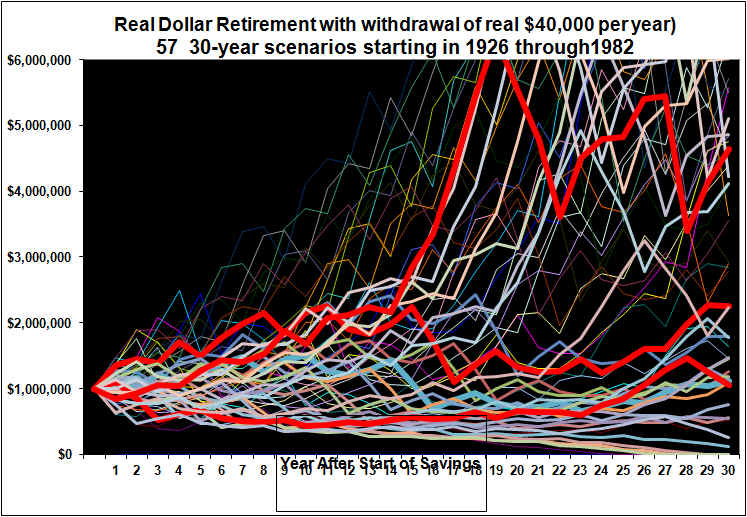
Asset 30

The graph illustrates that with a 4% or $40,000 initial withdrawal, that grows with inflation, from a 100% equity portfolio, in most cases the portfolio grows substantially in retirement. In only 4 cases did the money run out too early (retired in 1929, 1966, 1968 and 1969), and then never before year 24. (Again, remember that the late 60’s was the period that Warren Buffett closed down his equity partnership and indicated that extremely few if any bargains were to be found.) Three lines are high-lighted in dark red to better show the volatility.

The above graph vividly illustrates that what will happen to a 100% equity portfolio over a 30 year period, is highly uncertain. Analysis that focuses on so-called average outcomes such as a steady real 6% gain (which in fact never happens) are highly mis-leading because they do not consider the range of likely outcomes. We could calculate an average line to plot on this graph, but clearly most individual retirement experiences would be far from average.

The majority of these portfolios grow through retirement, with quite a number growing more than five fold. And this is in real dollars, adjusted for inflation.

If you look closely though you can see many huge near-vertical drops. Most of these all stocks 100% equity scenarios see a number of large drops over the 30 years (although most years see gains) and most have one absolutely devastating period (losses in the range of 35 to 50% or more) corresponding to living through the market crashes of 1929 through 1932, 1973 through ’74 (this one exacerbated by huge inflation) of the early 2000’s, and most recently, the crash of 2008.

Given the extreme volatility and extremely uncertain final wealth value illustrated with the 100% equities asset allocation approach, let’s now examine the fully balanced approach.

Graph for Balanced Approach to Asset Allocation with $40,000 initial withdrawal, growing with inflation. (60% Stocks, 35% Corporate Bonds, 5% Cash at the start of each year)
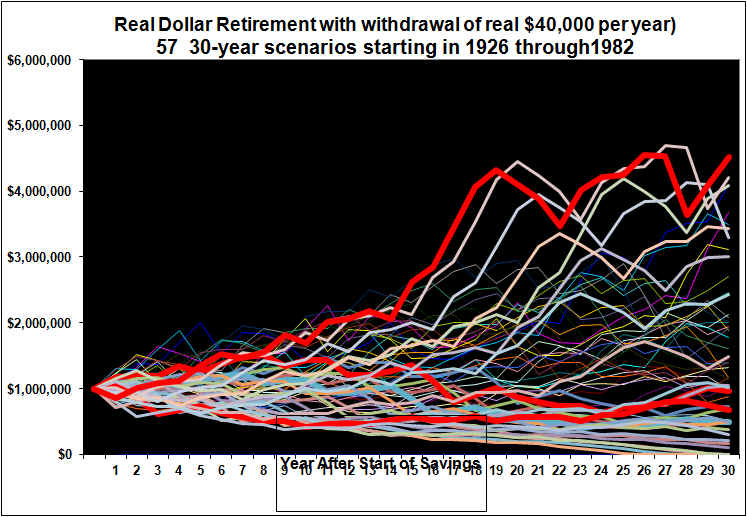
Asset 31
Note that the same scale has been maintained in all four graphs for easier comparability.

The (60% stocks, 35% corporate bonds and 5% cash) Balanced (and re-balanced annually) approach to 30-year retirements that started in 1926 through 1981 delivered a somewhat tighter – but still very wide – range of ending portfolio values and also less annual volatility. In most cases the portfolio would have increased through retirement. In many cases there was still significant volatility but nowhere near as large as for the 100% equity approach. Technically then, the balanced approach has less risk, less uncertainty.

However, this balanced approach ran out of money, just as often, 4 times (retirement in  ’65, ’66, ’68 and ’69).

This Balanced Approach only occasionally led to more total wealth over the full 30 years. (The only cases where this 60%/35%/5% Balanced approach did better, regarding ending wealth, was for retiring at the start of ’28,’29, ’30 and ’73). This represents 7% of the 57 cases. The Balanced asset allocation approach provided substantially less annual volatility but at a huge cost in terms of foregone wealth, for the vast majority of the retirement scenarios.

Illustration of the Difference in Ending Values

The above graphs show both the volatility along the way and the ending values for the all-equity versus the balanced approach over the 57 different 30-year retirement periods. Again, this is for historical data covering all the possible 30 calendar year retirement periods from 1926 through 1955, all the way to 1982 through 2011.

The following graph displays just the ending wealth values after 30 years for the all-equities versus the balanced approach. This is for starting with $1 million and withdrawing $40k per year adjusted for inflation each year and the ending values are in real dollars adjusted for inflation.
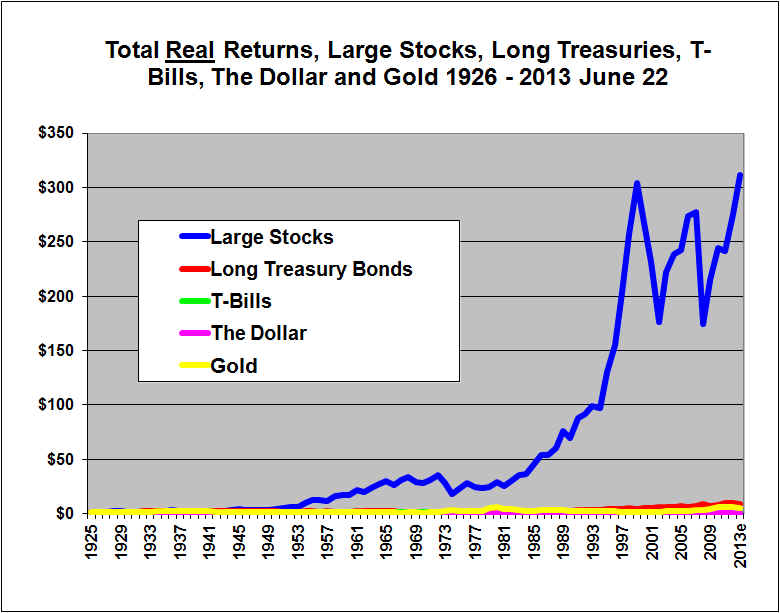
asset_32

Viewing the data this way, we see that the cases where an all-equity approach vastly out performed the balanced approach in terms of ending wealth values mostly occurred in the 30-year retirement periods that were started back in the 1930′ 40’s or 50’s. For many of the retirement periods started since about 1966, an all equity approach did not out perform the balanced approach by a great margin. (But all-equity approaches started in 1974 to 1978 did).


Observations and Conclusions

The above is the U.S. data for 30 year retirement scenarios starting 1926 trough 1982. I believe my calculations are correct but there is always a chance that I have made an error in calculations and or data entry.

Many books have been written about the proper asset allocation in retirement and about the only universal agreement is that the proper asset allocation is very much dependent on each individual’s unique circumstances including particularly the financial ability to accept risk and the emotional willingness to suffer large losses along the way.

Therefore it is perhaps best if readers draw their own conclusions from the graphs and seek other opinions as well.

However, I will provide my thoughts.

The graphs confirm that the the initial percentage that can be safely withdrawn from a portfolio (where the initial amount is to be fully increased for subsequent inflation), is distressingly low. Even when only 4% was withdrawn (and adjusted for inflation each year), in 7% of the past scenarios the money ran out in the last few years with either an all-equity approach or this 60/35/5 Balanced Portfolio. Higher allocations to bonds or cash, would lead to even more cases of the money running out. This may suggest that if absolute certainty is required then an inflation-adjusted life annuity (purchased from an insurance company) may be the best option.

I believe that the graphs show that it is completely unrealistic to think that a retirement portfolio, with any exposure to inflation, stocks, and/or bonds, can be left on auto-pilot with a withdrawal level that is set at the start and then never adjusted except for inflation. That scenario just does not match what really happens. In real-life, only an inflation-adjusted annuity can be deliver that result. And the annuity approach foregoes a huge potential up-side, and also precludes any of that money being left for an estate.

In real life, the withdrawal rate, and perhaps the asset allocation, will likely be reviewed and changed every few years, depending on many things including, health, life expectancy, financial needs and wants and particularly the portfolio’s performance. All of our working lives we are forced to adjust our spending in accordance with our income. In retirement if our income depends partly on a financial portfolio, then we can expect to adjust our spending in accordance with our investment results. If in retirement your original $1 million grows to $2 million, you are almost certainly going to withdraw more. Conversely, it it sinks to $700,000 after two years, you are going to have to cut back.

A high asset allocation to stocks/equities, even in retirement, appears to offer a good chance for huge rewards but at the cost of huge annual volatility. It may be that by understanding that occasional large losses are simply part of a jagged road to higher wealth, many of us could increase our risk tolerance. Looking at the graphs, the Balanced Approach does not look very appealing, though it would be less stressful.

An all-equity retirement approach started in 2012 might have an advantage because the bond portion of a balanced portfolio is currently offering very low returns.

Other analysts have claimed that the Balanced approach can often be superior, so please check other sources.

Caveats
Again, the above is the U.S. data for 30 year retirement scenarios starting 1926 trough 1982. I believe my calculations are correct but there is always a chance that I have made an error in calculations and or data entry.

The graphs are based on annual year-end data only . Actual daily volatility and distances from peak to trough based on daily data are not shown. For example, the unfortunate scenario of getting 100% into stocks on the highest peak day in 1929, for example, is not shown.

The future is not the past. Even if all-stocks/equities almost always beat balanced approaches over 30 year periods in the past, there can be no assurance that the same will apply in the future. Certainly if one began a retirement with 100% invested in equities at a market bubble peak, the results could be devastating.

The above analysis is based on U.S. data from 1926 onward. This included a golden age of progress but also a depression and several deep recessions. It is possible the future will be far less rosy for equities.

Tax rules might mandate withdrawals significantly larger than assumed in this analysis.

Data for Canada and other Countries may not show the same ultimately favorable (although volatile) picture for equities.

The equity stock allocation here is to the S&P 500 index. Allocations to less diversified or smaller cap equities would have different results.

We have ignored taxes. However in general, taxable accounts would sway the results even more in favor of equities because of the favorable treatment of capital gains historically and of dividends more recently.

We have ignored portfolio management and transaction costs. However, it is not clear that these are materially higher for equities versus bonds and cash. With the 100% equities approach, little trading might be needed if one were tracking an index. In the Balanced approach the annual rebalancing would add to trading costs. Management and trading costs would likely lower the curves in the graphs but not change their shapes much.

The bottom line is that there are no easy answers in investing. Asset allocation in retirement is a highly personal choice. However, the above analysis will hopefully allow the choice to be made from a  more educated level.

April 7, 2012 (updating the original article of February 20, 2007) and with some edits Oct 20, 2012

See also our related article about Asset Allocation During the Savings Phase of Life

Shawn Allen, CFA, CMA, MBA , P.Eng.

President

InvestorsFriend Inc.

www.investorsfriend.com

Additional Graphs

Below is the graph for an allocation equally divided between stocks, bonds and cash
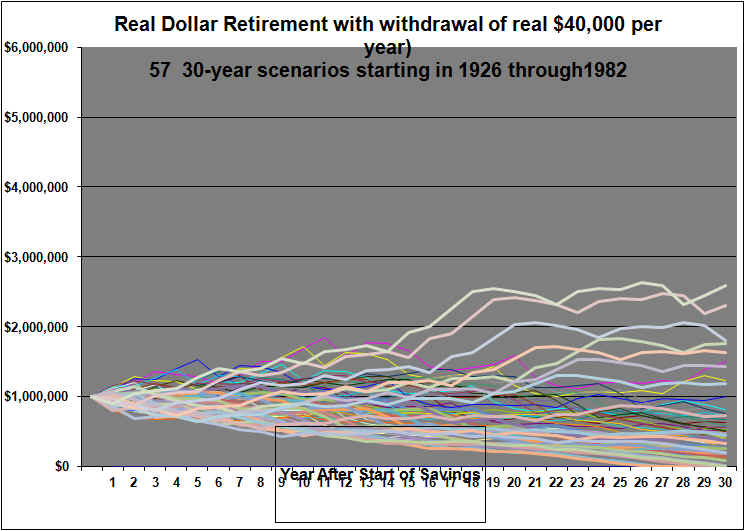
Asset 19


This fully balanced approach above with an equal allocation to each of stocks, corporate bonds and short-term cash investments often produces something close to the textbook smooth decline over the 30 years. However it foregoes the chance for a huge gain in the portfolio that was exhibited in the charts above.

The following is for 75% equities, 25% cash
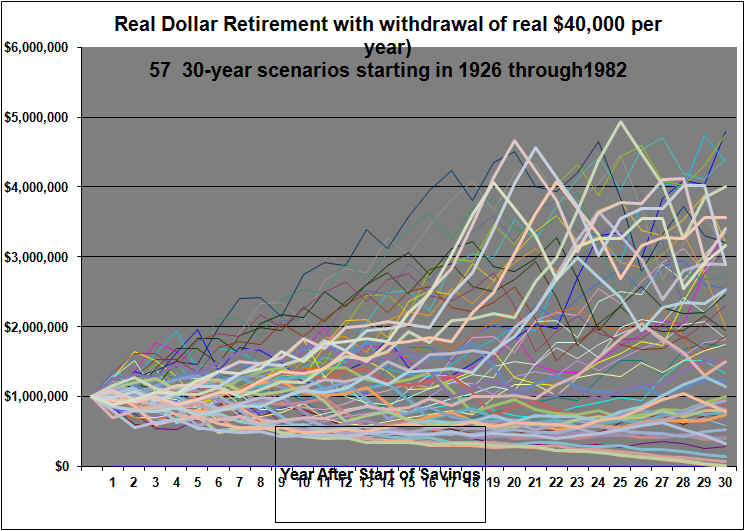
Asset 20

This allocation of 75% equities, 25% cash is interesting in that based on this past data, the worse scenario has been a smooth decline in the portfolio over the 30 years. However, many scenarios grew. Compared to the 100% stocks approach, it removes apparently much of the risk of running out of money early while retaining much of the up-side of the all-stock approach.

It may be that adding bonds to a portfolio does not reduce risk of running out of money as much as does adding a cash allocation.

Note that all scenarios in this article are based on past data. As we have recently been reminded, there is such a thing as unique circumstances and just like hot and cold temperature records are still being broken, the market in the next 30 years could turn out to be worse than we have ever seen before, or it could be the best scenario ever.

END


Are Stocks Really Riskier Than Bonds?

Updated October 14, 2023

Stocks are generally considered to be more risky than bonds. This article provides the data, in graphical form, so you can see and decide for yourself if stocks have really been riskier than bonds.

For short-term investors, stocks are indeed riskier than Bonds. But for long-term investors the evidence from actual historical returns indicates that Bonds were actually riskier than stocks. But it all depends on having a proper definition of what risk means.

When it comes to long-term investors, virtually the entire investment community is focused on the wrong definition of risk. Much of what is written about risk is at best inappropriate and at worse completely wrong for a long-term investor. This is caused by an over-emphasis on short-term volatility.

For long-term investors we need to have a proper definition of risk. Financial academics and the investment community generally define risk as the short-term (annual, monthly or daily) volatility of returns from an investment. The volatility of returns is measured by variance or standard deviation.

From the perspective of a long-term investor, this definition of risk is flawed for two reasons:

  1. The analysis and conclusions almost always focuses on the volatility of annual (or even monthly or daily) returns. An annual focus might be appropriate for many investors, but long-term investors should be mostly concerned about risks associated with their long-term wealth level and not primarily focused on the bumps along the way.
  2. The analysis and conclusions are almost always based on nominal returns and ignore the erosion of purchasing power caused by inflation. For short-term investors, inflation may not a be a big concern but it has a huge impact in the long-term.

As to the second point above, it seems self evident that better conclusions will be reached using real (inflation adjusted) returns rather than nominal returns.

As to the first point above, under the short-term volatility definition of risk, stocks are considered much more risky than long-term Bonds or Treasury Bills (T-Bills). Yet, it is a fact (based on United States data since 1926) that stocks have outperformed both 20-year government Bonds and T-Bills over all but one historical calendar 30 year periods. In all but one of the 69 different 30 calendar year “rolling windows” starting from from 1926 – 1955 then 1927 – 1956 all the way through to the most recent period being 1994 – 2023, stocks have provided a higher return. But due to higher annual volatilities, stocks are considered more risky! (Admittedly, there would be more 30-year periods based on non-calendar year start and end points where long term bonds out performed stocks.)

To avoid risk (defined as annual or daily volatility) you may be advised to put substantial portions of your investments into into Bonds or T-Bills even though the historic data suggests these are in fact are almost guaranteed to under perform stocks in the long run. This kind of thinking on risk, while it may allow you to sleep better, may be hazardous indeed to your long-term wealth. (That is, if your goal is wealth maximization at some distant point like 20 or 30 years in the future, as it is for many investors, and particularly younger investors).

The following graph shows the actual annual volatility in Stock, Bond and T-Bill returns from 1926 to present. In regards to stocks, this discussion deals only with the performance of the S&P 500 large company stocks as a group; it does not deal with the risks of investing in a non-diversified portfolio of stocks. The bonds are 20-year U.S. government bonds and the investment is rolled over into a new 20 year bond each year to keep the maturity always at 20 years. The data here is for U.S. returns as published in the Ibbotson yearbook entitled, Stocks, Bonds, Bills and Inflation. For 2023 the data is as of October 14th and taken from other sources. The returns are total “real” returns including dividends and capital gains or losses adjusted downward each year by inflation. (In the depression years the real returns are adjusted upwards by deflation since “inflation” was negative.)

The actual final results at the end of 2023 will differ somewhat.

Sure enough, the stock returns (the blue bars) were clearly far more volatile on an annual basis. Long-term Treasury Bond returns (the red bars) were also quite volatile while T-Bill returns (in green) were more stable. It’s also fairly obvious that the average stock return is much higher than the average Bond return which in turn is much higher than the average T-Bill return.

On a real return basis, stocks have had calendar year losses of over 30% in four of the 96 years from 1926 to 2021, with the latest occasion being 2008. And two (1930/1931 and 1973/1974) of those occasions included an adjacent calendar year with a loss of at least 20%, meaning the total compounded loss was over 60%! Using daily data there would be more occasions when stocks have plunged at least 60% from a previous peak. That is certainly very real risk and is extremely hard to stomach. Yet we know that despite this, stocks have clearly out-performed bonds in the long run.

The age-old question for investors is whether or not the (highly probable but perhaps not certain) higher long-term average return from stocks justifies the extra risk (short-term volatility).

In judging the risk of Stocks versus Bonds, you must consider more than the annual volatility. The following illustrates this.

Imagine your rich uncle offers to play a coin toss game with you. If you lose he gets half your net worth. If you win he gives you an amount equal to twice your net worth.

Your expected return is 0.5 * (-0.5) + 0.5 * 2.0 = 0.75 or 75%.

So on average you will win 75% of your net worth but you have a 50% chance of losing half your net worth and a 50% chance of tripling your net worth.

Should you play this game? Simple expected value math says yes, but most people would consider it too risky and would not play. It would be a real downer to lose half your net worth on a coin toss. (If in doubt, a male could ask his wife, she would likely have no doubts).

How risky is this game? It’s very risky unless you are allowed to play several times. But imagine now if your starting net worth were $100,000 and your rich uncle said you could divide your money into ten piles and play the game 10 times, each try based on $10,000. If you win 5 times and lose 5 times, you will win $100,000 and lose $25,000 to net $75,000 ahead. If you win only 2 times and lose 8 you win $40,000 and lose $40,000 to break even. So now you can only lose if you only manage to win less than 2 coin tosses out of 10. This changes things drastically. It now seems much more sensible to play the game since you have little chance of losing. Your expected return is still the same 75% but your risk is much reduced (though not eliminated).

This illustrates that in looking at any risky venture it is important to ask how many times you get to play the game. If the average return is positive, the risk declines with the number of times you get to play and if you are allowed to play many times then the risk approaches zero. Technically speaking, the standard deviation of your total return over “N” tries is equal to the standard deviation of each individual try divided by the square root of “N”. As “N” becomes large your total risk becomes very small.

Similarly, the stock market becomes much less risky, if risk is defined as a lower possibility of failing to beat bond or cash returns over your full holding period, the longer you stay in.

In regards to the stock market and the range of possible returns you simply cannot analyze your risk unless you first consider how many years that you will be investing. It is generally accepted that the typical investor is concerned very much with annual and even daily returns and has perhaps a one year time horizon. Most of the discussion you will ever see about stock market risks will focus on the one year or even daily volatility. That might be fine for the mythical average investor but it leads to completely wrong conclusions, for true long-term investors.

For a long-term investor, I would argue that the more relevant risk is clearly the risk of insufficient growth in long-term real purchasing power. Analysis which focuses on the risk of short term volatility in wealth or returns is quite simply looking at the wrong risk when it comes to the long-term investor.

will outperform even in a 30 year time horizon.

You don’t have to agree with my conclusions. You can also study the graphs above and draw your own conclusions.

Self-described long-term investors need to be sure that they really have a long time horizon before they act accordingly. For many investors, there is a chance that they will need to cash out their investments early. This could be caused by illness, job loss, disability, legal problems and other reasons. But, if an investor is virtually certain that they have a very long time horizon then it certainly appears that stocks (based on a U.S. large stock index) are not riskier than bonds, in terms of achieving the highest ending portfolio value.

Risk tolerance

Most investment theory teaches that the risk versus return trade-off is a matter of personal preference. The stock market offers higher average expected returns on stocks but at the cost of higher annual volatility. To their credit, the industry encourages those with longer term time horizons to use a higher equity weighting but still advises that all investors allocate some funds to Bonds and Bills. But this really offers little guidance to investors.

My conclusion is that the risk return trade-off is more a matter of time horizon and education, rather than personal preference. If you are virtually certain that you will not require the funds prior to 20 years or more, then history teaches that stocks have not been riskier. Stocks will almost certainly return more than Bonds or Bills (based on historic data).

If investors are educated about this then most of them can become more comfortable with the daily, monthly and annual volatility of stocks safe in the knowledge that high returns in the long-term is their almost certain destiny. It’s a bit like taking a drive on a mountain road with a lot of switchbacks. If you don’t know the road, the switchbacks and back-tracking might be highly stressful (as you think you are going in the wrong direction). But if you have studied a map carefully then you can relax and the switchbacks will not bother you since you know that the road to your destination will be circuitous.

Also, those investors who are in the savings phase of their lives are not reliant on any one thirty year period but instead typically invest a certain amount each year. This reduces risk through time diversification. If in any individual 30-year holding period stocks are highly likely to beat bonds, then in a long series of 30 year holding periods it may be virtually certain that stocks will beat bonds.

See also our article on the historical returns that been achieved overall ALL of the possible 30, 15 and ten calendar year time periods since 1926. This is based on stocks (the S&P 500), Bonds (U.S. 20 year Treasury bonds, Cash (U.S. 30-day Treasury Bills). It also includes balanced portfolios drawn from those three asset classes.

END

Shawn Allen, CFA, CMA, MBA, P.Eng.
President, InvestorsFriend Inc.
Article originally created in June 2001 and last updated October 14, 2023

DJIA Valuation February 2002

IS THE DOW JONES INDUSTRIAL AVERAGE (“DJIA”) INDEX OVERVALUED?

(This article is dated February, 2002, for a current version, click here)

As of February 8, 2002, the DJIA index was at 9744 and had a Price Earnings Ratio (“P/E”) of 25.17 and a Dividend yield of 1.12%. (Source: DJI Indexes)

The DJIA represents a portfolio of 30 stocks. For each $9744 (the index value) purchased the underlying companies in the portfolio are therefore currently earning $9744/25.17 = $387 per year and paying a dividend of $9744 * 0.0112 = $109 per year.

We know that the DJIA index is at 9744. We can estimate what the DJIA should be trading at based on the value of the earnings and dividends. My model calculates the value of the earnings and dividends for a ten year period and then assumes that the index is sold at a projected future P/E.

It appears that the current DOW earnings are depressed by recession and therefore are not representative of normal conditions. Therefore I will use the actual year 2000 DOW earnings of $485 as my starting adjusted earnings level. This is based on a belief that the DOW companies should return to pre-recession earnings levels and then grow from there. The Dividend level too appears depressed but that may be due to changes in the DOW component stocks and so I will use the current dividends. Dividends normally would not decline much during a recession.

In addition to the beginning earnings and dividend level, three additional factors are required to calculate the fair value at which the DJIA should be trading at. These are, 1. The forecast average compound growth rate in earnings and dividends over the next ten years. 2. The forecast P/E ratio at which the DJIA index will be trading in ten years time. 3. The estimated rate of return required by investors.

The DJIA portfolio average earnings should grow at a rate close to the growth rate of the U.S. economy in nominal (after inflation) terms. I believe a prudent estimate for this growth rate is 5% to 7%.

The average P/E for the Dow Jones Industrial average since 1950 is 18 and I believe that 15 to 20 represents a prudent forecast for the P/E at which the DJIA index will be trading in 10 years. The more optimistic we are about the level of the P/E in ten years time, the higher is the justifiable fair value level of the DJIA index today.

As o February 8, 2002, U.S. investors can get a risk-free return of 4.9% (10 year U.S. Treasury Bond yield) . An investor in the stock market will require a risk premium and I would estimate that a minimum return required by stock investors is in the range of 7% to 9%. The higher return required by investors then the lower the price that investors must pay for the index today, all else being equal.

The following table calculates the value that the DJIA should be trading at given prudent assumptions about earnings growth, the P/E ratio that will exist in ten years and the rate of return that investors require.

DJIA Current Annual Earnings DJIA Annual Dividends Earnings and Dividend Growth forecast P/E forecast in 10 years  Resulting DJIA in 10 years Required Return Resulting DJIA Fair Value Today
$485 $109 5% 15 11,850 7% 7,008
$485 109 5% 18 14,220 7% 8,213
$485 109 5% 20 15,800 7% 9,016
$485 109 5% 15 11,850 9% 5,898
$485 109 5% 18 14,220 9% 6,899
$485 109 5% 20 15,800 9% 7,567
$485 109 7% 15 14,311 7% 8,365
$485 109 7% 18 17,173 7% 9,820
$485 109 7% 20 19,081 7% 10,790
$485 109 7% 15 14,311 9% 7,031
$485 109 7% 18 17,173 9% 8,240
$485 109 7% 20 19,081 9% 9,046
$485 109 9% 15 17,223 7% 9,964
$485 109 9% 18 20,667 7% 11,715
$485 109 9% 20 22,963 7% 12,882

Conclusions

By changing the expected earnings growth rate, the return required by the investor and the assumed P/E ratio that will apply in ten years I can calculate that today’s DJIA index should be anywhere from 5,900 to 12,900.

My own best estimate is high-lighted in yellow and is 9,820.

Since the DJIA is (somewhat coincidentally) currently 9744, I conclude that it is likely about fairly valued.

The table illustrates quite a wide range for a reasonable fair value of the DOW. Investors should be sobered by the fact that if investors require a 9% rate of return and if the earnings only grow at 5% (say 3% GDP plus 2% inflation) and if the DOW commands a P/E of only 15 in ten years then the fair value of the DOW is calculated as only 5898. So conservative but not really gloomy forecasts of earnings, required return level, and P/E result in a fair value of the DOW at only 5898. Gulp!

On the other hand many people may believe that the DOW should be closer to 12,000 since it has already been over 11,000. In order to justify a 12,882 level we have to assume that investors require only a 7% return, that the earnings will grow at a robust 7% and that the P/E will be at 20 in ten years which is above the long term average of 18. I consider that to be a rather optimistic scenario.

Overall, I conclude that my highlighted estimate of 9820 is a fair value, though it probably leans more to the optimistic side since it requires: a 7% growth rate, that investors require only a 7% return and that the P/E will revert to the average of 18.

My conclusion is that at its current level of 9744, the DOW is neither dangerously high nor is particularly cheap. Long term investors should certainly not abandon the market but might want to avoid being 100% in equities.

Shawn Allen,
Editor
February 8, 2002

UPDATE, 10 YEARS LATER

10 years have now passed since this article was written. On February 8, 2012 the Dow Jones Industrial Average stood at 12,884. As shown in the yellow highlighted row in the table above, my best estimate in February 2002 was that in February 2012 the DOW would be at 17,173. That was based on earnings growing 7% per year from $485 to $954 and a P/E of 18 applying.

Well, it turns out that the earnings on the DOW for 2011 on a normalized basis were about $967. So, my growth estimate of 7% per year was quite accurate.

But it was the P/E ratio that I got wrong. I had used a historical average P/E of 18. However, I later realized that the true historical average after removing a few very high P/Es in the historical data (due to abnormally low earnings) was actually closer to 15. At a P/E of 15 and a growth rate of 7%, the above table predicted a DOW level in February 2012 of 14,311. That is only 10% higher than its actual level turned out to be.

In any event I would not expect the prediction to be very accurate given all the variables. The bottom line is that I concluded in 2002 that the DOW was at a fair value. In fact it turns out that it gained 3.0% per year and there was also the dividend of about 2%, for a total return of about 5%. In fact, Dow Jones reports that the DOW returned a total of 5.1% per year in the ten years ending February 2012. So in reality it turns out that the DOW was somewhat over-valued in February 2002, assuming that the 12,978 level of February 2012 is a “fair” level. Still, an investment in the DOW at February 2002 has returned 5% per year and that is not so very bad.

March 3, 2012

OWNING A BUSINESS VERSUS OWNING STOCKS

When you own stocks, you own shares in a business. That is obviously different than owning your own business. But there are some similarities. The table below explores some of the differences between owning your own small business versus owning shares of stock in a publicly traded business.

For most people the choice would be between buying one small business that you are going to own and operate (and perhaps grow into a large business) versus continuing to work for others and doing some investing “on the side”.

Issue You Own and Operate a Small Business You Own Stocks (shares) in Businesses. And You Keep your day-job.
Money Needed Usually you need a large sum of money to get into an owner-operated small business. If a business is going to replace your former employment income it is likely going to cost you at least a year’s salary, perhaps MUCH more. You can start buying mutual funds with as little as $50 or $100, and usually with a plan to buy additional funds monthly or yearly.You can start buying individual shares with as little as about $1000. However $10,000 to $25,000 is more realistic before you open a self-directed account to buy shares. We have an article that explains how to get started.You could buy shares with the assistance and advice of a full service broker if you have at least about $100,000
Borrowing to Buy For a small business that has real estate you can borrow some of the money. However for many businesses you will find the bank unwilling to lend. You could borrow on your personal line of credit or against your house. Vendor financing is also sometimes possible. In general you will want to have a large down payment and avoid too much debt.The better franchise opportunities, for example, will insist that you bring a very substantial down payment to the table. Borrowing to buy stocks is often frowned upon. You can, through a margin account, use some leverage. In theory you can borrow on your line of credit or against your house to buy stocks. It can be appropriate in some circumstances. In general though, investors tend to purchase stocks with their own money such as in a retirement account.
The Initial Buy Decision You will want to think long and hard about the type of business you buy. Once you buy it may be difficult or impossible to sell. Almost certainly a quick sale would involve a large loss. You may be virtually locking yourself for life into this business, so do think long and hard. You can buy easily for a very small commission. Usually the buy / sell spread is tiny and, if you wanted to, you could exit immediately at a only a tiny loss. You still need to be careful what you buy but not to the same extent as when you buy a business.
Diversification Often the owner of a small business has no diversification. He or she is “all in”. Diversification is almost automatic when investing in stocks. There is usually little reason to expose too much of your money to any one stock.
Job for you As an owner you can hire yourself. (Though it’s not guaranteed that you will have the money to pay yourself!) You will be keeping your day job, unless you are retired or quite wealthy
Jobs for the family and friends You have the option of hiring family members and friends, depending on your needs. This can be good, but it has its down sides as well. Having to fire or layoff these people would be no fun Not applicable
Management Depending on your view point you “get to” or you “have to” manage the business. You get to make the decisions. But also it is your phone that rings when any trouble arises or any material decision is required. Not applicable, you don’t have to worry about managing the businesses you own shares in, nor do you have any say in it.
Who’s the Boss? To a large degree you are the boss. No one tells you what to do. (Well except that bankers and customers often can be pretty bossy as well.) You are the boss over your investments.In your day job with rare exceptions like sales jobs, and certain professions you always face the fact that there are bosses that run your life. They judge you, often in arbitrary ways. As you get older and wiser you will usually face working for bosses who are younger than you at some point, and not as knowledgeable. It can be annoying.
Financial Security A business may or may not offer financial security Keeping your day-job usually offers financial security although that is not guaranteed forever.
Pension not applicable Sometimes applies
RRSP savings If you take a wage from your business you can contribute up to 18% of earned income to a limit of $22,450 for 2011. But that is only useful if you can afford it. If you have a pension your allowable contribution to RRSP may be small or non-existent.
Physic Income related to the Asset There is an important mental satisfaction to being able to drive up to you business and to point out to others that you own a business. While there is a mental satisfaction to owning a growing pile of loot invested in stocks, it’s not quite as satisfying as driving up to your own building. And bragging to friends about your loot is socially frowned upon.
Calculating Profits from the business(es) Profits are calculated by your book-keeper or accountant (who may be yourself) It would take some effort to calculate your share of the profits of the companies you own shares in. It will not be reported to you by your broker. It can be calculated by dividing the P/E ratio of each stock into the value of stock owned but few people make this calculation.
Who gets the profit For a lot of small businesses there may not be any profit beyond a modest wage for the owner. But if there is a profit, you get to decide how much to dividend out to yourself and how much to keep inside the business for reinvestment or perhaps just to shelter it from the taxes that would apply if you paid yourself a dividend Businesses in which you own shares are likely to make profits. They will decide how much (if any) to pay out as dividends.Profits that they retain are meant to be used to build up the
business. In most cases retained profits help the business grow and its share price to increase over the years.
Making the Profits Grow Through hard work, and / or smart work or through good luck you may be able to increase profits. The sky may be the limit in some cases. In other cases especially if you don’t work hard, or smart or you have bad luck, profits can evaporate. You will have zero control over the profits of the companies you own shares in. But you will have the ability to try to choose companies that will grow their profits.
Importance of Profits versus the Value of the business The cash flows and profits of the business and the wages or dividends that it can pay you are extremely important. The value that you could get if you sold the company may be of no importance at all except in the rare event that you do decide to sell. The value of the shares on the stock market is usually the most important factor. In some cases you will also value the dividends.If the price of the shares fall you will likely not be comforted much if the profits have actually increased.Similarly if the share price increases you may not be much bothered if that happened despite a reduction in profit.In the longer run profits matter a LOT, but stock investors usually focus on the short term.
Liabilities You could face liabilities even beyond the investment in your business You have no liability, the worse that can happen is that your shares become worthless.
Liquidity As noted in the Initial Buy Decision above, you will often have limited liquidity. It might take months to sell if you decided to sell. Often the sale price might be less than you would like. If you are very key part of the business, it may be difficult to sell because perhaps the customers will leave if you leave.Often there is a large buy / sell spread and so unless a motivated buyer comes along, you may need to lower the price to attract a buyer. You will face legal fees as well. You can sell anytime. You always know the price at which you can sell. In most cases the bid/ask spread is tiny and the Commission to sell is VERY tiny. Capital gains taxes apply to any gain unless you were investing in a tax sheltered account.
Market value Usually you will not know the market value of your business with any precision. And, if you intend to operate the business for a long time its market value may be largely irrelevant. The market value of an investment portfolio is presented “in your face” at least monthly and often daily or minute by minute as you obsessively check it value online. It can drive you to
distraction and cause you to bail out at at inopportune times.
Tax Advantages You may be able to deduct certain living costs and a portion of vehicle expenses. You may even be able to claim certain travel expenses – such as attending a conference, which you may be able to combine with a vacation.You can choose to pay yourself a salary and create RRSP room and CPP contributions. But you are taxed heavily.Paying yourself with dividends instead of profit may offer a lower tax rate (counting corporate and personal tax)There may be some limited exemption from capital gain taxes on the ultimate sale of the business Income from your day-job is heavily taxed and there are very few deductions available.Investment capital gains can be sheltered by not selling. And investment capital gains are taxed at half the regular rate and dividends are tax advantaged. Investments in RRSP are not taxed until withdrawn but then are taxed heavily. Tax Free Savings Accounts offer tax-free investing forever. In general no investment expenses are deductible except the direct costs you pay to your broker. Even your subscription to an investment newsletter is not deductible.
Becoming Truly Wealthy Most business owners will never become truly wealthy but definitely some will. Few stock investors will become truly wealthy through this means. But a few will, those who start young and save and invest aggressively may become truly wealthy late in life.

How to Make Owning shares more Business Like

Warren Buffett often quotes from chapter 20 of Benjamin Graham’s classic book, the Intelligent Investor that.
“Investment is most intelligent when it is most businesslike” (from the last section of the last chapter)

You should think of your ownership of stocks as what they are; partial ownership of actual businesses. Do not think of yourself as a share holder (which suggests your ownership may be brief and transitory) but rather as a share owner, a part owner of the business.  Where reasonably possible visit one or more of the business locations that you partially own. If you own shares
of Wal-Mart or Costco, remember your ownership when you shop there. Look around with satisfaction (or not) at what you see. If you own Tim Hortons, you can take a certain pleasure out of standing in those long line-ups.

If you can, estimate your share of the profit of each company you own shares in. Profit is the share price divided by the P/E ratio.

Try to understand the business model of the companies you own. shares in. What is their competitive position in the market?

Buying a Business

The following is a good web site that lists businesses for sale all across the world. Most of these businesses may not be attractive (at any price). But I think you will see at least some good ones listed. You can search by Country, State, Province and City as well as other search terms.

http://www.businessesforsale.com/#

END

Shawn Allen, CFA, CMA, MBA, P.Eng.
President, InvestorsFriend.com
October 29, 2011

Stock Market Earnings Growth and Dividend Yields Determine Long Term Returns

Stock Market Earnings Growth and Dividend Yields Determine Long Term Returns

In theory, earnings and dividends drive stock market returns in the long run.

For example, if a stock pays no dividend then the return is driven by the capital gain. If you buy a stock with a P/E of 15 and sell it ten years later at the same P/E of 15, then your Price rise will be exactly proportional to the earnings rise. If the earnings rise by 10% per year, then your return, in this zero dividend case, will be exactly 10% per year. Again this assumes that the P/E remained constant.

If the above stock pays a 3% dividend yield then your return will equal the earnings growth plus the dividend. In this case a 7% annual earnings growth plus the 3% dividend will yield a 10% annual compounded return.

But has this really been true historically? Have stock market returns not out-paced the earnings growth plus dividends? (Certainly they have in many years, but what about over the long term?)

Over short periods of time, stock market average returns clearly do not equal the average earnings growth plus dividend. But over most 30 year periods the theoretical relationship has proven to be approximately correct as the following graph shows.

In the above graph, the earnings growth plus dividends (the red line) is quite choppy due to certain years when earnings drop close to zero. The same data is shown below on a smoothed basis which perhaps better illustrates the trend and relationship.

The blue line shows average compounded total returns (capital gains plus dividends) on the Dow Jones Industrial Average (“DOW”) for all rolling 30 year holding periods that ended in years 1960 through 2017. The Dow total Return is smoothed by averaging the level of the DOW total return index over 3 years at the beginning and end points in order to minimize the impact of short term market changes, since this is a long term analysis.

The red line shows the compounded average DOW earnings growth over each 30-year period plus the compounded average dividend yield. The DOW earnings growth was also smoothed by taking the average of 3 years at each end point. This smoothing is necessary in order to prevent distortion caused by temporary large dips in earnings caused by one-time write-offs such as occurred in 1981.

The two lines track each other relatively closely. The earnings growth plus dividend yield drives your total return over long periods of time.

However, in all the 30 year periods ending from 1998 through 2017, the returns to shareholders over 30 year periods remained consistently above the earnings plus dividend line. This was driven by an increase in the P/E ratios from the very low levels from 1969 and particularly in the 1970’s.

IMPLICATIONS LOOKING FORWARD:

Average stock market returns over the long term should be about equal to the growth in earnings plus the dividend yield. Currently the DOW dividend yield is about 2%. And, most economists predict that the long run rate of growth in North America will be about 5% being about 2% for inflation and about 3% for real growth. If earnings grow at about 5% and the dividend is about 2% then the expected return on stocks should be about 7%.

But deviations from that 7% can occur when the P/E ratio changes materially. Significantly higher P/E levels occurred starting in 1991. Therefore in the 30 year periods ending 2020 and later we should expect to see that the DOW returns track closer to the DOW earnings plus dividend line.

Expecting any more than about a 7% long-term average return on stocks seems unrealistic.

This 7% is well below the historical average since 1930. This is because we are in an era of low inflation and relatively low real growth and low nominal growth. Nominal growth is the actual measured growth in dollars, the real growth is lower and deducts the impact of inflation.

OBSERVATION:

Any expectations that the markets will return 10% or more in the long-term are unrealistic. Virtually no economist would predict that average long-term corporate earnings will rise by the 8% annual rates that a 10% return implicitly requires – given a 2% dividend yield.

It is tempting to suggest that the graph indicates that the DOW return is going to have to decline because it has gotten ahead of the earnings growth. However, keep in mind that the these lines are 30 year compounded returns and they are very much affected both by today’s DOW level and DOW earnings and equally affected by the starting points for the DOW level and earnings. Actually, both lines will have to decline markedly to eventually show a 30-year rolling return in the range of 7% for 30-year periods that started now or in the past few years. This assumes we remain in a low inflation environment.

Another, perhaps more clear, way to look at this is to graph the growth in the DOW index versus the DOW earnings

This chart shows that the rise in the DOW index is roughly parallel to the rise in the annual DOW earnings. In the 20 years prior to 2000 the (blue) DOW index certainly rose faster than the (red) DOW earnings (the P/E ratio increased). With the market crashes of the early 2000’s and around 2008, the Down index dipped down to the Dow Earnings line as the P/E. From 2009 through 2017, the Dow Index has risen much faster than the DOW earnings as the P/E increased substantially

The DOW P/E is now about 22. This is higher than the historical average level of about 15.8 (The average is actually 17.8, but is 15.8 after excluding three high outlier values that were caused by abnormally low earnings). In the longer run the DOW earnings will continue to rise as will the Dow index. But in the shorter term the DOW could certainly fall or at least rise slower than earnings as the P/E declines with higher interest rates.

First written September 28, 2002 (Last updated January 20, 2018)
Shawn Allen, CFA, CMA, MBA, P.Eng.
President
InvestorsFriend Inc.

Expected Return from Stock Investments

Expected Returns From Investing in Stocks

This article provides calculations and insight as to what return you can logically expect from investing in stocks in general or in a particular stock.

Firstly, it must be recognized and acknowledged that we can never know in advance the return that will result from investing in a stock. Actual returns will be affected by whether the economy grows or shrinks. Various company-specific developments can dramatically affect a company’s cash flows (for example BP and its gulf oil spill). Interest rates and the mood of investors can dramatically affect the price at which a company’s shares sell for even if its expected cash flows are unchanged.

Still estimates of the expected return from investing in a given stock or bond can be made. Mathematically the expected return depends on estimates of key variables including growth in earnings per share and dividends and the P/E ratio or multiple of earnings that a stock is expected to sell for in “X” years. The uncertainty of such estimates will depend on whether they are applied to a single stock as opposed to the overall market index of equities, and if applied to a single stock will depend greatly on the nature of the particular company. The earnings of some companies are relatively predictable while the earnings of other companies are inherently unpredictable.

When calculating the expected return from stocks we would be wise to consider certain mathematical relationships. Given all the uncertainties in investing in stocks we can’t expect mathematics to provide all the answers, but it can certainly point us in the right direction. In order to use mathematics to estimate the expected return from stocks, certain assumptions must be made.

In the calculations that follow we will assume that a company making a given return on equity or ROE will continue to make that same ROE in future. In real life such an assumption may be valid for some companies but is certainly not valid for all companies. This constant ROE assumption means that we can calculate the earnings per share growth rate of a company as simply its ROE minus its dividend pay out ratio. A company earning a constant 10% ROE will grow its earnings at exactly 10% per year if it retains all of its earnings and it will grow its earnings at 5% per year if it pays out half of its earnings as a dividend. That is a mathematical fact once we assume a constant ROE of 10%. The scenarios below implicitly assume that the number of shares in the company remains constant.

Input Initial Share Price Input Initial Earnings Constant Pay-out Ratio Scenario Input Constant ROE Assumed Selling P/E after 5 years Calculated Buying P/E Calculated Buying P/B Calculated Initial Dividend Calculated Initial Dividend Yield Calculated Initial Earnings Yield Growth based on ROE times earnings retention ratio Expected Return per year 5 year holding period
100 10 100% 7.00% 10 10 0.7 10 10.00% 10% 0.00% 10.00%
100 10 50% 7.00% 10 10 0.7 5 5.00% 10% 3.50% 8.70%
100 10 30% 7.00% 10 10 0.7 3 3.00% 10% 4.90% 8.00%
100 10 0% 7.00% 10 10 0.7 0 0.00% 10% 7.00% 7.00%

In the above table we pay $100 for a share of a company earning an initial $10 per share and we assume that this arises from a constant 7.0% ROE. We examine the expected annual return if we sell it after five years at the same P/E ratio that we paid and assuming different earnings pay-out ratios. It’s interesting to note that this share purchased at a P/E of 10 mathematically has a Price to Book Value ratio of 0.7 or 70%. In reality stocks of companies earning even just 7% ROE do not today often sell below book value. Therefore it would actually be rare to find such a company selling at a P/E as low as 10.

The first row of the table shows our expected return if the company pays out all of its earnings. In fact this would mathematically be not only our expected but our actual return if all of assumptions turned out to be precisely correct – which would never happen in the real world. This first row scenario is more like a bond than a stock. The share has zero growth and pays out all of its earnings. Our expected return is 10.0% even though the underlying company is only earning 7.0%. The extra return comes from the fact that we bought the share below book value. 7.0% on book value turns into 10.0% on the price we paid. In this scenario we also sell the share at a P/E of 10 which will equate to a P/B of 0.7 and still we earn 10% on a company that is itself only earning 7% due to the bargain price we paid for the share.

The bottom row of the table shows what happens if the company pays no dividend but instead re-invests all of its earnings at the 7.0% ROE. In this case our expected return is precisely 7.0%. Our bargain P/E purchase does not increase our return because of our assumption that we sell the shares at the same P/E ratio as we paid. The company earns 7.0% and we earn 7.0%.
The above table shows that if we can buy a share at a P/E ratio that represents an initial earnings yield (in this case 10%) that is higher than the company’s current and expected ROE (in this case 7%), then we would strongly prefer that such a company dividend out as much of its earnings as possible.

Input Initial Share Price Input Initial Earnings Constant Pay-out Ratio Scenario Input Constant ROE Assumed Selling P/E after 5 years Calculated Buying P/E Calculated Buying P/B Calculated Initial Dividend Calculated Initial Dividend Yield Calculated Initial Earnings Yield Growth based on ROE times earnings retention ratio Expected Return per year 5 year holding period
100 10 100% 7.00% 12 10 0.7 10 10.00% 10% 0.00% 13.10%
100 10 50% 7.00% 12 10 0.7 5 5.00% 10% 3.50% 12.20%
100 10 30% 7.00% 12 10 0.7 3 3.00% 10% 4.90% 11.70%
100 10 0% 7.00% 12 10 0.7 0 0.00% 10% 7.00% 11.00%

This next scenario is identical to the one above except that in this case the investment is sold at a P/E of 12, rather than the 10 that paid. Equivalently the price to book value ratio recovers to 0.84 from the 0.70 paid. The expected returns from each row in the table are therefore higher. In each case the investor earns more than the 7% return that the company is earning due to buying the shares at less than book value and due to selling them at a multiple of book value that recovers somewhat.

Input Initial Share Price Input Initial Earnings Constant Pay-out Ratio Scenario Input Constant ROE Assumed Selling P/E after 5 years Calculated Buying P/E Calculated Buying P/B Calculated Initial Dividend Calculated Initial Dividend Yield Calculated Initial Earnings Yield Growth based on ROE times earnings retention ratio Expected Return per year 5 year holding period
100 7 100% 7.00% 14.3 14.3 1 7 7.00% 7% 0.00% 7.00%
100 7 50% 7.00% 14.3 14.3 1 3.5 3.50% 7% 3.50% 7.10%
100 7 30% 7.00% 14.3 14.3 1 2.1 2.10% 7% 4.90% 7.10%
100 7 0% 7.00% 14.3 14.3 1 0 0.00% 7% 7.00% 7.00%

In this scenario we buy shares at a price equal to book value. With an ROE of 7.0% this equates to a P/E ratio of 14.3. In this case if we also sell the shares at book value after a five year holding period. (The P/E at sale is the same 14.3 as at the purchase). In this case the company makes 7% and we make 7%. The dividend policy does no matter. We earn what the company earns.

Input Initial Share Price Input Initial Earnings Constant Pay-out Ratio Scenario Input Constant ROE Assumed Selling P/E after 5 years Calculated Buying P/E Calculated Buying P/B Calculated Initial Dividend Calculated Initial Dividend Yield Calculated Initial Earnings Yield Growth based on ROE times earnings retention ratio Expected Return per year 5 year holding period
100 7 100% 14.00% 14.3 14.3 2 7 7.00% 7% 0.00% 7.00%
100 7 50% 14.00% 14.3 14.3 2 3.5 3.50% 7% 7.00% 10.70%
100 7 30% 14.00% 14.3 14.3 2 2.1 2.10% 7% 9.80% 12.10%
100 7 0% 14.00% 14.3 14.3 2 0 0.00% 7% 14.00% 14.00%

This next scenario is perhaps most representative of what investors face in the real world. The shares are selling at twice book value, but have an attractive ROE of 14%. The initial earnings yield is 7%. In the first row the company pays out all of its earnings as a dividend and as a result does not grow its earnings. The Investor earns 7% despite the company earning 14%. This is because the investor has paid twice book value. In the fourth row, the company retains all of the earnings and is able to earn the same 14% ROE on the retained earnings. The earnings therefore grow at 14% per year. The investor can earn 14% as long as the selling P/E (or equivalently P/B) remain at the same level as the investor paid. It is interesting to note that due to the high ROE the investor is better off if the company retains all of its earnings. The investor who pays twice book value to acquire a high ROE stock should do so only if the company is expected to grow (which gnerally means it will retain its earnings rather than pay much if any dividend). The investor has to hope that the ROE will remain high and that this will lead to the market P/E and P/B remaining high.

Input Initial Share Price Input Initial Earnings Constant Pay-out Ratio Scenario Input Constant ROE Assumed Selling P/E after 5 years Calculated Buying P/E Calculated Buying P/B Calculated Initial Dividend Calculated Initial Dividend Yield Calculated Initial Earnings Yield Growth based on ROE times earnings retention ratio Expected Return per year 5 year holding period
100 5.00 100% 18.0% 15.0 20.0 3.60 5.00 5.0% 5% 0.0% 0.0%
100 5.00 50% 18.0% 15.0 20.0 3.60 2.50 2.5% 5% 9.0% 6.0%
100 5.00 30% 18.0% 15.0 20.0 3.60 1.50 1.5% 5% 12.6% 8.2%
100 5.00 0% 18.0% 15.0 20.0 3.60 0.00 0.0% 5% 18.0% 11.4%

This next scenario shows the danger of paying too much even when the ROE is high. In the first row the investor has paid a P/E of 20 for a stock with a very attractive ROE of 18. This equates to a price to book value ratio of 3.6. The company dividends out all of its 18% earnings. But due to the high price paid, the investor gets a yield of just 5%. If after five years the P/E has declined to 15 (perhaps due to the expectation that the high 18% ROE is going to decline) then the investor earns nothing. Five years of dividends at 5% are wiped out by the 25% fall in the P/E.

In the fourth row the company retains all of its earnings and so its earnings growth at 18% per year. In this case despite the 25% drop in the P/E ratio, the investor still makes an average return of 11.4% per year due to the rise in the value of the shares triggered by the huge 18% per year gains in earnings.

END
Shawn C. Allen, CFA, CMA, MBA, P.Eng.
InvestorsFriend Inc.
August 1, 2010

The (Amazing) Power of Zero Interest Rates

The (Amazing) Power of Zero Interest Rates

Interest Rates are one of the most powerful forces in the financial world.

Warren Buffett described it this way:

At all times, in all markets, in all parts of the world, the tiniest change in (interest) rates changes the value of every financial asset. You see that clearly with the fluctuating prices of bonds. But the rule applies as well to farmland, oil reserves, stocks, and every other financial asset. And the effects can be huge on values. If interest rates are, say, 13%, the present value of a dollar that you’re going to receive in the future from an investment is not nearly as high as the present value of a dollar if rates are 4%.1 (emphasis added)

For many financial assets including bonds, stocks and houses, it is longer term interest rates which have the most impact on value.

North America is currently experiencing record low interest rates. This is especially the case for short-term interest rates but is also the case for long-term interest rates. Where will interest rates head next?

Many financial analysts expect that interest rates will rise significantly in the next few years due to excessive government borrowing. It may be logical to expect interest rates to rise back to more normal levels given that they are currently at record low levels.

But many other financial analysts predict that interest rates will stay low or even decline. They predict that higher taxes to pay for government borrowing will lead to recession or even depression and lower interest rates. They point out the fact that long-term interest rates in Japan (which is one of the largest and most modern economies in the world) are dramatically lower than in North America. As of July 10, 2010, the 10-year government bond yield (interest rate) in the United States is a near-record-low 3.05%. Meanwhile in Japan, the 10-year Government bond yield or interest rates is 1.155% which is a staggering 62% lower than the near-record-low U.S. interest rates.

In this article, I will not attempt to predict whether long-term interest rates will rise or will fall. This article will focus on what will happen to the value of government bonds if interest rates rise or fall. As Warren Buffett says, the value of all financial assets including stocks, houses, oil reserves and farmland are also affected by changes in interest rates. However, except in the case of government bonds, those values are also impacted by many other variables that can affect the expected cash flows from such assets. Understanding the impact of interest rates on the value of government bond investments is useful in itself and it also goes a long way to understanding the impact of interest rates (as one isolated factor) on the value of all other financial assets.

Given their importance, all investors could benefit from a better understanding of interest rates and their impacts on the fair value of all investments.

The impact of changes in interest rates becomes more dramatic, the longer the time-frame that is used. We will use the example of 30-year government bonds which is the longest maturity bond that the United States (and Canadian) government issues.

As of July 10, 2010, United States Government 30-year bonds will pay an investor who purchases them an interest rate of 4.0%.

If an investor purchases a $1000 30-year government bond, then it will pay an interest rate or coupon of $40 per year to the investor and at the end of 30 years, the government will also return the original $1000.

Now imagine that if immediately after the purchase of this bond something changes in the economy and investors perceive more risk and demand higher interest rates. This could easily happen if for example the United States government announced that it was going to enter into yet another costly war, let’s say with Iran. Now, the government would find that it needs to pay say 5.0% interest on new 30-year bonds in order to entice investors to buy. So now when it issues bonds they will pay 5.0% or $50 per year and will return the original $1000 after 30 years.

So what happens to the market value of our 4.0% bond, the one that is identical to the new 5.0% bond but pays only $40 per year instead of the $50 per year available on the new bonds?

Well, the new bonds are selling for $1000 and deliver $50 per year. So clearly the “old” bond (though it is is actually only say 1 day older in this example) that only pays $40 is not worth as much as the $50-paying bond. Its value is clearly something less than $1000. It only takes a bit of financial math in a spreadsheet to calculate the new value of the 4.0% bond. I’ll show you the figure in a moment. The important thing to understand is that the value of an existing long-term bond paying a fixed interest rate automatically goes down when interest rates rise in the market.

Conversely, the market interest rate on 30-year United States bonds could fall even lower than the current near-record-low 4.0% level. (Remember that interest rates are dramatically lower in Japan). Imagine that it was announced tomorrow that Japan and Europe were both going to renege on their bonds. They were simply not going to pay back the money that they had borrowed since their deficits were too high and they were running out of ability to raise income taxes. And imagine at the same time that the Unites States deeply condemned this action and pledged that it would never even consider defaulting on its bonds. In this admittedly extremely unlikely scenario we would see a “flight to quality”. International investors would rush to sell any Japanese and European assets they had and would rush to buy United States Government bonds. This surge in demand for Unites States Government bonds which would allow them to be sold at even lower interest rates. Say, for sake of example, 3.0%.

So now we would have new bonds in the market that cost a $1000 and paid only $30 per year as well as the return of the $1000 after 30 years. So now, what would be the value of our identical day-old bonds that paid $40 per year? Clearly it would be higher than $1000.

To expand the analysis and to give the precise value changes of the “old bond” as market interest rates change, I have provided the following table. It shows the percentage increase or decrease in the value of our 4.0% 30-year bonds if interest rates were to suddenly jump to a new level, a higher level or a lower level.

Value of a 4.0% 30-year Government Bond at
Various Interest Rates
Market Interest Rate 0.0% 0.5% 1.0% 2.0% 3.0% 4.0% 5.0% 6.0% 8.0% 10.0% 15.0%
Bond Value $2,200 $1,973 $1,774 $1,448 $1,196 $1000 $846 $725 $550 $434 $278
Gain or Loss 120% 97% 77% 45% 20% 0% -15% -28% -45% -57% -72%

The Table shows that the original value of the 4% bond is $1000 when the market rate of interest is 4%. If interest rates suddenly drop to 3.0% then a 4.0% bond (with a full 30-year life remaining) is suddenly worth 20% more or $1196. In an extreme and unrealistic case, if interest rates were to drop all the way to zero then the value of the bond tops out at $2,200 which is the value of 30 years times $40 per year ($1200) plus the original $1000.

The Table also shows that if interest rates were to rise, then the value of an existing 4.0% 30-year bond would drop quite dramatically. If interest rates were to rise 1.0% to 5.0% such a bond would lose 15% of its value. And if 30-year government interest rates were to double to 8.0% then this bond would lose 45% of its market value.

It can also be shown that at lower interest rates there is not as much room for a 30-year bond to increase in value as rates drop. The following table shows what happens to a 30-year bond of various starting interest rates if interest rates suddenly fall in half or (as an extreme example) fall all the way to zero.

Staring Interest Rate for 30 Year Bond Market Value % Gain if rates immediately fall by half Market Value % Gain if rates immediately fall to 0%
94% 600%
77% 300%
59% 180%
4% 45% 120%
26% 60%
14% 30%

The Table illustrates that if 30-year rates start out high like 20% then there are tremendous gains as interest fall. But if rates are already low, then obviously they don’t have as far to fall. But even at today’s 4% 30-year rate, there would be a 45% gain if 30-year rates were to quickly fall in half to 2%. That seems unlikely but not impossible.

I mentioned above that 10-year interest rates in Japan are at just over 1%. That leaves very little room for gains if interest rates drop even further. Even if 10-year rates in Japan suddenly fell to zero, the maximum that 1% bonds could rise to is $1100 (1000 plus 10 years times the $10 coupon).

As I (and perhaps somewhat more convincingly, Warren Buffett) mentioned above, the changing level of interest rates also affects the value of stocks and all other financial assets. Due to all the factors that can affect the expected cash flows from stocks (whereas the cash flows on a U.S. government bond are know with certainty) it’s not as easy to determine what will happen to stock prices if interest rates drop. The value of cash flows go up as interest rates drop, but lower interest rates may also affect the outlook for corporations and so the analysis becomes much more complex for stocks as opposed to bonds.

Perpetual Bonds and Fun with Numbers

To really illustrate the absolutely amazing power of zero interest rates, I have to move now into the
realm of the theoretical.

There is a class of investments called perpetuities which promise to pay out a given coupon forever. The problem is that most of them are not really perpetual in that the issuer has some right to buy them back at a fixed price. I am not sure if there any government perpetuities that exist and where the government has no right to buy them back at any set price. British consol bonds which were issued in the 1700’s and which I understand still trade and pay 2.5%, may be a rare real-life example, but even there I understand the British Government has the right to buy them back at par, although it would take an Act of Parliament. Given their low interest rate, I would expect them to trade well below par.

Now imagine a perpetual bond issued by a government that pays $100 per year. And imagine market interest rates applicable to perpetuities are at 10.0%.

The value of this $100 per year to be received in perpetuity can be easily calculated by the simple formula of $100 divided by the interest rate. In this case $100/0.10 results in a value of $1000.00 for this perpetual bond.

Now what is the value of this perpetual bond if the market interest rate falls in half to 5%? The answer is $100 / 0.05 or $2000. Notice that the value of the perpetual bond precisely doubles as the interest rate drops in half.

If interest rates drop in half again to 2.5% the perpetual bond is then worth $100/0.025 or $4000.

At a 1.0% interest rate the bonds value has increased 10 fold to $100/0.01 or $10,000

Now, remember that we are in the realm of the theoretical here. It is hard to imagine that the market interest rate for a perpetuity would ever fall as low as 1.0%.

But, if rates could keep falling, how many times, in theory, could the rate fall in half and how many times could the value of our perpetual bond double? The answer is – an infinite number of times.

If the interest rate on a perpetual bond somehow fell to 0.1% then its value is calculated as $100 / 0.001 or $100,000. Notice that this is a 1000 year payback which seems rather long! (It would take 1000 years to earn back what you paid for the bond – after that though it would all be “gravy” as they say.) In the limit at a 0% interest rate the value of a perpetuity is theoretically infinite.

And, that really illustrates the truly amazing power of zero interest rates!

Sadly, the value of your 30-year government bond will not rise to infinity as interest rates drop towards zero. The reason is that it only pays out for 30 years which, although a long time, is seriously less than infinity. The maximum value that a 30-year bond can reach is simply the sum of the coupons to be received plus the value of the principal.

END

Shawn Allen, CFA, CMA, MBA, P.Eng.
President
InvestorsFriend Inc.
July 10, 2010


1. See Warren Buffett in Fortune Magazine
articleof December 10, 2001

Understanding Book Value For Investors

Why is Book Value Important For Investors?

The ratio of the Price to Book Value can help investors understand if they are getting good value in buying a share. On its own it often indicates little or nothing. But it can back up an opinion about a stock arrived at in another way such as the Price / Earnings (“P/E”) ratio. In combination with the P/E ratio and other analysis the Price to Book Value Ratio can help identify bargains and help investors avoid over-priced stocks. All serious investors should understand the Price to book Value Ratio and its implications.

How is Book Value Calculated?

Book Value means the value of the equity that is owned by shareholders according to the financial statements. Book Value is calculated from the Balance Sheet. Book Value is usually shown directly on the Balance Sheet as the total equity value. Usually the total equity (Book Value) is a subtotal that adds up the value of the original common share dollars invested in the company at the IPO and any secondary offerings including amounts received for warrants and options plus retained earnings. (Often there are a few other smaller items added in, such as gains or losses on foreign exchange rates). Alternatively, Book Value can also be calculated as the total Asset value minus all items on the liability side of the balance sheet that are not part of common equity.

Book Value is also referred to as the net asset value since it is the value of assets net of (after subtracting) all debts and liabilities of all kinds. However in recent years net asset value has also been used to mean net market value of assets rather than the accounting book value.

Some companies use preferred shares. These should not be included in the calculation of Book Value. Some companies (legally but rather annoyingly) show these preferred shares in the same subtotal as common equity and in that case they have to subtracted out.

How is Book Value per Share Calculated?

Unless you are Warren Buffett you are not likely going to buy the whole company. Therefore, you are interested in Book Value per share. To calculate Book Value per share divide Book Value by the current diluted number of common shares outstanding. Often the number of shares is shown directly on the income statement. The diluted number of shares can also be calculated by dividing the latest quarter net income by the diluted earnings per share in the latest quarter. (If there has been a share issue in the quarter this will not be completely accurate but it is usually close enough). Additionally you can find the number of shares in the notes to the financial statements, under “common shares”. Ideally you should use the diluted number of shares but you can use the actual number of shares at the quarter end if the diluted number is not provided.

Book Value per share is also known as the net asset value per share since it is the book value of assets per share net of (after subtracting) all liabilities per share.

What is the Price to Book Value Ratio?

The Price to Book Value ratio is calculated by dividing the market price of the shares by the Book Value per Share calculated above.

Most companies trade above Book Value and therefore the Price to Book Value Ratio is typically greater than 1.

Is the Book Value Per Share the “true” value of the Assets Per Share?

Absolutely not! You may see Book Value described this way but it is not true. Book Value per share is the accounting value per share. There is absolutely no guarantee that the assets could be sold for the accounting value in the event of a liquidation of the company. In almost all cases where a company is liquidated and sold off as assets, it is a distress sale situation. In that kind of situation the market value of the assets would usually be much less than the accounting value.

Conversely, the assets could have a market value that far exceeds the accounting value. This could occur, for example, with a company that has land on its balance sheet that has appreciated in value over the years.

Only in rare cases does Book Value tend to approximate the true market value of assets. Most corporations are valued for the earnings that the assets produce and not for the assets as such.

Can Book Value Per Share be Trusted to mean anything?

In many cases no, but it can give a directional signal and can be a red flag to indicate when a stock may be over or under priced. It would seldom ever be a reliable indicator on its own, but can be a secondary indicator.

Does Leverage Impact the Reliability of Book Value?

Leverage means the amount of liabilities on the balance sheet in relation to the common shareholder’s equity. In an extreme case if there is no debt or other liabilities, then all of the assets belong to shareholders. In this case Book Value is relatively more reliable. For example if the assets were sold at 95% of accounting value then the shareholders would receive 95% of Book Value.

At the other extreme, if liabilities amount to 95% of assets and the common equity amounts to only 5% of assets, then Book Value (also called net asset value) is almost completely unreliable. In this highly leveraged case if the assets are sold at 95% of the accounting value then there is nothing left for the shareholders. It is important to remember that in liquidation the common shareholders get paid last, only after all other liabilities are paid.

If the assets are very liquid in nature (easily converted to cash), then the Book Value may be relatively reliable even with a high debt ratio. Conversely, a combination of assets that are not easily converted to cash and a high debt ratio would mean that the common shareholder could not count on getting anything in the event of liquidation, so the Book Value would be meaningless in that case.

Why Do Most Shares Trade Above Book Value?

The goal of a corporation is to make a high return on invested common equity.

It makes perfect sense that if an established company is earning a high return, they are not going to sell you a part of it at Book Value, they will want some premium.

If an existing corporation is making a sustained 20% return on equity, then this is an excellent, highly profitable company. An existing shareholder is not going to sell you his shares at Book Value. If the shares are making a 20% return on Book Value, then the share price will usually rise. The existing shareholder might be willing to sell you a share for twice Book Value. In this case you should expect to make 10% on your investment. Since you paid twice Book Value. The company is earning 20% and you paid twice Book Value, so you would expect 20% / 2 = 10%. And as earnings are retained, if the company keeps on making 20%, you will expect to earn 10% on your original investment but 20% on the reinvested retained earnings.

Another reason that companies trade above the accounting Book Value is that the accounting figure is designed to be conservative. For example, land typically appreciates in value due to inflation but this is not recorded in the accounting figures. Also when a company is first starting it typically loses money due to spending on start-up costs or even research costs. These costs are meant to be an investment for the longer term but in the interest of being conservative, these costs are expensed rather than recorded as investments.

Why Would Some Companies Trade Below Book Value?

This can easily happen with unprofitable companies. Imagine a company that has invested heavily in assets which turn out not to be capable of generating a profit. If the assets consist of mostly equipment and processes it may not be worth much as salvage. So logically the company may not be worth much.

In 2003, examples of companies trading below Book Value were Nortel and JDS Uniphase. These companies purchased assets and paid prices that were “over the moon” for mostly intangible assets that turned out to be worth only a few pennies on the dollar. In this case much of the assets were recorded as goodwill or intangible and in fact turned out to close to worthless. Prior to writing off billions in goodwill, these companies did trade below Book Value.

A mining company is sometimes allowed to capitalize its costs to search for minerals. But if none are found, then the so called asset can be worthless.

Are “Hard Assets” more valuable than intangible assets?

No, not necessarily. Hard assets like, cash, accounts receivable, inventory to some degree, and residential and commercial real estate are likely to have significant value even in the event of a liquidation situation. Often we might not expect 100 cents on the dollar but at least there should be some significant return. (However, a large discount to 100 cents would mean the equity owners might get nothing if the debt leverage is high).

Intangible assets like goodwill and patents may have no value if if the company can’t generate earnings. On the other hand goodwill and intangibles can be extremely valuable in many cases. These assets prove their worth by producing earnings. But unlike cash and hard assets, they may have zero value if they can’t produce earnings.

Some hard assets can also be of very little value. Specialized equipment may have little or no salvage value.

In general, assets are valued for their earnings power. If the earnings power is not there, it is rare that the assets will return full Book Value. And since the debts must be paid first, it is even more rare that assets really offer that much protection to shareholders in the event of liquidation.

Does Cash Per Share Matter?

You sometimes hear analysts say that a certain company has so many dollars per share of cash. That in itself tells you little. It is rare indeed that there would be net cash left after subtracting debts. But it can happen with research companies that have raised a pile of money and have little or no debt. But in those cases the company is very intent on spending that cash (they actually refer to it as the burn rate – an analogy that is often frighteningly accurate) so the cash as such has little to do with valuation.

How Does Book Value Relate to Dilution?

When a company issues shares they almost always do so at a price above Book Value. This increases the Book Value per share and tends to help put a valuation floor under the shares. Buyers of the newly issued shares suffer dilution in that for every $1.00 paid, they usually get less than a dollar in Book Value. The existing shareholders benefit from an accretion in Book Value per share.

This is confusing because the existing shareholders will often claim that they are suffering a dilution. In fact they usually are suffering a dilution of earnings per share, at least initially, but they usually are getting an accretion in Book Value per share.

A share prospectus may tell investors the amount of dilution they are suffering. It should make you nervous when the dilution is more than about 25%, particularly for an Initial Public Offering. High dilutions can be justified by proven high earnings. But if you are being asked to suffer a large dilution to buy into a forecast of expected (rather than proven) earnings then you are obviously into a higher risk situation. Buyers in the stock market, who are interested, can calculate their own Book Value dilution figure which is calculated as 1 minus (1 divided by the Price to Book Value Ratio).

How Does Book Value Relate To Return On Equity and Return On Market Value?

A company that is expected to earn a 20% return on equity (“ROE”) would be a great investment – if you could buy it at book value. Investors should be interested in the return on their investment. The inverse of the P/E ratio tells you the initial earnings yield on your investment. For example a P/E of 20 is an earnings yield of 1/20 = 5%. The Earnings yield or return on market value can also be calculated as return on equity divided by the price to book value ratio.

A stock with an ROE of 20% and a price to book value of 1, has an earnings yield of 0.20 / 1 = 0.2 or 20%. The inverse of this is the P/E ratio and is an attractive 1/0.2 = 5. This looks like a bargain stock. However if the price to book value is 4 then the the earnings yield in 20% /4 = 5%, the P/E is 1/0.05 = 20. Now it is does not look so attractive.

The ROE tells you how attractive and profitable the underlying business is. You can then divide that figure by the price to book value to see the initial return yield on your investment.

A mathematical relationship between P/B and ROE and P/E is as follows:

P/B = ROE times P/E

(Technically in the above formula use Return on Ending Equity rather than the more common Return on mid-year equity, but the result will usually not be much different).

This formula directly illustrates why some companies have a high P/B ratio. A company with a high ORE and a modest or high P/E is going to have a high P/B ratio.

A value investor basically cannot insist on both a high ROE and a low P/B. That can only happen if the P/E is very low which is probably unrealistic, given a high ROE. In screening for stocks you cannot screen for more than two of the variable in the equation. Otherwise you are “over-constraining” the problem.

How Can Investors Use the Price to Book Value Ratio?

If a share is trading at twice Book Value, then this means that you are paying double the accounting value for your share of equity when you buy the share.

Companies trading below Book Value absolutely are not necessarily bargains, in fact they could be worthless. Only in very rare cases could you be confident that buying assets at less than book value would guarantee a good return. For example, if you were very sure that the assets had a reliable market value that was higher than the price you were paying, then that would likely be a good investment. Even in that case you would have to be sure that management would be willing to liquidate the assets and disburse the cash to you. In most cases a company trading below book value has a very poor or negative ROE. It is usually a mediocre company and in most cases the assets are not liquid enough to be sold for more than pennies on the dollar. Still, exceptions do exist and it is worth investigating companies that trade below book value despite having a reasonable ROE based on book value.

A share trading at more than at most 3 to 4 times Book Value is often (but not always) a danger sign. A company that has found the mother of all gold deposits or has found a cure for cancer could, in theory, be worth a huge multiple of Book Value. But the higher the Price to Book Value ratio then the more of that potential value is already being priced-in by the seller of the shares, leaving less up-side potential for today’s investor. If an existing company is making a sustained 20% return on book equity and they want to sell me a share at twice Book Value, then I am okay with that. But if they want to sell me a share at 10 times Book Value, then I get extremely nervous. That would imply they are going to make huge returns on book equity such as 50% or 100% in order to give me an initial return of 5% to 10% on my market value. I’m probably not going to take that bet.

The Book Values of mining and research oriented companies are almost completely meaningless. A cancer vaccine company could easily be worth anywhere between 0 times and 100 times (or more) Book Value. In this case Book Value is of almost no relevance. Book Values of companies that have made major acquisitions are also unreliable since we can’t be sure if they paid too much for the acquisitions.

Book Value is of most guidance when the company is a mature company that has earnings. Your main valuation decision should be based on earnings and cash flow and growth per share outlook. However, a Price to Book Value ratio that is within a reasonable range can add a fair amount of comfort to your decision. Book Value is also of more relevance when the company is not extremely leveraged. If the equity represents 30% or less of the assets, then the Book Value becomes increasingly unreliable.

The ideal scenario is to find a company that appears to be under-valued on a P/E basis, where the ROE is high, where earnings growth is sustainable and predictable, and which is also (of mathematical necessity, given the low P/E) selling at an attractive Book Value ratio, say less that 2.0, and where the net-asset value after liabilities seems reliable. The higher the price to book value then the higher the ROE and or growth in earnings per share is needed to insure your investment makes sense.

Shawn Allen, CFA, CMA, MBA, P.Eng

InvestorsFriend Inc.

March 29, 2003
Last edited, January 20, 2007

What is the Justifiable or Sustainable P/E Ratio?

It is possible to calculate a “Justifiable” long-run P/E level that can be used to identify under-valued stocks.

This Justifiable P/E can be used to judge whether the stock market as a whole is trading at a Justifiable level. It can also be used to calculate an assumed selling price for any stock after a five or ten year holding period. This is important in performing implicit value calculations.

In performing implicit value calculations an investor may assume that after a five or ten year holding period all stocks will revert to some sustainable long-term P/E ratio such 12 to 15. This article examines how to estimate the justifiable P/E.

This Justifiable (or sustainable) P/E level will vary with the investors required minimum rate of return and with the growth and dividend policy of the stock. The Justifiable P/E can only be expected to work on average and will never work in every case.

For groups of stocks such as the Dow 30 stocks or the TSX index, it is possible to make educated and conservative predictions about the average future earnings growth. In contrast it is harder to do that for an individual stock. An individual stock is subject to many random events and risks that are, to a large degree, averaged away when we deal with a larger group of stocks.

Even with groups of stocks the level of the Justifiable P/E is quite volatile depending on the assumptions regarding growth, dividend policy, and required minimum return.

I calculated the following Justifiable P/E levels by “discounting” the expected cash flows that would result from holding a stock permanently.

Required minimum rate of return Company’s Return on Equity Dividend pay-out ratio Sustainable Growth rate of earnings and dividend (ROE * 1-payout) Calculated Justifiable P/E
7% 7% 30% 4.9% 14.29
7% 8% 30% 5.6% 21.43
8% 8% 30% 5.6% 12.50
7% 8% 50% 4.0% 16.67
8% 8% 50% 4.0% 12.50
7% 8% 100% 0.0% 14.29
8% 8% 100% 0.0% 12.50
7% 10% 50% 5.0% 25.00
8% 10% 50% 5.0% 16.67

Investor Minimum Required Rate of Return:

With long term government bond yields currently in the range of 4 to 5%, equity investors require a minimum expected return of about 7% to 8% to compensate for the additional risk of equities. While we would all like to earn more than that, supply and demand forces should cause the market to adjust prices to a point where we can expect only 7% to 8%.

The only way that a company can provide investors with an 8% minimum return over its life is for the company to make an average Return On Equity (“R.O.E.”) of a minimum 8%. This applies to the returns to investors as a group, it does not prevent individual investors from making a high return by outsmarting other investors in trading which is a zero sum game.

Limitations of Sustainable Growth:

Individual companies can grow at high rates, but only temporarily. No company can perpetually grow faster than the economy – otherwise it would eventually grow bigger than the entire economy (an impossibility). Economist predictions for the long run growth of the economy are in the range of 4 to 5%.

There is also a relationship between investor required return and an average company’s R.O.E.. If investors require 8% then company’s should also find that the projects in which they invest are priced such that an 8% return results. In the long run other companies enter the industry and compete for resources such that the return on equity to all companies is driven toward the minimum required by investors, in this case 8%.

So, in equilibrium, investors require 8%, therefore company’s returns gravitate to 8%. The company’s growth rate can then be calculated using the sustainable relationship that growth = R.O.E. times (1 – the dividend pay-out ratio).

If mature companies tend to dividend out about 40% of earnings, then with an 8% R.O.E., they should grow earnings at 8%*(1-.4 )= 4.8%. Comfortingly, this is consistent with the economists predictions of economic growth.

Some companies will consistently earn more than the average ROE, but this will likely be offset by others that earn below average.

Conclusions:

Assuming that investors require an 8% return, then it is prudent to assume that sustainable company R.O.E.s will also be about 8%. A 40% dividend pay-out ratio is then consistent with an economic growth of 8%*(1-.4) = 4.8%. This 8% R.O.E., yields a sustainable justifiable P/E of 12.5. Interestingly, the sustainable P/E remains at exactly 12.5 across a broad range of dividend pay-out ratios from 100% all the way down to 10%. At a 100% dividend pay-out ratio this can also be calculated as the value of a perpetuity, using a return of 8%, $1.00/.08 = $12.5 again a P/E of 12.5.

Similarly if investors require a 7% return and the sustainable ROE becomes 7%, then the sustainable P/E is 14.29. (Not coincidently 1/.07 = 14.29).

A stock market average P/E above 15 would then seem to require that either investors are satisfied with equity returns below 7% or it requires an unsustainable assumption where companies deliver a long-term ROE that is higher than the investors require.

Recommendations:

My conclusion is that the equilibrium Justifiable P/E on a stock market index is currently between 12.5 and 15. Given recent very low interest rates I would focus on a required 7% ROE and a justifiable P/E of about 15. This is where it “should” be trading based on “normalized” earnings. Note that if current earnings are thought to be artificially and temporarily lowered by recession and unusual write-offs, then a higher P/E can be justified.

In performing intrinsic value calculations, investors should assume that the selling P/E, for a healthy company, after a five to ten year holding period should be 12.5 to 15. A higher assumed P/E can only be assumed if the company is thought to have unusually strong and enduring competitive advantages and barriers to entry that protect it from competition. A lower P/E should be assumed if the company is unhealthy or is exposed to unusually heavy competition.

Observations:

As investors we are quick to demand a minimum 8% return from every company. Given that many companies pay no dividend, this is mathematically equivalent to requiring that the company grow its earnings by 8% annually. An 8% annual growth, rather than being something to brag about, is then a minimum acceptable level for a non-dividend paying company, if investors require an 8% return. Before you conclude that such a company can meet your 8% return, you must consider if it can grow earnings per share at 8% minus any dividend yield.

It has often been noted that a low interest rate environment can justify a higher sustainable P/E. This is true. In a high interest rate environment of say 9%, if investors require a 12% return from stocks, then the equilibrium sustainable P/E is 1/0.12 = 8.33 which is indeed lower than the sustainable 12.5 P/E that applies if investors require “only” 8%.

Justifying a stock market average P/E of 20 requires that either investors require only a 1/20 =5% rate of return or that we were entering into a temporary period where the market is expected to earn much higher than the investors required minimum. At the end of both 1998 and 1999, the DOW P/E was at 24. It seems unlikely that investors were signaling that they only required a 1/24 = 4.2% rate of return. Instead investors may have thought that earnings going forward were temporarily going to grow at a rate much higher than their 8% required rate of return. My math indicates that this would have required the DOW earnings to grow at about 13% annually for 10 years before settling back to a more sustainable 4.8% annual growth (calculated as an 8% R.O.E. times a 40% dividend pay-out). A third possibility is that investors thought that companies could perpetually achieve, through technology, an ROE that was above the investors required rate of return. But, this seems to violate equilibrium conditions.

This was unrealistic. The market was simply greatly over-valued and investors paid the price for that with the market crash of the early 2000’s.

Exceptions to the Rule:

Individual companies can grow at very high rates temporarily, therefore the above analysis does not suggest that very high P/E levels can never be justified. The above analysis deals with sustainable P/Es in the long run for individual companies and with diversified groups of stocks in both the short and long run.

For individual stocks (as opposed to the market average), I have provided a separate table of justifiable P/E ratios.

If investors as a whole become very pessimistic then they could, for example, demand a 10% return even though the companies are only earning 7% in the long run. This could be achieved (going forward) if investors bid the average P/E down to 7.7. Today, this seems impossibly low but that is exactly where the DOW P/E was on December 31, 1980.

Possibly technological advances and new research and patents can allow companies to earn returns that are somewhat higher than the rate of return required by investors. If companies can perpetually achieve 8% R.O.E.s while investors only require 7%, then a P/E of 21.4 can actually be justified if the companies pay-out only 30% of earnings. This scenario seems to violate equilibrium conditions and is not something I would count on.

One always has to be cautious in applying theoretical rules to the stock market index or (much more so) to individual stocks. The market can remain at theoretically unsustainable low or high levels for many years as long as investors keep it there. Eventually it “should” correct, but it could take many years.

September 28, 2002 (minor edits to April 7, 2006)

Shawn Allen, CFA, CMA, MBA, P.Eng.
InvestorsFriend Inc.

Why Are Some Dollars Worth 20 Dollars While Other Dollars Are Worth Just 50 Cents

Here is a somewhat surprising fact. Sometimes when a corporation earns an extra million dollars, the value of the company increases by about $20 million dollars but at other times an extra million in earnings might only add a half million in value to the company.

Why is that? Why in some cases is a an extra dollar of income worth say $20 while in other cases it is worth maybe 50 cents? (In reality this works better with thousands or millions of dollars).

The difference lies in whether we are talking about an earnings increase that is expected to be permanent and recurring – or better yet growing – every year as opposed to a one-time earnings event that is not expected to recur.
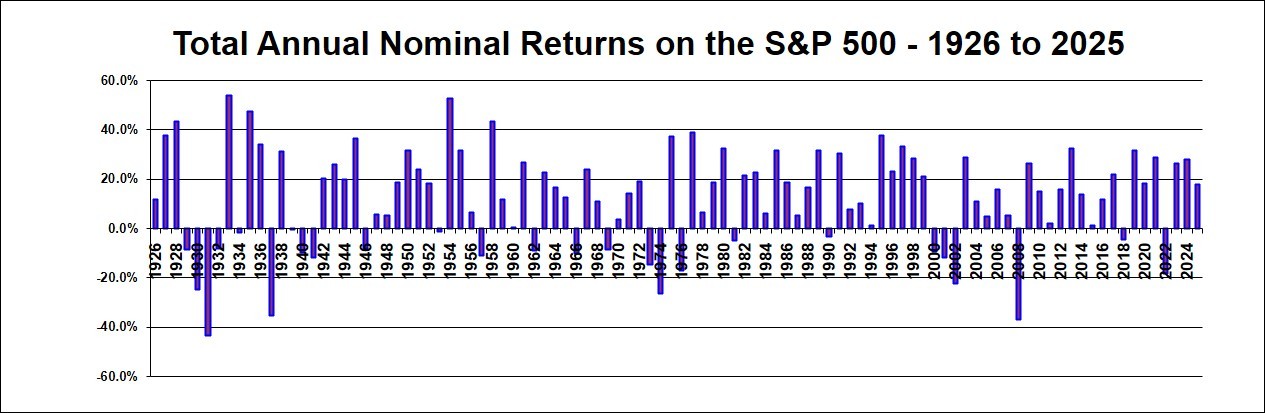
If an incremental earnings stream is expected recur every year then in the language of finance math this is known as a perpetuity. The value of each dollar of a growing perpetuity can be calculated by dividing the dollar by (the required return minus the growth rate of the dollar). For example, a dollar that is expected to grow forever by 5% per year and where an investor requires a 10% return, given the risk, is mathematically worth $1.00 /(0.10-0.05) = $20!

Of course in the real world earnings are not often expected to grow smoothly at say 5% per year. Also the equation assumes that the earnings are received in cash and do not need to be reinvested in the company. However, the theoretical math does work reasonably well in the real world. For example the above equation explains why a company might be trading at a Price / Earnings multiple of 20.

Because of this math, when “the market” believes that an incremental earnings stream (say from a new product line) will be permanent and will also grow, then it may place a “multiple” on the initial incremental annual earnings of say 20, thus each of these incremental dollars is worth $20! So, as long as this is a new unexpected (and recurring and growing) earnings source, not previously reflected in a stock’s price, the market may value each of these new dollars at say $20.

However, consider the value of a one-time unexpected earnings increment of $1 million. Often, such a one-time earnings increment will be used to pay-down company debt. With today’s interest rates companies may be paying about 7% interest for debt, which then may only cost the company 5% after considering that interest is tax deductible. So, an extra dollar used to pay down debt may save just 5 cents per year. And what is the value of 5 cents per year? If we assume a permanent reduction in debt of $1.00 then the 5 cents per year is saved in perpetuity. The value can then be calculated with the perpetuity formula above. There is no growth involved. Assuming the same 10% required rate of return applies, then the formula is $0.05/(.10-0) = $0.50. In other words the value of permanently reducing debt by $1.00 may be only 50 cents. Therefore the market often gives very little or almost no value to a one-time non-recurring increment in earnings.

In summary, the market highly values recurrent and growing streams of earnings and may place a value of $20 on each incremental dollar of earnings. However, the market is not very interested in one-time non-recurrent earnings and may value a one-time dollar at only 50 cents.

The above is meant to illustrate a concept. The exact values will not be $20 and 50 cents but these figures are reasonably close to reality in many cases and do serve to illustrate the point.

The same concept applies in reverse to declines in earnings. The market will punish quite severely a decline in earnings that it views as permanent, while being very forgiving of earnings declines that are viewed as being one-time events. For example the value of a company may be hardly affected at all if it suffers a one-time unusual expense.

Analysts often value stocks on P/E basis. Some stocks are considered to worth 15 times earnings and others may be worth 20 times current earnings. In doing this analysis it is implicit that the earnings to which the 15 or 20 “multiple” is applied are sustainable base earnings that can be expected to grow. This is why analysts will often talk about “ex-items” or “adjusted” earnings. A P/E multiple is only a useful indicator if applied to earnings that have been cleansed of any one-time items.

This is also why companies often attempt to convince investors that any decline in earnings is a one-time event while any increase in earnings is more often describes as being permanent.

The above analysis is fundamental to how stocks are valued and investors should attempt to become as knowledgeable as they can about such fundamental mathematical concepts. Sometimes investors can get an “edge” over other investors if they understand how to adjust reported earnings to arrive at the “true” core recurrent (and hopefully growing) earnings figure.

END

Shawn Allen, CFA, CMA, MBA, P.Eng.
President, InvestorsFriend Inc.
February 15, 2006

Beware The Value Trap

With the recent purchase of HBC by Jerry Zucker many investors were wondering aloud if Jerry had just bought himself a ‘value trap’. I began to think that any value investor could purchase themselves a value trap if they had not done some home work.

A quick definition of a value trap is when a stock has experienced a large price depreciation and is mistaken to be a value stock and the investor purchases the stock hoping for a price appreciation only to find that the price keeps dropping. Unfortunately, many investors mistake a low stock price for an undervalued stock and get sucked into buying it and find themselves with a value trap in their portfolio. Not every stock that has seen its price battered is a good value.

Most investors that purchase value traps solely look at the price of the stock and assume that it is a good value. Blindly picking stocks in this manner could take a few years off your life because of the stress of seeing your portfolio drop like a bad habit. Many value traps are once good companies that are experiencing a fundamental change in their business prospects and could be classified as dying companies. HBC is a good example of a potential value trap because of the fundamental shift happening in the retail sector. e.g. Wal-Mart
Most value traps are due to poor or lazy management. An entrenched management team that doesn’t care what happens to the company or is set on pursuing growth initiatives that don’t make any sense can have a disastrous effect on a company. If you find a cheap stock and can’t figure out why it is so cheap, move on, it’s probably bad management. You could miss out on a company that might turnaround but I’d be willing to miss that small percentage to avoid a value trap. If management isn’t working towards making the company a well run profitable venture you could be waiting years for your investment to turn a profit.

The best way to avoid a value trap is to ask some questions:

  1. Is this company highly leveraged? Most value traps are highly leveraged companies that never really generated enough free cash flow to support their past high valuations. (Also, a company with high debt may not stay alive to turn around)
  2. What are the business prospects for this company? Answering each of the five Porter questions to gain an understanding of its competitive environment is helpful.
    • Are there barriers to entry for new competitors?
    • Are there issues with powerful suppliers that can have an impact on pricing or other aspects of business?
    • Is there dependence on powerful customers?
    • Are there substitutes for the product or service offered?
    • Is there a tendency for the industry to compete ruinously on price to squeeze margins?
  3. Does management care? As I said previously, poor management is the main culprit for a value trap.
  4. What is the history of earnings estimates? Frequent negative earnings surprises are a huge big red flag. This would indicate to me that management doesn’t understand or are not willing to fix problems.
  5. What do the fundamentals tell me? The investor needs to understand the earnings and revenue history of the company. Also, dividend discount or discounted cash flow models can help determine the
    stocks intrinsic value.

The Holy Grail for the value investor is to find that quality company trading well below a conservatively calculated intrinsic value of the probable future earnings ready to burst out of its slump and earn the investor riches. However, the value trap is a common problem in value investing for those who only look at the price and don’t look at the fundamentals or take into consideration management and business prospects.

We at Investorsfriend do a comprehensive fundamental analysis of the ratios and earnings history, judge the motivation of management, and look at the competitive environment for a company with a discerning eye. This will help you, the investor, to avoid those value traps that can trap your money for years waiting for a turnaround.

END

Steve Wesch, Associate Editor
InvestorsFriend Inc.
February 11, 2006

Understanding Dual Class Shares

What is the history of dual class shares?

The rise in dual-class share structures can be traced back to the 1970s when media and telecommunications companies were getting established under the Canadian Radio-television and Telecommunications Commission. Because a limited supply of broadcasting licenses were involved, most companies were subject to foreign ownership restrictions. Two classes of shares was one way of raising equity in outside markets while retaining control of the company in Canadian hands.

What are dual class shares?

Dual class shares are two classes of shares issued by a company. Each class is either a voting share or a non-voting share. This means that only the voting class will have a say in the appointment of directors or a vote in any other meaning full decision to be made by the shareholders. The non-voting class shares do not participate in the decision making process of a company, they simply are a class that participate in the earnings potential of the company and receive dividends if they are paid. Non-voting shares allow for companies to raise capital without losing any control in essence.

What type of dual class shares are there?

Generally there are three types of dual class shares. One is where there are voting shares, with one vote per share, and the other class is classified as non-voting. The second common type is super voting shares and regular one vote shares. The super voting shares gives the holder more than one vote per share. An example is Magna founder and Chairman Frank Stronach ultimately controls 74 per cent of the vote for the price of less than 1 per cent of the equity. The third type is a voting and multiple voting class, so a class with one vote and another class (multiple) with 10 votes for example.

All types give the owners of voting, super voting or multiple voting class shares control of the company.

In some cases both classes of shares trade on the stock exchange. In other cases only the non-voting or subordinate voting shares trade while the voting or multiple voting shares are privately held.

Why do some companies use a dual class structure?

There are two views on this. The detractors and the supporters.

To detractors, having a dual class share structure is about maintaining control. They point out those owners of the voting shares have more power and can entrench poor management and insulate them consequences from bad decisions they may have made. Also, dual class shares allow for owners/management to keep an iron grip on the company while putting up less than a majority of the equity. This creates the separation between those who put up the money and take the risk and those who don’t own much of the company but have the controlling votes.

Supporters of dual class shares, usually the owners of such, reason that dual class shares protect a company from any unwanted take-over bids because the founders/management control the voting shares and would not allow a take-over bid to occur. This, they say, ensures the stability of the board and management and therefore investors don’t need to worry about change in power at the top. Founders/Management has a longer term vision for the company than investors who are focused on immediate profitability that could undermine the long term success of the company.

Can you name some of the companies that use a dual class share structure?

I’ll name some of the larger well known companies but many other companies listed on the TSX also have a dual class structure.

ATCO

Bombardier

CHUM

Canwest

La Senza

Magna

Onex

Quebecor

Jean Coutu

Shaw

Telus

Evidently, not just telecommunication companies are using dual class shares today.

Are there any differences in liquidity and premiums for dual class stocks?

When looking at Non-voting and a voting share dual class structure, where both types trade on the exchange, non-voting shares seem to have much more liquidity. This is probably due to the owners of the voting shares not willing to give them up. And there are typically a much larger number of the non-voting or subordinated voting shares. Of course, with less liquidity the bid / ask spread for voting shares is much larger.

Another common characteristic of this type of dual class structure is a price premium for the voting shares. Some voting shares have a very large premium relative to non-voting shares.

An example of liquidity and premium difference can be found with the dual class structure of CHUM. They have voting and non-voting shares trading on the TSX. CHUM voting shares have a negligible volume of shares trading daily whereas the non-voting shares have an average daily volume of over 50,000 shares traded. The non-voting was recently trading around $28.65 whereas the voting shares are trading at $38.50. A $10.00 premium for the voting shares. Interestingly, this is much large than the usual historic premium, as the graph indicates.

Let’s graph the differences in price movement and liquidity for CHUM.
dual_c1
dual_c2

Note that the volume of the voting shares is almost invisible on the graph. It is quite evident that the non-voting shares have much more liquidity but are punished with a price discount for not having a vote in the affairs of the company.

Which Class should an Investor buy?

This depends. The best advice is usually to buy shares with good liquidity. Usually the non-voting shares have the greater liquidity. However, if you are put off by owning shares that don’t give you a vote in the company maybe the voting share is best for you. That being said, a voting share with non existent volume may require you to hold on to these shares for a very long time. The bid / ask spread is also typically higher on the voting shares, and this can cost you money. To buy the voting you usually have to pay the asking price, but if you want to sell you can only get the (lower) offered price.

Also realistically, for small investors there is no chance to influence the company through your vote. If the chance to vote is realistically pretty meaningless to a small retail investor, then it makes little sense to buy the voting shares at a higher cost. However, if at a particular point in time the voting share is the
same price as the non-voting and if the buyer is committed to holding for a long time, then it might make sense to buy the voting, since its price could subsequently rise above the non-voting.

Class merger may be another reason to purchase one class over the other. For example, if there is the possibility of the merger of the classes you may want to purchase the non-voting share because the premium on the voting class may evaporate.

Arbitrage between the two classes may yield profits but there must be liquidity and the investor must be aware what a normal spread between the two share classes is. Determining if the spread will tighten or widen will decide how to execute the arbitrage. If the spread is expected to tighten then shorting the class with the price premium and buying the other class will yield gains. If the spread is expected to widen then the opposite arbitrage maneuver will yield gains. Looking at the CHUM price graph, it is evident that the spread is abnormally large and may be a candidate for arbitrage with the spread narrowing. However, arbitrage is a very complex financial maneuver and is best left to the experts.

In conclusion.

Dual class shares seem to be very unfair. They create a second class shareholder with no voice as to the direction the company can take. Saying that, the majority of (voting) shareholders have no real say because individually they hold a small fraction of shares outstanding. In buying either class of shares, investors should first look at both classes before deciding which to buy should consider the likely hood that the voting shares will rise more rapidly, the chance that the controlling management will somehow abuse the non-voting shareholders, the realistic value of the right to vote, the impact of the lower liquidity on the voting shares, the probability that the investor will want to trade the shares, the impact of the usual higher bid / ask spread on the voting shares, and the current premium on the voting shares versus the historical premium.

Ultimately, by owning non-voting shares the investor is placing a bet on management to make the right decisions to ensure long term profitability of the company. However, those who control the voting shares normally have an interest in maintaining a good reputation with investors. All the same, investors should keep in mind the effects of dual-class shares on liquidity, any premium difference and possible mishandling of the company from bad decisions which would affect both classes.

END
InvestorsFriend Inc.
February 5, 2006

The Great Pension Debacle – More Pain to Come

Click here for an updated version of this article

As of December 2005, investors and the public have been made well aware of the pension woes of many large North American companies.

Many defined benefit pension plans began to accumulate large deficits because of stock market losses in 2000 through 2002. And (as I predicted in my 2003 article) despite the relatively strong Canadian stock market of 2003 through 2005 many pension deficits remain very large.

Example Pension Fund Data $millions

Company Deficit Assumed Return Discount Rate Pension cost recognized
Air Canada 1563 7.5% 6.0% 36 (versus actual contribution of 265)
CN Railway 84 8.0% 5.75% 22 (versus actual contribution of 165)
Loblaws 99 (versus 44 surplus on balance sheet) 8.0% 6.25% 76 (versus actual contribution of 42)
Bombardier 1987 (of which only 287 recognized on balance sheet!) 7.4% 5.39% 270
Manulife 380 (of which 260 recognized on balance sheet) 8.2% 6.20% 55 (versus actual contribution of 83)

Many pension plans operate on the assumption that they will earn 7.5% to 8.5% on their combined stock and bond portfolios, after expenses. These assumptions seem too optimistic.

Some companies have been reporting unrealistically low pension expenses. For example, in my opinion, it defies common sense to see that CN has reported a pension expense of just $22 million in 2004 while actually contributing $165 million. These pension expenses seem sure to rise materially.

Companies will have to increase their pension contributions and pension expenses to eliminate the existing pension deficits even if they do in fact earn the 7.5% to 8.5% going forward. And if they lower those return assumptions then they will automatically face even larger pension expenses.

The result will be higher pension contributions for employees and companies and lower profits for companies. In the worst cases the pension plans will suck every dollar of profit out of some companies and even that may not be enough. Some companies will go bankrupt over this issue and the pension plans will be turned over to trustees who will be forced to reduce pension benefits to retirees. A vicious circle may result where newer companies with no pension deficits will out-compete the old-line companies and hasten their demise. Another result is that many companies will stop offering defined benefit pension plans to new employees. They are just too risky for the companies.

As if the problems of lower stock returns was not bad enough, low interest rates may be an even bigger problem.

Lower interest rates already have and are still dramatically increasing the value of the pension liabilities. The result is that many pension deficits will continue to soar. This has already been happening but the impact in 2005 may be larger than in recent years (although the strong Canadian stock market performance in 2005 will offset this problem to some degree).

Long term interest rates were still dropping like a stone during much of 2005 – even as short term interest rates were rising. The 10 year government bond rate in the United States was recently 4.53% and in Canada was 4.10%. High quality corporate bond yields were at about 4.70% to 5.0% for 10 year issues, and this probably represents a reasonable weighted average across the spectrum from short to very long bonds.

While long-term interest rates used in the 2004 annual reports were low, Canadian long-term interest rates have moved materially lower as of December 2005. These lower long term interest rates will lead to even higher pension plan deficits. A pension deficit exists if the value of plan liabilities (pensions) discounted at the appropriate rate is lower than the value of plan assets.

In Canada, the Canadian Institute of Chartered Accountants handbook at section 3461 requires that the discount rate be based on high quality corporate bond yields with maturities matched to the pension obligations. And guess what? today’s dramatically lower high grade corporate bond yields used to discount the future pension liabilities automatically leads to a dramatically higher value of those liabilities. When those higher liabilities are subtracted from the same level of plan assets, voila, you get a huge increase in the deficit. Or you move from surplus to deficit. To demonstrate, imagine that the weighted average liability amounts to $100 million to be paid in 15 years. Discounted at 7% this represents a present value of $36.2 million. But discounted at a lower interest rate of 5.0%, the liability rises to a present value of $48.1 million. This represents a huge 33% increase in the value of the liabilities.

Now, it appears that many Canadian companies have not yet adequately reduced their discount rates for pension liabilities. For example most of the discount rates noted in the table above are still well above the 4.7 to 5.0% level of current high-quality 10-year corporate bond yields. I expect that under the handbook, corporations have some leeway to use expected corporate bond yields rather than the spot rates at their year-end.

In fairness, using corporate bond yields as the discount rate is conservative. Normally, one might use the (higher) expected return on plan assets as the discount rate. But the Canadian law states that high quality corporate bond yields must be used. So it appears that if interest rates remain at recent very low levels or decline further, companies will be forced to lower

their discount rates thereby increasing their pension liabilities.

From the example above, you can see why companies would be reluctant to lower the discount rate. Since the end of 2004, interest rates have dropped a further significant amount. In reporting their 2005 results many companies may be forced to cut their pension discount rates substantially.

So, in spite of strong stock market returns in 2005, pension deficits will probably soar with the 2005 annual reports because of the dramatic drop in interest rates and (more specifically) in high grade corporate bond yields.

And there is more bad news. The declining interest rates have actually led to large capital gains in the bond investments held by pension plans. These capital gains have been adding to the pension assets and have hidden the true extent of the unfolding disaster. At some point interest rates must bottom out. At that point the capital gains must abruptly stop. At that point the pension liability amounts will be maximized by the low discount interest rate (high-grade corporate bond yield) used in the calculation. And at that point yields on high grade corporate bonds will be near historic lows of under about 5% for 10 year bonds.

Now a typical pension plan may have 40% of its funds in bonds. At that point with stocks returning perhaps 7 to 8% and high-grade corporate bonds returning perhaps 5% on average, pensions will have a tough time forecasting more than a 6% – 7% overall average return. This will automatically lead to higher pension expenses and reduced profits.

Many defined benefit pension plans are probably headed for an absolute disaster. When the extent of the damage that will be and has been caused by extraordinarily low long-term interest rates becomes known, the stocks of some of these companies could be hit hard. As an investor I will combat this by generally avoiding investing in large companies that have large defined benefit plans. I will particularly avoid those companies with a high ratio of retired workers compared to active workers.

A possible solution?

Some observers blame pension deficits on the inherent uncertainty of predicting stock market returns. (These people may not have noticed that in reality today’s incredibly low interest rates are the prime contributor to pension deficits). One solution proposed is for pensions to invest strictly in bonds and avoid stock investments. Incredibly then this solution proposes to solve the deficit problem which was caused to a large degree by low interest rates on bonds by restricting investments to only bonds!

Better Solutions

In the long-term corporations are wise to get out of the business of guaranteeing pensions and other  post-retirement benefits of workers. Such guarantees amount  signing a blank cheque. These defined benefit plans should (if possible) be essentially contracted out to large insurance companies who are in the business of managing such risks. Otherwise, if corporations cannot contract out their defined benefit pension plans then I believe that they would be wise to convert to defined contribution type pension plans.

If there is any hope of funding pensions at a reasonable cost, then pensions will have to continue to invest a significant portion of their assets in stocks. After all, stocks are expected to return more than bonds.

For existing pension plans the expected returns on plan assets as well as the discount rate assumptions need to be realistic. The accounting rules may need to be changed. It seems overly conservative to calculate pension deficits on the assumption that all plan assets would be invested in bonds, this accounting requirement may need to be challenged.  For most existing defined benefit pension plans, the contributions of both employees and the employer is likely going to have to rise.

END

Shawn Allen, P.Eng., MBA, CMA, CFA

InvestorsFriend  Inc.

June 15, 2003 (Last revised December 10, 2005)

Determining the proper asset allocation between, stocks, bonds and cash

Determining The Proper Asset Allocation between, Stocks, Bonds and Cash

Financial Planners and Portfolio Managers are trained to ask investors to define their investment goals. How much return do they want or need? And how much risk can they tolerate?

Many investors find these questions confusing. Almost everyone desires as much return as humanly possible. And while investors don’t want risk and volatility, they are generally willing to tolerate it if they are convinced that the high returns will be achieved in the end.

It is well documented and accepted that there is some relationship between risk and reward. Higher returns usually are associated with more risk. However, it is not true that more risk always leads to higher returns. First, if the higher return were guaranteed, then it would not really be risky. Second, financial theory indicates that only efficient risks can be expected to be compensated (on average) by higher returns. Dumb risks carry no expectation of high returns.

We all want high returns. But because risk tends to go up with higher expected return strategies, we end up being constrained by our capacity to take, and tolerance for, risks. So, Financial Planning involves determining how much risk we can take or want to take and then devising a strategy to maximize expected return, within that risk constraint.

Our risk constraint then directly impacts how we should allocate funds between stocks, bonds and cash.

Why Invest some Money in Bonds and Cash as well as Stocks?

In simplistic terms, investors have to decide what percentage of their money to invest in each of the broad assets classes. The three broadest asset classes are stocks, bonds and cash (money market). Some analysts like to further sub-divide this and would include other asset classes such as precious metals, real estate and income trusts.

The table below, describes generally the characteristics of the three main asset classes. Note that annual volatility is generally considered to be an excellent measure of risk. This is certainly true to short term investors but is not really true for long-term investors. For long-term investors the bigger risk is long term growth in purchasing power rather than annual volatility.

Asset Class Expected Annual volatility Expected annual average return
Stocks Highest Highest
Bonds (long term) Medium Medium
Cash (Money Market Near Zero Near Zero, after inflation

Determining an Appropriate Asset Allocation

An investor with a very low tolerance for risk (due to a short time horizon or lack of appetite for risk) is virtually forced to allocate close to 100% of their funds to Cash.

Conversely an investor with a very high tolerance for risk (which usually requires both a very long time horizon and a high tolerance for volatility) may choose 100% equities.

Most investors probably fall in between. They may have a relatively long time horizon. But there may be a chance that some life event could cause them to need to liquidate assets unexpectedly. Also most people do not have a very high tolerance for downward volatility and prefer to see a steadier march forward.

A proper determination of the asset allocation is probably best achieved through the services of a competent Financial Planner. Planners can use simulation software that can predict possible future volatility of a portfolio, based on the asset mix chosen and on historic rates of return and volatility by asset class. The software can show not only how the portfolio is expected to grow, but also what can happen in extreme scenarios. Risk and return decisions are not intuitive, most people will make very poor decisions unless they are shown a full range of possible results from simulation software.

Left to their own devices, too many investors (who may need the money in the short term) are probably taking on too much risk by over-allocating to stocks. Investors tend to have a poor understanding of the likely risks and rewards. We tend to be over-optimistic and we tend to think that stocks are like playing the lottery, except we really don’t expect to lose.

Taking a lottery ticket approach is probably okay if we allocate a bit of “fun” money to that game. But investors should not be thinking in terms of winning the lottery when it comes to retirement funds. Rather, we should be thinking of maximizing our expected returns within our risk constraint. That means we first have to define our risk constraint and then understand the best asset mix associated with that risk constraint. The best way to do that is to consult a Financial Planner who has access to simulation software. Investors should insist on seeing simulated results for multiple scenarios, before deciding on their asset allocation.

In the absence of asset allocation modeling software, it may help to examine graphs of actual performance of the three asset classes over various periods of time.

For the investor that has a long time horizon and who is comfortable with the volatility of annual returns and the volatility of potential long term outcomes, a 100% allocation to stocks may be quite acceptable.

Modern Portfolio theory actually teaches that this investor could get the same return with less risk by investing in a optimum combination of stocks and bonds and then borrowing money to dial in more risk and more return. There are several problems with this. First there is no agreement on what constitutes the optimal “market portfolio” allocation of stocks and bonds. Second, most investors are inherently nervous about borrowing for investment. Third, when I attempted to simulate this strategy on actual data over the last 79 years, it did not appear to work. There were some periods where stocks out-performed to such an extent that no amount of leveraging of a portfolio with a significant percentage of bonds, could keep up with the stocks. Over other periods the risk reduction was minimal. I concluded that a highly risk tolerant investor should simply invest in 100% stocks and not attempt to mix in bonds and then boost the return through borrowing and leveraging.

Other Asset Classes

Some other asset classes including precious metals and real estate can potentially offer high returns. In addition these asset classes are not highly correlated with stock and bond returns. Investing a small percentage of assets in these alternative asset classes can substantially reduce risk, while potentially having a small positive or negative impact on overall long-term returns. Again, simulation software is probably the only reasonable way to get a handle on this.

Asset Class Timing and Rebalancing

It would be wonderful to constantly have most of your assets in the best performing asset class each year. But attempting that on a large scale defeats the risk management aspects of having a mixture of asset classes. If an investor believes that they have access to a reliable way to predict which asset classes will out-perform, then it may be worth it to slightly alter the asset allocation in that direction. However, this strategy should be limited to only moderate changes in the asset allocation in order not to destroy the risk management aspect of asset allocation.

Asset rebalancing refers to re-setting the portfolio to the target asset mix periodically. For example if stocks performed best, then some of the winnings from stocks are reallocated to the other asset classes periodically in order to prevent the stock allocation from getting much higher than the target allocation to stocks. This also provides benefits from “dollar cost averaging” since it forces investors to buy the asset class that has moved down in price and sell the class that has moved up the most in price.

Conclusion

In conclusion, consider a visit to a Financial Planner who has proper asset class simulation software. It pays to get this very basic investment decision right before moving on to stock picking. Too many people are diving into stock picking, hoping to “win the lottery”, when they have not really stopped to understand the rules of the game and the expected pay-offs.

November 27, 2002 (with minor edits June 17, 2005)
Shawn Allen, CFA, CMA, MBA, P.Eng.
President, InvestorsFriend Inc.

The Only Two Sources Of Money in the Stock Market

All the money that ever has been made or ever will be made “in the stock market” can be divided into just two sources.

  1. Money made from other investors
  2. Money made from the profits of serving the customers of businesses that trade in the Stock Market

In many ways the above fact is obvious. Yet it may also be somewhat surprising to many investors who have never really stopped to think about it. In any advent, it is worth considering the implications of the above fact.

Many investors could be forgiven if they thought that all the money to be made in the stock market must come from other investors. Most of the attention on the stock market focuses on making quick money by buying and selling at the right time. In fact making money from other investors is definitely one of the key purposes of the stock market.

However corporations do not primarily exist for the purpose of investors to make bets against one another. Corporations exist to make money from their customers. (There are rare exceptions where a company is set up for the purpose of robbing money from investors, but that is a rare and presumably illegal exception.) Even corporations with really stupid ideas that will probably never make money at least hope to make money from customers at some point.

The essence of the stock market is that stocks are valued at the present value of the expected future cash flows that the corporation will ultimately provide to investors. At any given time there is wide divergence of opinion as to what this value is. The stock price is set by the intersection of the lowest value perceived by a current stock owner and the highest value perceived by a willing stock purchaser. This value can change radically as opinions change even if nothing about the company changes. But the company itself is constantly changing, which affects its value. And interest rates or returns on competing investments are constantly changing. The result is that the market value of any company on the stock market is constantly changing. In essence investors are constantly trying to outsmart each other and buy stocks that they expect will rise in price to provide an above average return and sell those that they expect will falling or be stagnant in price resulting in a below market return.

For every stock trade, one investor will be proven correct and the other will be proven wrong. The apparent winner of each trade may change many times depending on the time frame. Perhaps after 1 week the seller looks like the winner as the stock sinks. But perhaps after 5 years the buyer is the winner because the stock is not only up but has returned an above market rate of return.

As the market makes its determinations of the value of each stock, that value is based on future profits from customers. If there will never be any profits from customers then the true value of the corporation is the salvage value of selling off its assets and paying off its creditors.

If we look at the sum total of all the money that is made from other investors, it is immediately clear that for the total population of investors this amount must be zero (before trading costs) since all the gains are offset by someone else’s losses. In fact the true grand total of all the money made from other investors across the total population of investors is far less than zero when one considers trading costs.

The inescapable conclusion then is that all the Money that ultimately will ever be made in the stock market must come from the profits of serving the customers of the businesses that trade in the market.

Having hopefully brought to your attention that stock trading is a negative sum game while stock owning is a positive sum game, perhaps I could stop here and simply allow you to ponder for yourself the implications. However, I do offer below my own view of the implications.

IMPLICATIONS

There are important implications of the above facts for investors.

If you want to try and make money by buying the stock of a company that is not currently making profits and which will likely never make money, then virtually your only hope is that you can outsmart another investor and sell your stock to a “greater fool”. In this type of dog company, time is your enemy. You only want to hang around long enough to make some money, ultimately you want to sell before the market realizes the company is pretty much worthless.

If you want to make money in a company that is already making attractive profits and that is expected to continue to do so indefinitely, then as long as you have not paid too high a price for the stock, all you have to do is wait. Here, time is your friend.

It seems to me that it would be easier for most investors to make money by restricting their investments to currently profitable or soon to be profitable companies. If they are wrong and they pay too much then maybe they will make somewhat below the market rate of return. And if they are right they will make a market rate of return or higher. These investors will make or lose some money from other investors but in general the river of cash that is coming in from the profits on customers will insure that these investors always make a positive return in the long run. However some amount of trading will likely be needed in order to move out of a company if it becomes apparent that it will no longer be attractively profitable or if its stock price has simply been bid up far too high. In this strategy investors attempt to make most of their money from customers while attempting to at least not lose money to other traders.

In contrast those who invest in dog companies can only hope to make money from other investors. Meanwhile the losses of these companies is like a current heading to the sewer.

Of course it is inescapably true that some very astute traders can make great fortunes. Just because trading is a negative sum game does not mean that all traders will lose. However, if you are going to be a frequent trader you should first be able to convince yourself that there is good reason that you can expect to win at a game where the average player loses.

In conclusion, investors should invest in profitable or soon to be profitable companies rather than in loser dog companies. Such buy and hold strategies are often derided by traders. But buy and hold investors who invest in attractively profitable companies are swimming with the current. However, investors should not be strictly buy and hold, they should be prepared to sell when the price of a profitable company gets bid up far too high or when it becomes apparent that a once profitable company is no longer going to be attractively profitable. Traders who bravely trade in loser dog companies are trying to make money from other traders (greater fools) while swimming against the tide that is headed to the sewer.

END

Shawn Allen, CFA, CMA, MBA, P.Eng.
InvestorsFriend Inc.

May 8, 2005

The Joy of Investing in Familiar Companies

The Joy of Investing in Familiar Companies

There are a lot of good reasons to invest in familiar companies whose products and services you are familiar with.

Warren Buffett has suggested that investors stick to simple business that they understand. Warren is considered the greatest investor ever, so it makes sense to listen to his advice. It’s easier to understand consumer oriented businesses that we patronize as customers than it is to understand a lot of businesses that we never encounter in our daily lives.

Peter Lynch, another extremely successful investor in his famous book, One Up On Wall Street, suggested that ordinary investors could beat Wall Street by investing in companies that make some of the hotter new products that they see in stores. Cabbage Patch dolls flying off the shelves?, then think about finding out who makes them and investing in that company. Sony becomes the gold standard in electronics?, maybe we should invest.

Consider how many people invested in Nortel and ENRON and JDS Uniphase and Yahoo and many others without really having a clue what those companies did or how they made money.

Recently I have found myself investing in some profitable companies that are either local or that have stores and offices in my City. I chose these companies because they were profitable, and available at a reasonable price to earnings ratio and I have generally made good returns. I also found that I was better able to analyze these companies as investments because I was familiar with their products and services.

I am finding that I get a certain enjoyment out of owning these companies. I own shares in the company that owns Tim Hortons and I definitely get some enjoyment out of seeing how busy their stores are and how many stores there are. Similarly, I own shares in a local property developer and it’s enjoyable to walk through their development that is close to my house and see the new houses going up, knowing I am benefiting from that. When I owned shares in Sleeman’s I found myself buying their beer. It’s not like my purchase was going to come back to me in profits, but still it’s enjoyable to buy from the companies that I own. I recently bought shares in the company that owns all those MACs convenience stores. So now when my kids want to stop there for a “Slurrpy”, I actually might prefer if there is a long line up in front of me. The list goes on. The next time I am in Quebec I will make a point of visiting a restaurant chain called “Le Cage Aux Sports” because I own shares in it.

There are many examples of familiar companies that are obviously making lots of money. These include Canadian Tire, the big banks, Loblaws, the big gasoline retailers, Shoppers Drug Mart and many others. It’s not immediately clear if these companies are good investments at their current stock prices. However, because you are familiar with these companies it will be easier for you to either analyze them yourself or to interpret an analysis report or recommendation from someone else. In contrast it will be much more difficult for you or anyone else to analyze the likes of Nortel, a mining company, a biotech company, a forestry company, any commodity based company, an aerospace company and many others. Most of these companies sell products or services to other companies. Most investors would be unfamiliar with the prices for their products or any of the factors that determine if they make money.

Being familiar with companies can also help you avoid the bad ones. Over the years I have never been impressed by The Bay. My experiences as a customer helped me to avoid investing in a company that in fact has not done well on the stock market. I don’t know who owns the Arby’s fast food chain, but I would not want to invest in it because I can plainly see it has few customers (and I know I never go there). I avoided airline stocks because I can observe as a customer that the prices are generally much lower now than they were 10 years ago and its hard to imagine that costs would be lower. In terms of private businesses my experience as a customer is that investing in a private single location business would be very dangerous. For many decades now the various chains have taken over almost every type of business that serves retail consumers. It is apparent that it is very difficult to compete against the chains.

In summary it can be a very good investment strategy to focus on investing in simple businesses that you patronize as a customer. You will still need to analyze their financial statements or find someone you trust who has done that for you. But you will be a ahead of the game because these businesses are simply easier to understand than all those unfamiliar business that you have no interaction with. As a side benefit you will find a certain joy in being a part owner of these businesses that you tend to encounter often in your daily life. I call this a “psychic income”. It will also allow you to feel like you are more on top of your investment portfolio.

END

Shawn Allen CFA, CMA, MBA, P.Eng.
InvestorsFriend Inc.
May 7, 2005

Investing in Bonds

The topic of Investing in Bonds is a very broad subject area. It is also a topic about which most retail investors know very little.

This article provides an introduction to the topic.

Bonds are investments that pay interest every 6 months (or 12 months in some cases) and that return the face value of the bond on the maturity date of the bond.

Bonds are issued or sold by governments and corporations. After they are issued, bonds typically trade in the market (more about that below).  At the issue date, bonds have maturity dates that are at least 2 years in the future and the maturity date can be 30 or more years into the future. The face value of a bond is usually $1000.

Most retail bond investors invest in bonds with a goal of collecting a return through interest payments while desiring to incur very little risk.

Unfortunately, the only bonds available to Canadian investors that are essentially without risk are Canadian Federal and Provincial government bonds with about two years or less until maturity.  The unfortunate aspect is that Canadian Federal Government two-year bonds currently yield only 3.24%. This is a very small return, particularly when held in taxable accounts. However, it is better than nothing and is a guaranteed return. Investors that cannot afford any risk whatsoever for a two year holding period may find that this is the best available no-risk return.

Higher Bond yields can obtained either by investing in corporate rather than government bonds , or by investing in longer term bonds, or a combination of both.

10-year Canadian government bonds currently offer a yield of 4.32%, while 30-year Canadian government bonds currently offer a yield of 4.74%. This is an incremental annual return of 1.08% and 1.50% as compared to the 2-year government bond. While the extra return is attractive it comes at the cost of significant risk to principal value if market interest rates should rise. This
is of concern because retail bond investors typically are looking for a very low risk investment.

If market interest rates were to jump by 1% our 10-year government bond would immediately drop in value by about 7.6% while the 30-year bond would immediately drop in value by about 14.2%. If interest rates climbed by 2% then the 10-year bond would drop by 14.5% while the 30-year bond would drop by 25.5%. These are significant losses when one is looking for a no-risk investment! And the losses get worse if interest rates should jump by more than 2%. An increase in long-term interest rates of 2% may seem unlikely at this time but it is certainly feasible particularly over the long life of these bonds.

Some will argue that these are not real losses since the investor will still receive the expected interest rate payments and ultimately the maturity value of the bond. But the reality is that a loss in market value of the bond will occur. The investor’s monthly statement will show this loss. It’s questionable whether the added risk of longer term bonds is justified by the extra 1 to 1.5% return.

The second way for bond investors to boost return is to invest in corporate bonds rather than government bonds. High-grade corporate bonds (those with credit ratings of A- or higher) of two years duration can offer returns that are about 0.25 to 0.50% higher than the federal government two-year bond yield. This is only a small boost in return but the risk of default on a two -year high-grade corporate bond would be considered very low. The excess return on corporate bonds over the equivalent term federal government bond is called the “spread”. The “spread” on corporate bonds increases with longer maturity levels.

the corporate “spread” or incremental return also increases with lower credit ratings. For higher risk corporations the spread can easily be 4% or more butthe risk also increases sharply.

Retail investors who are looking for low risk bond investments should restrict themselves to government bonds and high-grade corporate bonds and should also probably restrict themselves to maturities of five years or less.

Retail investors can purchase bonds through their broker. This is an area where a full-service broker can be quite advantageous. Bonds can be purchased through discount brokers, but the discount broker is unlikely to provide any advice.

Bond investing, implies a buy-and-hold approach. Bonds can also be traded on a short term basis. Click here for a short introduction to Bond Trading.

Shawn Allen,CFA, CMA, MBA, P.Eng.
President, InvestorsFriend Inc.
April 9, 2005

Bond Trading

Bond Trading should be distinguished from bond investing.

Retail investors with limited knowledge can engage in bond investing as explained in our article on bond investing.

However bond trading is conducted mostly by institutional investors although some sophisticated retail investors. While bond investing is usually characterized by low risks, bond trading involves much higher risk in pursuit of short term gains.

Bond investing involves making a return that is paid by the bond issuer (a government or corporation).

Bond trading involves making a short-term return at the expense of another trader.

There are three main strategies in bond trading.

The first is trading based on interest rate movements.

If you believe that long-term interest rates will fall then you can buy long-term bonds. If interest rates do fall as you expect, then the value of a long term bond will increase. In this strategy you hope to make a short-term capital gain by betting correctly on the direction that long-term interest rates move. This method could also be used to bet that long-term interest rates will rise. In that case an investor could sell a long-term bond short, in the hopes of buying it back later at a reduced price. (But I doubt that it is feasible for retail investors to get into selling bonds short). This interest rate based trading strategy should be accomplished strictly with government bonds since they offer the best liquidity and do not introduce company-specific risk.

The second trading strategy is based on price arbitrage

In this strategy a trader buys bonds that appear to be under-priced relative to where they should be, compared to other bonds, based on interest rates and the credit quality. This strategy is not applicable to retail investors since it would require access to the very best pricing and lightening fast trade execution.

The third strategy is based on changes in credit quality of corporate bonds.

In this strategy an investor would purchase a bond that is a bit lower in credit quality, perhaps a BBB credit rating or lower. The investor believes that the fortunes of the company will improve and that the credit rating on the bond will improve, its interest yield will decline and this will create a quick capital gain on the bond. This is a reasonable strategy for knowledgeable retail investors to follow. This strategy could be a good alternative in place of buying the common shares of a company that is in some (temporary) difficulty.

Shawn Allen, CFA, CMA, MBA, P.Eng.
InvestorsFriend Inc.
April 9, 2005

Be Cautious With Low Trading Liquidity Stocks

Trading Liquidity refers to the ease with which you can buy or sell a stock at or near the current market price.

Highly liquid stocks have two features. 1. Many shares, totaling a significant dollar amount trade each day. 2. A significant number of shares can be bought or sold at any given time without driving the price up or down.

A highly liquid stock has a narrow “bid-ask spread”. For example if the current bid price on a liquid stock is $10.00 then the asking price (the lowest price at which a seller will sell) may be $10.05 or $10.10. If the stock is illiquid, then the offer price could be $10.50 or more.

If a stock is very liquid then you can sell it at any time for the market offered price, which will almost always be very close to the last price at which the stock traded.

For an illiquid stock, the concept of a market price has much less meaning. If a illiquid stock last traded a few shares at $1.20, that does not mean that you could sell 10,000 shares for anything close to that price. If the shares are illiquid, there may be no offers to buy at anything close to $1.20.

While holding an liquid stock, you will typically experience great volatility in value. It may not be unusual for the trading price to fluctuate by 20% or more on a daily basis. And you may not be able to sell your holding without driving the market significantly lower.

Illiquid stocks are highly unsuitable for quick trading strategies. You should only buy such a stock if you are comfortable with holding it for several years.

All trades of illiquid stocks require caution. Orders to buy or sell at the market should never be used. Rather, limit orders should be used. Patience will usually be rewarded with a lower purchase or a higher selling price.

The liquidity of a stock can be judged by, the daily trading volume, the current bid-ask spread and by the depth of the market.

The depth of the market shows how many shares are bid to be purchased at different prices. For example there may be 200 shares bid to purchase at $1.20, 1000 shares wanted at $1.10 and 5000 shares wanted at $0.50. This would indicate illiquidity if you sell at the market, you would get $1.20 for the first 200 shares and $1.10 for the next 1000 but only $0.50 for any additional shares. And this scenario is realistic for a highly illiquid share. Similarly, there may be 200 shares offered for sale at $1.30, 1000 at $1.40 and 5000 at $2.00. In this case the buyers and sellers are far apart and we would expect few trades. However, an inexperienced buyer or seller who enters a large order to by or sell at the market could “get burned” by this lack of liquidity. Unfortunately, depth of the market of second level quotes are not available to retail investors.

Shawn Allen, InvestorsFriend Inc.
December 21, 2002 (edited April 9, 2005)

Alternative Measures of Profitability

A number of companies tend to focus on measures other than net income as measures of profitability. Popular alternatives to net income include:
Cash Flow, Distributable Cash Flow, Operating Income, EBITDA (Earnings Before Interest, Taxes, Depreciation, and Amortization), and Adjusted Net Income.
Each of these are discussed in turn.

Cash Flow

Cash Flow has the potential to be a better measure of performance and profitability in certain limited cases. For example when an entire company is being purchased then the valuation is usually driven mainly by a forecast of how much cash the business will generate over its future lifetime.

But the figure that companies usually report as cash flow is NOT the free cash flow that could be taken out of the business and is not usually a particularly useful number at all.
When companies discuss “Cash Flow” they usually mean cash generated from operations. That is, cash from selling products and services less operating expenses. Cash Flow from operations is shown on the Statement of Cash Flow and is calculated as Net income plus or minus “items not affecting cash”.

In most cases Cash Flow is net income plus depreciation and amortization and plus deferred income taxes. Effectively then it is net income before deducting a depreciation or amortization expense and before deducting income taxes which were expensed for accounting purposes but which are not actually payable or owing (yet) due to timing differences between accounting rules and tax rules. All of these are non-cash expenses.

If assets are not in fact deteriorating and wearing out, then this measure of Cash Flow might be better than accounting net income as a measure of economic earnings. (Since the accounting depreciation expense implicitly assumes that assets are wearing out and will have to be replaced).

However, in most cases the assets are in fact wearing out and depreciation is a very real expense. For most asset intensive industries like manufacturers, railways, and (to a lesser extent) cable and telephone companies, depreciation and/or obsolescence is a very real phenomena and Cash Flow from operations is of no use in measuring performance.

To illustrate the difference between cash flow and net income, I recently calculated the value of two projects. The first involved an asset that had to be replaced each year. In this case net income was equal to free cash flow. The second project was similar but the productive asset would last 30 years before being replaced. In this case, net income would under-state free cash flow generation. At a 10% discount rate, the first project could justify a P/E of 10, while the second could justify a P/E of 13.7. Due to the non-cash nature of depreciation, the asset that lasted for 30 years, was worth about 35% more than was suggested by the earnings alone. The solution in the case of an asset that does not have to be replaced for 30 years is to add back the depreciation and treat it as additional earnings.

However, investors should be very cautious before treating depreciation as a non-cash item. In almost all real cases companies do need some capital spending just to maintain current operations. For example, apartment towers last a very long time, but carpets and appliances still need to be replaced.

In some cases unrealized gains on assets may be expected to occur at a rate that effectively “cancels out” depreciation expense. For example in housing and real estate there is no doubt that older buildings deteriorate and become obsolescent and are not as valuable as an equivalent new building. However, many buildings in popular areas will hold their value or appreciate in value due to their locations. For this reason, real estate companies argue that Cash Flow is a more valid measure of performance than net income.However since such appreciation in building and home values may not occur in the future, I am hesitant to accept this logic. And, if a building’s value has increased, then its rent should also have increased and the value should show up in higher net income. In fact, the real estate industry uses a decelerated form of depreciation called the sinking fund method. This method attempts to recognize that a newer building may depreciate slowly at first and then more quickly in later years. In view of this lower level of depreciation, I cannot agree that ignoring depreciation, makes sense. However, the main building structure will not need to be replaced for many many years. Even after inflation there is a benefit to the deferral of this expense. To deal with this, a certain percentage of the accounting depreciation could be added back to net income to recognize the value of the deferral of the replacement of the building structure.

In regards to deferred taxes, this amount is expected to eventually reverse and so I can’t completely support treating it as if it were not an expense. But it is true that a deferral of taxes is a benefit compared to paying the tax immediately. For example is taxes are deferred for five years on average then, on a present value basis, this is equivalent to a reduction in taxes. The best way to deal with this would be to add back to net income a portion of the deferred taxes that represents the reduction of the liability on a present value basis. Sadly, GAAP does not require the deferred taxes to be disclosed on a present value basis nor does management disclose how many years the deferral lasts on average.

Technically, Cash Flow from operations also includes “changes in non-cash working capital balances”. Working capital means all current assets and liabilities other than cash. If a company increases its short term liabilities, by not paying its bills, then its Cash Flow will increase. This manner of increasing Cash Flow is clearly a form of borrowing (albeit usually interest free) and is not a form of income. For that reason, when companies talk about Cash Flow from Operations, they usually mean Cash Flow before the changes in working capital. Most Cash Flow Statements provide this as a subtotal. In cases where investments in working capital are increasing steadily with growth, it may make sense to use this definition of cash flow. But obtaining an increase in cash flow by decreasing working capital is not likely a sustainable source of cash.

In summary, Cash Flow from operations is usually of no use as a substitute for net income. This is particularly the case in industries with a heavy depreciation expense and where it is clear that assets actually are wearing out and are being replaced on a constant basis. I generally ignore Cash Flow and start with net income. I can then adjust net income for any goodwill amortizations that are not real expenses and for deferrals of expenses and for true one-time items. This is discussed below.

If management does want to focus on Cash Flow, then they also should discuss how much of the Cash has to be reinvested in capital assets in order to sustain the business. Companies do report capital investments but they almost never separate out these investments into those that that are needed to sustain current operations and those that represent investments to create growth. Operating Cash Flow less sustaining capital investments is called Free Cash Flow and may be a reasonable substitute for net income. The problem is that companies seldom report such Free Cash Flow.

Distributable Cash Flow

Distributable Cash Flow has recently become very popular in Canada as a substitute for earnings. Income Trusts rely on this measure. Essentially it is a view of free cash flow. As indicated in the Cash Flow discussion above there may be cases where distributable cash flow legitimately and systematically exceeds net income. But I think investors have to be very cautious. There is no GAAP definition of distributable cash flow. Many companies and Trusts may be under-estimating capital spending needs. The concept of distributable cash flow effectively “thumbs its nose” at GAAP net earnings. A few years ago many companies did that by focusing on EBITDA and in most cases it turned out that the GAAP net income was closer to reality.

Operating Income

Operating income is income before costs for interest and income taxes and before non-operating income such as income from investments in other companies.

Operating income may be important when analyzing if a company is earning enough to stay in business and avoid insolvency. It is also of interest to bond investors and other lenders since they need to know how much operating income is available to pay interest on bonds. It can also be useful in understanding and analyzing why one company is more or less profitable than another.

However, it is certainly no substitute for net income. How could it be, when it is before such very real expenses as interest costs and income taxes? Equity investors get their return from net income after interest and income taxes.

What I find most aggravating about operating income is that it looks and sounds a lot like net income. It simply infuriates me when I see a company give top billing to operating income while leaving disclosure of net income (or more typically net loss) to the smaller print. Many novice investors and non-accountants are likely to be misled by such practices.

In assessing the profitability of a company, as an equity investor, I ignore operating income in favor of net income or, where applicable, adjusted net income.

EBITDA – Earnings Before Interest, Taxes, Depreciation and Amortization

This one is a real howler! An oxymoron if there ever was one, “Earnings” before interest, taxes, depreciation and amortization. In essence earnings before asset related expenses and before income taxes.

EBITDA arguably has some uses in comparing one company to another and in understanding all the components and steps in arriving at net income. And it is of interest to bond investors and lenders. But many managements seem to completely mis-understand the concept and present it as a substitute for net income.

It might be somewhat interesting to know that a certain company would have been nicely profitable if not for those pesky asset related expenses. But as an equity investor, I don’t care about EBITDA, I care about the bottom line, net income.

Whenever a company talks about EBITDA, I consider it a real danger signal. Usually it means the company is not earning enough net income, and they would like to deflect attention away from that fact. Even worse it can signal that management does not even understand that its job is to generate net income.

In his 2000 letter to his shareholders legendary investor Warren Buffett states “References to EBITDA make us shudder – does management think that the tooth fairy pays for capital expenditures?” And in his publication called “An Owner’s Manual” he states that that, with rare exception, depreciation is a very real expense and that “Managements that dismiss the importance of depreciation – and emphasize ‘cash flow’ or EBITDA – are apt to make faulty decisions”.

Enough said, the legend has spoken, let us learn.

Adjusted Net Income

At first thought you might tend to also be very suspect of any management that talks about net income before various unusual events. You might feel that net income is the bottom line and the company should live and die by its actual net income. After all, shouldn’t a company be punished in some way for an unusual loss or write-down? Why should you ignore it in favor of some adjusted net income?

However, experience and reflection reveal the merits of adjusted net income. When we look at net income, we are most interested in knowing what it tells us about future net income. If we adjust and “normalize” the net income for any unusual items, then we arrive at a more representative and (presumably) sustainable level of net income. It is this sustainable net income per share which is most useful in calculating the value of a share in a company.

Fortunately, in a great many cases management provides a figure for adjusted net income which adds back amortization of goodwill and reverses the impact of various one-time or unusual events. If management does this then it can often be the most representative view of the true economic net income. Unfortunately, many other companies do not provide these figures even when there are major one-time impacts. In the worse cases, management will tend to add back unusual expenses but fail to subtract the unusual gains. So, one has to be cautious.

For some industries it may also be appropriate to add back a portion of deferred taxes and depreciation on very long lived assets to reflect the present value benefit of the deferral.
Of course, some companies may abuse the notion of adjusted net income and start adding back expenses that are really not one-time costs.

Summary

In summary the concept of an adjusted net income is a very useful concept and is a figure that should generally be used in evaluating a company. Free cash flow is also a valuable figure, but is seldom provided by companies. The other substitutes for net income such as operating income, so called cash flow (operating cash flow) and EBITDA are in fact no substitute at all for net income and should not be used in place of net income.

Shawn Allen, CFA, CMA, MBA, P.Eng.
Editor and President
InvestorsFriend Inc.
March 22, 2001 (With modifications to Oct 9, 2004)

Finding Value (or Not) Beyond Net Income

Finding Value (or Not) Beyond Net Income

The Value of a an established corporation should normally be reflected in its Net Income. However, there are many cases where value has been created but it is not (yet) showing up in net income, even after adjusting net income for any unusual losses or charges.

If a company is trading on its net income value, an investor may be able to identify a bargain if he or she can discover hidden value that is not being reflected in net income.

A more frequent situation is where a company appears to be trading at an unreasonable multiple of net earnings. Companies often ask investors to ignore net income and instead focus on various measures of cash flow or cash distributions or assets. In these cases the investor needs to be able to understand why the company is worth more than its earnings would suggest. Understanding this will allow investors to avoid companies that are in fact over-valued. Investors will be better able to recognize when net income may indeed be under-stating the value of the company.

Companies can be creating hidden value in all three components of the Cash Flow Statement, Operations, Investments and Financing.

Hidden Value in Operations:

GAAP net income shows up in the operations section of the cash flow statement. If net income is under-stated this can create hidden value. Examples of under-stated net income include.

Deferred or Future Income Tax: This occurs when the accounting income tax is higher than the actual income tax. It could be argued that this is a phantom expense. It represents a tax expense that will be due in the future. However, growing companies are often able to continually defer a growing amount of income tax. Deferral of income tax always creates at least some hidden value due to the time value of delaying income taxes. In some cases the entire amount of deferred income tax is essentially hidden earnings since the deferral may be virtually permanent. On average, it’s probably prudent to add back about half of the deferred income tax as additional adjusted income.

Expenses that create future benefits. Customer acquisition costs to acquire customers that are expected to remain as customers for many months or years are often expenses even though they create future benefits. Examples include commissions paid to acquire cell phone, insurance, and cable T.V. customers and apartment rental incentives. Some companies do defer these expenses. It is in cases where they are expenses rather than capitalized or deferred that hidden value may be created. Unfortunately is is difficult to know how much of these expenses (net of tax) should be added back to create a more realistic adjusted net income. Some analysts attempt to reconstruct the income statement as if these expenses had been capitalized and then amortized over a reasonable period of years.

Depreciation that is greater than maintenance capital spending. In some industries that use long-lived assets, there may be little maintenance capital spending required. In that case most of the depreciation expense truly is a non-cash expense and should be added back to net income. However, investors should be cautious because companies may claim all of the depreciation is non-cash when in fact much of it is being spent on maintenance capital spending. The portion of depreciation that exceeds annual average maintenance capital spending is creating value and should be added back to adjusted net income.

Research expenses are usually conservatively expensed under GAAP even though they are expressly designed to benefit future years. As long as the research is creating something useful, this definitely creases a hidden value not reflected in net income.

Hidden Value In Investments

In certain situations it may be possible for a company to buy assets for say 50 cents on the dollar. Since the asset is recorded at cost the hidden value that has been created does not immediately show up. Instead it will show up in future years through a higher return on equity. Energy Royalty Trusts may be benefiting from this now. Oil and Gas assets are worth more to Trusts than they are to taxable corporations. Therefore if there are many corporations selling assets, then the Trusts may be getting assets for cents on the dollar and creating hidden value. This could end badly if the supply of assets changes such that their are more Trusts buying than Corporations selling. The Trusts would then not be able to buy for cents on the dollar. Another example of where this occurs is when a public company can buy and fold in small private firms. The private assets may suffer from a liquidity discount and it may be possible, for a publicly traded company, to buy them for cents on the dollar. I believe that this has been part of the success of Stantec and of First Services Inc.

Hidden Value in Financings

There is a technique that can be used when a companies shares are over-valued due to excessive hype or attention toward the stock. In this situation, the wise company tries to sell substantial equity at the high price, ostensibly to fund expansion. The result is that the book value per share rises. The company can use some of the funds raised to pay down debt. Even if the excitement dies down, the increase in book value per share can provide a floor of value under the shares. In the end shareholders would have been better off selling at the peak. But the company may brag about how its share price or book value per share rose over the years (ignoring that the spike in share price that creates this opportunity).

I believe that this phenomena was at work near the IPO of Boardwalk Inc. It also clearly occurred with FairFax Financial which created a phenomenal 31% annual increase in book value per share, in the 18 years ending 2003. This is exceptional by any measure. But it was created not simply by retained net income. Rather a good portion of it was created by selling shares, when it had the chance at over 3 times book value and later buying shares back when it had the chance at less than book value. During this period Fairfax had a very good annual average ROE of 16.0% but the additional 15% per year increase in book value per share apparently came from shrewd sales of stock and buy-backs at opportune stock prices. Investors would have been far better off to have sold when the share price peaked. This is a type of hidden value that did not “run through” the net earnings. But investors cannot expect to benefit from this in the future, since it depends on selling shares at inflated prices. It does indicate an astute management. Most managements like that of Nortel were , frankly, too stupid to sell substantial shares when their stocks were flying ridiculously high. They actually believed that their stock deserved to be that high when a more financially literate management would have known better.

This phenomena may also be occurring today with various Income Trusts, including Royalty Trusts. On average they are paying out double their earnings and so may be over-valued. (they would claim distributable cash flow is at lest double earnings, and only time will tell if their disrespect of GAAP is justified). Possibly they are using the cash from over-priced unit sales to shore up the balance sheet. Capital spending that is required to merely maintain operations could be passed off as growth oriented capital spending. It certainly increases book value per unit. However, if units are indeed over-valued then this will eventually become apparent and unit prices will fall.

END

Shawn C. Allen, CFA, CMA, MBA, P.Eng.
President, InvestorsFriend Inc.
October 9, 2004

Canadian Insider Trading Reports

Canadian Insider Trading Reports

Before buying or selling a stock it is always useful to know if insiders have been buying or selling.

Canada has an accessible internet based system where individual investors can access insider trading reports on a timely basis.

The System for Electronic Disclosure by Insiders is known a SEDI and was implemented by the various Canadian provincial security regulators.

SEDI can be accessed at https://www.sedi.ca

SEDI has been described as somewhat clunky to navigate. To search for insider trades by company (security issuer, in SEDI’s jargon) go to https://www.sedi.ca/sedi/SVTReportsAccessController?menukey=15.03.00&locale=en_CA

For insider trading reports, click the link above and then choose “view summary reports” then choose “insider transaction detail” and hit “next”. Then in the first field choose “issuer name” and enter the name of the company. It will normally be appropriate to enter a range of dates such as the last six months. Then scroll down to “Equity” and click “select all”. Then scroll to the bottom and click “search” and your report will be generated.

For Insider holdings reports, click the link above, then choose view summary reports, then choose “insider information by issuer”, then enter the company name. It is not necessary to choose a date range since the default is to show all insiders as of today.

Currently, the regulations call for insider trades to be electronically reported within 10 days of the trade.

Insiders are typically prevented from trading during certain periods. I understand that this includes the period from the end of a quarter, until the earnings are released.

Insiders are not allowed to trade on “material” inside information that has not been made public. This is something of a farce, in my opinion, because insiders are always in possession of non-public information that I would call material. However, the regulators have set the bar for what constitutes, materiality, very high. Generally, insiders are not challenged by the regulators unless they trade in advance of very major news such as merger and acquisition activity or closure of plants and divisions. It is precisely because insiders do have some inside information, whenever they trade, that I believe that their trading actions can provide signals as to whether insiders think the share price is going to rise or fall.

Analysis of Insider Trading Data

One of the most common trade types you will see is when insiders have exercised options. Most often they immediately sell all of the acquires shares. This is not necessarily a negative signal. They typically need to sell some shares to cover the income taxes payable on the share exercise. I consider it a positive signal when insiders exercise options and then hang onto most or all of the acquired shares.

Another common insider trade is the acquisition of shares “under a plan”. In many cases the company is paying for these shares and they are bought on a regular monthly basis. I don’t take this as a positive indicator since it tends to be a brainless monthly purchase, not dependent on where the insiders think the share price is going.

Sometimes the principal owner will be selling shares under a plan. Typically they continue to hold thousands of shares. Directionally, I have to consider this a negative signal. But I would not over-react to this if other signals wee positive. All kinds of excuses are given for this type of selling, such as estate planning, the need to diversify and a need for cash. So, it is not necessarily an indication hat the principal owner thinks the shares are over-valued, but I still have to consider it to be directionally a negative indicator.

If numerous insiders are selling, then that is clearly a very negative indicator.

If numerous insiders are buying (other than small amounts, “under a plan”), then that is clearly a positive indicator.

END

Shawn Allen, CFA, CMA, MBA, P.Eng.
President, InvestorsFriend Inc.
November 29, 2003

Trading Strategies For Longer Term Investors

This article explores trading strategies for use by longer-term value-oriented investors. This article does not address day trading or momentum type trading strategies.

Trading issues faced by long-term investors include:

  • minimum size of trades to efficiently spread out trading costs
  • impact of buy/sell or bid/ask spreads
  • use of market orders versus limit orders
  • use of stop loss orders
  • using share price volatility to advantage
  • taking profits
  • income tax considerations

Trading strategies involve choices and risks which may or may not pay-off. Trading strategies in several common situations are discussed below.

Minimum size of trades:

Trading charges for self-directed accounts at the major Canadian bank-owned brokerages are in the area of $30 per trade for up to 1000 shares. I consider $3000 to be the normal minimum size for an efficient trade. On a $3000 round-trip trade, (bought and then sold) about 2% is lost to trading fees. I consider this to be high. Even if you buy and hold, 1% is immediately lost to the trading fee. For stocks priced above $3.00, I would prefer to trade a minimum 1000 shares in order to spread out the trading charge as efficiently as possible. However, for most of us that would be unrealistic.

On more predictable dividend-paying stocks, you are more likely to be hoping for a 15% return in a year as opposed to a 100% gain. In these cases the trading cost is important because a 2% round-trip trading charge can eat up a large portion of your expected gain.

For highly volatile stocks, the trading charge may be the least of your worries. In this case you may be hoping for a 200% gain but also risking a 100% loss. In this case even a 5% round-trip trading charge may not be your biggest concern. In this case the minimum trade size is more likely to be set by the maximum amount that you are willing to risk, although you would not want to go so low as to incur a ridiculous percentage round-trip trading charge.

On “penny” shares (below $2.00), the bank-owned brokerages are charging about 1.5% of the trade value, with a $30.00 minimum. In this case as long as your trade is above about $2000 (i.e. $30/0.015) then you are paying 1.5% each way or 3% for a round-trip trade. Therefore, we should try to use $2000 as the minimum trade size, with about $1000 as a lower limit.

Investors should be aware of the trading charges of their particular broker and set minimum trade sizes accordingly.

Impact of Bid/Ask Spreads:

While broker trading commissions are a concern, they are at least highly visible. Buy/Sell spreads in contrast are rather nefarious in that they are a hidden cost of trading. For more detail see our article on understanding Bid/Ask spreads.

The difference between the bid price and the ask price is the bid/ask spread and should generally be considered to be an added cost of a round-trip trade. Sometimes this cost can be avoided when you are in a position to be patient, but the risk then is that the market will move against you while you are waiting for a favorable price.

Market Orders Versus Limit Orders:

A market order means that you will buy immediately at the best available asking price or sell immediately at the best available bid price. A limit orders means you will buy at or below your limit (bid) price or sell at or above your limit (ask) price.

A market order should generally be used when you are very motivated buy or sell and the stock is very liquid (high volumes traded and small bid/ask spread) and you entering the trade during the trading day. Since you are very motivated to buy or sell it is probably not worth the risk to try and enter a limit price to try to get a better price because the market could move against you and you could fail to make a trade that you were very motivated to make.

Limit orders should always be used for stocks with very high bid/ask spreads. Even if you are happy to take the current bid or current ask, it would not be safe to enter a market order on an illiquid stock since that bid or ask might suddenly change by a material amount just as you attempt to trade.

Limit orders should also generally be used when you are more ambivalent about making the trade. For example you think that XYZ is a probably a reasonable buy at $28 but you are a bit uncertain. In this case you might want to place a limit buy order at say $27. In this case you can take advantage of normal volatility and can often buy at the more attractive price by being patient. Sometimes though the price will rise away from you and you will miss an opportunity.

Orders placed when the market is closed are a special situation. When the market is closed, a situation often arises where there a a number of bid prices that are above the lowest ask price. This can’t happen when the markets are open, abecause the trades would have executed. When the market opens the orders where the bids and offers have “overlapped” will set the opening price. The stock market will determine a fair price at which all the overlapped orders will trade and this becomes the opening price. For example assume the closing price on a stock was $100, and assume that by the time the market is set to open there is an order to sell 1000 at $98 and another order to sell 1000 at $96, and assume there is an order to buy 2000 at $99. In this case while the market was closed these orders became overlapped. The average sell price is $97 and the buy price is $99. In this case, a fair opening price for these trades is $98. Traders may wish to avoid placing market orders when the market is closed because based on over-night news the opening price can be unpredictable. In this case it is logical to enter a Limit price. In this example if you suddenly became motivated to sell you could enter a limit sell at say $95, but you will receive the opening price if it is higher than your limit sell price.

Use of Stop Loss Orders

A Stop Loss order becomes an order to sell at the market as soon as any trade occurs at the specified Stop Loss price, which is set below the current market. If the market id declining sharply, the Stop Loss order could be filled at a price below the Stop Loss amount.

Long-term value-oriented investors do not tend to make heavy use of stop loss orders. The reason is that these investors tend to invest based on the underlying value of the company. For these investors a price decline may signal a buying opportunity rather than a time to sell. However, there may still be merit for using stop-loss orders in some cases.

The stop-loss order should be set lower than the stock would be expected to move on normal trading volatility. On a $22 stock you don’t want to be sold out at $20 on normal volatility only to se the stock bounce back to $22. However, perhaps a price of $18 is outside the normal range and might be more indicative of bad news that is more permanent.

Stop Loss orders could be used to protect against a large decline when news comes out, such as a disappointing earnings release. Stop Loss orders are much more applicable to very liquid stocks. On thinly traded stocks a stop loss order could see you filled well below the Stop Loss amount.

Stop Loss order are more applicable to riskier stocks where you are not as sure about the underlying value. If you are very sure that the stock is already under-valued, then you would not want to be sold out on a Stop Loss.

Using Share Price Volatility to Advantage

Thinly traded shares often exhibit huge volatility. For example, for shares trading around 20 cents, you may see occasional trades at 30 cents or more and at 10 cents or less and then see the price return to 20 cents.

When holding shares like this it may be advantageous to place a sell order at 50 to 100% above the current price. That way, if a some shares go out at a high rice spike, you can take advantage of it. The danger is that if there was good reason for the price increase, like a take-over offer or major good news, then you might have sold at too low a price. But as long as your sell price was well above the current market this strategy may often be advantageous.

Taking Profits

I believe that it usually makes sense to take some profits when gains reach 30% to 100% in a short period of time. Generally in these cases the share price has moved faster than the earnings and the stock is at least less of a bargain. A strategy of selling half the position by the time the gain has reached 100% in a short period of time, is probably sensible. However, if the company fundamentals and earnings are growing as fast as the stock price then it may not make sense to sell.

Income Tax Considerations

Investors in taxable accounts should be much more hesitant to take profits. In this case it may be better to risk a price decline than to accept the certain loss associated with paying income taxes. However, if the shares are clearly over-valued then it probably makes sense to take the profit and run.

END

November 1, 2003
Shawn Allen, CFA, CMA, MBA, P.Eng.
InvestorsFriend Inc.

The Great Pension Debacle – Relief May Finally Be In Sight

As of mid 2013, investors and the public are well aware of the pension woes faced by most large North American companies, as well as by governments.

Many defined benefit pension plans began to accumulate large deficits because of stock market losses in the “tech wreck” of 2000 through 2002. And (as I predicted in my original 2003 article) despite the relatively strong Canadian stock market of 2003 through 2007 many pension deficits remained very large as of 2008. At that point pensions were walloped by the stock market losses of the financial crisis. If that was not bad enough pension liabilities have soared throughout the 2000’s as interest rates dropped.

Corporations have also had to deal with accounting rule changes that have required pension deficits to be recognized on their balance sheets.

As a result of all of these pension woes many companies have closed or eliminated their defined benefit pension plans. Those that remain have generally increased contributions dramatically.

Pension deficits result when pension assets are less than the pension liability. Pension assets are of course the value of cash and stocks and bonds that the pension fund has accumulated. A pension liability is the amount needed to fund the future pensions assuming the amount is invested at some expected rate of return. In order to be conservative the pension liability calculations for corporations (government plans have different rules) assume that all of the money is invested to earn interest in relatively safe high-grade corporate bonds.

The resulting pension “liability” (and therefore the pension deficit) is arguably significantly over-stated since in reality the corporation fully expects to earn the higher returns associated with a mix of bonds and equities and therefore a smaller amount of assets would turn out to be sufficient to fund the pensions.

Stock market crashes have led to pensions assets that have grown far less than expected. Lower interest rates have been at least equally problematic because lower interest rates lead to an increase in the pension liability as they lower the assumed return on pension assets.

However, ss of 2013 many of the defined benefit pension plans that remain have started to turn the corner. Pension deficits are beginning to decline due to higher contributions, strong market returns since 2009 and more recently due to the end and partial reversal of the long period of declining interest rates.

The following is some data on the pension plans of some well known companies as of their 2012 annual reports. This data is from a Dominion Bond Rating Service (DBRS) report.

Example Defined Benefit Pension Fund Data 2012 $millions

Company Funded Status Assumed Return Discount Rate Employer Contribution Pension cost recognized
Canadian National Railway Company 97% 7.25% 4.15% $833 $( 9) (benefit)
CIBC 95% 6.3% 4.6% none 125
Canadian Oil Sands Trust 62% 6.5% 4.0% 100 75
Caterpillar Inc. 69% 8.0% 3.7% 580 512
Coca-Cola Company 78% 8.25% 4.0% 1056 241
Dupont 67% 8.6% 3.89% 203 832
General Mills 87% 9.5% 4.85% 222 29
H.J. Heinz 107% 8.2% 4.8% 23 25
Intel Corporation 39% 5.0% 3.9% none 210
IBM 94% 8.0% 3.6% none 507
J.C. Penny 100% 7.5% 4.2% 22 353
Loblaw Companies 85% 5.75% 4.0% 154 60
Moody’s 47% 7.85% 3.8% 21 29

Most pension plans remain under-funded. DBRS found that almost 50% of pension plans are at least 20% under-funded. Only 5% were in surplus.

Many pension plans operate on the assumption that they will earn 7.5% to 8.5% (or more) on their combined stock and bond portfolios, after expenses. These assumptions seem too optimistic. This is particularly the case if 40% or so of the assets are in bonds where average yields to maturity would be under 4%.

Some companies have been reporting unrealistically low pension expenses. For example, in my opinion, it defies common sense to see that CN has reported a pension benefit (as opposed to expense) of $9 million in 2012 while actually contributing $833 million. The reported pension expenses for CN seem sure to rise materially. In the meantime CN shows its “excess” pension contributions as a pre-paid asset. A number of the examples above similarly are reporting much smaller pension expenses than the actual cash they are required to contribute. In part, this may be due to overly conservative pension rules that require large cash contributions to attempt to make up short-falls within a few years even while accounting rules allow the deficit to be accounted for much more slowly.

Over the past few years, companies have raised their pension contributions substantially and this has lowered their profits to some degree. That may continue for some years yet.

What is next for pension plan deficits?

Plan assets should grow with good returns in 2013 due to the strong U.S. equity markets. To some extent this will be offset by weak returns in fixed income investments. (And, in Canada by weak equity returns).

Plan liabilities may decline or not grow as much due to interest rates that have increased materially in 2013.

Fixed income investments are at risk for losses if interest rates continue to increase but overall the impact on funded status would likely be positive.

Updated mortality tables may soon come into place that will add to liabilities and worsen the liabilities and funded status.

Towers Watson provides a model pension that is 60% equities and 40% fixed income. The funded status of this model pension fell from 100% in year 2000 to just 56.1% at Q3 2012. My understanding is that the model pension would not have reflected the higher contribution rates of most actual pension plans. The good news is that the funded status of the model pension has increased in each of the last three quarters and now stands at 62.2%.

Overall it appears that the worst is finally over for pension shortfall levels and that the funded status will likely continue to improve

A possible solution to pension deficits?

Some observers blame pension deficits on the inherent uncertainty of predicting stock market returns. (These people may not have noticed that in reality today’s incredibly low interest rates are the prime contributor to pension deficits). One solution proposed is for pensions to invest strictly in bonds and avoid stock investments. Incredibly then this solution proposes to solve the deficit problem which was caused to a large degree by low interest rates on bonds by restricting investments to only bonds!

Better Solutions

In the long-term corporations are wise to get out of the business of guaranteeing pensions and other post-retirement benefits of workers. Such guarantees amount signing a blank cheque. These defined benefit plans should (if possible) be essentially contracted out to large insurance companies who are in the business of managing such risks. Otherwise, if corporations cannot contract out their defined benefit pension plans then I believe that they would be wise to convert to defined contribution type pension plans.

That would be unfortunate because the pooling of longevity risk that is inherent in defined benefit plans is a major benefit. DC plans need to plan for maximum life-spans whereas DB plans can plan for average life-spans.

If there is any hope of funding pensions at a reasonable cost, then pensions will have to continue to invest a significant portion of their assets in stocks. After all, stocks are expected to return more than bonds.

For existing pension plans the expected returns on plan assets as well as the discount rate assumptions need to be realistic. The accounting rules may need to be changed. It seems overly conservative to calculate pension deficits on the assumption that all plan assets would be invested in bonds, this accounting requirement may need to be challenged.

END

Shawn Allen, P.Eng., MBA, CMA, CFA

InvestorsFriend Inc.

September 28, 2013 (revising earlier and prescient versions of June 15, 2003 and December 10, 2005)

How To Pick Stocks Using Return On Equity

How To Pick Stocks Using Return On Equity

A great stock investment is one that is selling at a low P/E ratio and that has a high forecast growth in earnings per share. If the earnings per share grow fast then the stock price has to grow along with the earnings (if the P/E remains constant). If earnings per share continue to grow rapidly, then the only danger the investor faces is that the P/E will shrink. That can easily happen if the stock is purchased at a high P/E. But, if the P/E is low when the stock is purchased then as earnings per share grow, it is not likely that the P/E will fall.

If we are not expecting the P/E to increase, then the only way a stock’s price can grow is if the earning per share grow. Therefore it is clear that a great stock to invest in should be one that is expected to have a rapid growth in earnings per share.

Clearly then, it is important to be able to predict which companies will show high growth in earnings per share.

All else being equal, companies with a high return on equity will show the highest growth in earnings per share. In fact, in the absence of a dividend and in the absence of share issues or share buy-backs, a companies earnings per share will grow at exactly the same rate as the return on equity. The sustainable growth rate is return on equity times the percentage of earnings that is retained (as opposed to paid out as a dividend). This establishes the mathematical fact that a company with a higher sustained Return on Equity can be expected to grow earnings at a higher rate than a company with a lower return on equity, assuming both companies pay out the same percentage of earnings as a dividend. Furthermore, if the P/E ratios remain constant then it is a mathematical fact that the company with the higher sustained return on equity will provide a higher growth in stock price, again assuming both companies pay out the same percentage of earnings as a dividend.

A high return on equity is therefore a very good thing, however, we must be cautious not to pay too high of a P/E ratio. Mathematically, a high P/E stock automatically has a higher price to book value ratio then a low P/E stock, given the same return on equity.

The following table illustrates the relationship between the Return on Equity, the Return on Market Value, the Price to Book-Value ratio and the P/E ratio.

(1) (2) (3) (4)
Forecast Return on Equity Price to Book-Value Ratio Price / Earnings Ratio First Year Earnings Return On Market Value
    =(2)/(1) =(1)/(2)
10% 0.5 5 20.00%
10% 1 10 10.00%
10% 2 20 5.00%
10% 4 40 2.50%
25% 0.5 2 50.00%
25% 1 4 25.00%
25% 2 8 12.50%
25% 4 16 6.30%

Observations:

The first company earns 10% on equity and all else being equal, the second company earning 25% on equity is a stronger and better company. However, which company is the better investment also depends on the price of the stock.
If the first company earning 10% Return on Equity can be purchased at a price to book value of just 0.5, then this implies a very attractive P/E of 5 and implies that the investor can expect to earn (in the first year) 20% on the money invested in the stock provided that the company does earn 10% ROE and the P/E does not change. This example also assumes a no dividend applies. However if the first company earning 10% Return on Equity can only be purchased at a price to book value of 4 which is equivalent to a P/E ratio of 40, then this implies that the investor can expect to earn (in the first year) only 10%/4 = 2.5% on the money invested, assuming the P/E remains unchanged and again assuming no dividend applies.

This illustrates the fact that the price to book value or the P/E ratio must be used in conjunction with the Return on Equity. It is not enough to know that the Return on Equity is 10%. It should also be apparent that buying at a P/E ratio of 5 which is equivalent in this case to a price to book value ratio of 0.5 is much less risky than buying at the higher P/E ratio of 40 (price to book value of 4). It is less risky because a P/E of 5 is a lot less likely to decline then is a P/E of 40. This assumes that we are equally confident that the Return on Equity will continue at 10% in both cases.

If we look at the Second company with a return on Equity of 25%, the same math applies. The difference is that the return on the investors money is a lot higher for each P/E or price to book value. With a Return on Equity of 25% even a P/E of 40 equates to an expected return on the investors money of 6.3%. It should be apparent that a higher Return on Equity justifies paying a higher P/E or a higher multiple of book value.

If the P/E or price to book values are equal then the company with the higher expected Return on Equity is clearly the more attractive investment.

Note that paying twice book value for the 25% Return on Equity Company is more attractive than paying just book value for the 10% Return on Equity Company. The investor expects to earn more by paying the higher price for the higher quality company. This is directly indicated by the P/E ratio which is 8 for the 25% company and 10 for the 10% company.

However, consider the choice between paying book value for the 10% ROE company and earning 10% on your investment or paying four times book value for the 25% ROE company. In this case the investor expects to earn 10% annually on the 10% company. However on the 25% Return on Equity company the investor expects to earn only 25/4 = 6.25% on the investment the first year. However due to retained earnings, the investor expects to earn 6.25% on the original investment but 25% on retained earnings. By the second year, the investor is earning just over 10% and in the long run, due to retained earnings the investor’s return would approach 25% per year. This illustrates that it can make sense to pay a relatively high multiple of P/E or price to book value in order to access high retained earnings rates going forward.

The above analysis assumes that the initial Return on Equity is sustainable. The challenge for investors is to identify companies that have high sustainable Return on Equities but not to be too optimistic in projections.

The above analysis indicates how to use price to book value and the P/E ratio in conjunction with the Return on Equity to identify good stock picks.

Company managements that really understand investment math will focus on and discuss achieving a high return on equity because they know that it mathematically drives earnings per share growth which benefits investors. Company managements that do not focus on achieving a high return on equity, and sadly this is most managements, do not “get it” and should be avoided.

Shawn C. Allen

Editor, Investorsfriend.com

September 13, 2003


Why Are Stock Investors Confused About Investing?

Most investors are, and always will be, confused about stock investing because stock investing is and always will be confusing to most investors. The Market Price Inherently Suggests That Every Stock is a Hold Investors want to buy stocks that will r...


Members only content

The content on this page is for members only. If you are a member, log in below. If you are not a member, please Register.

The Great Pension Debacle – The Next Shoe To Drop

Click here for an updated version of this article.

As of June 2003, investors have been made well aware of the pension woes of many large North American companies.

Many defined benefit pension plans have begun to accumulate large deficits because of stock market losses in 2000 through 2002.

Many pension plans operate on the assumption that they will earn 7.5% to 9.0% on their combined stock and bond portfolios, after expenses. The reality has now generally begun to set in that the return assumptions of many companies are too optimistic and that the stock market will not rise fast enough to eliminate the pension deficits.

Companies will have to increase their pension contributions and pension expenses to eliminate the existing pension deficits even if do in fact earn the 7.5% to 9.0% going forward. And if they lower those return assumptions then they will automatically face even larger pension expenses.

The result will be higher pension contributions for employees and companies and lower profits for companies. In the worst cases the pension plans will suck every dollar of profit out of some companies and even that may not be enough. Some companies will go bankrupt over this issue and the pension plans will be turned over to trustees who will be forced to reduce pension benefits to retirees. A vicious circle may result where newer companies with no pension deficits will out-compete the old-line companies and hasten their demise. Another result is that many companies will stop offering defined benefit pension plans to new employees. They are just too risky for the companies.

As if all of the above was not bad enough, another huge shoe is about to drop. Actually it is more like a heavy boot and it will probably crush many a pension plan when it lands.

This other shoe is the impact of today’s dramatically lower interest rates. While the stock market losses have lowered the pension assets, lower interest rates are dramatically increasing the value of the pension liabilities. The result is a double whammy that will see pension deficits absolutely soar. In fact this has already been happening but has not been generally recognized.

Long term interest rates were recently dropping like a stone. The 30 year government bond rate in the United States was 4.2% and in Canada was 4.75%. High quality corporate bond yields were at about 5% for 10 year issues, and this probably represents a reasonable weighted average across the spectrum from short to very long bonds. (Yield figures were as at June 14, 2003). As of July, 2003, rates have recovered somewhat but are still extremely low.

Lower long term interest rates will lead to dramatically higher pension plan deficits. A pension deficit exists if the value of plan liabilities (pensions) discounted at the appropriate rate is lower than the value of plan assets. In Canada, the Canadian Institute of Chartered Accountants handbook at section 3461 requires that the discount rate be based on high quality corporate bond yields with maturities matched to the pension obligations. And guess what? today’s dramatically lower high grade corporate bond yields used to discount the future pension liabilities automatically leads to a dramatically higher value of those liabilities. When those higher liabilities are subtracted from the same level of plan assets, voila, you get a huge increase in the deficit. Or you move from surplus to deficit. To demonstrate, imagine that the weighted average liability amounts to $100 million to be paid in 15 years. Discounted at 7% this represents a present value of $36.2 million. But discounted at a lower interest rate of 5.0%, the liability rises to a present value of $48.1 million. This represents a huge 33% increase in the value of the liabilities.

Now, it appears that many Canadian companies have not yet adequately reduced their discount rates for pension liabilities. For example CN has used 6.5% for each of the last three years, with no recent recognition of the dramatic decline in long-term interest rates. Canadian Utilities lowered its discount rate to 6.9% in 2001 from 7.1% in 2000. Manulife lowered its discount rate to 6.7% from 6.8%. It appears to me that these companies and their advisors are refusing to fully face the market realities of dramatically lower long-term interest rates. I expect that under the handbook, they have some leeway to use expected corporate bond yields rather than the spot rates at their year-end.

In fairness, using corporate bond yields as the discount rate is conservative. Normally, one might use the (higher) expected return on plan assets as the discount rate. But the Canadian law states that high quality corporate bond yields must be used. So it appears that if interest rates remain at recent very low levels or decline further, companies will be forced to lower their discount rates thereby increasing their pension liabilities.

From the example above, you can see why companies would be reluctant to lower the discount rate. Since the end of 2002, interest rates have dropped a further significant amount. By the end of 2003 many companies may be forced to cut their pension discount rates substantially. If these companies are indeed forced to lower the pension liability discount rates, we will hear this other shoe drop.

So forgetting about the stock market, pension deficits will probably soar with the 2003 annual reports because of the dramatic drop in interest rates and (more specifically) in high grade corporate bond yields.

And there is more bad news. The declining interest rates have actually led to large capital gains in the bond investments held by pension plans. These capital gains have been adding to the pension assets and have hidden the true extent of the unfolding disaster. At some point interest rates must bottom out. At that point the capital gains must abruptly stop. At that point the pension liability amounts will be maximized by the low discount interest rate (high-grade corporate bond yield) used in the calculation. And at that point yields on high grade corporate bonds will be at or below their recent historic lows of about 5% for 10 year bonds.

Now a typical pension plan may have 40% of its funds in bonds. At that point with stocks returning perhaps 7 to 8% and high-grade corporate bonds returning perhaps 5% on average, pensions will have a tough time forecasting more than a 6% – 7% overall average return. This will automatically lead to higher pension expenses and reduced profits.

Most defined benefit pension plans are probably headed for an absolute disaster. When the extent of the damage that will be caused by extraordinarily low long-term interest rates becomes known, the stocks of some of these companies could be hit hard. As an investor I will combat this by generally avoiding investing in large companies that have large defined benefit plans. I will particularly avoid those companies with a high ratio of retired workers compared to active workers. I wish that this shoe was not about to drop – but I really think it will, and I plan to get out of the way!

Shawn Allen, P.Eng., MBA, CMA

investorsfriend.com

June 15, 2003 (Last revised July 1, 2003)

Learning To Sell Your Losers – No Stock Owes You Money

Learning To Sell Your Losers – No Stock Owes You Money

Most investors have a very hard time selling a stock that has declined.

Now I don’t advocate always selling losers. Sometimes, a lower price means that the stock is even more of a value and it would be appropriate to average down.

However, the more normal case is that the stock price has declined due to some bad news or change in outlook. (And bad news almost always seems to be followed by more bad news.) In this case, the original reason for buying the stock has changed. Often the investor would not be a buyer at the new lower price. And yet investors stubbornly hold on these kind of losers.

We don’t want to sell at a loss. Implicitly we are saying that this stock “owes us money” and, damn it, we aren’t going to sell until we get it back.

Another reason that we don’t sell these losers is that we can’t stand the thought of the regret we would feel, if the stock actually did recover after we sold it. In that situation it feels like we lost the money twice.

When we hold a loser we can blame management or our stock advisor for the loss. This is comfortable. But if we sell the loser and it happens to go back up, then we feel stupid and can only blame ourselves.

A good rule to follow is that if you absolutely would not buy the stock today if you did not already own it, then you should sell it.

Holding on to losers, that we would not buy today if we did not already own them, is a comfortable state of denial. This is not the same as when we hold onto stocks that we truly think are under-valued.

Learning to Sell Losers:

Investors need to learn to focus more on doing what is right for their overall portfolio, not on how they are doing on individual stock picks. The goal is to make a return on your portfolio, not to win on every stock pick.

Since the natural human tendency is to hang onto the losers, we need a set of rules that virtually forces us to sell them.

For example we could adopt a rule that we will not have more than say 10 to 15% of our money in stocks that we would not be prepared to buy more of today. We could also adopt a rule of not paying attention to what a stock does after we sell it.

My own portfolio has not done as well as my Strong Buy picks. The reason is that I have held onto stocks that I no longer consider to be a Strong Buy or even a Buy and therefore I have not had enough invested in my Strong Buys. I now intend to correct this by forcing myself to have at least 60% of my equity portfolio in my Strong Buys at the start of each year. Another 30% can be in Buys and with the last 10% I will allow myself to stay in some loser stocks that I just can’t seem to give up on. This way I will force myself not to become over exposed to hanging onto any past picks that I am no longer confident in.

I will attempt to always remember that no stock owes me money, no matter how much I have lost on it.

If I sell a stock, at a loss, that I no longer think is a Buy, I will consider that to be a good decision and I will not concern myself with what the stock does after I sell it. If it does happen to recover, then that is a bad outcome for me, but that does not change the fact that it was a good decision to sell at the time, given the information in front of me.

Investors have to learn to stop blaming poor managers and bad advice for their losses. Investors must take the responsibility to avoid bad managers and bad advice. This includes learning to sell losers when you realize that the company is being ran by bad managers or that the outlook is negative, that the original reasons for owning the stock are no longer valid, or that the stock is over-priced for any reason.

Taking Out The Trash

Investors should identify all of their stocks that are down more than about 15% from the price they paid or from their recent high.

Those that you are sure that you definitely would not buy at this price if you did not already own them should be sold.

Those that you are convinced are still good value should be kept.

Those where you are not sure should be investigated further and then put into
one of the first two categories above.

Shawn Allen, CFA, CMA, MBA, P.Eng.
March 29, 2003

Essential Basic Math for Investors

The fundamental essence of investing in stocks is to buy a share in a company and make an acceptable return over a holding period through a combination of dividends and capital gains.

True investing requires a planned holding period of at least one year although in many cases you may plan to hold the stock indefinitely for many years.

A planned holding period of less than one year is an operation in pure speculation or gambling, rather than investing.

An acceptable company for investment should have a high probability of making a positive return and only a very small probability of incurring a significant loss if held for several years.

Returns on a stock will come from: 1. Dividends collected over the holding period and 2. The (hoped for) capital gain on ultimate sale of the stock.

The capital gain is fueled by two things, first the growth in earnings. For example, if a stock is bought at a P/E of 12 and its earnings double over a five year period, then the stock will yield a capital gain of 100% if the P/E remains at 12.

The second driver of the capital gain or loss is the change in the P/E ratio. If you buy a stock with a P/E of 12 and the P/E changes by 50% to 18, over any period of time, then this yields a 50% capital gain, assuming earnings are unchanged.

The P/E is fueled by investor outlook for earnings growth and the general market sentiment. Changes in the P/E account for most day to day stock volatility.

But, ultimately over longer periods of time earnings growth will determine the capital gain since earnings growth produces capital gains at a constant P/E and is also the main driver of changes in the P/E.

Therefore, investors should be very concerned about the expected growth in earnings per share (“EPS”).

Growth in EPS is the buoyancy force that drives up the value of a stock. Your goal should be to buy companies with strong EPS growth potential AND IMPORTANTLY to buy them at prices that reflect a lower EPS growth. For example, if a stock price is implicitly pricing in 20% EPS growth, then you can expect to lose money if the EPS ultimate grows at “only” 15%. You must seek to buy stocks that will grow EPS at a higher rate than the growth that you are implicitly paying for when you buy the stock. This is a fundamental concept that most investors (and even most advisors) simply do not understand. You are ahead of the game if you understand this.

Any dividends and growth in dividends are also buoyancy forces that drive stock values up.

The required rate of return on investment is a gravitational force that pulls stock values down.

Investors require a return on investment. If you require a 5% return on your investment then you should be willing to pay up to $7.84 today for a guaranteed payment of $10.00 five years from now. However, if you require a 10% return (perhaps because you have alternative uses for the money that will return 10%) then you would now be willing to pay no more than $6.21 today for that same guaranteed $10.00 payment in five years. Your higher required return has acted as a gravitational force pulling down the value of the investment. The impact of a higher required return becomes very dramatic over longer periods of time.

The result is some interesting and surprising results.

A stock that pays no dividends MUST grow its earnings at at least the same rate as your required return. (Assumes no change in the P/E).

If you want to make a 9% return on a non-dividend paying stock, then that company MUST grow EPS at at least 9%. Often such a company would brag if earnings grew at 8%, but the fact is that this is a losing investment for you.

Surprisingly, if you must make 9% on your money and the non-dividend paying company can only grow earnings at 8%, then the stock is ultimately worthless to you!

Consider a non-dividend paying company that is selling at $12.00 and earning $1.00 per share and therefore selling at a P/E of 12. Now imagine that the earnings will remain at $1.00 per share for ten years (because management keeps investing the earnings in bad projects). If the P/E stays at 12 then this company will still be selling for $12.00 per share in ten years. If you could forecast all of this and your required rate of return was 9%, what is the value of that share to you today? The surprising answer is that it is worth $5.07 today. That means this stock with zero growth and zero dividend should only be selling at a P/E of 5! And if it is assumed to keep on making a $1.00 per share forever but with no growth and no dividend then in the very long term, it is actually exactly worthless!

Investors should be aware of the concepts of growth as buoyancy force and required return as a gravitational force or at least find an advisor who understands this.

Shawn Allen, CFA, CMA, MBA, P.Eng.

March 7, 2003 (last revised March 15, 2003)

Understanding Your Investment Goals and Risk Tolerances

Understanding Your Investment Goals and Risk Tolerances

Two of the first questions that an investment advisor must (by law) ask each new client, is ” What are your investment goals” and “What is your risk tolerance”?
These seem like simple questions. In reality they are both very complex questions. The vast majority of investors have never really thought through their goals or risk tolerances and they are in no position to provide well thought out answers to these questions.

For investors who are still in the working and saving phase of their life, the first reaction that often comes to mind as a goal is “to accumulate as much money as humanly possible by retirement age”. However while very attractive, this goal is usually too simplistic and fails to take into account exactly how and when you might spend this nest egg.

Investors need to have well thought out goals because your investment goals (and not your sleeping patterns) should directly determine how much risk you can afford to take and therefore how your money should be allocated between stocks, bonds, cash and other asset classes.

Risk tolerance is often approached as if it is simply a matter of individual preference. In reality it should be approached as a question of tolerance, not preferance. Higher risk over long period of times is strongly correlated with higher returns but it is not a guarantee. Risk tolerance is mostly determined by how soon the invested money is needed for spending and what the consequences are if the investment declines in value due to risk.

Money that is needed for next year’s groceries should not be put at risk even if the investor psychologically loves to gamble.
I recommend that investors first think about when they will need the money and what are the consequences of not having the money when needed before deciding on their investment goals and risk tolerance. The typical investment process can be broken down into a number of levels that may be attained over a lifetime.

Level 1 – Emergency Fund

Every working investor should consider setting aside a certain amount as an emergency fund. This money should be outside of an RRSP and should be in low risk cash or short term investments and definitely should not be in an investment that you cannot or would not want to liquidate as soon as required.

My view is that this fund is not needed to pay for things like an unexpected medical expense or a new roof on the house. Those expenses can be handled through a line of credit. The reason an emergency fund is needed is that almost all workers are at least somewhat vulnerable to sudden job loss. If you lose your job you won’t want to use a line of credit for living expenses as this would drive your stress levels through the roof. If you expect a severance on job loss, you still need the emergency fund since it may take several months or more to negotiate and receive your severance settlement. An emergency cash fund will allow you to comfortably take your time and negotiate a reasonable severance settlement.

Two income families could forego the cash emergency fund if they can get by on one salary. Also if you think your job security is iron-clad then perhaps you don’t need an emergency fund.

Level 2 – Long Term Contingency

Every investor should consider that there is at least a small chance of becoming totally and permanently disabled. Many Canadians have little or no disability insurance, particularly against disability caused by illness. This is perhaps best handled by purchasing disability insurance. But this insurance (except through certain employee group plans) is quite expensive.
Unlikely but possible contingencies can also include getting involved with an expensive legal battle or an expensive divorce situation.

Even though you may have a very long term time horizon for your investments, there is always some chance that something major and unexpected will happen and you will need to dip into your long term savings. This is one of the reasons that most investors should not lock up all of their investments in stocks since there is always a chance that you will need to access cash quickly, and you would not want to be forced to sell stocks at an inopportune time.

Level 3 – Sustenance in Retirement

Almost all investors should have as a major goal, the maintenance of a reasonable minimum life style in retirement.

A 100% stocks strategy has the best chance of making you really rich but also has some small chance of leaving you with a completely inadequate lifestyle, so you need to think very seriously before you choose a 100% stock allocation. If you go 100% stocks, the percentages are on your side and you will probably win in the long run. But you only have one life to live and even though the risk is small you don’t necessarily want to risk living in poverty when you could have locked in at least a minimally comfortable lifestyle with a more balanced – and lower risk – allocation.

We all buy fire insurance on our houses even though it is extremely unlikely that our house will ever burn. It is this same rationale that would cause us to give up some of the potential up-side from stocks and invest some money in safer assets in order eliminate the remote chance of poverty in old age that could be caused if stocks tank for decades.

Anyone not eligible for CPP should take this sustenance requirement most seriously.

Similarly, those without good pension plans need to be careful to insure they can fund an adequate lifestyle a even if the stock market tanks for decades.

Thos who are eligible for full CPP, old age pension and a good employer pension may be able to ignore this sustenance level completely. With an adequate level of comfort already assured, these investors can afford to go for the gusto and could consider a much higher stock allocation in their investments.

Level 4 – Upper Middle Class Comfort and Freedom in Retirement

Once investors have assured themselves of an acceptable sustenance level in retirement, the next step is to save for and ultimately lock in a reasonable level of comfort and freedom.

This would include the ability to travel somewhat and perhaps to spend a month or two in southern climes each year. This would equate to an upper middle class lifestyle maintained throughout retirement.

Level 5 – Real Wealth

Investors reaching this stage probably have the equivalent of at least $2 to 3 million in wealth (including the value of CPP and all pension plans, which are often well over $1 million) as they enter retirement.

This will fund a fairly luxurious lifestyle.

It also allows for a large estate to be passed on to offspring or a favorite charity.

For most investors this would require an aggressive approach with a very significant allocation to stocks combined with heavy savings for many years. It may also be funded through ownership of a very successful business.

DISCUSSION

I believe that most younger investors would like to get to Level 5 or at least to Level 4.

But just because we want to get to level 5 does not mean that we should be overly aggressive with our entire portfolios.

My view is that we should mentally (or physically) segregate our investments and lock in each Level one at a time before moving on to the next level.

Many of us are muddling along sort of working on all the levels at once, and not really approaching the problem rationally.

For example, some investors (think ENRON employees) did very well on tech stocks and were well on their way to securing a Level 5 scenario. But they failed to set aside a sufficient portion of their funds to lock in Level 4 or even Level 3. In the most extreme cases they now face a a struggle for much beyond bare sustenance in retirement when they could have easily locked in an upper middle class lifestyle – for the rest of their lives. And they did this by chasing extra dollars in the Level 5 scenario that would not really have changed their lifestyle much at all, at that point.

As investors accumulate enough to fund each level they should then focus on capital preservation to lock in each level.

A typical scenario would be the following:

In the 20’s to mid 30’s pay off any student loans and accumulate a 3 month emergency fund. Keep this fund invested in cash and money markets permanently. Forget about RRSP contributions until this is done. The RRSP “room” will probably be worth more to you later as your salary increases.

Next begin maximizing RRSP contributions. With any extra cash, pay down the mortgage. At this stage I suggest being fairly aggressive with a heavy or even 100% allocation to equities to achieve the highest probable returns. Some portion might be kept in cash in respect of Level 2 the need for sudden
contingency money on a longer term basis.

Completing Level 3 to insure sustenance in retirement could take several decades and depends heavily on the existence of a pension plan. As Level 3 becomes more assured begin to focus on locking in this layer of your retirement money by moving increasingly into shorter term bonds and away from equities. About 25% might be permanently left in equities in order to protect against inflation.

Those with good pension plans and very secure jobs may consider moving directly to Level 4. In this case the mortgage should probably be paid off first in order to be more sure that Level 3 is in fact locked in.

By the time the mortgage is paid you may have locked in Level 3 and you are moving into funding Level 4.

Often Level 4 may involve investing outside of the RRSP. At this point much of the RRSP has moved into fixed income investments to lock in Level 3 and the non-registered plan should focus on a large allocation to equities and can be more aggressive.

After another decade or so, Level 4 may be assured. As Level 4 becomes assured it is logical to lock in this level by focusing on capital preservation and moving away from riskier investments and into more fixed income, leaving perhaps 25% in equities to protect against inflation.

Eventually, some investors can completely lock in level 4 and finally begin working aggressively on Level 5, safe in the knowledge that at a minimum they have already locked in an upper middle class lifestyle for life. Even the oldest investoirs may keep a large portion of their “Level 5” investment in equities since the time span for spending this money may be after their ultimate deaths and since they don’t depend on this money for their lifestyle.

Conclusion

It is no wonder that investors don’t give logical answers when asked about their investment goals and risk tolerances or preferences. First they have not really thought about it. Secondly, it is not really a logical question, as posed.

Investments should be thought about in layers. No investor should claim to ignore capital preservation in favor of maximum (probable but risky) capital growth. Instead each investor should have different goals and risk tolerances appropriate for each level.

The above scenario is not a totally clear-cut path. For example, each investor has to discuss with their advisor how much money is needed to reach each Level threshold. And this will likely change as the investor’s salary and time horizon changes.

But thinking about your investment goals in terms of these successive levels should add to your clarity of thinking. Rather than being overly conservative or two aggressive, you can think about how much money you NEED to be conservative with in order to lock in sustenance, comfort, or relative luxury, depending on your own situation, and then how much is left with which you can afford to be much more aggressive.

February 14, 2003
Shawn Allen, CFA, CMA, MBA, P.Eng.
President, InvestorsFriend inc.

Understanding the Bid Ask Spread and Its Cost

What is the Bid Ask Spread?

At any given time, the highest bid price offered for any stock is somewhat below the lowest ask price for which someone is willing to sell.
The bid and ask prices equalize momentarily during a trade but at all other times the ask exceeds the bid. This is referred to as the bid ask spread.
Highly liquid stocks which trade many shares per day and many times per day have bid ask spreads in the order of 10 cents or less which is only one half of one percent of the value of a $20.00 stock.

Thinly traded stocks can have huge bid ask spreads. Often this is the case for penny stocks. It is not particularly unusual for a stock that last traded at 30 cents to have a bid of 25 cents and an ask of 35 cents. In which case the bid ask spread is 10 cents or a huge 33% of the last traded price.

Does the Bid Ask Spread Represent a Cost to Investors?

Yes, this bid ask spread constitutes a hidden cost when you trade stocks.

For example if a stock has a bid of $20 and an ask of $21, you would expect to lose $1.00 or 4.8% of your money if you bought at the ask of $21 and then immediately changed your mind and sold at the bid of $20. If you had bought 100 shares, you lose $100 on the bid ask spread. And this is in addition to the trading charges of perhaps $29 each way.

In this case you can see that the bid ask spread is significant. However, if this were a very liquid stock then the bid ask spread might only be 10 cents and then the loss would only be $10 and not very significant.

Who Receives the Bid Ask Spread Paid By Stock Traders?

In some cases there is a market maker who keeps an inventory of a particular stock and who makes a business of selling at the ask and buying at the bid. This market maker posts bid and ask prices that are slightly narrower than the the market would post in his or her absence

The market maker hopes that buyers will raise their bids to his ask in order to a make a trade and that sellers will lower their price to his bid in order to make a trade. The market maker is at risk that the market will fall and he or she will lose money on their inventory.

Where there is not a market maker, the more reluctant trader or patient trader receives the bid ask spread at the expense of the more eager and impatient trader.

Can a Trader Avoid The Bid Ask Spread?

In practical terms, no.

In theory a trader can avoid the bid ask spread by being patient. If you want to buy, you can enter at the bid and hope the seller will come down to meet you. Similarly, when you sell you can enter at the ask offer and wait for buyers to raise their bids to come up to the offer.

But you take the risk that the market will move away from you and you will have to pay an even higher price to buy or a lower price to sell. Also when you enter a trade at the bid or ask, the traders that posted those prices are ahead of you in the trading queue.

When you have decided that you want a stock, you are probably expecting it to rise in price. Therefore it becomes risky to enter a limit order under the ask price. Similarly, if you want to sell because you fear a price drop, it is risky to enter a sell price above the current ask. In both cases if your expectation comes true, the market will move away from you.

Often when I have tried to get “cute” by entering a bid or offer that was off the market, I have regretted it as the market moved away from my bid or offer.

How Should the Bid Ask Spread Be handled?

For very liquid stocks that you want to trade, you should generally enter market orders. The bid ask spread is not particularly material in these cases.

If you are very ambivalent about buying or selling, then use a limit order that is off the market to avoid the bid ask spread and/or to buy or sell at a better price.

For thinly traded stocks be very cautious. The bid ask spread is often too high to ignore. The best course is to use limit orders at prices that you are comfortable with.

In general consider the bid ask spread to be part of your round trip trading costs. For this reason, stocks should usually not be traded in amounts under about $1500 since the trading charges and bid / ask spread become too large.

Be aware too, that the bid ask spread increases for large orders. For thinly traded stocks the increase with larger orders can be dramatic . This is affected by the depth of the market. In a shallow market the bids and offers are for small amounts of shares and larger amounts require higher buy prices and lower sell prices.

Shawn Allen, CMA, MBA, P.Eng.
InvestorsFriend Inc.
January 10, 2003

Investing In Mutual Funds versus Exchange Traded Funds

Mutual Funds are pools of funds invested in some combination of stocks, bonds or money market funds. A defining characteristic of mutual funds is that the fund manger allows you to buy or sell units at the net asset value as calculated at the end of each trading day. When you place a buy or sell order you transact at a future closing price that is not known at the time you enter your order.

Mutual funds are available to cover virtually all asset classes and all regions of the world.

The fund manager charges an annual management fee that is often in the range of 2.5% but which varies quite widely. A portion of this fee often goes to the mutual fund dealer who sold the mutual funds to an investor. This is an upfront commission and an ongoing (trailer fee) income for the mutual fund dealer. The manager is also typically allowed to charge certain expenses such as trading fees directly to the fund.

Some mutual funds charge fixed fees upon purchase (front end loaded) or charge redemption fees upon sale (back end loaded). In recent years most new mutual funds are no load funds.

Reasons to Invest in Mutual Funds:

1. Independent Mutual Fund Dealers Sell Investors on Mutual Funds

This is a valid reason to be invested in mutuals. Many investors need the guidance of a financial planner. The usual system is that the investor is not paying any fee to the planner. The financial planner gets paid through trailer fees and an up-front sales commission that are part of the (hidden) management fee charged by the fund. These fees are hidden and not apparent to the investor.

Given that most investors need advice and are not usually willing to pay separate fees for advice, this system works reasonably well. In some ways it is also superior to the old system of obtaining advice through a brokers since with mutual funds the advisor does not have an incentive to churn your account.

2. Investors Buy Mutual Funds to Achieve Diversification

Some individual investors select a broad based equity mutual fund in order to provide diversification. This is not a very efficient method of diversification. In this case the investor is paying for advice that they are not using. Diversification can be better achieved with exchange traded funds which offer much lower management fees.

Investors who are in mutual funds of their own choosing to achieve diversifications should consider selling their mutual funds and replacing them with exchange traded funds. (Check first if redemption fees apply).

3. Mutual Funds for Specific Sector Exposure

Specialized mutual funds can provide exposure to a broad range of segments such as biotechnology, emerging markets, gold, real estate and many many others.

This is a legitimate reason for using mutual funds. However new Exchange Traded Funds are rapidly being introduced that will provide these exposures at a far lower management fee. Investors should consider switching to Exchange Traded Funds.

4. Mutual Funds For Superior Performance

Many Mutual funds are sold on the basis that the fund is expected to beat the stock market index.

In a few cases this may be a reasonable assumption. If an investor has done their homework and believes that the manager will be able to beat the applicable index (after deducting management fees) through stock picking skill then it is logical to hold that fund.

But realistically, this will seldom be the case. My understanding is that the great majority of stock market funds are either professionally managed or are in index funds. If this is true then it is a mathematical imperative that the index will be set by and will be about equal to the performance of the average professional manager. Deduct management fees and it becomes a mathematical necessity that the average professional manager will underperform the index by about the amount of the management fee. Furthermore, studies have shown that a different group of professional managers will tend to out-perform each year. Very few managers outperform on a consistent basis.

Therefore, unless an investor has strong reasons to believe otherwise, he or she should assume that his mutual fund will not outperform the index and therefore should sell it and buy an Exchange Traded Fund.

Again, this does not apply if you are using the services of a Financial Planner. If you want and need that service, then you need to pay for it some way.

5. Mutual Funds for Small Monthly Investments

Mutual Funds allow monthly investments as low as $50 per month. It is not cost effective to invest small amounts like this in Exchange Traded Funds, due to trading commissions. Therefore, this is a legitimate reason to hold mutual funds.

Conclusion

Invest in mutual funds if you are getting good advice and service from a financial planner who is compensated by fees from mutual funds. Also invest in mutual funds if you have good reason to believe that a particular manager can beat the index, even after management fees. Use mutual funds to invest in specific sectors where exchange traded funds are not available.

In almost all other cases, sell your mutual funds and invest in Exchange Traded Funds, to lower your management fees and reduce risks.

Invest in individual stocks only if you have access to a trusted source of analysis or can undertake your own analysis.

Shawn Allen, CFA, CMA, MBA, P.Eng.

January 9, 2003

Do As The Rich Do

Do As The Rich Do

If you wanted to be a champion in any sport you would surely emulate the moves and training of the best performers in that sport. All sports champions stand on the shoulders of those that went before.

How strange then that most people that want to be rich are not copying the techniques of rich people.

Rich people did not generally get that way by buying lottery tickets or by “betting the farm” on hot stock tips.

Rich people tend to hold blue chip type stocks. They tend to be interested in preserving their wealth, adding to their wealth, and letting their wealth compound.

When I look at the stock bulletin boards at www.stockhouse.ca, I find that the blue chip stocks, favored by the rich, are all but ignored. The bulletin boards for the likes of Manulife Financial and CN are very quiet. CN averages about 2 posts per month, while Manulife averaged about 9 posts per month recently.

Meanwhile the most popular stock on www.stockhouse.ca recently was Microcell Telecommunication, trading at 19 cents, down from a 52 week high of $4.00 and which has no earnings. On investigation, I learned that this company is currently emerging from bankruptcy and that the former shareholders will own less than 0.1% of the new company in total. The shares have value primarily because existing shareholder will receive warrants to buy more shares if the company succeeds and the share price ultimately rises. Clearly, these shares are now priced, not an investment but as a wanton speculation.

From this I draw several conclusions:

We know that rich people often hold large capitalization stocks (They would not be large cap without some pretty big individual holders) which can often be considered blue chip and which often pay dividends.

Apparently these rich people are not spending much time viewing the boards on stockhouse.ca (since almost no one is viewing the blue chips there).

The (non-rich) masses are often viewing message boards for highly speculative and typically low capitalization stocks with no earnings and getting their investment ideas that way.

If you want to be more like rich people, than start thinking about the slow but steady approach of investing in safer stocks. Stop trying to win the lottery.

Slow and Steady is Proven to work

Many individuals can afford to invest $5,000 to $10,000 per year by the time they are 30 years old. They then generally have an investment horizon of 25 to 35 years.

A reasonable after-inflation goal for investment income is in the range of 5% to 10%.

$5000 per year, adjusted upward for inflation annually, invested at 5% after-inflation, will grow to $239,000 in today’s dollars in 25 years. And to $332,000 in 30 years and $452,000 in 35 years. The figures obviously double if you invest $10,000 per year, which is well within the reach of many middle class individuals.

If you can achieve a 10% after-inflation return then $5000 per year (adjusted upward for inflation each year) grows to $492,000 in 25 years (and this is in today’s dollars, before inflation) and to $822,000 in 30 years and $1,355,000 in 35 years. Again the figures double if you invest $10,000 per year.

Over a period of years, a steady investment program is mathematically proven to produce a reasonable level of wealth.

Live Below Your Means And Invest The Difference

Studies of rich people consistently find a certain level of frugality. Most rich people do not waste money. Rich people often live in plain houses and drive quite ordinary vehicles. For more read The Millionaire Next Door by Thomas J. Stanley and William D. Danko and What The Rich Do
by Jerry White.

Invest For Tax Efficiency

Rich people tend to pay attention to tax minimization. You should do the same.

Buy and Hold

The investment community often ridicules the buy and hold strategy. It’s no coincidence that many of them earn their living through commissions on trading.
Research has indicated that millionaires tend to buy and hold. This is also income tax efficient.

Conclusion

If you want to be rich it might be a good idea to emulate the rich. That means you stop buying lottery tickets and risking your money on hot stocks. You start to use slow but steady approaches. This Web Site can help you identify relatively safe and under-valued stocks.

Shawn C. Allen
Last modified on January 6, 2003

Cash Flow – Often Discussed – Seldom Understood

Investors are often advised to focus on Cash Flow instead of on accounting net income. Investors need to understand exactly what Cash Flow means and how and when it can be a legitimate substitute for net income.

This article illustrates that in most cases net income is a better measure of free cash flow compared to the various figures that many companies rather loosely refer to as cash flow. However, there are indeed cases where investors should focus on free cash flow rather than net income.

Unfortunately, the term Cash Flow is subject to multiple definitions and this causes much confusion for investors.

The broadest definition is that Cash Flow is the total increase in cash over a year or quarter. The Statement of Cash Flows provides this and breaks it out into three components; 1. Cash Flow from or used in operations, 2. Cash Flow from or used in financing (borrowing and re-payments) and 3. Cash Flow from or used in investing activities (capital spending). This broad definition of Cash Flow is of great use in understanding exactly how the company generated and used cash but it is not a useful performance measure since borrowed cash is certainly no substitute for net income.

The following table describes cash flow in detail:

Typical Statement of Cash Flow Interpretation
Statement of Cash Flow Shows where cash came from and where it was
used
Cash From Operations This section calculates cash from operations before the use of cash to
replace worn-out capital assets and before cash from financing (loans,
stock issues, dividends). The crux of the problem is that companies usually refer
to Cash from Operations as “Cash Flow” and hope that you will
conveniently forget about the fact that much of this cash may be needed to
replace worn out equipment and is (usually) in no way a valid replacement
for earnings.In some cases Cash Flow can indeed be used to arrive at an
adjusted earnings figure, but only after deducting cash needed to replace
worn out assets.
Net Earnings The calculation starts with Net Earnings from Income Statement
+ Depreciation Adds back the depreciation expense since it is not paid in
cash. Depreciation is the
accountant’s way of charging a capital cost to earnings over a number of
years. Cash capital costs are dealt with in the section,
“cash from investments” discussed below.
+ Amortization Similar to depreciation but relates to goodwill or
intangible assets.
+ Deferred Income Tax The portion of Income tax that is charged for accounting purposes using the
statutory tax rate but which is not actually payable due mostly to the capital cost
allowance on the income tax form being generally bigger (faster) than
depreciation. Effectively this is like an interest free loan, it’s not free
money, but on a present value basis there is a definite benefit to the delay of tax
paid.
– gains or plus losses on fixed asset disposals Gains are removed here (since gains are not related to
normal operations) and are added back in the “cash from investments”
section.
+ Restructuring charges Restructuring charges amount to setting aside money as a
quasi liability to pay future expenses like employee termination costs.
Added back when it is has not yet been paid out as cash.
Subtotal = Funds From Operations This subtotal is often omitted, when present this may be the
figure that the company calls “cash Flow”.
+ Changes in non-cash working capital This is a very confusing concept. This is the net increase in money that is tied up in operating working capital, (Accounts Receivable plus Inventory less Accounts payable). Typically every company must tie up some cash here and the amount increases as the company grows. If a growing company shows this as a source of cash, you can be sure that is a one-time phenomena. This section should not include changes in short term borrowing.
= 1. Cash Flow From Operations Many firms that don’t provide the subtotal above will refer to this line as “Cash Flow”. Again, the problem is that this Cash from Operations or Funds From Operations, loosely called “Cash Flow” does not deduct for cash used to replace worn out equipment and as such is generally not a very useful number until that deduction is made.
2. Cash From (or Used in) Investing This section shows cash used to buy fixed assets and cash generated from selling any surplus assets.Often most or all of the cash that is generated from the non-cash depreciation add-back above is in fact used here to replace worn out equipment.A Free Cash Flow figure can be derived by subtracting cash used in investing (capital spending to replace depreciated assets) from the figure for Cash From Operations.

Unfortunately Cash used in investing often includes cash used in new expansions and acquisitions, this should not be subtracted in calculating Free Cash Flow but is not usually separated out.

Unfortunately, almost no companies discuss their Free Cash Flow even though that figure is a far better substitute for net income than is Cash Flow from Operations.

3. Cash From Financing This section shows the impact of borrowing money and repaying debt and also the impact of paying dividends.
Total Increase in Cash Generally this figure is not considered any type of performance measure since it includes the net impact of new borrowing. It is usually just used as a reconciling figure to show how the cash balance changed over the year.

Many companies and analysts take only the first of these three components, Cash Flow from operations and (rather slyly) call it simply “Cash Flow” and imply that it is a performance indicator. This definition omits the Cash Flow from financing which seems quite appropriate since borrowing or repaying loans is not in any way an indicator of profitability. But this (Operating) Cash Flow also omits the required capital spending that is necessary to replace worn out assets. For that reason it is very flawed as a measure of profitability. This definition of Cash Flow should not be used as any kind of substitute for net income.

To add to the confusion about Cash Flow another large group of companies and analysts use the term Cash Flow to mean simply net income plus depreciation and deferred income taxes. (See the “box” for an explanation of why those two items are added back to net income.) This is actually only a sub-component of Cash Flow from Operations. Technically speaking, it is Cash Flow from Operations before the “increase in non-cash working capital”. This accounting jargon means the Operating Cash Flow before the net increase in money tied up in accounts receivable and inventories less the cash effectively provided by customers through accounts payable. Most growing businesses need to tie up increasing amounts of cash each year in this “working capital”.

Finally, a few companies focus on “Free Cash Flow”. This is best calculated as Cash Flow From Operations before changes in working capital and minus sustaining capital spending that is necessary to replace worn out assets. Free Cash Flow can also be stated as net income plus depreciation minus sustaining capital spending. This effectively replaces the accountant’s non-cash depreciation with the actual cash outlay to replace worn out assets.

Sustaining capital spending is the capital spending required to maintain current operations. It should omit capital spending on major projects and corporate acquisitions that are designed to boost growth and capacity beyond the current level of operations.

Free Cash Flow is an excellent performance measure and is often superior to net income as an indicator of value. In fact, forecast Free Cash Flow is the most theoretically sound way to place a fair value on any company (and therefore 1 share of any company). If investors focus on Free Cash Flow then they are in good company. Warren Buffett, the world’s richest investor uses historic and forecast Free Cash Flow to value the businesses that he buys.

Technically, Free Cash Flow often includes the change in working capital and all capital spending. This definition of Free Cash Flow is used by business valuators and is forecast for a period of years. In this manner, all investment spending is considered and so is the cash flow that results from the total investment.

When calculating Free Cash Flow for a single year, it is best to omit the change in working capital and discretionary, non-maintenance capital spending because the ultimate pay-off from those investments is not yet included in operating cash flow. For this reason, Free Cash Flow for a single year is calculated as Operating Cash Flow before the change in working capital less sustaining capital spending.

Free Cash Flow is the only version of Cash Flow that investors should accept as a substitute for net income.

Unfortunately most companies and analysts do not directly provide the Free Cash Flow figure. But it can often be approximated as Operating Cash Flow (before changes in working capital) less total capital investments. However, large capital spending amounts designed to materially expand the scope of operations including spending on corporate acquisitions should be omitted if it can be identified. In addition Cash Flow from Operations should ideally be adjusted to remove any material unusual or one-time items.

In many cases good old GAAP net income is a better estimate of Free Cash Flow than is so called Cash Flow due to the omissions noted above. This is particularly true in cases where depreciation is roughly equal to the capital spending that is required in an average year or quarter to replace worn out assets.

However, there are some notable situations where net income is systematically less than Free Cash Flow. In those cases a focus on Free Cash Flow could lead to identification of stocks that deserve a high P/E ratio and could lead to some bargains if the market is focusing on net income.

Certain asset intensive industries tend to have large and continuously growing amounts of deferred tax. GAAP net income treats this as an expense since it can theoretically reverse and have to be paid. In reality some companies defer these amounts indefinitely and so Free Cash Flow is systematically greater than net income for this reason.

In addition certain industries have very long lived assets that will not need to be replaced for many years. GAAP net income charges an annual depreciation expense which is often a reasonable estimate of required capital spending to replace worn out assets. But in cases where assets will not be replaced for many years, the present value of that eventual capital spending may be minimal and again annual Free Cash Flow is systematically greater than net income.

Also accounting net income always assumes the company is a going concern and that therefore capital assets will in fact be replaced as they wear out or as resources are depleted. However some companies such mines and large oil and gas deposits may be worth more as wind-down operations. In a wind-down operation Free Cash Flow tends to systematically exceed net income.

In conclusion Free Cash Flow is a superior performance and value indicator, but only if investors take the time to understand it and how to calculate it properly. The so called Cash Flow that most companies and many analysts quote is flawed as a measure of the true Free Cash Flow that a company is generating because it usually omits the necessary capital spending to replace worn out assets. Investors should ignore those flawed versions of Cash Flow. In most situations investors should simply focus on net income. However, investors should calculate and focus on Free Cash Flow in those cases as identified above where Free Cash Flow tends to systematically exceed net income.

BOX It is important to understand the major non-cash expenses that are “added back” to net income to arrive at Operating Cash Flow in all of the above definitions.Depreciation is added to net income because depreciation is a non-cash expense. It represents the share of previous spending on assets that is being charged to a particular period.

Deferred income tax refers to the additional income tax that a company would have had to pay if it were subject to the full statutory income tax rate. Many asset intensive companies are allowed to claim a bigger depreciation expense for income tax purposes compared to the amount allowed under GAAP accounting rules. In theory the deferred income tax will eventually reverse and the company will have to pay it. In reality some growing companies can defer income taxes indefinitely and so simply face a lower effective cash income tax rate. The deferred income tax is therefore a non-cash expense that was not paid and is not even actually legally owed. Even if the deferred tax does reverse it will usually do so many years in the future and this creates a large “present value” saving. A deferred expense is in effect a reduced expense in terms of present value. Deferred income tax is purely an accounting construct. GAAP accounting errs on the side of being conservative by including this non-cash “expense”. Deferred income tax is added back in calculating Operating Cash Flow since it is a non-cash expense.

Shawn Allen, CMA, MBA, P.Eng.
Investorsfriend.com, July 6, 2002 (modified November 8, 2002).

How the Stock Market Works

History

The word “stock” originates from the early days when corporations were called “joint stock” companies. The word stock meant “the aggregate of goods, raw material etc. kept on hand for trade, manufacture or as a reserve store”. The “joint stock” companies were formed when men jointly pooled some of their “stock” (or money to buy stock) such as ships, goods, access to skilled employees, land , buildings etc. to form a large business enterprise chartered as a joint stock company. Today, the word capital is used to describe what once was called stock. The historical meaning of stock survives today, as in “live stock” and “housing stock”.

Certificates of partial ownership in the joint stock company attested to an ownership share and could be bought and sold. Ultimately the stock certificates representing ownership in the capital stock of the joint stock company came to be referred to as simply “stocks” or “shares”.

The first company that raised money through a public share offering where the shares later traded actively was the the Dutch East Indian Company, known by its Dutch initials as the VOC. The VOC raised money in 1602. While it was always possible to sell share most were initially kept as long term investments. An increasingly vigorous trading market for these VOC shares arose over the decades mostly in Amsterdam

The Two Divisions of the Stock Market

The Stock Market can be divided into two major divisions.

1. The Primary Market, which could more descriptively be called the Money Raising Market, where companies sell shares to investors and receive money (also referred to as capital) which they typically invest in assets necessary to carry out their business. Also in this market (successful) companies (eventually) issue dividends to the share owners. Transactions that occur in this Primary (Money Raising) Market include the following:

  • A company typically sells shares to a small number of investors when it is initially formed and then may (or may not) issue shares again at later dates.
  • A company that wishes to become publicly traded on a stock exchange typically sells shares to a much larger number of investors through an Initial Public Offer (“IPO”).
  • Subsequent to the IPO there may be no further need for a company to issue shares, but if it wishes to increase its capital available for investment it may periodically issue additional shares in a “secondary offer”.
  • Many publicly traded companies also issue stock options and when these are exercised the result is that the company issues additional shares in exchange for the face amount of the option.
  • Some companies also occasionally offer to repurchase shares from their investors.
  • Successful companies ultimately issue dividends to investors.

This Primary (Money Raising) Market does not include trading shares with other investors. An investor in the Primary Market should expect to earn a reasonable return on investment by collecting dividends over the indefinite future. An additional possibility is that the company itself might offer to repurchase its own shares. Thus an investor can earn a good return without ever trading shares with other investors.

History proves that investors in aggregate and on average have received reasonable returns in the Primary (Money Raising) Market – that is by investing their money in corporations and collecting their future pro-rata share of dividends (with no stock trading). Such investors have historically received sufficient returns via dividends to entice them to forego the immediate and alternative uses of their capital in return for uncertain future dividends. This supports the buy and hold approach to the market – on average it generates reliable long-term returns.

When we say that companies raise money in the stock market, it is in this Primary (Money Raising) Market that they do so.

The development of the Primary (Money Raising) Market played a large role in creating the early trading and manufacturing companies in Europe and in financing the industrial revolution and subsequent technological achievements. It has played a huge role in bringing our standard of living and productivity to today’s level. (All hail the Primary Market!). The existence of the Primary Market also led directly and immediately to the development of a Trading Market.

2.  The Secondary Market (or Trading Market) is where investors trade their share certificates with each other. This is the “Stock Market” as we commonly know it. This Secondary (Trading) Market is the one that garners almost all of the media attention.

When a company sells a share certificate in the Primary (Money Raising) Market, that share might later trade hands many many times in the Secondary (Trading) Market.

In theory, the Primary (Money Raising) Market could exist without the Secondary (Trading) Market. In reality the Secondary Market supports and enhances the Primary Market in a number of important ways:

  • The Secondary (Trading) Market provides liquidity so that an investor in the Primary (Money Raising) Market can cash out the investment without having to wait and collect dividends over the indefinite future. Without this liquidity investors would be much more reluctant to invest in the Primary Market and if they did they would want a bigger expected return. The cost of raising money would be much greater. Many companies would never have been able to raise money. In short the technologically advanced world that we live in would have been delayed, perhaps for centuries, if there were no Secondary Market. (All hail the Secondary Market!)
  • The Secondary (Trading) Market provides “price discovery”. The fundamental value of any share is the (difficult to estimate) “present value” of the stream of future dividends to be expected from holding that share. The Secondary Market allows investors to vote or bet as to that expected value.

Companies are indirectly affected by the value at which their shares trade in the Secondary (Trading) Market. If their shares trade higher then they can more easily raise additional funds in the Primary (Money Raising) Market, if they choose to do so. Conversely, if their shares trade lower then they will have a more difficult (if not impossible) time raising additional funds in the Primary Market.

Investors can therefore use the Secondary (Trading) Market for at least four purposes:

  1. To enter the market by buying out existing investors rather than waiting until companies wish to raise money in the Primary (Money Raising) Market.
  2. To cash out of an investment at any time, rather than waiting to collect dividends over the indefinite future.
  3. To trade away from companies that are selling for more than the future dividends are likely to be worth and toward bargain priced shares.
  4. To trade into shares that they expect will rise in price (even if temporarily and regardless of fundamental value) and away from shares that they expect to fall in price.

The Bad News about the Secondary (Trading) Market.

Investors in aggregate always lose money in the Secondary (Trading) Market.

Dividends are paid in the Primary (Money Raising) Market and trading shares does not directly change the amount of dividends that a firm will ultimately pay. (An argument can be made that that the Secondary Market does indirectly affect the Primary Market by identifying which companies will be able to raise additional funds in the Primary Market. But in general the fact that a share trades hands has no impact on the dividends that it pays).

For every trade that is profitable for one investor by buying a share at what turns out to be a bargain price, an equal and opposite loss is suffered by the investor(s) on the other side of the trade. This is in sharp contrast to the Primary (Money Raising) Market where if the fortunes of a company improve, all investors make more money and no investor loses money as a result of a company becoming more profitable. Also, for every share that is traded, a third party makes a commission. Thus trading shares is ultimately a negative sum game. Investors in the aggregate must always lose money on the trading aspect of investing.

Still, this trading is necessary and supports the Primary (Money Raising) Market. And, more astute (or luckier) traders will make money at the expense of less astute (or unlucky) traders. But all traders should be aware that they are ultimately engaged in a game that is clearly stacked against most of them. The brokers are always taking a commission and traders in the aggregate must always lose.

Trading is ultimately an exercise in trying to outsmart other investors. In contrast, investing in the Primary (Money Raising) Market is ultimately an exercise in making money from the customers of business enterprises. It’s an exercise of financing the selling of a product or service at a profit.

Even though trading is in aggregate a losing exercise, almost all investors do and should engage in some trading. The stock market often offers some shares at what appear to be irrationally expensive prices and other shares at what seems to be irrationally low prices. Investors trade to take advantage of this. A trading investor does not have to outsmart all other investors. But a trader does have to be “right” somewhat more than 50% of the time in order to cover commission costs and still make a profit on trading. A certain level of trading activity is absolutely essential to the proper functioning of investing. However, it is not necessary for any individual investor to engage in more than a very minimal level of trading.

Out-Smarting Other Investors

A strategy of “index fund” investing allows an investor to follow the average of the trading crowd but at minimal trading costs. It provides an average return at minimal commission or investment management costs. An index strategy does not rely on outsmarting other investors and in the long run derives its returns from the dividends and profit potential of companies and not from other investors.

Any and all strategies that aim to provide better than average returns must by definition rely on outsmarting other investors to garner the above average return. Clearly only a minority of investors can ever achieve above average returns.

All strategies except buying and holding randomly selected portfolios and index investing attempt to outsmart other investors. As noted above, this is always a losing game for investors in aggregate, after trading costs are considered. Technical trading and timing the entire market or individual stocks are obviously designed to outsmart other investors. Less obvious is the fact that even value investing strategies such as buying low P/E stocks or selecting only “good” companies with sustainable advantages also rely on outsmarting other investors in order to beat the market average. In order for some investors to beat the market, it is clear that others have to under-perform the market.

The good news on this front is that it seems clear that most investors have little or no expertise in investing and often seek their advice from non-partial sources such as brokers. It does seem logical that more educated investors that apply knowledge, diligence or inside information should in fact be able to outsmart the crowd. In most fields of endeavor, such as sports, the most gifted and hard-working “combatants” consistently beat over 99% of their competitors. Viewed in this light it should be possible for the most gifted and hardest working investors to handily beat the average performance.

Still, analysis has shown, that after trading commissions, it is very difficult to consistently beat the market average. I believe that beating the average requires consistent and diligent application of an intelligent methodology.

Implications, Summary and Recommendations:

Investing in businesses is profitable, on average, in the long run. A diversified portfolio of investments in businesses will tend to earn a good return in the long run. Investing only directly in the Primary (Money Raising) Markets is usually not feasible since it is difficult to gain access to a diversified range of private placements and Initial Public Offers. In addition such a strategy would initially result in all of the money being placed in newer less mature companies. The best way to simulate an average investment in the Primary Market is probably to invest in equity index funds.

Trading and all stock selection methods (including conservative value based strategies) are exercises in trying to outsmart other investors and (after commissions) are by definition a giant losing game for investors in aggregate. Beating the crowd will require an investor to follow a somewhat unpopular strategy and will require diligent analysis or inside information (or access to such). The strategy must be at least somewhat unpopular since you clearly cannot beat the crowd – by following the crowd. Investors should not enter the active trading game or even the stock selection game unless they have good reason to think that they can win a game where by definition fewer than 50% can win.

By investing in index funds, investors can make an average return, which because of low trading costs will turn out to be well above average after commissions are considered.

The inescapable conclusion is that most long term stock investors should invest strictly in index funds unless they have strong reasons to believe that they can consistently outsmart other investors.

Not coincidently, portfolio theory arrives at the same conclusion, on a risk adjusted basis the market index is where investors should place their equity investments. Even if an investor has a strong aversion to the volatility of the index and has other goals such as stability of returns, financial theory is clear that this is best accomplished through adjusting the proportion of investments in the index fund and the proportion in risk free investments.

Those investors who truly can consistently beat the market (and they are probably few in number) should certainly attempt to do so since they can potentially earn much higher than average returns.

There may be merit in following historically winning strategies such as investing in low P/E stocks or even momentum based trading. But these strategies cannot by definition beat the market if they have become too popular. Again, you can’t beat the crowd by following the crowd.

Since mutual funds are very popular, there is no possibility that, after expenses, the average mutual fund will beat the index. Future market returns are expected to average only about 7 to 8%. Therefore the mutual fund management fees and costs of about 2% virtually guarantees that the average mutual fund will under-perform the lowest cost index funds by close to 2% in the long run.

It is remarkable that almost the entire financial community consisting of hordes of advisors and brokers of of all kinds exist to perpetuate and profit from the notion that most investors can and should attempt to beat the market. The reality is that the great majority of investors have no good reason to think that they can consistently beat the market and should stick to index funds to improve their results and raise them up to average, after commissions. (All hail index funds!). All attempts to beat the average will, by definition, result in (on average) under-performing the average after trading costs are considered.

However, some smart investors will indeed consistently beat the average. But it requires skill and a diligent application of an intelligent methodology. Unskilled investors (including those using mutual funds and most advisors) betting that they can beat the market should be aware that the math is stacked against them.

October 20, 2002 (With minor edits on April 9, 2018)
Shawn Allen, CFA, CMA, MBA, P.Eng.

Why 8% Growth In Earnings Per Share Is (Often) Only Barely Acceptable

Why 8% Growth In Earnings Per Share Is (Often) Only Barely Acceptable

It has been well established that stock market investors require and expect at least an 8% (approximate) annual return on investment. Investors can currently earn just over 4% in long term bonds. It is often thought that investors expect an additional 4% return (approximately) to compensate for the risks in the stock market.

It is not so well known however, that a required 8% return is equivalent to requiring earnings per share to grow at a rate of 8% minus the dividend yield (if any).

How fast does a company that pays no dividend have to grow its earnings per share in order to provide an 8% return?

This question cannot be answered unless we first assume that the P/E ratio will remain unchanged. If the P/E ratio is expected to remain unchanged then the company needs to grow earnings per share at 8% annually to provide an 8% return to the investor. Similarly, if you expect a 10% return then the earnings per share must grow at 10% annually.

If you invest in a zero-dividend stock with a P/E of 15 and you don’t expect the P/E to change then your return must come entirely from the capital gain which is then riven entirely by the growth in earnings per share.

So, a zero-dividend company that expects to grow earnings per share at 8% annually is barely acceptable. The investor requires an expected 8% and this is what the company offers. The company’s shares are not a bargain unless one could expect the P/E to rise or that the earnings will in fact grow faster than 8% annually.

How Do Dividends Affect the Analysis?

The expected return on a dividend paying company where the P/E ratio is not expected to change is approximately equal to its expected growth in earnings per share plus the dividend yield. A company that pays a 3% dividend yield only needs to grow earnings at 5% to provide an 8% return.

What are the Implications?

High expected returns above 8% will require earnings per share growth in excess of 8% (or 8% less the dividend yield) or an expectation of an increase in the P/E ratio.

Often stocks are trading at relatively high P/E ratios and it then should be assumed that the P/E ratio will revert to a more sustainable (and lower) level in future. In this case the earnings growth will have to be even higher than 8% to offset the decline in the P/E.

High returns may therefore be difficult to find given that they require significant growth.

The overall economy only tends to grow at about 4% to 5% including inflation. A company that earns 8% return on equity can return 8% to the investor on a sustainable basis. This can be explained by the fact that an average company may dividend out 40% of earnings so that an 8% ROE turns into an 8*(1-0.40) = 4.8% growth rate.

Management that grows earnings at 8% minus the dividend yield are providing only an 8% return (assuming the P/E will not change) which is barely acceptable. Despite this, stock option plans usually lavishly reward such merely average and merely acceptable performance.

A stock with a P/E of 6 and no dividend is no bargain at all if the earnings are not expected to grow and the P/E is not expected to rise. In fact, if it pays no dividends and it cannot grow earnings, even in the long term, it is theoretically worthless.

What is the Investment Action?

Avoid companies that cannot offer an expected earnings growth plus dividend yield of at least 8%. 8% is a barely acceptable level. And this assumes that the P/E will not drop. Demand even higher growth if the P/E is even moderately high (> 12).

In general avoid companies with a P/E above 20, they are pricing in too much assumed growth.

Seek companies with a high return on equity since a higher return on equity drives a higher growth in earnings per share. Be wary of companies that continually issue more shares, it becomes harder for them to grow earnings per share if the number of shares is increased.

September 21, 2002

Shawn Allen

Growth in Earnings Per Share is Everything

The expected future growth in earnings per share (“EPS”) is an incredibly important factor in identifying an under-valued stock.

The impact of earnings growth is exponential. A company that grows earnings at 5% will be earning (1.0510 = 1.63) 63% more in ten years. But if the company grows earnings at 10% then it will be earning (1.1010 = 2.59) 159% more in ten years. Notice that when the annual growth doubled, the total growth in earnings in ten years grew by (159%/63%) 2.5 times. More dramatically if a company can grow earnings at 15% annually then it will be earning 304% more in ten years. In this case the growth tripled but the earnings in ten years more than triples to 4.8 times due to compounding.

Over 20 and 30 year periods the impact of a small increase in return is staggering. Five percent earnings growth compounded over 30 years results in earnings growing by a factor of 4.32 times or 332%. But 10% earnings growth compounded for 30 years results in earnings growing by a factor of 17.45 or 1,645%. In this case doubling the growth caused the earnings to grow by about 4 times.

Over the long run, the price of a stock will generally go up in lock step with its earnings (assuming the P/E ratio is constant). Therefore stocks with higher earnings growth should offer the highest capital gains. And doubling the growth more than doubles the capital gain, due to the compounding effect.

It’s worth remembering that some growth measures do not have such a direct impact on the price of a stock.

Growth in the industry, though often touted as a panacea, may be of absolutely no help. If an industry is very competitive and offers few barrier to entry of new competitors then growth in the industry sales may lead to no increase in earnings per share of the existing competitors.

Growth in earnings may not translate into any increase in per share earnings if the company is issuing new shares. This is why we need to focus on earnings per share.

Growth in revenues does not necessarily translate into growth in earnings per share. Some companies such as Air Canada have stubbornly chased after growth in market share while all but ignoring the goal of growing earnings
per share.

Given the importance of identifying companies that will grow earnings per share at high rate, we then need to consider how to identify which companies will achieve high growth rates.

One obvious way to identify high earnings per share growth companies is to find companies that have demonstrated such growth over the past 5 to 10 years. We can’t assume the past will always reflect the future, but logically stocks that have grown earnings per share strongly in the past are a good bet to continue to do so.

Another way is to seek out companies with a high return on equity. The direct relationship between return on equity and growth is explained in my article on that subject.

Investors have to be careful not to buy stocks where all of the expected growth and more has already been priced-in to the stock. See my detailed article on this subject.

September 14, 2002

Shawn Allen, Editor

The Incredible Importance of a High Return On Equity

Every investor wants to achieve the highest possible return without taking undue risks. Investing in companies with a high Return on Equity is an excellent way to achieve this universal goal.

It seems obvious that it will be easier to make money as a share owner of a company that is making high returns rather than as a share owner of a dog company with dismal returns.

Sometimes it might be possible to make high returns on a company that is itself making little or no profit. For example if you buy a dog company at a P/E of 6 and manage to sell it soon after at a P/E of 8, because the market sentiment improves, then you will have made a 25% return. But that’s a bit like getting blood from a stone. (More likely the the market sentiment will not improve and you will not make money from a company that is not making money).

Logically, it will be a lot easier to make money from a company that is itself earning high returns and growing earnings at say 10% per year. In that case you might buy at a P/E of 15. Then you just hang on for the ride, 10 years later you can sell it at a P/E of 15 and still make a 159% gain (not coincidently a 10% compounded annual return). And if the P/E of this company rises then that is just “gravy”.

So with companies that are making high returns, you can make high returns by simply going along for the ride (buy and hold), whereas with a low return company you can only make money by outsmarting other investors.

The trick is to identify which companies are making high returns. How odd then, that investors seldom look at measures of the return that a company is making.

Return on Equity (calculated as net earning / shareholder’s equity) directly measures the returns of a company. Obviously, the higher the better. In this calculation it is very important to adjust the net earnings for any unusual gains or losses, otherwise the result will be distorted and not sustainable. It is useful to calculate return on equity for the past several years to determine an average or sustainable figure.

If a company continues to make 15% return on equity and retains all earnings and reinvests it at the same 15% return on equity, then its earnings will grow at 15% per year. If the company dividends out half its earnings then it will grow earnings at 7.5% per year. The sustainable rate of earnings growth is ROE * (1 – percent of earnings paid out as dividends).

Of course a company that makes 15% ROE this year may not make 15% next year. But if a company has been making 15% ROE for 5 or more years, and conditions have not changed then we can reasonably expect this performance to continue. Of course it will continue only temporarily, no company can forever grow faster than the economy. Or we can be more cautious and assume that future years (say the next 5 or ten years maximum) will be at least 12%. And certainly we would have more faith that this company will make 15% ROE next year as compared to some dog company that has never been higher than a 6% ROE.

Sometimes a company with low returns on equity will find a way to grow by making a good acquisition, by increasing its financial leverage or other means. That is a hopeful possibility, but a high ROE company offers a higher degree of confidence of achieving a high earnings growth.

A sustained high ROE is incredibly important because it signals that the company can sustain a high earnings growth in the short to medium term. And unless a stock starts out with an excessive P/E ratio, a high earnings growth rate must pull up the share price with a gravitational like force, over a period of years.

However, in some cases the initial P/E ratio is already pricing in all of the expected growth and more, see my article on that subject.

September 14, 2002
Shawn Allen, Editor

How Much Growth Is “Priced-In” To A Given Stock?

How Much Growth Is “Priced-In” To A Given Stock?

Summary

To make a long story short, before investing in a stock, solve for the amount of growth that is “priced-in” to the stock by modeling a (say) two year holding period and assuming a required rate of return and an assumed terminal P/E at which the stock will be sold.

Consider if you are comfortable paying for this level implicit growth, if you believe the actual growth will be at least that high, then you can buy the stock, otherwise do not buy.

This calculation can help you avoid over-paying for growth.

The formula for a 2 year holding period for a non-dividend paying stock is

implicit annual growth = ((stock price * (1+ required return)^2) / (starting earnings * assumed terminal P/E))^1/2-1

The Details

The essence of value investing is to calculate the “implicit” value of a stock based on its expected earnings and growth and to then buy stocks that are trading significantly below their “implicit” value.

Unfortunately, calculating the “implicit” value of a stock requires hours of effort.

Another way to approach the problem is to consider how much growth is implicitly priced into a stock and then consider whether or not that growth rate seems attainable.

Established, profitable companies often tend to trade on a P/E basis. Most investors realize that higher growth stocks command a higher P/E.

Stocks that trade at a high P/E are implicitly “pricing-in” a certain amount of growth.

This article explains how an investor can easily calculate the amount of growth that a stock is “pricing-in”. This is very important because investors are essentially paying for that much growth when they buy the stock. If that “priced-in” amount of growth actually occurs then the investor should make a”market-level” return such as 9% which is the market level of compensation for the risk taken. Of course investors are hoping to make a wind-fall “above-market” return. The only way this will happen is if the growth turns out to be higher than the amount of growth that was “priced-in” to the stock when it was purchased.

For example, a company that is expected to grow at 30% per year is a bargain if the market is only “pricing-in” a 10% growth rate. But if the market becomes “irrationally exuberant” and is pricing in 35% growth, then this will most likely be a very poor investment. In this scenario the growth has to be even higher than the expected 30% in order for the investor to make a good return. If the growth turns out to be “only” 20% then the investor will likely lose money.

The implicit growth rate can be estimated by assuming that after a certain time period the P/E ratio will revert to sustainable level such as between about 10 and 18. In addition the investor must assume a required minimal acceptable rate of return.

The formula is:

stock value = present value of dividends + present value of proceeds of selling the stock after the holding period.

The present value of the dividends and proceeds of selling the stock are affected by the required rate of return (discount rate), the growth rate in dividends and earnings and the P/E at which the stock is expected to be sold.

Length of assumed holding period:

A longer holding period such as 10 years has the advantage that we can be more confident that the P/E will by then revert to a conservative sustainable level such as 12 to 15. However, a major disadvantage is that it is often very difficult to judge whether a given growth rate is sensible over that time period. In many cases a high growth rate would be expected to persist for only a few years and to then revert to a more sustainable growth rate.

Conversely over a shorter holding period it is easier to judge whether the implicit growth rate is achievable. However, it is more difficult to judge where the P/E level will be . A high P/E level can often persist for several years and it is difficult to judge when it might revert to am ore sustainable level.

For this purpose, I recommend using a holding period of 2 to 5 years. Higher growth stocks should be evaluated using shorter holding periods.

Example

The formula for a non-dividend paying stock with a 2 year holding period is:

stock price = (beginning earnings * (1+implicit annual growth)^2 * assumed terminal P/E) / (1+required return)^2

It takes a bit of math, but we can solve for the implicit growth as:

implicit annual growth = ((stock price * (1+ required return)^2) / (starting
earnings * assumed terminal P/E))^1/2-1

For a three year holding period replace the 2 and 1/2 by 3 and 1/3, etc.

The following table provides some representative examples for a stock that
does not pay a dividend.

Example 1 Example 2 Example 3
Initial Earnings per share $1 $1 $1
Stock Price (=P/E) $20 $20 $30
Required Return 9% 9% 9%
Holding Period, No. of years 2 2 2
Terminal P/E 20 15 15
Calculated implicit annual growth 9% 26% 54%

Observations:

In the first example, the P/E is not expected to change over the two year holding period. Mathematically, the implicit growth is exactly equal to the required rate of return. The P/E will not change and so the earnings must grow at the same rate as your required rate of return. If you “need” to earn 5% on this stock, then earnings must grow at 5% to deliver that return. If you require a 9% return then whenever you buy a stock, with no dividend, that you expect will have a stable P/E ratio over your holding period, you are implicitly assuming that the earnings will grow at that same 9% . You need to be comfortable that the company is capable of growing as fast as your required rate of return.

In the second example, the initial P/E is 20, but you expect the P/E to revert to a more sustainable P/E of 15 by the time you sell in two years. In this case the earnings must be dramatically higher at 26% each year to offset the reduction in the P/E and still provide your 9% return. The message here is that an impressive earnings growth rate of say 25% per year is no guarantee of high returns, if that rate of growth cannot be sustained and if therefore the P/E can be expected to decline.

The third example shows an ever larger regression in the P/E which therefore drives up the required growth rate. In this example, if the P/E is expected to decline by 50% (from 30 to 15), then the stock is actually “pricing-in” an aggressive 54% earnings growth over the two years. This could occur where the high growth was expected to be quite temporary. This example illustrates the extent to which a P/E contraction is the growth investors worst enemy.

Value investors can estimate the amount of growth that a stock is “pricing-in” under various assumptions about the required return and the terminal P/E and then consider whether or not the stock is pricing in more growth than it would be prudent to pay for.

This analysis is most applicable to established companies with reasonably predictable earnings. The initial earnings has to be a “normalized” earnings (with unusual gains or losses removed) and the company has to be growing in a predictable manner. Highly cyclic or commodity linked businesses are not conducive to this analysis. Companies with negative or abnormally low earnings are also not conducive to this analysis.

For more predictable companies, this method can provide a reasonably easy “dumb check” to insure that you are comfortable with the amount of growth that is “priced-in” and that you would therefore be paying for (in advance) if you bought the stock.

Shawn Allen, Editor April 5, 2002

Smart Corporate Growth Versus Irrational Growth

Smart Corporate Growth Versus Irrational Growth

In general, growth is an investors friend. A growing company can create ever higher earnings per share and which leads to ever higher share prices and (where applicable) dividends.
But, there is a right way and a wrong way to grow.

How Smart Companies Grow:

Successful companies with smart rational management grow by investing internally generated profits and cash flow as well as judicious amounts of borrowed funds into new projects. This is called “organic” growth and includes expanding the business by investing in larger production facilities, increased research and development, increased advertising and sales efforts and similar initiatives.

In this scenario the company issues very few or (ideally) no new shares. Therefore, increases in corporate earnings translate directly into increases in earnings per share which (all else being equal) leads directly and inexorably to a higher share price.

In addition, the company ideally issues only a limited number of stock options so that its number of shares is held reasonably constant. In some cases the company uses share buy-backs to offset the options and may even decrease its number of shares outstanding.

Loblaw Companies Limited is an example. In the 5 years from the end of 1995 through the end of 2000, the company invested heavily in new stores and doubled revenue. Meanwhile the number of shares grew by a modest 13%. Earnings per share grew by 207% and the share price increased from $10.29 to $50.50.

CIBC is another example. In the same 5 year period it continued to invest and grow. It actually decreased the number of shares outstanding by 10%. Revenues and earnings per share doubled and the share price more than doubled.

It is extremely rational for companies to grow by investing retained earnings in attractive projects because it is tax efficient (to investors) compared to issuing dividends and because investors would not otherwise have an opportunity to invest in those particular attractive projects.

There is a formula that tells us how fast a company can grow without issuing new shares. The sustainable growth rate is equal to the Return on Equity times the percent of earnings retained (as opposed to paid out as dividends). Therefore a successful company that has an R.O.E. of 15% and which pays out 25% of earnings as dividends retains 75% of the earnings and can sustain growth at 15% * 0.75 = 11.25%. A company growing at a compounded rate of 11.25% per year will increase earnings by 70% in 5 years and 190% in ten years. If no new shares are issued then the Earnings Per Share will grow at the same rate.

A higher growth rate would require an increased proportion of debt or the issuance of new shares. But rational managers know that increasing the number of shares outstanding has the potential to dilute and decrease the growth in earnings per share.

How Irrational Companies Grow

Irrational company managers seek and congratulate themselves on absolute growth in revenues and disregard the all important growth per share.

Nortel grew enormously from the end of 1995 through the end of 2000. But its earnings went from positive to negative and the number of shares increased by 47%. In retrospect it seems clear that in return for the stock issued, Nortel received grossly over-valued assets that often were ultimately worth little or nothing.

It is “interesting” that during its glory days, Nortel would brag of 30% plus increases in (pro-forma) earnings while not focusing on the fact that (pro-forma) earnings per share were growing at less than about 20%. 20% is still very robust, but the point is that the 30% on which management focused was essentially irrelevant to the investor.

Another possible example is Telus. The company touts itself as a “growth” company. In the five year period from the start of 1997 through the end of 2001, I calculate that its share base has increased by 26% as it issued shares to fund acquisitions. Meanwhile normalized earnings have also increased by 26%. This is a compounded annual normalized earnings per share growth of just 4.8%. I also calculate that even revenue per share grew by only 4.8%.

And yet by focusing on growth in number of customers, Telus considers itself to be a growth company. Telus wanted to grow at a rate faster than its retained earnings could fund. This growth came at the expense of diluting the share base, cutting the dividend and also having to sell off valuable assets such as its directory services and even its office buildings to raise cash. Possibly, accelerated earnings per share growth in the future will result and this will prove their strategy to be correct. But meanwhile the stock price was recently down about 60% from its high and the strategy so far appears less than rational.

The Folly of Growing By Purchasing Other Companies with Shares instead of Cash

In the great growth-by-acquisition boom of the late 90’s it was often said that a company could use its shares “as a currency” to buy other companies. And this was accepted as a good thing.
But if company “A” doubles in size by purchasing similarly sized company “B”, but in the process doubles the number of shares outstanding, then I fail to see how this represents real growth for shareholders.

In fact, the only time this makes a lot of sense is when company “A”s shares are actually highly overvalued. In that case it might get exceptional value in buying company “B” in return for a relatively few of its over-valued shares. But, this should be a clear signal to investors sell their shares rather than wait for the almost inevitable share price correction.

The Folly of Public Companies Buying Other Public Companies:

When a public company buys another publicly traded company, it is implicitly saying that it is smarter than the market and its investors. After all if company “A”s investors had wanted to buy company “B” shares , they were free to do so in the market. Instead company “A” then buys company “B” at some premium to the market and thereby forces its investors to become owners of company “B”. There is a certain arrogance in this.

In general, companies should instead invest in non-public assets and projects that its investors are not otherwise able to access.

The Dangers of Issuing Shares to fund Growth:

Anytime a company issues shares for cash or assets it implies that it values the cash or the assets more than its own shares. Typically shares are issued at a slight discount to the prevailing market price in order to insure they are sold. But this immediately suggests that this is (at most) what the shares are worth. The immediate message is that the shares are either fully valued or possibly over-valued since the company is willing to sell them for that price.
If a company thinks that its shares are under-valued then it should be buying them in the market, not issuing new ones.

The Folly of excessively Promoting and Talking Up the Share Price:

Many growth oriented managers crave a higher share price in order to facilitate acquisitions and will endlessly talk up and tout their shares in an attempt to raise the price.
This is acceptable behavior as long as the higher share price is justified. But if the share price is artificially raised too high, then new investors are almost bound to lose money. Ethical managers should attempt to make money for investors, not from them.

Exceptions to the Rules:

Sometimes it does make sense to issue shares to fund growth. If a company is certain that it has a very attractive investment opportunity then the dilutive impacts of a share issue might be quickly over-come.

For example Precision Drilling increased its share base by a hefty 69% in the period from late 1996 through the end of 2001. But it also increased earnings per share by 169%.

Conclusions:

“Organic” growth is often preferable to growth that is funded by share issues since organic growth does not dilute earnings. Be very cautious of managements that focus on absolute growth (to which their pay is usually tied) rather than per share growth (to which your return is tied). Issuing shares can be a rational growth strategy but be wary of companies that do so wantonly and then focus on absolute growth. Always focus on earnings per share rather than on absolute earnings. Be skeptical of companies that grow by buying public companies, rather than by investing cash into new or private assets. Finally, remember that the phrase “our shares are a valuable currency” is a clear danger signal that often means – “our shares are grossly over-valued, Sell!, Now!.

(c) Shawn Allen, Editor
March 1, 2002

How to Get Started Picking Individual Stocks

This article explains how to get started picking individual winning stocks based on fundamentals.

There are basically two main ways to pick stocks:

The first way is based on Charting or price patterns. This method looks at charts or profiles of how the stock’s price has risen and follow. Some practitioners have elaborate methods of looking for patterns and believe that they can pick the highs and lows. One variation is to simply try to buy whatever stocks seem to be rising and then sell if the price begins to fall. Trading stocks based on price patterns is known as technical analysis. I find that name to be an unfortunate misnomer. I don’t consider it to be technical in that it is usually not based on mathematics but is based on patterns. Almost all short-term traders use some form of price pattern method.

Academic types mostly dismiss Charting out of hand, although they have lately admitted that momentum strategies have tended to work to some degree. Overall, while charting might work it makes little or no sense to me. I don’t have the stomach to trade rapidly in and out of the market. I will have nothing further to say about charting or momentum strategies.

The second big category of stock picking methods is called fundamental analysis and this is the method that I follow and recommend.

Fundamental analysis attempts to identify stocks that are under-valued based on their current and future expected earnings and or cash generating capacity.

Fundamental analysis can be pursued on a number of levels from very simple methods to quite complex methods.

Level 1: “Mechanically” Buy stocks with low Price to Earnings (“P/E”) ratios. P/E ratios are published in newspapers and other sources. Many financial Web Sites have a “screening” facility that allows you to easily identify stocks with the lowest P/E ratios.

Advantages: I understand that various academic studies have proven that this methods works (or at least that it works based on historical data, there is no way to prove that it will work in future). A major advantage of this method is that it is very easy to apply. It is also very intuitively appealing, using this method you get more earnings for each dollar spent on a stock.

Disadvantages: When applied mechanically to lists of low P/E stocks it will result in the purchase of some stocks that have a a low P/E for good reason. For example if a stock has unusually high earnings in one year that are not expected to be repeated in future, then it will usually trade at a low P/E. When earnings return to normal, the P/E rises as the earnings fall and you find that you actually don’t have a low P/E stock. In other cases the stock may be the subject of negative news. For example as ENRON collapsed it sported an increasingly attractive looking P/E. The problem was that the historic “E” part of that ratio was now thought to have been a fraud and in any event it became clear that the earnings were never going to return to historic levels.

Overall, this can be a reasonable way to get started picking stocks. However, it is crucial to pick at least 6 and preferably 10 or more low P/E stocks in order to diversify away the risk that at least some of your low P/E stocks are on their way to bankruptcy.

Level 2: Apply discrimination in buying low P/E stocks. At this level the stock picker begins to look at how representative the earnings are that drive the P/E. For example P/E ratios that are based on analyst estimates of future earnings rather than mechanically calculated based on the previous 4 quarter earning can eliminate most of the problems with unrepresentative historic earnings.

The stock picker may also decide to restrict purchases to low P/E stocks with good earnings potential due to being in more profitable industry segments.

The stock picker begins to realize that higher growth can justify a higher P/E. The PEG ratio divides the P/E by the expected growth rate to attempt to “normalize” for growth. Low PEG ratio stocks have a low P/E relative to their expected growth.

The stock picker may also begin to look at other ratios such as the dividend yield and the price to book value ratio to assist in the stock picking decision.

This level has infinite variations but generally consists of picking relatively low P/E stocks with good growth prospects relative to the P/E.

Advantages: Compared to level 1, this level should weed out some low P/E stocks that are probably on their way to bankruptcy or where the apparent low P/E is based on an unusual blip in earnings and is therefore not really valid.

Disadvantages: When using the PEG ratio, a problem arises as to which growth rate to use. Last year’s growth or next year’s expected growth is not likely representative of the longer term growth rate. The PEG ratio only very imperfectly normalizes for growth. Investors can be fooled by a low P/E or low PEG that is associated with a cyclic stock. A cyclic stock, when it is near the top of its earnings cycle, should and usually does trade at a much lower P/E or PEG compared to a non-cyclic stock.

Level 3: Buy stocks that are priced low compared to their true value based on expected future cash flows to the investor. This method sounds very daunting if not impossible. The investor is required to forecast the future cash flows, perform a “present value” analysis and then compare that to the stock price. I call this the Price to Value Ratio and it is the ultimate way of picking bargain stocks. Warren Buffett follows this method and talks about a goal of “buying dollar bills for 50 cents”.

Fortunately there are some simplifications that can make this seemingly impossible calculation reasonably straightforward. First we must start with a normalized level of earnings per share for the most recent year or the upcoming year that adjusts for unusual gains and losses. This earnings per share level provides a base from which we can project growth. The easiest way to obtain this figure is to use analyst forecasts of future earnings per share. I’m generally loath to trust those estimates but they do have the advantage of usually not containing any forecast for unusual gains or losses, so in theory they do represent a normalized level of earnings. The other way to obtain this figure is to start with actual net income and make necessary adjustments based on information in the financial reports. Also many companies report their “recurring” earnings per share after adjusting for unusual items.

The next step is to forecast the longer term (5 to 10 years) average earnings per share growth rate. This can be based on the past growth rate and should take into consideration the economic outlook for the company and ideally its industry.

My policy is to be conservative on the growth rate assumption and to never assume a growth rate higher than 20% and rarely higher than 15%. (And, for more mature or stable companies, 5% might be more realistic). Assuming a very high growth rate is essentially saying that you are willing to pay-up now for that growth rate and leaves too much down-side risk and little up-side risk. By assuming a conservative growth rate you leave yourself plenty of up-side risk.

Next we assume that we will cash out of the stock after the 5 or 10 year growth period by selling the stock at an assumed P/E ratio. My policy is to assume that the P/E will revert to some conservative value such as 12 to 15 or sometimes lower. Again this assumption leaves room for an up-side risk.

Finally we calculate the present value by calculating the value of the dividends received each year and proceeds from selling the stock at the end all “discounted” at some reasonable return rate such as 9%.

Voila, you now have a calculation of the amount that the share is worth based on your conservative (but not overly conservative) estimate. If this value is sufficiently higher than the stock’s current market price, you buy.

There are many variations of the method, but the above steps should be common. Additional steps would include attempting to understand which industries have the best growth prospects in order to fine-tune growth rate assumptions.

One variation on this method is to restrict the analysis only to stocks that have shown a long and consistent history of consistent earnings and earnings growth. It is a lot easier to predict the growth of stocks that have exhibited a high level of consistency in the past. In fact it amy not make much sense to
attempt to apply this method to any stock that does not have a consistent history.

Advantages: This method is well grounded in fundamental finance theory. It “should” work on average as long as you can find under-valued stocks.

Disadvantages:

For cyclic and commodity linked stocks there is essentially no such thing as a “normal” level of earnings so it is probably best to not attempt this method on resource and commodity based stocks (oil, gas, mining etc). This method cannot be applied to early stage companies that have yet to earn a profit. This method is also a fair amount of work.

Summary:

Getting started picking your own stocks based on fundamentals is very easy if you start with the simplest method of picking low P/E stocks. Enhanced methods are then available as you gain skill, understanding and experience. An experienced and knowledgeable fundamental analyst can eventually get to the point of being comfortable calculating the “true” value of a stock and selecting low “P/V” – Price to Value ratio stocks.

If you are comfortable with the above material, then you are ready to graduate to my more detailed and advanced article on Stock Picking.

Shawn Allen, CMA, MBA, P.Eng.
InvestorsFriend Inc., (c) February 27, 2002

TSX Index Valuation

IS THE TSE 300 INDEX (STILL) OVERVALUED?

(This TSX valuation article is dated January 2002, for a current version, click here)

It’s amazing how little attention is paid to this very important question.

Most investors would probably conclude that the TSE 300 is not overvalued at its current level (recently 7659) since it is down 33% from its historic high of 11402 reached in early September of 2000.

Indeed, it seems quite clear that the TSE 300 is a better value at a recent 7659 then it was at its peak.

But is there a way to actually calculate if the TSE 300 represents good value at its current level?

Well, the TSE 300 index is calculated based on the share prices and market values of its 300 component companies. So, the TSE 300 can be thought of as a portfolio of stocks. So yes, it is possible to calculate the theoretical value of the earnings and dividends of the companies that make up the TSE 300.

There is a relatively simple way to model the value of a stock or portfolio.

It works by starting with the initial dividend and then forecasting the growth rate for (say) the next ten years. We then assume that the investor sells the shares at the end of ten years at an assumed P/E ratio. The value of the share or portfolio is then simply the present value of the dividends plus the present value of the proceeds from selling the shares.

Many analysts use this type of approach to calculate an intrinsic value for a given share. The tricky part is to forecast the growth rate in dividends and earnings and the likely P/E at which the shares will ultimately be sold.

The good news is that this approach is actually quite a bit easier to apply to a portfolio of stocks like the TSE 300 then it is to an individual stock. The reason is that the average growth rate on a broad portfolio of stocks and its likely future P/E ratio are both much more stable and predictable compared to individual stocks. This is because individual stocks are subject to a variety of unique and even random factors as they fight for success in the market. But a broad portfolio basically averages away most of the “noise” and so the portfolio is much more stable than individual stocks.

Strangely though, my experience is that you will seldom see this calculation made. The legendary investor, Benjamin Graham routinely made this type of calculation. That type of calculation may have fallen out of favour because in recent years the indexes continued to relentlessly advance even though they were probably fundamentally overvalued since perhaps the mid-nineties. After reading Graham’s work I was motivated to make this calculation. And with the recent collapse of the NASDAQ, it’s probably high time to revisit this type of calculation.

So, in order to calculate the value of the TSE 300, we need to know the starting point earnings and dividend.

The National Post indicates that on Friday January 25, 2002, the TSE 300 closed at 7659 and had a P/E of negative 42.3 and a dividend yield of 1.56%. This means that an investment of $8259 in the TSE 300 stocks had an underlying (trailing) earnings of 7659/(-42.3) = negative $181 per year and pays a dividend of 7659 * 0.0156 = $119 per year.

The negative P/E results from huge negative earnings by Nortel and other companies. This has to be considered an aberration. It’s hard to guess what the normalized earnings of the TSE are but it seems to me that the earnings are likely to recover to past levels. In order to approximate the adjusted or normalized earnings of the TSE I use the actual earnings that did occur in the past.

The National Post indicates that on Friday June 8, 2001 the TSE 300 closed at 8259 and had a P/E of 28.3. This means that an investment of $8259 in the TSE 300 stocks had an underlying earnings of 8259/28.3 =$292 per year at that time.

Using this historic earnings level, the adjusted P/E on the TSE at this time is 7659/292 = 26.2

The dividend is then $119/292 = 41% of earnings.

If you invested $7659 in the TSE 300 index for a period of ten years you would collect the dividend each year and then after ten years you could sell the index and realize a capital gain (or loss).

The dividends you would get would depend on the starting dividend of $119, and the growth rate in dividends.

The capital gain (or loss) would be determined by two factors. First is the earnings growth. If the average earnings of TSE 300 companies grows by 5% each year then the earnings will grow to $292 * (1.05) raised to the 10th power = $476. If we can sell the TSE 300 index at the same P/E (26.2) at which it was purchased then the TSE 300 index would be expected to be at $476 * 26.2 = 12471. In that case the capital gain for a $7659 investment would be $12471-$7659=$4812.

So far, so good, but now we must consider the other factor which is the P/E level that will actually apply in ten years. If the P/E level on the market falls back to a more historic average level of say 18, then the TSE 300 would be at only $476 * 18 = 8568 after ten years. This reduces our capital gain to just $8568 – $7659 = $909. Even with the dividends, this would not be a very good return for a ten year investment of $7659.

By assuming different growth rates and final P/E ratios it is a simple matter to calculate the value of the cash-flows that are expected from each $7659 invested in the index. The result would be a number that represents where you think the TSE 300 should be rather than where it is.

The following table provides this calculation and investors should study it carefully. The table is based on investing an initial amount of money equal to the current index. ($7659)

TSE 300 Current Annual Earnings TSE 300 Current Dividend Earnings and Dividend Growth P/E forecast in 10 years Resulting TSE 300 in 10 years Required Return TSE 300 Fair Value Today
296 119 7% 18 10,481 10% 5,066
296 119 7% 18 10,481 8% 5,986
296 119 5% 18 8,679 8% 5,042
296 119 10% 18 13,819 8% 7,719
296 119 10% 18 13,819 10% 6,518
296 119 10% 18 13,819 12% 5,529
296 119 15% 18 21,555 10% 9,842
296 119 7% 26 15,139 10% 6,862
296 119 7% 26 15,139 8% 8,143
296 119 5% 26 12,536 8% 6,829
296 119 10% 26 19,961 8% 10,564
296 119 10% 26 19,961 10% 8,886
296 119 10% 26 19,961 12% 7,506
296 119 15% 26 31,135 10% 13,536

Conclusions

By changing the expected earnings growth rate, the return required by the investor and the assumed P/E ratio in ten years I can calculate that today’s TSE 300 index should be anywhere from 5,000 to 13,500.

The actual value at which the TSE 300 index represents good value can be determined by considering a reasonable set of projections for the earnings growth, required return and future P/E ratio.

To set the expected average earnings growth rate we can start by assuming that the nominal (before inflation) Gross Domestic Product (“GDP”) may grow at around 5% (3% real growth plus 2% for inflation). And note that Warren Buffet in a December 1999 article in Forbes Magazine concluded that we should not expect corporate earnings to grow faster than GDP. A more optimistic GDP growth would be 7%.

So, a prudent estimate for average earnings growth is about 5% to 7%

Next we need to predict a reasonable P/E at which the TSE 300 index will be trading in ten years. The current P/E is about 26 but the average P/E on the DOW since 1950 is 18. Therefore I believe that a maximum future P/E of 18 should be assumed.

Finally, we need to assume a required rate of return. While we would all like to hope for 15% plus in the market, a realistic required return is probably 8% to 10%.

So, using 5% to 7% for growth, and 18 for a future P/E, will result in a TSE 300 index being at only 8679 to 10,481 in ten years time. I admit that that this sounds frightfully low but to get to a higher number requires that the average TSE 300 earnings will grow faster than the economy or that the P/E ratio will remain at a high level like 26 in ten years. If I require a 8% to 10% return, then I would need the TSE 300 to be at about 6000 or less today in order to consider it a safe investment. This assumes that the $292 that the TSE 300 was earning in June 2000 is a representative starting point. Today’s actual earnings on the TSE 300 are negative and cannot be used as a representative starting point.

The picture improves dramatically if I am willing to assume that the P/E will still be at 26 in ten years. In that case with an earnings growth of 5% or 7%, the TSE 300 index would be at 12,536 to 15,139 in ten years. That’s more like it and in this case if earnings grow at 5% and I want to earn 8% then I am willing to invest in the TSE 300 at 7217 or lower. But if I expect earnings to grow at 7% and I must earn 10%, then I can invest in the TSE 300 at 6829 or lower.

Since the TSE 300 is currently around 7700, I conclude that it is likely over-valued. Since I expect the P/E to be about 18 in ten years and earnings growth to be 5% to 7%, the table above indicates that the TSE should be about 5,000 to 6,000 today, in order to provide an expected return of 10% to 8%.

As investors we should be very concerned (alarmed?) that investing in the TSE 300 at today’s level is tantamount to betting that the average TSE 300 company will achieve a compounded earnings growth over 7%, or that the P/E ratio will remain at a level of 26 or more. Both of those seem like poor bets. The third possibility is that by investing in the TSE 300 index at today’s level, we are indicating our willingness to accept a return significantly less than 8%. This last seems the most likely scenario for today’s investor.

In summary, any way you look at it a TSE 300 index of about 7700 seems over-valued unless you are willing to bet that corporate earnings will grow significantly faster than 7% and/or that investor optimism will continue to support a P/E of 26 or higher and/or that you are willing to accept an expected return of less than 8%.

BUT, I hasten to point out that the TSE 300 has almost certainly been over-valued for a number of years now. Still, investors did quite well (until recently) because the P/E rather than regressing back to say 18, in fact continued to rise until the pull-back that began about 15 months ago. More recently the TSE P/E ratio actually fell below zero. This was not because stock prices fell but rather was because the earnings became negative mostly due to some huge write-offs by the likes of Nortel.

Also note that the above calculations assume that the annual TSE trailing earnings of $292 for an investment equal to the index value in dollars, achieved in June 2001 is a representative starting point. The fact that the TSE trailing earnings are currently negative illustrates the difficulty of obtaining a representative measurement of TSE earnings. If the actual normalized TSE 300 earnings are above $296 at this time, then the analysis above may be too conservative.

Given that the TSE 300 appears to be significantly over-valued, a prudent investor should not have all of their money in the market at this time. While I certainly would not advocate abandoning the market, an investor should probably be under weight the equity market at this time and should have some funds invested in cash or fixed income.

One possible solution is to avoid investing in the TSE 300 index and instead to invest in individual stocks that are under-valued.

Shawn Allen
Editor
January 26, 2002

The Accountant versus the stock valuation analyst

Accountants and stock analysts often disagree on which expenses are “real” or relevant and which if any can be ignored.

For example, the accountant believes that goodwill and virtually every other asset (with the notable exception of land) should be depreciated or charged against income over a suitable number of years. In contrast, the stock analyst often argues that depreciation and amortization should not be deducted in arriving at the relevant net income for stock valuation purposes. Since the accountant has already deducted these items, the analyst often “adds them back” to net income.

The accountant believes that unusual gains and losses such as restructuring charges and gains on asset sales need to be accounted for in net income. The analyst argues that these one-time items need to be added back to arrive at the adjusted or recurring earnings.

Who is correct? the analyst or the accountant?

Actually both are correct. They each have different goals in measuring earnings and their different purposes require differing methods.

The accountant is interested in measuring the income earned by the original investors in a company. The accountant is always reporting historical figures.

In contract the stock analyst is interested in historical earnings only to the extent that they provide clues about future earnings and cash flows.

The accountant depreciates an asset to account for its original cost. The stock analyst in contrast considers the original cost of an asset to be irrelevant and instead is interested in the future capital spending that will required to replace the portion of assets that were worn out during the year.

Why analysts and investors care about earnings.

In theory, a share in a business is worth the “present value” of all future net cash flows that are expected to accrue to that share.

If companies provided useful figures on the net free cash flow generated each year then investors would probably be better served to focus on that figure, rather than on net income. The accountant’s cash flow statement reconciles beginning and ending cash but unfortunately mixes up the capital spending needed to replace worn out assets with the discretionary capital spending which is intended to grow the business. Therefore, the accountant’s statement of cash flows does not clearly reveal the amount of free cash flow generated. And companies (with rare exception) simply do not provide a supplemental disclosure of free cash flow.

Investors therefore tend to focus on net earnings because it is usually the best available estimate of sustainable free cash flow generation.

When a stock analyst looks at earnings or cash flow he or she (paradoxically) is not primarily interested in the earnings for that year. He is really interested in using current earnings to project the future stream of earnings or free cash flow since a share is worth the present value of future cash flows.

The analyst must always adjust reported net earnings for any unusual one-time gains or losses in order to arrive at the sustainable, recurring earnings.

The analyst has a completely different view of depreciation, as compared to the accountant. Depreciation as such is a non-cash charge. It does not affect cash flow and is therefore not directly of interest to the analyst. However, the analyst is very much concerned about assets wearing out and needing to be replaced. The analyst wishes to estimate the present value of capital expenditures to replace assets that were worn out in achieving the years net income. Therefore, ideally the analyst will add back depreciation to the accountant’s net income and then subtract off the present value of the capital spending that will be needed to replace the assets that were worn out or depleted in earning the year’s income. Unfortunately, in practice, there is usually no estimate available of the capital spending that will be required to replace worn out assets.The analyst will often accept the accountant’s depreciation as a reasonable approximation of the ultimate cash flow impact.

But there are a few notable exceptions. Goodwill is usually amortized for accounting purposes. But goodwill is usually not a wasting asset. It may never need to be replaced. On that basis the analyst can ignore this amortization as an expense. Depreciation of a building is charged by the accountant. But an analyst may determine that the actual capital spending to replace building after it is “worn-out” will not occur for say 35 years. In this case the present value of that capital spending (even after inflation) may be much smaller than the depreciation charge. In this case the analyst may add back most of the depreciation charge on the basis that it (and the ultimate capital spending 35 years hence) has no material impact on the present value of cash flows. This explains why real estate is usually analyzed on a cash flow basis rather than on net income. The net income of a real estate company may consistently under-state its cash flow, while for for many other companies, that would not be true.

The purpose and meaning of the net earnings reported by the Accountant under GAAP.

Accounting Net Income is meant as a performance measure. Over the life of a corporation the total net income is precisely equal to the net free cash generated by the business. Over any long period of years, the total net income is usually approximately equal to the net free cash generated by the business.

The major goal of accounting is, as the name implies, to give an accounting of the business during the year.

The income statement attempts to show in a fair manner the share of the total net cash that “belongs” to each particular year or period of time. However, income is measured on an accrual basis and not on a cash basis. For accounting purposes, we do not care when the cash will be received. To the accountant a dollar to be received in two years, is just as good as a dollar received now.

Accounting net income is very much affected by the historic cost of invested assets, and not at all affected by the future cost to replace worn out assets. For example the historic cost of a building may be amortized as an expense over (say) 20 years. Whether or not he building has to be replaced at the end of 20 years or what it will cost to replace the building at that time has no bearing at all on the Accounting net income.

The accountant measures the net income from the perspective of an original investor in a company. The accountant amortizes goodwill because it was paid for and must be charged against income over a period of years to arrive at net income.

Land is not depreciated on the assumption that it does not wear out and can be sold for (at least) its original cost at any time.

The accountant includes unusual gains and losses in net income because they do contribute to the return earned by the original investors in a firm.

Conclusion

The accountant and the analyst will always differ in their opinion of the “true” net income because they employ different methods driven by their differing goals. The accountant is historical oriented and asks how much did we make? The analyst is future oriented and asks what is the level of recurring income that can be used to predict future income? (and therefore the value of the shares).

Shawn Allen, CMA, MBA, P.Eng.

January 11, 2002

Dilution and Anti-Dilution

Dilution refers to a dilution (lowering) in earnings per share or book value per share caused by issuance of additional shares or options.

When companies issue stock options, your share of earnings is diluted. This is not a concern if the number of stock options is relatively small and represents fair compensation and incentive pay for executives. However, investors need to wary of management that rewards itself with obscene and obese amounts of stock options. JDS Uniphase is the worse case I know of. In 2000 the president was awarded a staggering (sickening to me) 9.6 million stock options.

I personally would tend to simply avoid investing in a company that does this. Warren Buffett reportedly believes that it is important that you trust management. I don’t trust those managers (the hired help really) who appear to be attempting to grab an unfair portion of the company away from its owners through excessive compensation (granted to them by compliant boards of directors who are supposed to be looking after the owner’s interests).
This is why my reports discuss management compensation.

Dilution also generally occurs every time a company issues shares. When your company issues new shares your earnings might be diluted but your book value will actually often be increased (anti-diluted). If a company with a high price earnings ratio issues shares that will usually increase the book value per share. For high tech companies with high share prices, it is a very smart move for the company to issue shares. This may dilute your earnings (or losses) but usually substantially increases your book value per share. This moves puts cash in the bank and can put a floor under the stock price since the shares will not usually decline below their cash value per share. In my opinion Nortel made a huge error by not issuing shares for cash when the price was high. Instead they issued hundreds of millions of shares for what (it seems) amounted to worthless junk. A few $billion in the bank would have protected the stock price.

In purchasing an IPO you are usually subject to dilution in book value. You may be paying $10.00 for a share that has a after IPO book value of $1.00 (90% dilution). In some respects this is irrelevant, if the company is worth $10.00 per share based on earnings, then the fact that the book value is $1.00 will never be a concern. But if earnings falter you have almost no book value to fall back on. I get nervous when an IPO dilution is too high. If you organize a successful company, I don’t expect to get shares for book value but I’m pretty nervous paying say more than double book value.

The IPO is how some company organizers get rich without ever actually making a cent. They invest say $1 million. Then they convince the world to buy say 25% of their company for say $10 million. Voila, the 75% that they paid $1 million for is suddenly worth $30 million. They quietly sell off an additional 25% of the company to investors for $10 million more . Now they have extracted $9 million in profit on their $1 million investment and they still own 50% of the company. The $9 million profit came from investors and not from earnings. Now, even if they never earn a dime and the stock price goes to zero, they still have $9 million in their pockets. Nice work if you can get it. In reality it’s not usually that easy and it’s not easy to convince investors to pay inflated prices. But in the dot com error this formula was repeated daily.

In the IPO case the company founders benefited from anti-dilution. They might sell a stock with a book value of $1.00 for a price of $10.00. The dilution suffered by investors is to the benfit of the company founders. After the IPO with ash in the bank the company shares will have increased in book value. For example start with $1 million shares with book value $1 dollar each. Sell $1 million shares for $10 million. Now the book value is $11 million / 2 million shares = $5.50 per share. IPO investors suffer $4.50 in dilution while the company founders gain $4.50 per share in anti-dilution. It’s all fair if the company can live up to its potential.
Shawn Allen, CMA, MBA, P.Eng.
InvestorsFriend Inc.
January 11, 2002

What Causes Stock Prices To Increase?

All Investors hope that every stock that they buy will increase in price. But few investors understand much about what would cause a stock price to increase.

Mathematically, we can divide all stock price changes into just two categories:

1. A stock’s price can change because its multiple(s) change. This means that stock traders change their view of what a stock is worth without any underlying change in the stocks achieved revenues or earnings. For example the (trailing) P/E ratio or multiple changes, or the Price to Book value ratio changes. Generally this means that the outlook for future earnings has become more positive or more negative or the required rate of return on the stock has changed.

2. A stock’s fundamentals change as a result of releasing updated financial data. For example the stock’s book value, trailing 12 months revenue or trailing 12 month’s earnings changes when it releases financial performance for the latest quarter.

Category 1 (multiple changes) are responsible for almost all of the day-to-day, minute-to minute, movement in stock prices.
Category 2 (fundamental growth) is responsible for most of the long term change in a stock’s price over a period of years.

This creates two major categories of ways to make money from stock price increases.

1. You can look for stocks that seem under-valued based on their multiples. For example a company with a strong earnings outlook that is trading at (say) 10 times earnings and (say) 1.5 times book value could increase rapidly in price due to a “multiple expansion”. For example the market could suddenly recognize that the stock is under-valued and the P/E could jump from 10 to 20 as the stock price doubles. If you buy this stock at a P/E of 10 and then it rises to a P/E of 20, you have effectively out-smarted the investor who sold it. The company’s fundamentals may not have changed but the market’s view of what the company is worth has simply increased. This is classic value investing and generally involves buying stocks with low multiples.

2. You can buy stocks of companies that seem likely to grow their earnings per share over time. These could be stocks in growth industries. Or it could be a successful market leader in a mature industry that has a history of growing earnings at a reasonable and steady pace. For example Canadian banks have, on average, increased their earnings per share and book value per share over the years. It seems reasonable to assume that this will continue into the future. If you buy a share of a Canadian Bank now at a P/E multiple of say 14, then you can be reasonably confident that over a long period of time such as 5 to 10 years, the Bank’s earnings will grow and therefore the stock’s price must rise if the P/E remains the same.

Often companies with very high expected growth trade at high multiples such as 50 times earnings or more. In this case the investor is hoping that the earnings will grow very rapidly and therefore the stock price will rise even if the P/E multiple falls back somewhat. This is classic growth stock investing and generally involves buying stocks with high multiples.

Some investors combine features of both strategies.

Warren Buffett , the world’s most successful investor, is known to look for companies that he is very sure will grow relatively rapidly for at least 10 years. He does not necessarily require the company to grow at exorbitant rates because that is unrealistic for large companies. He looks for companies that will predictably grow at an acceptable rate such as 10% to 20% per year. Warren teaches that companies that grow predictably are those with strong competitive advantages. He often looks for strong brand names like Coke and Gillette and American Express. And his chosen universe of companies often grow while paying a healthy dividend. Warren then will only buy these companies if they are available at a reasonable price multiple. Essentially this is a predictable-growth-at-a-reasonable-price strategy.

I am increasingly of the view that this predictable-growth-at-a-reasonable-price strategy is an excellent strategy for investors. It forces investors to try to restrict their purchases to good companies that are available at good prices. This avoids the common mistake of value investors of buying bad companies at what appear to be very good prices.
Bad companies can often continue to deteriorate and destroy value. Buying a stock at 6 times earnings is no bargain if earnings are about to disappear. This strategy also avoids buying growth stocks that are very unpredictable. Buying a stock that may grow at 1000% or that may go bankrupt, depending on how things work out, can often be a painful experience. Finally, this predictable-growth-at-a-reasonable-price strategy avoids buying good companies at overly inflated prices. Buying a stock that grows at 20% per year can be a bad investment if the price you paid was implicitly assuming 30% growth.

End

Shawn Allen, P.Eng.,MBA,CMA,CFA
Editor InvestorsFriend inc. (Written and posted here approximately 2002)

Should You Attempt To Pick Individual Stocks?

Not everyone should attempt to pick individual winning stocks in the market. Only if you can satisfy the following conditions should you attempt to pick individual stocks.

  1. You must believe that it is possible to beat the market by picking individual stocks.
  2. You must have some method in mind as to how you will pick stocks and beat the market.
  3. You must have the time and inclination to apply the method.

If you do not believe that it is possible for anyone to consistently beat the market by picking individual stocks (particularly after trading fees) then you should invest the equity portion of your portfolio in the broadest possible equity index funds. This is a perfectly reasonable position to take and many market observers believe that this is the best approach. Note that most advisors and equity market brokers will argue against this since it effectively cuts them out of a job.

If you believe that it is possible to beat the market but you yourself don’t know how to do it or don’t have the time or interest to attempt it then it is logical to use an advisor or and/or mutual fund approach. You should look for an advisor or a mutual fund manager(s) that has an excellent track record and that you feel comfortable with.

But if you believe that you are capable of beating the market on your own, then you should articulate the approach that you will use.

I can think of several broad approaches that people use to attempt to beat the market

1. Charting Approaches. (Another name for this is technical analysis.) Essentially these methods try to predict where the crowd is going. They ask the question “which stocks will go up”. Investors attempt to read signals from charts in a sophisticated manner. These methods can be very complicated. Academics tend to dismiss most of this out-of-hand. However, it is followed by many investors.

A sub-set of the charting approach is the momentum approach. Buy hot stocks and then sell them when they turn down in price. Academics have observed that there is some momentum in the markets and this method has worked well for many investors. The challenges include how to recognize when the primary trend of a stock has really changed from up to down, since stocks don’t rise or fall in straight lines.

All charting approach investors have to be disciplined to sell losing positions quickly and cut their losses when a stock fails to rise as expected.

3. Buy Growth Stocks. Buy stocks that have achieved very high sales (and ideally income) growth rates. Buy them even when their valuations seem very high, since the theory is that the sales and profit growth will eventually justify the price paid.

4. Buy Value Stocks. This method asks the question, “which stocks should go up?”. Value investors look at the fundamentals of the company including sales, earnings, book value, growth, risk and overall outlook. The value investor uses present value techniques to calculate an estimate of the true value of a stock and then buys those stocks that are trading below their true fundamental values. Short-cut value methods include simply buying low P/E or low price to book value shares, but more skilled value investors consider many factors to calculate an estimate of the stocks true intrinsic value. This method requires an investor to have faith in his or her own analysis. Value investors tend to be patient and are willing to ignore the market in the short term based on a belief that in the long term the market will recognize and fully value each stock. A common mis-conception is that value investing excludes growth stocks. In fact value investors recognize the value of growth. They typically seek growth stocks but will only buy them when they are under-valued in the market.

So, if you can meet all three conditions presented at the start of this article and if have selected a stock picking methodology that suits your skills and temperament then, Yes you should attempt to pick your own winners in the stock market.

Alternatives to picking your own stocks include following advice of a trusted newsletter or publication that picks stocks, turning your funds over to a portfolio manager, relying on a full-service broker, investing only in index funds or investing in mutual funds.

December 8, 2001

Taking The Value Pledge – Charting versus Fundamental Analysis

The two main methods of picking individual winners in the stock market are:

  1. Charting or so called technical approaches, and
  2. Fundamental or value approaches.

Charting techniques attempt to predict which stocks are going to go up and which are going to go down in the very immediate future. Charting relies on momentum and signals in the price pattern and volume of trades to predict which way the market for a particular stock is headed. Chartists (at least in their purest form) are not at all concerned with why the stock is going to go in one direction or the other. This method simply tries to predict which way the crowd is going and then attempts to buy into rallies and sell as stocks enter decline phases.

Charting is appealing in that it promises to predict the future. If charting can be made to work reliably then vast fortunes can be quickly made. In the ultimate scenario, imagine if charting would allow you to reliably predict just one big gainer on the market each day. By simply buying a big gainer each day and switching to another big gainer every day, you could easily double your money each week. If you started with $1000 and doubled it each week then after 10 weeks you would have over a $1,000,000. In short order you would be the wealthiest person in the world. So even if charting works only imperfectly, we can see the immense appeal of it.

But the problem is that it’s not at all clear that charting works at all. Despite legions of followers, it is derided by academics and documented cases of great fortunes made with these methods are notable by their absence.

Fundamental or Value techniques completely ignore trying to predict what the crowd is doing. Value investors look at the fundamentals of the company including sales, earnings, book value, growth, risk and overall outlook. The value investor uses present value techniques to calculate an estimate of the true value of a stock and then buys those stocks that are trading below their true fundamental values. Short-cut value methods include simply buying low P/E or low price to book value shares, but more skilled value investors consider many factors to calculate an estimate of the stocks true intrinsic value.

Value techniques require an investor to have faith in his or her own analysis. (Or in the analysis of a Value advisor). Value investors tend to be patient and are willing to ignore the market in the short term based on a belief that in the long term the market will recognize and fully value each stock.

A common misconception is that value investing excludes growth stocks. In fact value investors recognize the value of growth. They typically seek growth stocks but will only buy them when they are under-valued in the market.

Value investors explicitly believe that the market price of shares is often “wrong”. Value investors believe that the current market price is simply the intersection of supply and demand. It is the price set by the marginal seller and the marginal buyer. The market price is dictated only by those few investors that decide to trade at or near the market price. On any given day most investors choose not to buy any given stock and most investors who hold a stock choose not to sell it. Under these circumstances there is little reason to accept the notion that the market price is somehow divinely correct. The market can and certainly does get it wrong with great frequency, otherwise there would be no “bubbles” in the market.

If you are ready to take the Value Pledge, then the following descriptions should apply to you.

  1. You are capable of valuing a company based on its sales, earnings, dividends, industry attractiveness, growth, management, risk factors and overall outlook. (Or at least you are willing to apply simple rules of thumb such as a low P/E given the expected growth or to follow the advice of a Value oriented
    advisor).
  2. You have confidence in your methods (or your advisor).
  3. You care a lot about about earnings and other developments in the companies situation and you care not that much what the market thinks the company is worth at any given point in time.
  4. You view the market price as simply an opinion on what a stock price should be and you view your own opinion (or that of your advisor) of the stock’s value to be a least as valid as that of the market.
  5. In cases where the stock price falls but your own valuation of the stock has not changed you are not distressed and you view it as an opportunity to acquire more shares at a bargain price. You know that the market has to eventually recognize the value but you willing to wait a very long time, if necessary, for that to occur.

Warren Buffett likes to buy stocks that are worth (according to his valuation) say $10.00, when they are trading at say $4.00. He calls this buying dollar bills for 40 cents. He says that people either “get this” (immediately) or they don’t. If you “get this” and are willing to undertake the work and discipline involved (or to trust a Value oriented advisor) then maybe you are ready to take the The Value Pledge.

December 8, 2001

Shawn Allen, CMA, MBA, P.Eng.

Should You Save, Invest or Just Spend it All Now?

Should You Save, Invest or Just Spend it All Now?

The rewards of saving and investing are great, but investing is not for everyone.

Imagine for a moment that your dollar bills are like potatoes. If you eat a potato (spend a dollar on a consumable), it’s gone. If you plant a potato (invest a dollar) it will multiply several fold in quantity in one growing season (unfortunately dollars take longer to multiply). But if you plant all the potatoes (invest all your money) you might starve to death before the harvest. Another consideration is that disease could wipe out your crop. Perhaps another possibility is to plant all your potatoes and borrow other potatoes to eat, with a requirement to pay back more potatoes than you borrowed.

In this scenario, the return on planting potatoes is quite rapid. All else being equal, most people would probably try to plant at least some of their potatoes (invest their dollars) while eating only the remainder.

But perhaps not everyone would plant potatoes. Perhaps some people would have so few potatoes (dollars) that they were all but forced to eat all of their potatoes just to stay alive and might even feel forced to borrow more potatoes to eat as well.

Similarly, no matter that the rewards from investing are expected to be high, there will always be some people who simply have no money to invest or who otherwise will choose not to invest. And there are always people who need to or choose to borrow for consumption purposes.

Saving/Investing Can Be Very Rewarding

$1,000 “real” dollars (adjusted upward for inflation each year) saved/invested per year for 30 years at an interest rate that averages 5% higher than inflation will grow to $66,439 “real” dollars. This means that a total investment of $30,000 has more than doubled in purchasing power.

If the interest rate is increased to 7% higher than inflation, the savings instead grow to $94,461. At an interest rate of 10% higher than inflation (which is hard to achieve), the savings grow to $164,494.

If the interest rate remains at 5% higher than inflation, but the investing period is changed to 35 years, the savings (of $1000 per year for 30 years) grow to $90,320. At an investment period of 40 years and a 5% interest rate the savings grow to $120,800.

This illustrates that saving/investing can be very rewarding and that rewards increase rapidly with the interest rate and the number of years.

These examples are not as dramatic as some you may have seen. Some authors will illustrate the growth that occurs with an interest rate of say 15%. But they are usually ignoring the impact of inflation. A 15% return after inflation would be extremely rewarding, but is not at all realistic.

Saving/investing allows purchasing power (after inflation) to double, or triple or more over 3 or 4 decades. That’s a long time, but as someone said, those decades will pass by whether you save or not. The cost of saving is the foregone consumption. But if some people can meet all their needs and still have money left to save and invest then those people may consider that there is really little or no cost or pain to saving.

Consider too, that it is not at all unusual to live for 80 years or more and that many people have descendents that they wish to bequeath money to, so your investment time horizon can easily stretch to 55 years or more.

The benefits of saving and investing are extremely large if you wait enough years. But is it worth it to forego spending now and take the risk that you will be too old to enjoy it later or possibly even dead?

There are no right answers to these questions.

Are you a Spender, a Consumer, a Saver or an Investor?

Each of us will likely occupy all four groups at various times in our lives. But at any given point in time, each of us likely fits mostly into just one of the groups.

1. Spenders – Tend to spend all of their monthly earnings. Willing (or feel forced) to purchase furniture and even vacations on credit. Likely to run balances on credit cards. Preparing for retirement is either way in the future or consists of buying lottery tickets.

2. Consumers – Likely to spend all of their monthly earnings but tend to avoid consumer debt. Will borrow for a mortgage and car but usually not for furniture, vacations and cloths. Do not run monthly credit card balances. Tend to have a pay-as-you-go philosophy. Not saving for retirement.

3. Savers – Likely to live frugally and to regularly save a portion of their income. They like to save for a rainy day. The rate of interest that they get on their savings is not the motivation to save. First priority is paying off the house. Also typically saving some amount for children’s education and for retirement.

4. Investors – These people have the same motivations as savers but they are more concerned about the rate of return, Usually willing to take some risk in search of a higher return. May not live as frugally as savers and may even borrow to invest.

None of these groups is inherently better than the others. It’s a matter of personal preferences and circumstances. Most people will occupy all four positions at various points in their lives.

How Savers take Advantage of Spenders (or is it vice-a-versa?):

Some spenders are very much motivated (or virtually forced) to live-for-today. Some of them would borrow $100 now to enjoy some purchase even if they knew that they would have to pay back $200 or more in one year. This is what makes loan-sharking a reality. On the other hand some spenders would refuse to borrow the $100 now unless the eventual re-payment was less than say $105.

Luckily for spenders, there are many savers out there who would basically save money even if they received no interest on their money. Others have to be enticed with say 10% interest or more before they are willing to save money.

Today the market rate of interest is about 2% to 4% for savers and from 7% to 20% for borrowers. (Banks and financial institutions take the difference, in return for matching savers with borrowers).

Spenders may feel that they are taking advantage of savers. Some spenders would (if necessary) pay 25% interest rates and they are happy that the market lets them borrow at say 7% to 20%. Some spenders think that Savers are foolish to forego consumption now in return for a paltry 2 to 4% interest.

Meanwhile some Savers are so dedicated to saving for tomorrow that they would save even for zero interest. Some Savers realize that after inflation and taxes they are falling behind. But they still save because they feel that they don’t need to spend the money.

A Saver knows that by foregoing a consumption now and saving their money there will come a time (eventually) where they could spend the interest to buy what they want and still retain the original principal (even adjusted for inflation). In this way Savers my feel that they are taking advantage of Spenders.

In any event the market sets the interest rates for both Savers and Borrowers and both parties get what they want.

How Long Term Investors Can Take Advantage of Short Term Investors:

Investors expect to earn a higher return than Savers but also understand that they are taking more Risk and may in fact lose money on their investments.

The reward that investors expect over and above the risk free savers rate of return is very analogous to the relationship between Borrowers and Savers.

At a given point in time, the stock market investor might expect to get say a 5% higher return compared to the risk free saver. Some might argue that the 5% is necessary to compensate for the extra risk and that an investor should be indifferent between the risk free rate and the 5% higher stock market rate of return.

In reality, each person has their own view of how much extra expected return they require in order to take on the risk associated with the market.

A 25 year old in saving for retirement has time to ride out any market down-turns and might choose to invest in the market even if the expected rate of return was only 2% higher than the risk free rate.

A 70 year old who expects to need the money in five years has a short time horizon and who is generally risk averse might not be enticed into the market unless the expected return was say 15% higher than the risk free rate of return.

The market then sets the actual expected return premium on the market based on the equilibrium of the supply and demand for equity investment funds. It has been suggested that market equity risk premium reflects an average time horizon of about 1 year.

As a result the 70 year old, is priced out of the stock market. He or she would need a 15% expected return premium. It’s not available so the 70 year old chooses the risk free treasury bill approach.

An opportunity for most investors is that the market risk premium is 5% (based on the average
one year time horizon) while (arguably) many long term investors would choose the market even if the risk premium were only 2 to 3%.

Investors with long term horizons and a higher tolerance for risk can essentially take advantage of the fact that the market risk premium is set by a average investors with a much shorter time horizon and a lowish tolerance for risk.

In other words, from the point of view of those with a long time horizon and a tolerance for short term fluctuations, the market risk premium is higher than it really needs to be.

The end result is that the market allows people with a long time horizon to build up a larger wealth by, in a sense, taking advantage of the high premiums that the average investor demands for the assumption of the risk of short term fluctuations. The long term investor is not indifferent between the equity market rate and the risk free rate that has been set to achieve an equilibrium in the total population. Instead the long term investor strongly prefers the equity market return (even with its volatility) to the risk free return.

Investors with a long time horizon and a tolerance for short term fluctuations should take advantage of this by investing most or all of their assets in the market rather than in the risk free investment.

The bravest long term investors can also take advantage of savers by borrowing some of the savers money at or close to the risk free rate and then investing it in the market. However, while this should work in theory, this can be dangerous and can lead to the financial equivalent of the farmer who planted all of his potatoes and ended up starving to death, due to a drought. So, I don’t recommend this last route.

My overall conclusion is that the rewards of saving and investing make it attractive to those people who are earning enough money to afford the savings.

Shawn Allen, CFA, CMA, MBA, P.Eng.
President InvestorsFriend Inc.
October 21, 2001

How to Achieve Higher than Average Returns in the Market

Here are Six ways that investors can attempt to achieve higher than average returns on their investments.

  1. By dumb luck
  2. By investing in the Market Index and using borrowed money to create leverage
  3. By taking on more Risk
  4. By using charting and momentum techniques to outsmart other investors
  5. By using rumors and inside information to gain an advantage over other
    investors
  6. By using value analysis techniques to identify under-valued investments

Each of these methods is explained below. In each case, I also discuss who ends up paying for these higher returns.

1. Dumb Luck

Sadly this is probably the most popular strategy. Investors cobble together a collection of stocks, bonds, equity mutual funds, and money market funds. There is often little rhyme or reason for the selected investments. Some selections will come from broker advise, some are bought after reading an article in the newspaper or seeing some company featured on an investment show.

The chance that such a portfolio will out-perform the market is basically random. Therefore, it will not be at all unusual if some such portfolios get lucky and beat the market for a period of time or in rare cases for years on end. Others will badly lag the market. Due to broker and mutual fund fees, the average portfolio will lag the market.

To the extent that some people do achieve high returns through good luck, this would come at the expense of those with bad luck.

The obvious problem with this method is that it relies on luck and therefore is not a reliable route to high returns.

However, investors who achieve high returns using any other method should always be aware that good old dumb luck may be largely responsible for their superior results.

2. Market Index Combined With Cash Investments or Borrowing

This method is based on the theory that the market portfolio is the most efficient portfolio based on risk and expected reward. Your portfolio risk and expected return can be easily adjusted downward by splitting your funds between a market index and short term risk free investments such as Treasury Bills. Alternatively, your portfolio risk and expected return can be adjusted higher by simply borrowing additional money and investing all funds in the market portfolio. The market portfolio consists of an index fund for a broad stock market index and should also include an index bond fund and may include some foreign stock and bond index funds.

This method has strong theoretical grounding and has much empirical support. For more about the theory see my article, Practical Lessons From from Modern Portfolio Theory.

The advantages of this method are that in theory it will reliably yield higher returns in the long term, it is very easy to apply, and trading and management fees are very minimal.

One disadvantage is that there is no clear rule for setting the exact make-up of the market portfolio including the proportion of the index funds that should be in stocks versus bonds or domestic versus foreign assets.

Another disadvantage is that you could go broke waiting for the method to work out in the long term. Using borrowed money (as long as it can be borrowed at reasonable interest rate) will lead to a higher expected return compared to the market. And over a long time period it is extremely likely that the actual return will in fact turn out to be higher than the market (this simply requires the average market return to be higher than the borrowing costs). However, an investor has to be able to fund the borrowing along the way and must be prepared and financially able to resolutely stay the course during bear markets. Over a long period of time there is very little (but still some) risk that the investor will earn less than an average market return. The price for this highly reliable superior return is the fact that your portfolio will definitely be more volatile than the average market.

This method works reliably in the long run but is very boring. Some people are not attracted to a method that requires little or no effort or thought. But most people find this to be an attractive feature of the method.

A very strong argument can be made that this is by far the best and most reliable method to obtain higher than average returns, though it comes at the expense of higher volatility.

The higher long term return that is highly likely to result from this method comes at the expense of those who are willing to loan out funds at a low interest rate. There is no need to outsmart these lenders. They may have short term investment horizons or are risk averse. They are perfectly happy to loan you money (through a bank) at a relatively low interest rate which you can then invest in the market at an expected rate of return that is higher than your borrowing cost.

Personally, I am happy to use this logic to invest fully in risky assets and to avoid investments in “cash”. However, I am not prepared to borrow money to increase my leverage and long-term return. I am simply not comfortable with borrowing to invest notwithstanding the higher probable long-term return.

Also, in following this method it would be wise to increase the cash component at any point in time where it was appant that the market was quite possibly over-valued compared to historical P/E ratios.

Perhaps the ideal way to use this method ids to select a percentage of money to allocated to cash or to be borrowed. Then, resolutely rebalance at least once a year to maintain the target cash percentage. This forces you to sell the market when it rises and buy the market when it has fallen (Buy low, sell high, often said, seldom done!).

3. Adding Risk

This method is a more general version of item 2 above. One key difference, this method will not work.

Many people mistakenly believe that taking on more risk always leads to a higher return. They are a just a little bit correct and a whole lot wrong due to gross misinterpretation of the theory.

In fact, the theory (such as the Capital Asset Pricing Model and the Security Market Line) is that taking on more (compensatable) risk in an efficient manner will lead to a higher expected return. Expected is a key word, there is no guarantee at all that the actual return of the risky portfolio will be higher. Over short time periods such as less than 5 years, there is a very significant probability (significant but less than 50%) that the actual return will be less than the market return. Over long time periods it becomes highly probable (but never quite certain) that the higher market (efficient) risk will lead to a higher return.

The main key words are efficient and compensatable risk. The theory is that some portfolios are more efficient than others in terms of return versus risk. According to the theory the overall market (the entire market of stocks and bonds and other risky assets) is the most efficient portfolio. The theory actually indicates that is quite possible to take on risk in an inefficient manner and that inefficient risk will not be rewarded. For example putting all of your money into just one stock creates an inefficient risk that cannot be expected to reliably lead to a correspondingly high reward. The theory actually indicates that certain risks can be diversified away in an efficient portfolio and that no additional return is associated with such diversifiable risks. These inefficient risks are not compensatable.

So, the market only rewards efficient risks, it does not reward stupid risks. People who believe that any risk that they take on will be rewarded (at least over the long term) by higher returns are sadly mistaken. Sadly this is an extremely common view since so many people know just enough about risk and return to be dangerous to themselves. They correctly understand the theory that higher returns usually require higher risks but they don’t know that only efficient risks are compensated in the market.

Note that the way that the market rewards efficient risks is by setting the price of assets with with compensatable risk lower than the price of comparable lower risk investments. If a stock seems over-priced then it is risky but this particular risk is an inefficient risk, one that the market cannot be expected to compensate.

4. Charting and Momentum Techniques

This method relies on trying to predict which way the market and individual stocks are going, in the short term, based patterns of price and volume movements. The extra return from this method is earned at the expense of other traders who are selling or buying at the wrong time.

This is a zero sum game except that after trading fees the average investor using this method must lose ground compared to simply buying and holding the market average.

The advantage of this method is that extremely high returns are possible. If you can reliably predict the market in this manner than you can far surpass the market average return. And if your method is reliable then you are not in fact taking on higher risks.

Disadvantages are that this method requires very close attention to the market during the trading day. It also usually requires investors to make frequent and lightening fast decisions and trades. It often requires investors to close out trades that move the “wrong way” taking their losses and moving on. Many investors are unable to stomach taking losses and making such fast decisions. This method also leads to very high trading and management fees which sharply undermines the ability of this method to actually work.

Most academic research has found little or no support for these methods. The average investor should not expect this method to work reliably.

In conclusion this method could work for some people but due to trading costs is much more likely to lead to lower than average returns in the long run.

5. Rumors, Inside Information and Breaking News

This method consists of tapping into sources of news and then reacting before the market.

This is a zero sum game that earns excess returns at the expense of those who happen to be trading the opposite way, unaware of the rumor, inside information or breaking news.

This method should work as long as one has early access to accurate rumors, inside information or breaking news.

Disadvantages include the possibility of being caught violating securities laws and of falling victim to false rumors. It also often requires close attention during the trading day and an ability to make and act on decisions in a lightening fast manner.

Overall, this is “good work if you can get it” but is not a realistic method for the average investor.

6. Using Value Analysis Techniques To Identify Under-Valued Investments

In essence this method relies on identifying assets that are mis-priced in the market.

Value investors believe that the market does not always get the prices right and that it is possible to identify undervalued securities.

The excess return is made at the expense of those investors who cannot see the mis-pricing. Value investors tend to be infrequent traders and so trading fees are not a major issue.
For the entire population of investors, value investing is a zero sum game, the gains come at the expense of others. However, it appears that the gains come at the expense of those that follow other methods and not at the expense of other value investors.

A disadvantage of this method is that it is very difficult to calculate the proper value for a stock. Valuation requires accurately forecasting cash flows to an investor and also properly applying an appropriate discount rate for the level of compensatable risk. (However, Warren Buffer has argued that a significantly under-valued investment is always a low risk investment and therefore he uses a constant discount rate for all such assets based on long term bond yields.)

Another disadvantage of this method is that the market may in fact be quite efficient and therefore may be pricing the stocks correctly. Value investors will often be mistaken and the stock will not move as expected, even over an extended period of time. Some value investors follow simple, mechanical approaches such as buying low price to book value stocks. Other value investors calculate intrinsic value using complex models which require much study and effort.

The advantages of value investing include the fact that academic research has provided some support for the more mechanical approaches. The most successful investor of all, Warren Buffett, follows a value approach. And, he has documented other investors who learned this method from Benjamin Graham and who have also achieved consistently stellar results in a way which he demonstrates cannot be explained as random luck. Value investing is also intuitively attractive to many investors.

The excess returns hoped for in value investing do not necessarily come at the expense of higher risk. In fact Warren Buffett argues that buying undervalued stocks significantly reduces risks in comparison to buying a market portfolio. In support of this consider that Mr. Buffett’s investment company, Berkshire Hathaway has never once suffered a decline in book value in the 36 years that he has managed the company.

In conclusion, value investing is an option that investors who have the time and inclination should consider because it promises both higher returns and lower risks.

Conclusion

Borrowing extra funds to invest in a market index portfolio is a reliable and easy route to higher than average long term returns for most investors, but investors must be able to understand and handle the volatility and fund the borrowing.

A lower risk approach is possible through value investing but it requires intensive time and effort to identify and profit from market inefficiencies.

The other methods discussed above that purport to beat the market probably don’t work reliably or are inaccessible to the average investor.

Copyright September 30 and October 7, 2001
Shawn Allen, CMA, MBA, P.Eng.

Practical Lessons from Modern Portfolio Theory

Modern Portfolio theory is a set of tools and theories designed to find or explain the relationship between risk and return. If it works it can help investors to find portfolios that offer the highest return for a given level of risk and it provide a way to calculate the required return on any investment based on its risk level.

After a very close study of these theories I found that much of it is of theoretical interest only and that there is much controversy over which theories are valid and which are not.

But out of a mass of complex theory we can pick out a few fundamental truths that are not controversial and that are of real practical significance to ordinary investors.

1. Higher average historical and expected future returns are associated with higher compensatable risks.

For example it is well established that Bonds on average have higher returns and risks than treasury bills and that an investment in a broad stock market average has still higher long term average returns and a higher risk.

In the long term this can provide a very reliable method for investors to achieve a higher return. But investors have to understand that only certain types of risks are compensated by the market through a higher return.

Some theories hold that only those risks that cannot be reduced by diversification are compensatable. Other theories indicate that some company specific risks may be compensatable. However it seems clear that most company specific risk that are easily diversified away are not compensatable. The market does not reward stupidity such as investing all of your assets in one company.

Note that the way that the market increases the return on riskier assets is for the asset to trade at a lower price than does a similar but lower risk asset. If during a period of irrationality, the market is pricing a particular risky stock very highly, then there is no way for the market to deliver a higher return on this asset. It is irrational (but perhaps not uncommon) for higher risk assets to trade at higher prices than similar but lower risk investments.

2. The higher return for higher compensatable risk implies that the cash flows from an asset with higher compensatable risk should be discounted at a higher rate compared to lower risk cash flows.

The Capital Asst Pricing Model (“CAPM”) provides a theoretical method to calculate the proper discount rate. The risk is measured by looking at “beta” (the correlation of the asset with some total market index). Unfortunately there is much controversy about whether or not CAPM works and there is much evidence that even if it works in theory it is not possible to reliably measure beta and there is no agreement on exactly what constitutes the total market portfolio of all available risky assets. But the point to remember is that the concept of using a higher discount rate for higher non-diversifiable (or compensatable) risk is valid. It is better to be approximately right by guesstimating an appropriate discount rate rather than being precisely wrong by ignoring the risk premium.

3. There is no one “correct” answer for how much compensatable risk an investor should take on. The market provides a certain expected return for each level of compensatable risk. It is up to each investor to select a spot along the efficient curve based on their time horizon and risk tolerance.

It is often claimed that the market return is equivalent to the risk free rate of return on a risk adjusted basis and that an investor should therefore be indifferent between the two. This is not correct, it is up to each investor to decide if the extra expected return on the market justifies the extra risk. Individual investors should and do have strong preferences between the two depending on their circumstances, time horizon and risk tolerance and are absolutely not indifferent.

4. There are significant benefits to diversification of stock and bond portfolios. A non-diversified portfolio includes unnecessary risks that can be easily diversified away with no loss of return.

A broad stock market index is likely to be a more efficient portfolio compared to most other portfolios.

5. An efficient way to adjust your risk level is to allocate a certain portion of your funds to a broad market index (or several indexes including domestic stocks and bonds and possibly foreign stocks and bonds) and to allocate the other portion to a risk free cash investment. The portion allocated to the market index can be more than 100% of your funds if you are willing to borrow funds to invest.

As long as you are willing and able to accept the risk and you can borrow at close to the risk free rate then this can constitute a money machine. Over the long term you can reliably earn a high return. (It is highly probable but never quite certain that you can exceed the market average through this leverage technique). But you must be sure that you will be able to service the debt and will not be forced to sell at an inopportune time.

Unfortunately, there is no consensus on what market index you should invest in. A portion should likely be in bonds but it’s not clear what portion. Some would recommend a large allocation to foreign stocks but after considering exchange rate risk, perhaps the foreign content should not be too high. I believe that the concept of investing or borrowing cash is an excellent way to adjust the risk and return position and that investors have to use some judgment in selecting the make-up of their “market” portfolio. But it should probably consist mostly of an indexed stock fund with some bonds and a smallish parentage allocated to foreign. It’s a case where the theory is not perfect, but by using judgment to select a market portfolio based on broad index funds you can be reasonably sure of getting the market portfolio approximately right, which is better than ignoring this theory altogether and being precisely wrong.

6. Modern Portfolio Theory does not have all the answers. The market does have its inefficiencies.

If there were no market inefficiencies then there would be no sense in trying to pick individual stocks either through value methods, insider information or through analysis of price and volume patterns and momentum. In a perfectly efficient market, the only logical strategy would be to invest in market index funds and use cash investing or borrowing to dial in the desired level of compensatable risk and then accept the associated market return. But, studies have shown that markets are reasonably but not perfectly efficient.

If investors can find methods to reliably find undervalued stocks then a portfolio of such stocks will turn out to be more efficient than portfolios falling along the “efficient” market line. Such inefficiencies can (if found) be exploited to find stocks that offer both high returns and relatively low risk. The most successful devotee of this logic is Warren Buffett.

The ultimate example of this type of inefficiency is an arbitrage strategy where a speedy trader sees that he can buy an asset in one market and simultaneously sell it in another market at a higher price to gain a risk-free arbitrage.

As long as markets are not perfectly efficient there is room for investors to attempt to beat the market. For more on this see my Article, How to Achieve Higher than Average Returns In The Market.

Copyright September 30, 2001

Warren Buffett claims P/E Ratio has Nothing to do with Valuation

We all know that the P/E Ratio is one of the most useful ways to find undervalued stocks. Right? Almost every book on Value Investing seems to recommend using the P/E ratio. I have happily been using the P/E ratio for many years.

But I must admit that I sometimes struggled to understand exactly why some stocks with a P/E of 30 are bargains while other stocks with a P/E of 10 might still be over-priced. I learned how to

make sure the “E” part of the ratio was based on adjusted or normalized earnings. This removes distortions caused when earnings are abnormally high or low due to unusual or one-time items. I did a lot of calculations, thinking and reading which helped me to refine my methods of using the P/E ratio.

I even published two articles on the subject to my Web Site.

Understanding the P/E Ratio

Does that P/E ratio of 20 indicate a buy or is it a sell?

After all of this analysis and effort I was satisfied that I had honed to a sharp edge my understanding of exactly what level of P/E was attractive in different circumstances. Having read and studied intensively many books on Value investing including three books about Warren Buffett’s methods I found that I was very comfortable with Buffett’s methods and I imagined that I was becoming quite a skilled disciple of his.

So…imagine my confusion at reading on March 13, 2001 the following sentence which Warren Buffett wrote in his year 2000 annual report for his holding company Berkshire Hathaway. Warren Buffett wrote “Common yardsticks such as dividend yield, the ratio of price to earnings or to book value, and even growth rates have nothing to do with valuation except to the extent they provide clues to the amount and timing of cash flows into and from the business.”

My reaction was… Warren, why has thou forsaken me? You say the price to earnings ratio and the price to book value ratio have nothing to do with valuation? Are these not the very foundation of value investing? Have you given up on value investing? in short, have you gone senile, taken leave of your senses?

Having invested a lot of personal time and energy into valuing stocks using the P/E ratio and to a lesser extent the price to book value ratio, I did the sensible thing and put this offending sentence out of mind.

But a few things were still bothering me. When I analyse a stock, I estimate the intrinsic value of the stock and compare it to the price. I also consider the P/E ratio but I was starting to think that maybe the P/E was not needed since the intrinsic value was my main gauge of value. It also bothered me that the P/E level at which a stock becomes a bargain can vary over a huge range depending on circumstances.

I did more calculations to determine exactly what level of P/E was justifiable under different assumptions about earnings growth, the dividend pay-out ratio and the required rate of return. I was very pleased to create a table to help investors judge when the P/E represented a bargain in different circumstances. This table is available at my Web Site How to Pick Stocks Using the P/E ratio

But I was still bothered. My table of maximum justifiable P/E ratios was created by calculating the present (or intrinsic) value of cashflows (per dollar of initial earnings) that could be expected from stocks with different growth, dividend pay-out ratio and required rate of return assumptions.

Finally it dawned on me, all I really needed to look at was simply the ratio of the stock’s price to its calculated intrinsic value. You simply can’t properly determine the maximum appropriate P/Eratio without knowing the growth, dividend pay-out ratio and required rate of return. There are no short cuts you have to know or estimate all of those. But if you know all of those you can simply calculate the intrinsic value of the share and compare it to the price. Let’s call this the (“P/V”) or Price to Value ratio.

Warren Buffett was right after all (surprise!) the P/E is of no real use without additional information. He has recognized that the P/E ratio and book value are simply too crude to use directly as value indicators, particularly when he is able to calculate an actual intrinsic value for a share.

Using the P/E ratio is like trying to estimate the weight of a person by looking at their shadow. It only works if you start factoring in the angle of the sun and you need to estimate how fat the person is, which may not be apparent from the shadow. It’s really not too accurate. In order to judge the P/E you need to know all these other factors. I think that in effect Warren Buffet would simply want to look at more indicators, if available, rather than trying to judge someone’s weight by their shadow.

At this point I realized that my calculation of the intrinsic value was all I needed to actually calculate my estimate of the P/V (Price to Value) ratio of the stock. There was no need or value for me to look at the P/E ratio as such. (Why look at shadows to judge weight if there is a scale available?)

It’s useful to look at the various value ratios as a progression as summarized below.

  1. Uncorrected P/E ratio – Calculated by dividing the price by the actual trailing net income per share. The advantage of this ratio is that it is easily and mechanically calculated. This ratio is provided in portfolio tracking programs such as on YAHOO. The severe disadvantage of this method is that the earnings are not normalized or adjusted for unusual items. There can be no assurance that the earnings are in any way representative of future sustainable earnings. There can be no rule of thumb for this P/E. Using this uncorrected P/E to judge which stocks are bargains is likely to lead to some severe errors.
  2. P/E Ratio based on normalized earnings – Most often calculated by using future earnings estimates provided by analysts. Sometimes calculated by adjusting actual net income for unusual items or after ascertaining that the actual earnings are sustainable. More useful than the uncorrected version. Useful for gross indications, for example anything over 30 is more likely to be over-priced. Ratios under 10 are possible bargains. But there is quite a spread and its hard to know if a P/E of 20 is a bargain or not without also looking at the growth and the dividend pay-out ratio.
  3. PEG Ratio. – Divides the P/E based on normalized earnings by the estimated growth rate. This is a big improvement as it attempts to normalize for the growth rate. Some rough rules of thumb for appropriate PEG ratios are possible. The disadvantage is that it is not a mechanical calculation, it ignores the impact of the dividend pay-out ratio and it does not deal with the very common situation where the growth rate is expected to change, such as a forecast of a few years at a very high growth followed by a lower more sustainable growth rate in the long term.
  4. P / V Price to Value Ratio – This gets much more directly to the heart of the matter. It directly indicates if the price is higher than or lower than the calculated value. Recognizes that if one knows the normalized earnings level, the growth rate and the required rate of return then the intrinsic value can be directly calculated and compared directly to the price, rather than trying to work through the shadows with the P/E ratio.

Strangely, one does not often see references to calculating the P/V ratio. Many books do talk about comparing the intrinsic value to the price but it seems more clear to call this the P/V ratio.

In summary if you can determine the initial adjusted (and sustainable) earnings per share, the growth rate (which may be in several stages) and the dividend pay-out ratio. Or if you can otherwise forecast the cashflows, then you can directly calculate the intrinsic value and P/V ratio using available tools. This is simply much more direct (although more work) than looking at the P/E ratio and then trying to figure out what P/E level represents a bargain. It seems that Warren Buffett already knew this and perhaps the rest of us need to catch up and catch on.

Shawn Allen
September 14, 2001

Does the P/E of the DOW Predict Major Market Moves?

Does the P/E of the DOW Predict Major Market Moves?

Logic dictates that the Price to Earnings (“P/E”) Ratio of a stock market index such as the Dow Jones Industrial Average (“DJIA”) should be of some assistance in predicting major moves.

If the P/E is expected to work as a value indicator for individual stocks, then it should work all the better for a stock index. This is because a stock index averages out a lot of random events that can happen to individual stocks.

If the P/E on the DJIA is under 10 many investors would conclude that the market was “cheap” and that it was a good time to invest. Conversely, if the DJIA were much above 20, many investors might conclude that the market was “expensive” and that it would not be such a good time to invest.

In this article, I examine past data to see if the DJIA P/E would have provided good market signals or not.

pe_as_1

In this graph the DJIA declines sharply from 1929 to 1933. It then rises until 1936, then falls until 1941, then rises fairly steadily and sharply until 1965, then sideways or down until 1981, then sharply upward until 1999 and has declined since.

The P/E was very volatile over the period and does not seem to be a very good predictor. However, we can see that when the P/E was under 10, those were very good time to invest.

The P/E is very volatile, even though the Price or DJIA is more stable. This is because the total earnings on the DJIA are very volatile. During recessions the earnings can plummet. In some cases a number of DOW companies incurred large losses and the the DOW earnings fell sharply. This can result in the P/E ratio going very high such as in 1933, 1982 and 1991.
To correct for this I graphed a revised version of the P/E against the DJIA. In this case the P/E is calculated using the highest earning in the current year or the prior 3 years. This graph gives a much better result.
pe_as_2

In 1936 a P/E (based on highest earnings in the past 4 years) of just over 15 signaled a down-turn in 1958, the P/E went to 18.8 a P/E of about 19 did not stop the market from rising substantially through 1965 (though with much volatility). In 1992 the P/E spiked to 19.2, but the market continued its very sharp rise. In 1997 the P/E was 20.2 and has remained high since then. But the market down-turn did not arrive until 2000.

Overall, it would not have been a very good strategy to get out of the market at what appeared to be high P/E levels. (But arguably there is some indication here that P/E’s over 20 are dangerous.) P/E’s under 10 were good times to invest except that in some cases it took some years before the market turned upward.

In theory, the P/E ratio should rise as interest rates decline.

The equation for an annuity is:

Price = Earnings / (risk free return – growth + market risk premium)

Roughly, we might expect both the growth and the market risk premium to both be about 4% and so “cancel out”.

Thus: Price = Earnings / risk free return
Price/Earnings = 1/risk free return
Price/Earnings * risk free rate = 1

So, I can make an argument that the P/E multiplied by the risk free rate should equal about 1. Numbers much above 1 would indicate an over-valued market.

The results are graphed below:
pe_as_3
In theory, this view of the P/E corrects for changes in long term interest rates. Unfortunately, following this rule would have caused an investor to miss out on most of the great bull market of the 80’s and 90’s. This rule is also more complex to apply.

Conclusion:

The ability of the P/E to provide signals about the DJIA is quite disappointing and does not match theory very well. However, it does appear that a DJIA P/E below 10 represents a good point to invest and that a DJIA of more than about 20 is dangerously high. It is very important to note that the P/E should be calculated using the highest DJIA earnings in the past 4 years. This prevents being misled by a P/E that spikes higher due to drop in earnings. Earnings will tend to recover. When the P/E rises above 20 due to higher prices (rather than lower earnings) investors should be quite cautious. This will by definition be a period of great optimism about the market as prices are bid up, but this is a time to be cautious. Because the DJIA P/E that will be reported in the press will be based on the latest annual earnings rather than the highest earnings in the past 4 years, investors need to be careful not to be misled.

August 31, 2001

How to Pick Stocks by Using the P/E and PEG Ratios

How to Pick Stocks by Using the P/E and PEG Ratios

In investing as in most areas of life, a little knowledge can be a dangerous thing.

Most investors have a rough understanding that low Price to Earnings (“P/E”) stocks are or might be bargains and that high P/E stocks are expensive. Most investors also understand that high growth stocks usually have a higher P/E.

Unfortunately, most investors have very little understanding of exactly why this is and exactly how the math works. Therefore, most investors are not in a position to judge when the P/E of a stock is too high and when it truly is a bargain.

Below are concise and practical rules for use of the P/E ratio.

For the more ambitious reader more detailed analysis of the mathematics of the P/E ratio is available. See the following:

Understanding the P/E ratio

Is that P/E of 20 a bargain or not?

www.investorsfriend.com’s Practical Guide to P/E and PEG ratios

(Keep this Guide handy when placing Buy and Sell orders on the basis of P/E)

The P/E ratio values a stock as a multiple of its initial earnings. Fundamentally this is actually not an ideal way to value a stock because the future earnings of a stock could vary radically and in unexpected ways from its initial earnings. Nevertheless, the P/E ratio can provide some guidance in certain cases.

The P/E ratio can only be used to value stocks for which a representative initial earnings per share is available.

– The earnings must be adjusted for unusual gains and loses. Never apply the P/E ratio to judge if a stock is a bargain without checking if the earnings are abnormally high or low due to some unusual or one-time items. The use of a P/E ratio to judge a stock implicitly assumes that the earnings provide a sustainable basis from which to forecast future earnings.

– P/E is of little or no use for very cyclic or commodity linked stocks since we can not judge if the initial earnings are in any way indicative of future earnings

– P/E is of little or no use for start-up companies since the earnings will not have reached a stable representative level

– P/E ratio is of most use in cases where a company has a history of stable
earnings or stable growth which is expected to continue in the future.

For stable, predictable companies, the maximum justifiable P/E ratio is heavily dependent on the growth rate, the dividend pay-out ratio, and the appropriate required rate of return (which in turn is affected by the risk free long term interest rate, expected inflation and the non-diversifiable risk of the company).

The following table indicates the highest justifiable P/E ratio for various levels of these variables. A stock trading at a P/E level substantially below the maximum level that can be justified by its perceived growth, dividend and risk may be a bargain. However, investors should also show due respect to the “wisdom” of the market, there may be unknown reasons why a stock is trading at what appears to be a bargain level.

First ten years annual growth expected Subsequent stable growth First 10 years Dividend pay-out ratio Subsequent stable dividend pay-out ratio Required Return Maximum Justifiable P/E ratio PEG Ratio
4% 4% 0% 50% 8% 8.8 2.19
6% 4% 0% 50% 8% 10.6 1.76
8% 4% 0% 50% 8% 12.7 1.59
10% 4% 0% 50% 8% 15.3 1.53
15% 4% 0% 50% 8% 23.7 1.58
20% 4% 0% 50% 8% 36.2 1.81
25% 4% 0% 50% 8% 54.4 2.18
 
First ten years annual growth expected Subsequent stable growth First 10 years Dividend pay-out ratio Subsequent stable dividend pay-out ratio Required Return Maximum Justifiable P/E ratio PEG Ratio
4% 4% 0% 50% 10% 5.2 1.29
6% 4% 0% 50% 10% 6.2 1.04
8% 4% 0% 50% 10% 7.5 0.94
10% 4% 0% 50% 10% 9.0 0.90
15% 4% 0% 50% 10% 14.0 0.93
20% 4% 0% 50% 10% 21.4 1.07
25% 4% 0% 50% 10% 32.1 1.28
 
First ten years annual growth expected Subsequent stable growth First 10 years Dividend pay-out ratio Subsequent stable dividend pay-out ratio Required Return Maximum Justifiable P/E ratio PEG Ratio
4% 4% 50% 50% 8% 12.7 3.18
6% 4% 50% 50% 8% 15.0 2.49
8% 4% 50% 50% 8% 17.6 2.20
10% 4% 50% 50% 8% 20.6 2.06
15% 4% 50% 50% 8% 30.7 2.04
20% 4% 50% 50% 8% 45.2 2.26
25% 4% 50% 50% 8% 66.1 2.64
 
First ten years annual growth expected Subsequent stable growth First 10 years Dividend pay-out ratio Subsequent stable dividend pay-out ratio Required Return Maximum Justifiable P/E ratio PEG Ratio
4% 4% 50% 50% 10% 8.8 2.20
6% 4% 50% 50% 10% 10.3 1.71
8% 4% 50% 50% 10% 12.0 1.49
10% 4% 50% 50% 10% 13.9 1.39
15% 4% 50% 50% 10% 20.3 1.35
20% 4% 50% 50% 10% 29.6 1.49
25% 4% 50% 50% 10% 42.7 1.71

From this table, it is apparent that it is dangerous to generalize about the P/E ratio. For example statements such as a P/E of over 20 is “too high” or a P/E of under 10 is always a bargain are quite false and quite dangerous. A fair level of P/E for a stock can only be judged after considering the likely growth, the dividend pay-out ratio and the required rate of return. These variables MUST be input into a calculation formula or looked up in a table such as this. It is interesting that many analysts rely on the use of P/E ratios and yet tables such as this are not widely available.

It does appear that some very rough generalizations can be made about the PEG, but only if we make allowances for the dividend pay-out ratio and the required rate of return. The PEG ratio is the P/E divided by the initial growth rate. Assuming an 8% required rate of return, a rule of thumb for P/E is that for companies which retain all earnings (it is assumed that a dividend of 50% will apply beginning after 10 years), the PEG ratio should not exceed 1.5. For companies that dividend out 50% of earnings, the PEG ratio should not exceed 2.0 If the required return is changed to 10%, it appears maximum PEG should be no higher than about 0.9 if there is no initial dividend and no higher than about 1.4 for an initial dividend pay-out ratio of 50%.

Growth – Higher initial growth rates can lead to dramatically higher justifiable levels for the P/E ratio. The initial growth rate is the forecast average annual growth rate for the first ten years. After ten years it is assumed that the growth rate will stabilize at a sustainable level that reflects to normal growth of a healthy company. For a company that pays out 50% of earnings as dividend, a sustainable growth rate is 4% which corresponds to a return on equity of 8%. Note that this refers to growth on a per share basis. A company which grows by 10% but which has issued 10% more shares has a zero growth per share. Note that it is very aggressive to forecast an annual compound growth rate of 15% or higher. It can be very dangerous to pay for this type of growth since there is a large down-side risk if the growth does not appear (i.e. Nortel)

Dividend – Scenarios are provided above for two dividend assumptions. A zero dividend policy is typical of early stage and higher growth companies. A 50% dividend pay-out ratio is more typical of a mature company. In both cases it is assumed that after ten years the dividend pay-out ratio is fixed at 50%. A zero dividend policy assumption for the very long term leads to mathematical difficulties. If all earnings are retained for many decades then the value of the company converges toward zero if the percentage earnings growth is lower than the required return and converges toward infinity if the percentage earnings growth is higher than the required return ( a perpetual money machine!). The math suggests that it is more logical to assume that a dividend will occur at some point and I have assumed a pay-out of 50% of earnings starting after ten years.

Return – Two scenarios for the required return are provided, 8%and 10%. This may seem low to those that would “like” 15% but the fact is that in today’s low interest rate environment an average stock market return of 8% to 10% is a fair level. In some cases we might like to discount at a higher rate, but alternatively, one can lower the assumed growth rate to deal with risk.

Subsequent growth – The above table is calculated by assuming that the subsequent growth occurs for an additional 40 years. At the end of the total 50 year period it is assumed that all retained earnings are flowed back to the investor. My calculations indicate that the the value of the earnings beyond 50 years would not change the P/E in a material manner.
The above table provides a range to show what the P/E ratio should be over a broad range of growth and for the two dividend and required return assumptions. This should help investors to judge whether a given P/E level is a bargain or not.

August 30, 2001

Disclaimer: The above figures are believed to be mathematically accurate based on the assumptions provided. However, accuracy cannot be absolutely guaranteed.

CALCULATING THE “CORRECT” OR TARGET PRICE EARNINGS RATIO (“P/E”)

CALCULATING THE “CORRECT” OR TARGET PRICE EARNINGS RATIO (“P/E”)
Investors are often faced with the problem of understanding whether or not the P/E of a stock makes it a buy or a sell. The Price / Earnings ratio that a stock can justifiably support depends on a number of factors and varies quite dramatically with growth, interest rates, risks and even the dividend pay-out ratio. The following will help you understand exactly how much growth is required to support a given P/E ratio.
I have calculated the justifiable present value of shares to an investor using certain assumptions. I use an assumption that an unusually high growth rate can be sustained for ten years. After that the growth continues for 40 more years at a more sustainable level of 4% to 8% per year. I then assume that the company is liquidated at the end of 50 years and the retained earnings distributed to the investor. While different results can be obtained using other assumptions, I believe the table below provides a useful indicator of roughly the growth level that is required to support various P/E levels. I analyzed a situation where there is no dividend and one where 50% of earnings are paid out each year. The required investor
return is held at a constant level of 8% which is arguably a reasonable and realistic target return today.
Justifiable P/E Ratio Required Return First 10 Years Growth Subsequent Growth Dividend pay-out ratio PEG Ratio
8 8% 4% 8% 0% 2.11
12 8% 8% 8% 0% 1.53
16 8% 11% 8% 0% 1.46
21 8% 14% 8% 0% 1.49
35 8% 20% 8% 0% 1.74
12 8% 4% 4% 50% 3.06
17 8% 8% 4% 50% 2.09
21 8% 11% 4% 50% 1.92
27 8% 14% 4% 50% 1.9
42 8% 20% 4% 50% 2.11
 This table shows that P/E ratios of over 20 require a healthy growth rate of at least 11%, P/E ratios of over 30 are very difficult to justify because the growth has to be over about 20%. Assuming that any company can grow at over 20% per year for a ten year period is very optimistic (perhaps even irrationally exuberant?). If the company has a high dividend pay-out ratio, then a somewhat lower growth is needed to justify a given P/E. This table can be used to compare the growth of a company to its P/E to see if it is justifiable. Please note that this table is only relevant when the beginning earnings figure used to calculate the P/E is representative. The table also is not relevant if the earnings are near zero (say an R.O.E. less than 5%) since the P/E ratio starts to become large and such a low earning is not representative of a stable situation. As rule of thumb, it appears that a stock with no dividend should have a PEG ratio (P/E divided by growth) of no higher than 1.50 while a stock with a 50% dividend can support a PEG ratio as high as 2.00.
The reader who is interested in exploring the relationship between growth, interest rates, risk and supportable P/E ratios should benefit by studying the following tables and discussion.
Study the following to learn exactly why a growth stock with a P/E of 30 may be a bargain while a stable company with a P/E of 15 may be over-priced. Learn exactly how expected future inflation, interest rates, earnings growth rates, the risks associated with a particular stock, and the dividend pay-out ratio all determine the “correct” P/E for a stock.
The following calculations show price earnings ratios that would result by taking the “present value” of a very long term cash flow stream under various assumptions about interest rates, earnings growth, inflation, company specific risk premiums. Most of the scenarios are for bond like investments where all earnings are paid out to the investor each year. The final example illustrates a “stock” type investment where earnings are retained by the company. Note that some scenarios include high growth rates but only for the first ten years. It would not be realistic to forecast abnormally high growth to occur for more than about ten years. A careful review of this data will give an investor a much better “feel” for the “correct” level of the price earnings ratio. The investor will then be in a much better position to judge whether the P/E on a particular stock signals
“buy” or “sell”.


Calculated impacts of inflation on the Price Earnings Ratio for Long term bonds
Scenario 1 2 3 4 5
First 10 years profit growth rate 0% 0% 0% 0% 0%
Subsequent 990 years profit growth rate 0% 0% 0% 0% 0%
Risk free real return required 4% 4% 4% 4% 4%
Expected inflation rate 0% 2% 4% 6% 8%
Risk premium required 0% 0% 0% 0% 0%
Total discount interest rate required 4% 6% 8% 10% 12%
Theoretical Price equals present value of the 1000 years of earnings $25.00 $16.67 $12.50 $10.00 $8.33
Resulting Price Earnings Ratio 25 17 13 10 8
Year 1 Earnings and pay-out $1.00 $1.00 $1.00 $1.00 $1.00
Year 2 Earnings and pay-out $1.00 $1.00 $1.00 $1.00 $1.00
Year 3 Earnings and pay-out $1.00 $1.00 $1.00 $1.00 $1.00
etcetera etcetera etcetera etcetera etcetera etcetera
Here a risk free government bond paying a steady $1.00 per year for 1000 years is worth $25 with no inflation but only $8 if inflation rises to 8%. Illustrates that the appropriate price earnings ratio for a “risk free” investment drops dramatically with even a moderate level of inflation. For example if inflation increases from 2% to 6% the P/E drops 70% from 17 to 10. Long term bond prices drop dramatically when inflation rises. Long term “risk free” government bonds are actually very risky when inflation is considered.
Calculated impacts of inflation on the P/E Ratio for an Inflation Indexed long term bond
Scenario 1 2 3 4 5
First 10 years profit growth rate 0% 2% 4% 6% 8%
Subsequent 990 years profit growth rate 0% 2% 4% 6% 8%
Risk free real return required 4% 4% 4% 4% 4%
Expected inflation rate 0% 2% 4% 6% 8%
Risk premium required 0% 0% 0% 0% 0%
Total discount interest rate required 4% 6% 8% 10% 12%
Theoretical Price equals present value of the 1000 years of earnings $25.00 $25.00 $25.00 $25.00 $25.00
Resulting Price Earnings Ratio 25 25 25 25 25
Year 1 Earnings and pay-out $1.00 $1.00 $1.00 $1.00 $1.00
Year 2 Earnings and pay-out $1.00 $1.02 $1.04 $1.06 $1.08
Year 3 Earnings and pay-out $1.00 $1.04 $1.08 $1.12 $1.17
etcetera etcetera etcetera etcetera etcetera etcetera
Here a risk free “real return” “bond” pays $1.00 in the first year and the payment rises with inflation in future years. The indexing completely compensates for inflation and the value of the bond remains steady at $25. This also implies that a rise in inflation should not decrease the value of a company as long as that company is able to increase its prices and profits in lock-step with inflation. A Government real return (inflation indexed) bond is a true risk free investment. Today actual real return bonds do in fact earn only about 4%. Investors should keep this in mind as an important reference level. Investments with an expected returns above about 4% will involve risk.
Calculated impacts on P/E ratio of an increase in “real” interest rates
Scenario 1 2 3 4 5
First 10 years profit growth rate 2% 2% 2% 2% 2%
Subsequent 990 years profit growth rate 2% 2% 2% 2% 2%
Risk free real return required 4% 5% 6% 8% 10%
Expected inflation rate 2% 2% 2% 2% 2%
Risk premium required 2% 2% 2% 2% 2%
Total discount interest rate required 8% 9% 10% 12% 14%
Theoretical Price equals present value of the 1000 years of earnings $16.67 $14.29 $12.50 $10.00 $8.33
Resulting Price Earnings Ratio 17 14 13 10 8
Year 1 Earnings and pay-out $1.00 $1.00 $1.00 $1.00 $1.00
Year 2 Earnings and pay-out $1.02 $1.02 $1.02 $1.02 $1.02
Year 3 Earnings and pay-out $1.04 $1.04 $1.04 $1.04 $1.04
etcetera etcetera etcetera etcetera etcetera etcetera
In these examples inflation, growth and risk premium are constant at 2%. The P/E drops sharply from 17 to 8 as the real return rate increases from 4% to 10%. When the real interest rate available on inflation indexed risk free investments rises then the value of all future cash flow streams from all investments must decline. Unfortunately governments can increase the real market interest rate almost at will. When the market real interest rate increases there can be no expectation that companies’ earnings will grow to compensate as there would (arguably) be for an increase in interest rates due to inflation. In this example the value of the cash flow stream falls by 14% when the risk free rate rises from 4% to 5%. This explains exactly why the stock market and bond prices inevitably drop sharply whenever the government even hints it might raise interest rates. The stock market and the value of long term bonds are in fact always very vulnerable to a rise in interest rates at any time.


Calculated impacts of risk free growth on the P/E ratio
Scenario 1 2 3 4 5
First 10 years profit growth rate 2% 5% 10% 25% 50%
Subsequent 990 years profit growth rate 2% 2% 2% 2% 2%
Risk free real return required 4% 4% 4% 4% 4%
Expected inflation rate 2% 2% 2% 2% 2%
Risk premium required 0% 0% 0% 0% 0%
Total discount interest rate required 6% 6% 6% 6% 6%
Theoretical Price equals present value of the 1000 years of earnings $25.00 $31.78 $47.42 $152.12 $875.91
Resulting Price Earnings Ratio 25 32 47 152 876
Year 1 Earnings and pay-out $1.00 $1.00 $1.00 $1.00 $1.00
Year 2 Earnings and pay-out $1.02 $1.05 $1.10 $1.25 $1.50
Year 3 Earnings and pay-out $1.04 $1.10 $1.21 $1.56 $2.25
etcetera etcetera etcetera etcetera etcetera etcetera
 This shows the impact of a growing cash flow over the first 10 years. The risk free rate, inflation rate and risk factor and the cash flow growth after ten years are all held constant. The present value of this cash flow stream increases dramatically with growth. If we can predict with certainty that an investment’s cash return will grow at a high rate for the next ten years then we are justified in paying a large amount for the security compared to its current earnings. This explains why very high P/E ratios are usually exhibited by growth companies. Next though, we look at how risk impacts the analysis.
Calculated impacts on the Price Earnings ratio of required risk premiums
Scenario 1 2 3 4 5
First 10 years profit growth rate 25% 25% 25% 25% 25%
Subsequent 990 years profit growth rate 2% 2% 2% 2% 2%
Risk free real return required 4% 4% 4% 4% 4%
Expected inflation rate 2% 2% 2% 2% 2%
Risk premium required 2% 5% 10% 15% 25%
Total discount interest rate required 8% 11% 16% 21% 31%
Theoretical Price equals present value of the 1000 years of earnings $91.39 $52.73 $27.43 $16.89 $8.40
Resulting Price Earnings Ratio 91 53 27 17 8
Year 1 Earnings and pay-out $1.00 $1.00 $1.00 $1.00 $1.00
Year 2 Earnings and pay-out $1.25 $1.25 $1.25 $1.25 $1.25
Year 3 Earnings and pay-out $1.56 $1.56 $1.56 $1.56 $1.56
etcetera etcetera etcetera etcetera etcetera etcetera
In this example the earnings grow at a compounded 25% for 10 years. The market real return and inflation remain low. The example shows the impact of various required risk premiums. For real companies there can be no guarantee that a predicted 25% growth rate will occur. We need to add a premium to our expected return to account for the risk that the growth will not materialize. As the risk premium rises the theoretical P/E ratio quickly falls. If the risk premium rises to equal the growth then we have essentially indicated that we place no value on the predicted growth and the company’s worth is based on its current earnings.
Calculated impacts on the Price Earnings ratio of 0% dividend pay-out stock
Scenario 1 2 3 4 5
First 10 years profit growth rate 4% 8% 11% 14% 20%
Dividend pay-out ratio 0% 0% 0% 0% 0%
Subsequent future years growth rate 8% 8% 8% 8% 8%
Risk free real return required 4% 4% 4% 4% 4%
Expected inflation rate 2% 2% 2% 2% 2%
Risk premium required 2% 2% 2% 2% 2%
Total discount interest rate required 8% 8% 8% 8% 8%
Theoretical Price equals present value of the 1000 years of earnings $8.43 $12.23 $16.04 $20.89 $34.75
Resulting Price Earnings Ratio 8 12 16 21 35
PEG Ratio, P/E divided by Growth 2.11 1.53 1.46 1.49 1.74
Year 1 Pay-out $ – $ – $ – $ – $ –
Year 2 Pay-out $ – $ – $ – $ – $ –
Year 3 Pay-out $ – $ – $ – $ – $ –
etcetera etcetera etcetera etcetera etcetera etcetera
In all previous examples the cash flow or earnings were paid out to the investor annually. This example is similar to the previous one except that the earnings are retained by the company and assumed for calculation purposes to paid out only at the end of the 50 year analysis period. The assumption is that in the long run (after ten years) the growth rate will stabilize at a moderate sustainable level. The theoretical P/E ratio then varies with the growth in the first ten years.  Note that if the growth is 8% which is a health growth rate, and the company retains all earnings then a P/E of only 12 is justified if the investor is to earn an 8% return.
Calculated impacts on the Price Earnings ratio of 50% dividend pay-out stock
Scenario 1 2 3 4 5
First 10 years profit growth rate 4% 8% 11% 14% 20%
Dividend pay-out ratio 50% 50% 50% 50% 50%
Subsequent future years growth rate 4% 4% 4% 4% 4%
Risk free real return required 4% 4% 4% 4% 4%
Expected inflation rate 2% 2% 2% 2% 2%
Risk premium required 2% 2% 2% 2% 2%
Total discount interest rate required 8% 8% 8% 8% 8%
Theoretical Price equals present value of the 1000 years of earnings $12.23 $16.71 $21.11 $26.66 $42.26
Resulting Price Earnings Ratio 12 17 21 27 42
PEG Ratio, P/E divided by Growth 3.06 2.09 1.92 1.9 2.11
Year 1 Pay-out $0.50 $0.50 $0.50 $0.50 $0.50
Year 2 Pay-out $0.52 $0.54 $0.56 $0.57 $0.60
Year 3 Pay-out $0.54 $0.58 $0.62 $0.65 $0.72
etcetera etcetera etcetera etcetera etcetera etcetera
This example is identical to the last one except that the dividend pay-out ratio is increased to 50% and the long term growth rate is reduced to 4%. The theoretical P/E ratios increase in each case. In general, we should be willing to pay a higher P/E ratio for a company that pays out a higher percentage of its earnings, if the growth rates are similar. In general a company with a higher dividend pay-out ratio cannot grow as fast as a similar company that retains all of its earnings. A company with a 50% dividend pay-out that can grow at 8% per year for 10 years and which then stabilizes to a 4% growth thereafter justifies a P/E of 17 if the required return is 8%.

Last Updated on August 24, 2001

How much do you need to Save to Retire Wealthy

How Much Do You Really Need to Retire Wealthy?

We’ve probably all heard the story and seen the math, how if today’s newly retired senior citizen had invested a one-time lump-sum of $10,000 in the Dow Jones Industrial Average Index in 1960 when they were say 25 years old and let it compound for 40 years, it would be worth $736,843 at the end of 1999. This is a compounded return of 11.35%. If you have not seen that particular example you may have seen something similar in a mutual fund advertisement, perhaps showing an even more dramatic growth if the fund happened to beat the DOW. For example if a fund achieved a compounded 14% return over the 40 years, the original $10,000 would be worth $1,888,835.

But there is a major problem with this scenario. The average wage in 1960 was $4080 per year (Note that United States figures are used throughout this article). So expecting someone to have invested $10,000 in 1960 is to expect them to have invested about 2.5 times their annual gross salary in a lump sum at age 25. This is clearly not realistic. At age 25 most people have little or no savings. In 1960 a typical 25 year old probably had a mortgage or may have been saving for a house. There is no way that very many 25 years could have found $10,000, or anything close to that amount, to invest for the long term.

So these types of scenarios are totally unrealistic. You can stop beating up on the seniors in your family about why they did not invest $10,000 40 years ago.

The other scenario we often hear about is the 10% solution, that you will be wealthy if you save and invest 10% of your gross salary over your career. In order to explore this, I analyzed data using the actual average salary level back to 1950.

The table below shows the results of the median male U.S wage earner investing 10% of gross salary into the Dow Jones Industrial Average with all dividends reinvested. The results are shown for 12 different recent 40 year periods.

Note that the average wage is based on the median for males and was U.S. $27,275 in 1999. This analysis assumes the investment is in a tax deferred plan and ignores broker commissions or other advisor costs.

40 Year Time Period Average Wage Ending Wage Total Invested Ending Portfolio current dollars Portfolio as Number of times final wages Ending Portfolio 1999 dollars
1950-1989 8,309 19,893 33,235 273,184 13.7 367,033
1951-1990 8,752 20,293 35,007 255,986 12.6 326,299
1952-1991 9,190 20,469 36,759 297,837 14.6 364,973
1953-1992 9,623 20,445 38,493 301,502 14.7 358,014
1954-1993 10,070 21,102 40,281 332,769 15.8 383,658
1955-1994 10,533 21,720 42,134 329,372 15.2 370,271
1956-1995 11,014 22,562 44,054 431,466 19.1 471,664
1957-1996 11,519 23,834 46,077 534,675 22.4 567,719
1958-1997 12,058 25,212 48,231 642,589 25.5 667,005
1959-1998 12,626 26,492 50,506 725,259 27.4 741,274
1960-1999 13,208 27,275 52,834 886,940 32.5 886,940
1961-2000 13,802 27,821 55,208 820,392 29.5 820,392

Observations and Conclusions:

The median male U.S. wage earner could have become relatively wealthy with this 10% solution, applied for 40 years. For example, the 1997 retiree would have had a portfolio worth $642,589 ($667,005 in 1999 dollars). This is over 26 times the median wage in 1997. Not bad at all for someone who earned the median wage all those years.

A retiree in 1990 did not fare quite as as well. The 1990 retiree had a portfolio worth $255,986 ($326,299 in 1999 dollars). This is over 12 times the median wage if 1990 which was $20,293.

So, it does appear that by investing 10% of your gross wages for 40 years, you might expect to build up a fortune of some 10 to 30 times your annual wage level. So, the 10% solution does seem to work, if applied for 40 years.

But realistically, most people are going to be net debtors well into their 30’s or beyond. Investing 10% of gross income may not be possible when paying a mortgage and perhaps paying a student loan. Also many people have a goal of retiring at age 55. Both factors tend to reduce the number of years available to build a retirement portfolio.

The data below presents the results of applying the 10% saving rule to people who retired in each of the last 22 years and who invested for 30 years. Again, this is based on the actual median income for males in the U.S. and actual total return (with dividends reinvested) from the Dow Jones Industrial Average.

30 Year Time Period Average Wage Ending Wage Total Invested Ending Portfolio current dollars Portfolio as Number of times final wages Ending Portfolio 1999 dollars
1950-1979 5,738 11,779 17,215 45,666 3.9 102,813
1951-1980 6,070 12,530 18,211 52,299 4.2 105,867
1952-1981 6,421 13,473 19,264 47,699 3.5 88,196
1953-1982 6,783 13,950 20,348 57,256 4.1 99,778
1954-1983 7,163 14,631 21,489 69,554 4.8 116,342
1955-1984 7,577 15,600 22,730 64,718 4.1 103,773
1956-1985 8,008 16,311 24,025 85,011 5.2 131,626
1957-1986 8,459 17,114 25,376 105,022 6.1 159,644
1958-1987 8,929 17,786 26,787 108,052 6.1 158,463
1959-1988 9,435 18,906 28,304 119,744 6.3 168,635
1960-1989 9,964 19,893 29,893 152,704 7.7 205,164
1961-1990 10,505 20,293 31,514 149,185 7.4 190,163
1962-1991 11,047 20,469 33,142 179,781 8.8 220,306
1963-1992 11,583 20,445 34,750 188,199 9.2 223,474
1964-1993 12,136 21,102 36,409 213,047 10.1 245,627
1965-1994 12,705 21,720 38,116 217,701 10.0 244,733
1966-1995 13,290 22,562 39,870 290,054 12.9 317,077
1967-1996 13,908 23,834 41,723 363,909 15.3 386,400
1968-1997 14,563 25,212 43,689 438,402 17.4 455,060
1969-1998 15,247 26,492 45,740 500,488 18.9 511,540
1970-1999 15,942 27,275 47,825 612,235 22.4 612,235
1971-2000 16,647 27,821 49,940 558,615 20.1 558,615

Conclusions and Observations:

Retirees in each of the last five years would have done quite well indeed using the 10% solution for 30 years. These people could have accumulated a nest egg worth 15 to 22 times their final salary level. That constitutes a pretty wealthy position particularly in combination with other sources of retirement income.

But, retirees through the 80’s and early 90’s would not have found great wealth with the 10% solution. In some cases the nest egg is as little as 3.5 times the final salary level. The number of cases in which the final nest egg is less than 6 times the ending salary level should come as a sobering shock to anyone who thinks that it is possible to accumulate say $1,000,000 by investing 10% annually of a $50,000 salary for 30 years.

The lesson here is that saving 10% of gross salary for 30 years does not guarantee a particularly wealthy retirement. In some cases it was enough, in other time periods it would have proven insufficient.

It seems clear that investors need to start saving as early as possible and that they should try to save more than 10% if possible.

Every investor’s situation is unique, many investors can expect to start out below the mean salary level but may end out their career far above the mean salary level. Most investors will not invest exactly 10% each year but will invest less in the early years and more as they near retirement. But the above scenario can help you to set a realistic goal for your retirement fund, based on real results from the Dow Jones Industrial Average and based on real wage levels. This should be better than trying to set your goals based on patently unrealistic scenarios such as investing a huge lump-sum at age 25.

Shawn Allen, CFA, CMA, MBA, P.Eng.
President, InvestorsFriend Inc.
Copyright: June 18, 2001, Edited July 8, 2001

The Dangers of Low P/E Stocks

If you sometimes pick stocks based on a very attractive P/E ratio, then I congratulate you for using that sensible approach.

But I warn you that it is very dangerous to apply this technique without digging deeper. Sometimes low P/E stocks are no bargain at all.

For example in 1998, Air Canada had a trailing P/E of around 6 for much of the first half of the year. It was trading around $12.00 and had 1998 earnings of $1.98 per share. It looked like a great bargain. I bought it for its low P/E. Only much later did I realize that over half of the earnings in 1997 were from a one-time gain on asset sales. The P/E based on adjusted earnings was more like 12. Also the company had a very poor history of profits and a P/E of 12 was no bargain.

After making a few mistakes like that, I decided to start digging a lot deeper before concluding that a low P/E stock was a bargain.

The P/E ratio that you will see on YAHOO or in the newspaper is, in the majority of cases, distorted by various one-time and unusual items that have affected income over the past year.

Refer to my article Reported Net Income – can you trust it? for a complete explanation of all the items that can distort earnings and therefore the P/E.

For a review of what the P/E ratio means see my article Understanding the P/E ratio.

To understand what level constitutes a bargain P/E consider a close study of my article Does that P/E of 20 indicate a buy or is it a sell?. This includes calculations that show you exactly how a higher expected growth rate leads to a higher justifiable P/E ratio.

In summary, I encourage you to continue to use the P/E ratio in evaluating stocks, but before you Buy do some extra digging to see if the earnings need to be adjusted for one-time items.

Shawn Allen, June 9, 2001

Executive Compensation – Fair Wages or Abuse of Shareholder Trust?

Executive Compensation – Fair Wages or Abuse of Shareholder Trust?

“My fair wages for that work I will openly take”.

The above quote is part of an oath that Professional Engineers in Canada take as part of the “Iron Ring Ceremony”. By taking that oath I have sworn to work to bring honour to my profession and honourably guard my reputation. But the oath also indicates that I should be paid fair wages.

“I work hard, I get paid”

Some years ago when I had made an offer on a house the seller asked my real estate agent to take a cut on his commission. My agent’s quick reply was no and he said; “I work hard, I get paid”. Those six words succinctly express how a fair employment contract should work. You work hard, you should get paid. You employ someone, you should pay a fair wage.

I firmly believe that no one should apologise for taking fair wages for their work.
Now, the hard part. What exactly is a fair wage? This article is not about the working man’s wages. Most groups of workers arguably won that battle a long time ago. This article is about executive compensation.

Presidents and executives of large corporations deserve to be paid fair wages too. Most of them work very long hours and many of them are very effective and instrumental in creating shareholder value. But I think it’s plain to see that there has been an accelerating trend towards lavish salary and bonus packages and particularly a trend towards breathtakingly rich stock option grants.

This is important to shareholders because it is getting to the point where the compensation of the executives is, in many cases, a material percentage of the net income. Also extremely rich executive pay packages may be a signal that management and the Board are more interested in helping themselves to corporate funds than they are in working to grow shareholder value. Boards and Management are in a position of trust and stewardship in regard to the corporation’s funds, which ultimately belong to shareholders. It could be argued that if executive pay becomes too lavish, that constitutes a breach of trust. Even if the amount is not material as a percent of profit, I am not entirely comfortable trusting the control of my corporations to persons who seem to possibly be abusing my trust.

When the President of Quebecor receives $2.5 million is salary and bonus plus 350,000 options, it seems like quite a rich pay package; when the President of Nortel receives a salary and bonus of $6.7 million plus 750,000 options, it seems more than rich and might well be called obscene; but when the President of JDS Uniphase receives a salary and bonus of $890,000 (admittedly smallish by CEO standards) but with 9.6 million options (that’s right 9.6 million options), we have gone well beyond obscene and into a realm of offensive and completely unjustifiable excess (in my opinion). Stock option grants at JDS are so staggeringly rich that the former CEO of JDS Uniphase had unexercised, in-the-money options worth $2 billion Canadian dollars at their last fiscal year end. When compensation reaches this kind of excess it’s time for share holders to take notice and take action. (P.S., you can guess that I shed no tears when the value of this fellow’s options plummeted with the recent collapse in the JDS stock price).

When the only way you can possibly justify executive compensation is to note that all the companies seem to be doing it and anyway don’t they deserve as least as much as star sports figures?, you know something is wrong and that it’s time for shareholders to take action.

When the President of Nortel when criticized for his total compensation (mostly through exercising stock options he was given in previous years) of $135 million U.S. defends himself by noting that the CEO of Cisco realized $345 million in stock option gains, its clear that a time of mindless excess has arrived and it’s time for shareholders to take action.

It is, of course, very difficult to say what would be a fair amount for a successful president of a large corporation. But I offer the following thoughts.

  • A one time payment of about $5 to $10 million (even after taxes) would be more than enough for a man or woman to immediately retire on and to keep the person and family in relative luxury for the rest of their days.
  • It does not seem logical to me to pay someone an annual sum that is so large that within a year or three the executive is completely financially independent. That could certainly take the edge off of a person’s hunger and drive to succeed.
  • Good executives are generally driven to succeed by their inner drive and sense of accomplishment, so why are we paying them ungodly sums?
  • If you can’t get a good executive for under a million (or five million) per year, then how do we explain the fact that Prime Ministers, Premiers, and even the President of the U.S. is paid far less than that, with no shortage of highly qualified applicants?
  • A million dollars is roughly 20 times the wage of an average worker. Do people really need to earn more 20 times higher than an average industrial worker? If 20 times is acceptable is 200 times ($10 million) acceptable. Where does this end?
  • Money represents a claim on goods and services in our society. If an executive receives a claim (money) that can be redeemed for $5 million worth of goods and services, then all else being equal, an awful lot of other people have to take a bit less in goods and services in order to make way for the claims of the executive.
  • I believe in free enterprise, but at some point if those at the top end of the salary scale begin to completely abuse their position in society then the masses will eventually take action.
  • I’m not sure exactly how much is fair, but I do know that amounts over $2 million per year are excessive. After all, these guys are the hired help, not the owners of the business. As the great investor Ben Graham once said, you don’t have to know how much someone weighs to know that they are fat. If money were fat, there would certainly be a large number of obscenely obese executives waddling around.

In fact it’s clear that there has been a bubble in places other than “tech stocks”. There is a bubble in executive compensation, and it needs to be burst. And, I think that the board members who approved some of the more scandalous compensation packages might just have a bubble or two in their brains.

Accountability to Shareholders

It’s important to understand that in most cases there is no majority shareholder. Quite often this means that management themselves control the company. Many of the Board members may have been nominated for their memberships by the President of the company (who often doubles as the Chair of the Board). In this situation we have a nice clubby clique of individuals running the show. It’s really no wonder that President’s tend to take advantage of this situation and that pay packages get fatter and fatter.
In the past, executives were paid quite handsomely but arguably not obscenely. Even if the pay package seemed fairly outrageous, it was probably not a large enough amount for share holders to get concerned about.
However, the recent trend is getting out of hand. The pay packages are getting large enough to be a significant drain on profits. Excessive stock options dilute ownership and are especially dangerous.
It is very difficult for shareholders to organize and hold management accountable to keep executives salaries within reason. But in some cases we have reached the point where shareholders do need to organize and take action.

Stock Options

Stock Option grants can constitute excessive wages by stealth. When the typical 10 year life stock options are granted with an exercise price equal to the current share price, they are not then “in-the-money”. They cannot be exercised for an immediate gain. But they are not worthless. In fact stock option pricing formulas would indicate that in may cases they are worth (very roughly) one third or more of the actual share price. This is because over a ten year period a share price of an average company is almost bound to rise. The shares of a mediocre company that is earning just 7% return on equity can be expected to double in ten years if the company simply retains all of its earnings (no dividend).

So, when an executive is granted 100,000 options on a share trading at $50.00. Those options are worth perhaps (very roughly) 100,000 x $50 / 3 = $1.67 million. Amazingly, in Canada, companies are not required to disclose the estimated value of the options that they grant. With companies granting options by the hundred thousand it seems to me that Boards of directors may not even understand the value that they are giving away. Option valuation is a complex subject. It seems to me that some Boards may be allowing that complexity to mask some very lavish compensation packages not only obscuring the amount from investors but perhaps from themselves as well. If Boards don’t disclose the estimated value of the options that they grant, I can have no confidence that they understand the value of the options and the cost of those options to shareholders.

Many shareholders may think that granting stock options is always good and is not costing the company anything. They are good…to a point. But too much of a good thing can turn it bad. Stock options probably do motivate executives. But they most assuredly have a cost to shareholders. Stock options obligate the company to sell shares at less than full value at some future time. Stock options dilute earnings per share.

The accounting profession also lets us down when it comes to stock options. Warren Buffet has noted that stock options are most assuredly compensation and that they should (like other compensation expenses) be shown as an expense on the income statement. It would have to be an estimated expense. But that is no excuse. The Accounting rules should require an expense to be shown and a reserve could be set up on the balance sheet to charge against the amount that shareholders , as a group, lose, through dilution, when the options are eventually exercised at less than market value. This treatment would make it clear to investors that stock options are an expense.

Stock options should always be granted at an exercise price that is well above the current market price of the shares. Or the exercise price could rise each year. The reason for this is that we want to use stock options to reward better than average growth. When options are issued at today’s market price, an executive will receive a large gain by the end of ten years even if earnings per share grow slower than your average money market fund. That serves to reward mediocre performance.

The Great Pension Bonanza

Pensions are another component of compensation that has gotten out of hand. Most pension funds pay out based on the highest 5 year’s average earnings and the total number of years employed. That formula was derived perhaps 40 years ago and seems designed to adjust the pension for inflation in wages over the years. A more accurate formula would be to use a percentage of all years of employment but to adjust prior years salaries for actual inflation. The 5 year formula works okay if wages have in fact risen at about the rate of inflation or where everyone in the pension fund has had roughly similar inflation in wages over the years. But that formula produces ridiculous results when we have a situation where executive pay is increasing at phenomenal rates. It simply defies common sense to pay an executive say an additional 2% of say $3 million ($60,000) for every year the person was employed. The early years of employment were likely at less than say $60,000 (adjusted for inflation) and it makes no sense at all for those early years to now be generating an additional $60,000 per year in pensions. It is becoming common now to see pension pay-outs approaching or surpassing $1 million per year for life. This is ridiculous and is going to add up to a significant profit drain for companies as executives retire at today’s fat wages. Of course companies can argue that this is the normal pension formula that most companies follow. Well, yes it is normal and yes it is completely ridiculous and unacceptable.

Shareholder Action

As shareholders it is difficult to take action. We can hope that institutional investors will take action for us to prevent the worse abuses. But shareholders can at least voice their concerns. At the very least companies should be required to disclose the estimated value of the options that they grant. As well, accounting rules should be changed to require that the estimated value of the options be charged as an expense on the income statement. If enough shareholders take action by voicing their concerns then changes will be made.

As an investor I get nervous of management’s that have obscene pay packages. It makes me wonder about the character of these individuals and whether they are looking out for all shareholders or just looking out for number 1. These people may be fine characters but I find outlandish pay packages to be a negative indicator and would tend to avoid investing in those companies, all else being equal.

Executives, like engineers, should indeed openly take their fair wages. We as shareholders and their ultimate bosses should insure that those wages are indeed fair and that there is open disclosure. And after all I would not want to pay an executive so much that he or she would be embarrassed to openly take his or her wages.

Shawn Allen, May 19, 2001

How to Get Rich in the Stock Market

How to Get Rich in the Stock Market:

There is a simple way to get rich in the stock market. “All” you have to do is buy stocks that are bargains and avoid or sell stocks that are over-priced.

The approach used in our analysis is to attempt to determine whether the “true” value of a share is above or below the current market price. The “true” value of a share based on its current and projected balance sheet and earnings can be estimated using two main approaches:

  1. Based on the liquidation value of the assets.
  2. Based on the present value of future cash flows to the investor.

The first approach is applicable only when there is a reasonable possibility that the company might soon be “wound down” and its assets liquidated. It is the second approach that we focus on in most cases.

Calculating the present value of future cash flows

“All” that is required is to forecast all of the future cash flows to the investor and then calculate the present value of those future cash flows. At first glance this is an impossible task. How can anyone predict the future cash flows of any company over its entire future?

In many cases the task is impossible. However, there are some approximations that we can use to model the cash flows of some companies. Some companies have a history of a steady growth in earnings. For some of these companies it is reasonable to assume that the earnings will continue to grow at the historic rate. If we combine this assumed growth rate with an assumption that the investor will sell the share after 10 years at given price earnings ratio, then we can model the present value of the future cash flows.

In our method, the value of a share consists of two components.

  1. The present value of the expected dividends to be received during a 10 year holding period.This is based on the initial dividend and a forecast dividend growth rate.
  2. The present value of the proceeds of selling the share after the ten year holding period. This
    share price in ten years is estimated by starting with the initial normalized earnings per share, and then calculating the earnings in ten years by applying an expected average compounded growth rate, and then valuing the share at a conservative P/E ratio of between 10 and 20.

The ten-year period is selected because it is arguably conceivable to predict the growth rate in earnings and dividends for at least some companies for that period of time. We cut the analysis off after ten years because it becomes increasingly harder to predict the earnings that far into the future. We assume the share is sold after ten years. We suspect that a holding period of ten years is also something that makes more sense to most investors compared to an analysis based on holding a share forever. We use a conservative estimate of the P/E to determine the proceeds of the share sale at that time. The conservative P/E recognises that today’s high growth company will not continue to grow at very fast rates forever.

In application, our stock valuation model requires five separate input assumptions

  1. Beginning earnings per share
  2. Beginning dividend per share
  3. Growth rate in earnings and dividends over the next 10 years
  4. Price / Earnings ratio at which the share will be sold in ten years.
  5. The appropriate risk adjusted interest discount rate

There are many uncertainties and assumptions involved in setting these five input numbers for each company to be analysed.

  1. The beginning earnings per share should be representative. We use an adjusted earnings per share figure that removes the impact of unusual gains and losses. Many but not all companies provide data on adjusted or normalized earnings per share. Note that there is no point in attempting the analysis if the beginning earnings figure is not representative.
  2. Beginning dividend per share. This is the initial annual dividend per share. Dividends are the cash that an investor receives each year. This figure is readily available from the company financials.
  3.  Earning growth rate. This can be very difficult to predict. If past earnings have grown at a steady rate then that figure could be used. The past revenue growth rate can also be used, since in the long run earnings growth and revenue growth should be similar. In general we use two figures for this, one a conservative estimate and the second being a more optimistic estimate. In many cases if the company’s past earnings and revenue growth are volatile then we can’t make any intelligent estimate and we don’t perform the analysis. The growth rate in earnings per share (“EPS”) and in the dividend is predicted by considering several methods. The historic rate of growth in sales per share and EPS are considered. Another estimate is calculated by multiplying the current ROE by the percentage of earnings that are retained. We also consider that a company that pays out 50% of its earnings as a dividend should be expected to grow EPS only about half as fast as a similar company that retains all of its earnings for reinvestment. The value of the dividends received is considered in part 1 of our calculation, and therefore dividend stocks are not being “penalized” by this lower expected growth rate. In our analysis we calculate two separate estimates of the share value; one using a conservative growth rate, and a second estimate based on a more optimistic rate of growth. The conservative growth rate is not a worse case scenario but rather is simply a conservative estimate. Similarly, the optimistic estimate is not wildly optimistic. It does not seem logical to us to value a share using more than about a 20% EPS ten year average growth rate in the most optimistic case. A 20% growth rate for ten years will result in EPS increasing by over 520%. Consider a scenario where we expect that a stock will grow at 30% and value it as such and find it is selling at a value that reflects “only” 22% growth. If we buy it and it grows at “only” 20% then we have made a poor investment despite the excellent performance of the company. Based on that logic we find it unacceptable to value a stock by predicting that it will grow EPS at more than 20% or 25% even in the most optimistic cases.
  4. The price / earnings ratio at which a share will sell in ten years time is difficult to predict. Higher growth companies will sell at higher price earnings ratios. Our approach has been to assume that in tens years time, growth will have slowed to a market average level. No tree grows to the sky and our approach is a conservative one. It would also make sense to use a conservative and an optimistic value for the future price earnings ratio. In general it would not be wise to assume a price earnings ratio of more than 20 or 25. A higher P/E assumes that today’s growth company will still be growing strongly in ten years.
  5. The interest discount rate reflects the minimum rate of return that the market should require from the company on a risk adjusted basis. We use 10% for most companies and 12% for riskier companies.

In attempting to use the above calculation method, we divide all stocks into three categories

  1. Stocks that have no current earnings or for which future earnings are virtually impossible for aninvestor to estimate. These stocks would include most mining exploration companies, emerging high technology stocks, those biotechnology stocks that are still primarily in the research and development stage, arguably most commodity companies, and many other smaller and newer companies. These stocks are a bit like buying a lottery ticket. They are definitely highly speculative. Stocks in this category cannot be valued based on earnings since investors cannot even roughly estimate earnings. In addition it is not possible to value these stocks based on their invested assets or book value. The asset investment may generate a return or it may turn out to be money down the drain. Successful strategies do exist for these stocks. But application of fundamentals from the balance sheet and income statement are of little or no help for these stocks. An investor in these types of stocks would likely invest in a portfolio of such stocks in order to minimize risk. Another strategy for these stocks would be to become very knowledgeable in a particular sector and to monitor industry and company developments very carefully.
  2. The second category is stocks for which future earnings and/or dividends can reasonably be estimated. This would include large, stable, well-established companies that have already demonstrated a stable history of growth. In the ideal scenario, these stocks are valued like bonds with earnings and dividends that are very predictable. The legendary investor, Warren Buffet has argued that there are stocks that fit this mould. He has used this type of approach to justify very large investments in Coke, Disney, McDonalds’s and a small number of other stocks. He calculated that these stocks were trading at a large discount to their intrinsic value based on their future earnings, which he felt were reasonably predictable.
  3. The third category would include all of the other stocks in the middle that seem predictable enough to exclude from category 1 but which are not stable enough to qualify for category 2. investment-pick.com believes that valuation methods can be used to identify opportunities in category two and to a lesser extent in category three but not for category one.

If the share can be purchased below our more conservative valuation then we think it is very likely to be a good investment. Stocks which are below the more optimistic valuation that we calculate may also be good investments. Stocks which are trading above our more optimistic valuation will have to grow at very high rates to turn out to be good investments and therefore we would not normally invest at those levels.

Pitfalls of this method:

The valuation arrived at by this process is extremely dependent on both the starting earnings per share and the expected growth rate. We deal with this by only applying the method to the latest fiscal earnings adjusted for unusual items. In addition we exclude companies that did not earn at least 5% on equity. And we exclude companies if the earnings and / or sales are too volatile. In addition we will not forecast a growth rate of more than 20 or 25% in the most optimistic cases.

Our valuation method will give a reasonable result as long as the company continues approximately along its current earnings trend. The strength of this method is in quantifying exactly how an expected growth rate in earnings per share should translate into a reasonable share price range.

However, the method certainly will not prove to be even reasonably accurate in every case. If the company fortunes take a sudden very sharp turn for the better or for the worse (despite a stable past) then our method will fail.

The following example illustrates how we calculated a present value for each share of Nortel.

Nortel Example:

Next 10 years expected earnings and dividend growth rate 30%
Dividend as percent of earnings 25.9%
Assumed P/E when share is sold after 10 years 15
Risk free real return required 4%
Expected inflation rate 2%
Risk premium required 4%
Total discount interest rate required 10%
Prior year earnings per share, adjusted for unusual items $ 1.009
Earnings per share Dividend per share Proceeds share on sale Total Cash flow
Year 1 $ 1.31 $0.340 $0.340
Year 2 1.71 0.442 0.442
 Year 3 2.22 0.574 0.574
Year 4 2.88 0.746 0.746
Year 5 3.75 0.970 0.970
Year 6 4.87 1.261 1.261
Year 7 6.33 1.640 1.640
Year 8 8.23 2.132 2.132
Year 9 10.70 2.771 2.771
Year 10 13.91 3.603 $ 208.65 212.251
Present value of projected cash flow stream of each share $87.79

In the Nortel example the dividends and earnings increase at a quite optimistic average of 30% per year. After ten years the earnings have grown to $13.91 per share. The share is assumed to be sold at the end of ten years at a conservative P/E of 15 for proceeds of $13.91 times 15 = $212.25. In order to earn a 10% compounded rate of return an investor must purchase the shares for $87.79 today.

If an investor believes that the growth scenario is realistic then he would find Nortel attractive at prices below $87.79, but would not want to purchase above that price. Many shares like Nortel trade at prices that reflect an expectation of very high growth. Value investors tend to be leery of these stocks. The reason is that if the growth of Nortel turns out to be “only” 20%, then the investment will not provide a reasonable return.

In purchasing a stock like Nortel, we think it is useful to calculate the kind of growth or future P/E that would be required to earn a compounded 10% return on the share. Our share value calculation tool can be used for that purpose.

Note that the present value that we calculate is not a prediction of where the market price will go, particularly in the short term. We do believe though that purchasing shares that are trading below a conservative estimate of the present value will on average be a good strategy.

Efficient Market Hypothesis

Some people believe that it is complete folly to think that it is possible tp calculate which stocks are being under-valued in the market. The problem is that if the stock market is efficient, it will be impossible to consistently pick out the winners.

An entire industry has developed that centres on the belief that the market is not fully efficient and that in fact it is possible to consistently pick out the winners. Most mutual fund managers, pension fund managers and investment advisors believe that they are quite capable of outperforming the market consistently.

The efficient market theory holds that the fair value of a share is equal to the market price at all times. If the market is totally efficient then the market price of all shares immediately adjust to take account of all possible information about each company and its industry. At any given time the market price is the consensus valuation of each share. Under this efficient market hypothesis it is not possible to consistently predict which shares will outperform the average share on a risk adjusted return basis. In reality some stocks will in fact outperform. But in this view it is simply not possible to reliably pick those winners.

A review of the evidence would indicate that the market for large capitalization stocks is somewhat efficient but is not perfectly efficient. We believe that there are enough inefficiencies to justify not relying blindly on the efficient market hypothesis. We believe that the market for smaller capitalization stocks, which are not generally followed by analysts, must be rather inefficient. At the same time though we recognize that acting on an analysis that suggests that the market price is wrong is always a risky proposition.

Some trading strategies do not rely on determining the “true” value of any given share. This includes the efficient market hypothesis, which would suggest an index investment or a random portfolio approach. Another strategy that has proven successful in recent times is a momentum strategy of investing in “hot” stocks and “hot” sectors.

END
Shawn Allen
May 12, 2001

Why Amortization of Goodwill is not a real Expense

Why Goodwill Amortization is not a real expense

Note: the following article is somewhat out-of date since the accounting rules were subsequently changed to no longer require amortization of goodwill. In retrospect, Nortel was not the best example to use…

Nortel, in 2000, lost a staggering US$3.5 billion as reported under Generally Accepted Accounting Principles (“GAAP”). But they made US$2.3 billion in earnings before acquisition related costs (amortization of goodwill and write-off of acquired research costs), stock option compensation from acquisitions/divestitures and one-time gains and charges.

That’s a swing of US5.8 billion dollars depending on which income figure you want to believe. So it’s pretty important to understand the difference between the two figures.

The biggest item of the difference, by far, is the amortization of goodwill. You may have noticed that most companies with an amortization of goodwill expense will report and focus on earnings prior to that expense. It seems that they don’t think that amortization of goodwill is a “real” expense.

This is quite confusing for most investors. I must admit that I was rather confused myself, despite being a Professional Accountant and an amateur stock analyst. So I decided to analyse what this is all about.

First we need to understand what goodwill is. It is an intangible asset that arises whenever one company buys another company at a price which exceeds the book value of the assets acquired.

Consider a manufacturing plant that has assets (after accumulated depreciation) of $2 million dollars and total liabilities of $400,000. The net book value or equity of the plant is therefore $1.6 million. ($2 million minus $400,000). Now suppose the plant consistently earns a profit of $800,000 per year. If another company buys the plant they are not going to be able to buy it for its book value of $1.6 million, which is only 2 times the annual earnings. Instead they might have to pay say 10 times the annual earnings so 10 x $800,000 = $8,000,000. The acquiring company would pay out $8 million in cash and receive only $1.6 million in net book asset value. The company then records an intangible asset called goodwill equal to $8 million less $1.6 million = $6.4 million.

The accounting entry might look like this: (assume the land is leased)

Building        $2.0 million       (increased building asset)

Goodwill      $6.4 million       (intangible asset purchased)

Loan             $0.4 million       (took over the existing loan)

Cash            $8.0 million        (paid out $8 million cash)

The intangible asset of $6.4 million represents the fact that the assets, although valued at $1.6 million, can generate $800,000 per year in profit. For a variety of reasons such as having an established customer list and proprietary manufacturing methods, the earnings power of the plant is a lot higher than the physical value of the plant itself. So goodwill is the intangible portion of the value of a purchased business or asset which is in excess of the value of the purchased tangible assets.

Under accounting rules the Goodwill is amortized or expensed over a period of no longer than 40 years. For example if a company buys another company and creates a goodwill asset of $40 million, it will expense $1 million in Amortization of Goodwill expenses each year. The value of Goodwill on the balance sheet will therefore decline by $1 million each year until it reaches zero after 40 years.

As an accountant, that seemed fair to me. The Goodwill was purchased in order to earn income and it seems fair to charge it against earnings over a period of time. Amortization of Goodwill is very much like charging depreciation of a building to expense.

But wait a minute. Goodwill is not like a building, it does not necessarily deteriorate or wear down. And even if it did become worthless, unlike a building, it does not have to be replaced.

And, that most trustworthy and reliable authority and legendary investor, Warren Buffettt has said “To begin with, we agree with the many managers who argue that goodwill amortization charges are usually spurious. … Economic goodwill does not, in many cases, diminish. Indeed, in a great many cases – perhaps most – it actually grows in value over time.” (From his 1999 letter to shareholders section of the Berkshire Hathaway annual report at page 12.)

So, Warren Buffett seems to agree with Nortel that amortization of goodwill is not a real expense and should be added back to the GAAP net income to get a truer picture of reality.

Being an independent thinker, and an accountant who thinks that GAAP matters, I was not completely convinced. How could the accounting GAAP be so wrong?, What does Warren Buffett know anyway? (well I mean besides how to earn a 24% continuously compounded return over 35 years and become a multi billionaire!). Since, I had the greatest respect for Mr. Buffett I thought I had better ponder this some more.

A simple thought experiment convinced me that Warren Buffett was right (surprise!).

Imagine a company that has just one asset, a plant with a book value of $5 million, which earns $1 million per year in profit and is expected to continue to do so indefinitely. If an average investor requires a 10% rate of return on such an investment it is worth $1 million/ 0.10 = $10 million, or twice its book value. The company has no debt so the company is worth $10 million.

Now if another company with no assets manages to buy the first company in exchange for $10 million of its shares, it would end up with the plant worth $5 million on its books and also an intangible Goodwill asset of $5million. The new company would also earn $1 million per year from the plant. But, under GAAP the new company has to amortise the goodwill at the rate of at least $5,000,000 / 40 = $125,000 per year. So the net earnings of the second company are $1,000,000 – 125,000 = $875,000 per year. If I accept the accountants figure then I would now calculate the acquiring company to be worth $875,000 / 0.10 = $8.75 million. But that does not make sense, the second company is making the same income as the first company was. The amortization of goodwill is not a real expense in economic terms.

The amortization of goodwill should be added back to reported net income to get the “true” net income. Effectively as an analyst, Warren Buffett and others are saying the accountants are mistaken when they deduct the amortization of goodwill, we need to add it back. For the purposes of valuing a company on the basis of earnings, amortization of goodwill is simply not an expense. In fairness, Accountants have other goals in mind when they deduct this “expense”. Accountants are being conservative and they want to write-down the value of the intangible goodwill over a period of years.

But this does not mean that the amount paid for goodwill is irrelevant. If Nortel or any other company buys another company, the amount that they pay for goodwill affects the company in another way. Nortel has purchased billions of dollars in goodwill. When they have borrowed money to finance the purchase this has increased their interest expense and lowered their net income. When they have issued more shares to buy goodwill then this reduces their earnings per share since there are more shares to spread the earnings over.

So, when a company buys goodwill, the more they pay for the goodwill the lower their earnings per share will be, all else being equal. So the company has a strong incentive to pay as little as possible for every acquisition.

But the companies are right when they say that amortization of goodwill is not a real expense. The financing of the goodwill has already reduced their earnings per share. If we deduct amortization of goodwill, we are in some sense double counting the expense of the acquisition.

But what if they really paid too much and the goodwill really is worthless? The goodwill was paid for to get earnings. If the goodwill is worthless then the earnings will not be there. The lack of earnings will lower our calculated valuation of the company. Again, we don’t need to deduct more for a write-off of goodwill. That would be double counting.

In summary, amortization of goodwill is not a “real” expense. Nortel is correct to focus on earnings before amortization of goodwill.

But there is one quid-pro-quo to all of this. In calculating book value of a company I believe that goodwill should be assumed to have a value of zero. In most cases a company is valued for its earnings. Its book value is important only as a possible safety margin in the event that earnings dry up. We could sell off the assets. But if the earnings have dried up then presumably this would be evidence that the goodwill was worthless. So we should deduct goodwill in calculating book value.

Shawn Allen, CFA, CMA, MBA, P.Eng.

March 11, 2001

The Mystery of Calculating a Target Price Earnings Ratio

The Price Earnings Ratio Defined

Understanding the P/E

Validity of of P/E as an indicator of value

Using the P/E Ratio to Select Stocks to Buy

Pitfalls in using the P/E ratio

The Price Earnings Ratio Defined

The Price Earnings Ratio (“P/E”) is one of the key ratios that investors can use to assess the current price of a stock. The P/E is provided in newspaper stock price listings and in programs like YAHOO financial that track portfolios.

But how is an investor to judge whether a P/E is good or bad? How can an investor calculate a target or “correct” P/E that a stock should trade at?

Mathematically the P/E is the ratio of a stock’s price to its (current or forecast) annual earnings per share. If a share is priced at $10.00 and earnings are at $1.00 per share per year then the P/E is $10/$1=10.

Understanding the P/E

One useful way to understand the P/E is to calculate its reciprocal, the earnings divided by the price (“E/P”). For a $10.00 stock with annual earnings of $1.00 this is $1/$10 = 0.10 or 10% . This indicates that the company is currently earning an amount per share equal to 10% of the price the investor must pay for the stock. Any P/E ratio can quickly be converted to an “E/P” yield by dividing the P/E into 100%. For example a P/E of 25 indicates a current earning yield of 100%/25 =4% .

The P/E also indicates the number of years it would take for the current level of earnings to “pay back” the amount being paid for the share. A $100.00 share with current earnings of $4.00 has a P/E of 25 and it would take 25 years of earning $4.00 to accumulate to the stock price of $100.

The P/E is the price that you must pay for each $1.00 of current earnings. If all other things were equal, investors would want to pay the same amount for each $1.00 of earnings from any source and all P/E ratios would tend to be equal. As usual though all other things are far from equal and various investments should and do exhibit vastly different P/E ratios.

Validity of of P/E as an indicator of value

The notion that a stock should trade at some multiple of its current annual earnings is really not very valid. Consider the following companies:

Company Year 1 EPS Market share price Calculated P/E Ratio Expected growth Forecast Year 2 EPS Forecast Year 10 EPS
Mature $1.00 $10.00 10 5% $1.05 $1.55
Start-up ($0.25) $10.00 Negative varies ($0.35) $5.00
High-tech $0.20 $10.00 50 35% $2.98


The mature company has good earnings but is growing quite slowly. A P/E of about 10 might be expected.

The start-up is losing money but is expected to earn quite large profits in the future. since there is no earning, the P/E cannot be calculated. The stock market still assigns a positive value to the share because of its future potential.

The high-tech starts out with low earnings but is expecting very strong growth. The market might value this stock at a P/E of 50.

The three companies could trade at vastly different P/E ratios due to the different expectations about future earnings. Different stocks should and do trade at quite different P/E ratios. Therefore, knowing the P/E of a stock tells you very little. Without further information, you absolutely cannot conclude that a stock with a P/E of 10 is a bargain compared to a stock with a P/E of 50.

The P/E is just a relationship between the stock price and its current earnings. The current P/E may or may not be justified by the earnings potential of the stock.

The P/E is useful if you can compare the current P/E to a target P/E that a stock with a given level of growth and risk should command. This is why it is useful to compare the P/E ratios of stocks in similar industries but it is not very useful to try to compare P/E ratios across industries.

Using the P/E Ratio to Select Stocks to Buy

The P/E ratio can be used in selecting stocks. But it requires an understanding of exactly why some stocks deserve a higher P/E ratio than others.

The current yield on government bonds is about 6%. A perpetual government bond would therefore pay out $6 per year for each $100 market value of the bond. The E/P is $6/$100 = 6% and the P/E is $100/$6 = 16.7. Note that earnings from the bond will remain constant, the growth rate is precisely zero.

A logical but wrong conclusion would be the following:

“A risk free government bond has a P/E of 16.7 and a current earnings yield of 6%. Therefore I shall buy stocks with a P/E below 16 which will then yield more than 6% and I shall shun all stocks with a P/E above 17.”

However, the true value of a stock or bond cannot be calculated as a multiple of only the current year earnings. If that were true though, all stocks would trade at similar P/E values.

The true value of a stock must be based on the value of all expected future cash flows to the investor.

The future cash flows are impacted by the expected current earnings, the dividend pay-out ratio, the expected growth rate in earnings and the risks that expected growth in earnings will not occur. If a liquidation of the company and the sale of its assets is a possibility, then the market value of its net assets might also determine the cash flows to an investor.

In addition the market interest rate and inflation expectations determine the present value of those expected future cash flows.

The P/E is available as an easily calculated reference number. However the P/E level of any investment can only be judged by making a complex adjustment for all of the factors that can impact the true value of the future cash flows to the investors.

Investment-picks has made available to you a table of calculations that mathematically illustrates the impact of the dividend policy, real interest rates, inflation, expected earnings growth and risk on the true value of a cash flow stream. A close study of our table will provide you with a better understanding of how these factors affect the appropriate level of the P/E. This table is available in our articles section.

We have provided a table of target P/Es that can be justified by a given growth level and dividend pay-out ratio. We have also provided an indication of how the P/E varies with interest rates, inflation and risk.

You can now look at the P/E of a company and then use our table to see the level of growth that would be required (in our opinion) to justify that P/E at various levels of risk. Then, consider whether a given stock has enough forecast growth and low enough risk to justify its current P/E.

Many investors might believe that a P/E of 30 is low for a growth stock. But most investors and investment advisors would not be able to provide the mathematical reasons why a P/E of 30 is justified. If you are interested in fundamentals and the math, investment-picks can help you understand exactly how much growth is needed to justify that P/E of 30.

Pitfalls in using the P/E ratio

The P/E is by no means a perfect indicator of stock value. The value of a stock clearly depends on future earnings and cash flows to the investor and not on past earnings. There is no way that a simple ratio of current earnings to current price can determine the value of a stock. But the P/E is used because current earnings provide the best available starting point in forecasting future earnings.

The use of current earnings in calculating a stocks value leads to two main pitfalls:

  1. The current earnings may not be representative. Current earnings may be affected by unusual gains and losses and by unusual economic conditions for the company. You must adjust the current year earnings and be certain that you use a representative starting point for earnings. This might include adjusting for unusual items or using an average of several year’s earnings. Our research reports deal with this by providing you with up to five different P/E ratios. We calculate the P/E based on latest fiscal year current earnings, adjusted latest fiscal year earnings, previous fiscal year earnings, latest four quarters earnings and (where available) projected earnings. Key Learning – Never rely on a published P/E without checking if it has been affected by unusual earnings.
  2. A more difficult challenge lies in calculating a target P/E for a company. This depends partly on expected interest rates and inflation. This factor is not difficult as the yield on long term government bonds represents the market’s best guess. The target P/E also depends on the company’s specific projected growth in earnings per share and its specific risk factors. These two are very difficult to project. The best approach is probably to calculate past or forecast growth rates and then to calculate a target P/E at various potential levels of growth and risk. This may give quite a wide a wide range of target P/E ratios. Our research provides you with a calculation of past growth in earnings per share. A stock with an actual P/E trading near or below the targeted range of P/E would be a buy signal.

Another approach would be to try and judge the growth prospects and risk in comparison to very similar companies. Then, if the P/E seems low compared to this peer group after considering the differences in growth and risk then the P/E would indicate a buy signal.

Key Learning: – You cannot make a logical judgment about a stock’s P/E if you do not have some understanding of its earnings per share growth prospects and risk profile.


Shawn Allen,

February 4, 2001

Corporate Disclosure Issues

Corporate Disclosure Issues:

Analysis of the value of shares based on a company’s fundamentals (including earnings, sales, assets and liabilities and growth rate) depends on adequate and fair disclosure by the companies. Unfortunately, current disclosure practices leave a lot to be desired. The following is a list of issues where companies frequently do not provide an ideal level of disclosure.

Earnings Forecast Disclosure:

Why is it that investors rely on analysts to project the earnings of companies? Clearly, the company itself is in a much better position to estimate its own future earnings. The problem is that the companies are afraid of being sued by investors if earnings take an unexpected turn for the worse.

I think that the entire framework of disclosure of company future earnings forecasts in Canada and the U.S. is a ridiculous charade. The reason is that earnings forecasts are ostensibly provided by independent analysts. However, I think that these analysts are usually not independent. I think that they usually base their estimates on an earnings forecast that they have obtained from management. They even have a name for it, they call it “guidance”.

The companies do not make public their own profit estimates. But, most analysts are in close contact with the subject company when they develop their earnings estimates. But investors are supposed to believe that the company does not disclose its own estimates of profitability to the analyst. And, this is in spite of the fact that the company very much wants the analyst to predict the “correct” number. I believe that most companies routinely disclose their own internal earnings estimates to Analysts. In some cases the company will do so publicly.

It is illegal under securities laws for companies to disclose material facts that would have a material impact on the share price without making that information public. Unfortunately, disclosing information to a group of analysts in a conference call during business hours is considered public disclosure. This puts retail investors at an information disadvantage. Also, I suspect that most companies routinely disclose important information, such as profit estimates, to individual analysts as normal practice. I can only assume that such selective disclosure is allowable under the laws. When I called companies a number of them spoke freely to me about their earnings estimates and other information that had not been made public. Companies want analysts to get the estimates right and avoid “surprise” earnings in a negative direction. The analyst also wants to get it right. Under this system, the temptation for the company to disclose important information to the analyst must often be irresistible.

It also seems rather silly to think that employees of public companies are not routinely providing the company’s internal earnings estimates to their friends and acquaintances. It becomes a judgment call as to whether or not this constitutes illegal insider trading. It would not be an issue if management simply disclosed their earnings estimates to the public on an ongoing monthly basis.

My conclusion is that the whole system is wacky and is not serving retail investors well. I would prefer companies to disclose revenue, earnings, and capital investment forecasts on at least a quarterly basis (and preferably monthly) through their Web sites and press releases. Disclosure should not be limited to “material” items since that leaves far too much room for abuse. Ideally such releases would be posted after trading hours to give all investors time to access the information before the market opens.

Best practice: Earnings are released after trading hours. Retail investors are given advance notice of the “analyst” conference call and may participate. The call is broadcast on the We. The full transcript of the call, including the questions and answers, is posted for later viewing on the Web or a recording is made available at a toll-free dial in number.

Poor Practice: Earnings are released during the trading day. Retail investors are not informed about the analyst call. No transcript is available.

Disclosure of Insider Trading Reports:

Companies are required to file insider trading reports with securities regulators. But they are not required to file them until some weeks after the fact. And the securities regulators generally do a very poor job of making these accessible to the public. For example, these reports are not included on the Ontario Securities Commission’s SEDAR Web Site. Instead the Securities Commission provides this information to certain parties (at a fee I presume) and those parties then make those reports available to analysts and investors for a fee. This system works quite poorly for individual retail investors.

Best Practice: The company immediately posts insider trades to its Web Site, or issues periodic press releases with the details. I know of no examples of this.

Normal (Bad) Practice: The company complies with the regulation by sending the reports, on a delayed basis, to the regulator and does nothing further to make these reports available to investors.

Disclosure of earnings before unusual gains and losses:

Companies are required to report the affect of certain extraordinary items on an after tax basis. However there are often a number of other unusual and one-time items that are affecting net income. Companies vary widely in there disclosure of such items. Investors need to know the normalized earnings since that forms the best starting point to calculate a P/E or from which to forecast future earnings.

Best practice: The company indicates the normalized net income after all unusual items on an after tax basis. This estimate is provided in the 5 or 10 year summary information as Ill. Example BCE provides “baseline” earnings.

Normal practice: Some mention is made of unusual items but not on an after tax basis and the normalized earnings are not provided.

Poor practice: No particular attention is drawn to such unusual items.

Disclosure of net income:

Investors are interested in the net income applicable to common shares.

Best Practice: Net income is always given top billing ahead of other similar sounding measures like net income before unusual items, operating income, cash flow, and EBITDA (“Earnings” Before Interest, Taxes, Depreciation and Amortization). Where preferred dividends are paid the company always focuses on net income applicable to common shares and not on net income before preferred dividends.

Poor Practice: Many companies focus on things like operating income or discuss net income when, due to the existence of preferred dividends, they should be discussing net income applicable to common shares.

Disclosure of prior years financial summary:

Best practice: Provide at least 6 years data and preferably 11 years data so that analysts can calculate the growth over 5 or 10 years. In graphs show increases in income and sales on a per share basis.

Poor practice: Only the strictly required two years of data is provided. Graphs may show sales and /or income increasing while sales per share are actually declining due to share issues.

Disclosure in Quarterly Reports:

Best Practice: A detailed quarterly report is provided. It includes full unaudited financial statements. It includes a management discussion. The press release contains the full text and financial statements. The average and final numbers of shares outstanding are provided. The annual report provides a summary of the quarterly results.

Poor Practice: The balance sheet is omitted from the quarterly report. A press release is issued which does not contain the full data from the quarterly report. The number of shares outstanding is not provided. The annual report does not contain a summary of the quarterly results and therefore analysts cannot rely on the annual report as a stand-alone document for that year.

Disclosure of information in the annual meeting circular:

This circular contains important information including the existence of a controlling shareholder, names of Directors, share holdings of directors, and executive compensation and stock options.

Best Practice: Ideally this document would be posted to SEDAR and to the company Web site.

Poor Practice: The normal practice of sending this out only to registered shareholders prior to the annual meeting.

Cash Flow:

So-called “cash flow” is disclosed in the financial statements. In the simplest cases it consists of net income plus depreciation and amortization, which are added back to net income since it is a non-cash expense. Other items added back would include losses on disposal of assets and “write downs” of asset values and restructuring expenses that have not yet actually been incurred. Changes in accounts receivable and accounts payable balances are also added back, but generally a sub-total is provided before that item since an increase in cash caused by an increase in accounts payable is not comparable to cash generated by net income.

A major problem with this definition of cash flow is that it is often fairly meaningless. Investors need to know how much of that cash flow had to be reinvested in fixed assets to sustain the company. Cash flow less sustaining investments can be called “free cash flow”.

Best Practice: The cash flow statement would separate capital investments into sustaining investments and investments in growing the business. Free cash flow would be disclosed. I know of no examples of this practice.

Normal practice: The standard cash flow statement is provided.

Poor practice: The company does not bother to provide the sub-total before the changes in non-cash working capital.

Unrealized Gains on Investments:

Some companies have substantial unrealized gains based on shares they hold in other publicly traded companies. In extreme cases such as Power Corporation of Canada the value of the company’s shares is largely determined by these unrealized gains rather than by the reported earnings of the company.

Best Practice: These unrealized gains should be disclosed.

Poor (but normal) Practice: These gains are not provided even when they are extremely large.

Unrealized Gains and Losses on Assets:

There are some companies where the unrealized gains or loses on their assets would be material. In the real estate industry it would be important to know if the book value of the companies buildings is substantially less than or greater than the market value of those buildings. In fact, many real estate companies suffer from quite low profitability. But the assumption is that the profitability is understated since the buildings are not depreciating or are even appreciating in market value. This seems to be the justification when real estate companies add back depreciation and to focus on “cash flow” rather than on net income. A far superior system would be for the real estate company to provide supplemental information on the unrealized gain in market value. With the move to market value as the basis for municipal tax assessments, this should be easy to implement.

Best Practice: Provide details on major asserts such as buildings, include the age of the building its market value, its assessed value. I know of know cases where this is done.

Normal Practice: Disclose net income but focus on cash flow, bemoan the fact that investors don’t understand that the real net income is much higher than the accounting net income.

Written approximately 2001

The Relationship Between Risk and Reward

The first thing we need to know about risk and reward is that under certain limited circumstances, taking more risk is associated with a higher expected return.

The second thing we need to understand about the relationship between risk and reward is that there in many cases there is no relationship.

It has been well established that on average stocks have a higher return (reward) than treasury bills or bonds and that this extra reward comes at the expense of a higher standard deviation of return than treasury bills. For example stocks might have an average annual return of 11% but in any one year the range might fall within say -10% to 20% two thirds of time and the range would be outside of that range the other 1/3 of the time. Meanwhile treasury bills might average only 5% but might have an expected range of plus or minus 1%. Further it is well established that on average small company stocks are expected to have a higher return than large company stocks and that this comes at the expense of yet a higher standard deviation in annual returns.

One of the most widely accepted theories about risk and return holds that there is a linear relationship between risk and return But there are many fallacies and misconceptions about risk.

The fact that a relationship between risk and reward exists on average does not mean that the same relationship holds for individual stocks.

  • Risk Fallacy Number 1: Taking more risk will lead to a higher return. False, if a higher return was assured then it would not in fact be risky. The theory states that the average or expected return should be higher. Due to the existence of risk the actual result could be a much lower return
  • Risk Fallacy Number 2: All types of risk will lead to a higher expected average return. False, the Capital Asset Pricing Model (“CAPM”) indicates that the only risk that is expected to lead to a higher return is the non-diversifiable risk that is correlated with overall market risk. CAPM indicates that taking risks that could be diversified away will not be rewarded. My own theory is that stupid risks will not be rewarded. If you take a stupid risk by putting all your money into one company that is over-valued then you will not be rewarded. And, Warren Buffett has argued that there are cases where taking less risk leads to higher returns. If one can identify under-valued stocks then Buffett argues convincingly that this will both lower your risk and increase your return as compared to the overall market.
  • Risk Fallacy Number 3: That risk can be measured. False, at least it can’t be measured precisely. Most work on risk assumes that historic nominal (before adjusting for inflation) volatility of the stock market price or the historic correlation (beta) of an individual stock with the market are good measures of risk. Beta may capture the market related risk and under CAPM that is the only risk that matters since all other risk can and should be diversified away. But studies have shown that beta varies over time, therefore it is not clear that beta can be actually measured. And calculations of beta vary dramatically depending if one works with monthly, daily, weekly or annual returns. And if one believes that diversifiable risks are also relevant then it is clear that those cannot be so easily measured. How can you measure the chance that completely random events will occur?

In addition some investors are not so concerned about volatility but are much more concerned about the risk that their long term wealth will be below an acceptable level. Short term volatility does not address very well the risk of long term purchasing power. For example treasury bills are not risky in the short term but putting all funds into Treasury bills would cause a large risk of insufficient long term purchasing power, as the returns barely keep up with inflation.

My belief is that at best we can get a rough qualitative sense of the risk but we cannot precisely measure it. I also believe that their is too much focus on short term volatility and not enough focus on the risk of long term real (after inflation) wealth risk.

  • Risk Fallacy Number 4: That you can compare various investments on a “risk adjusted basis”. False, this theory holds that on a risk adjusted basis the expected return on the market (say 11%) is equivalent to a risk free return (say 6%), and that an expected return of 16% gained by using borrowing to create a portfolio twice as risky as the market is also equivalent to a risk free return. This fallacy is based on the fact that 6%, 11% and 16% are the market rates of return for this risk level as set by CAPM or the Security Market Line (“SML”). Well, they might all be market returns but they are not equivalent in any sense. The person who invests in the market at 11% and earns that over a lifetime expects to end up with a lot more money in the end but puts up with more volatility along the way. And there is some small chance that even over many years the risk free rate will actually turn out to beat the market return.

A mythical average investor might be indifferent to the two positions along the SML. But real individual people will typically have very strong preferences for one position or the other. I may choose the safe route and expect a lower return. You may choose to take a maximum amount of risk and its expected far superior return. There is nothing equivalent about this. Neither of us would be willing to trade places. You might have been willing to take on all that risk for a much lower risk premium than the market is currently paying. I might not have been willing to take on the risk even if the market risk premium was significantly larger. This is based on individual preferences and the average market risk premium does not imply that individuals should accept that level of premium as creating an equivalency.

Another problem with the concept of talking about a risk adjusted return is that it would be necessary to be able to measure the risk of an investment before we could state what its risk adjusted return is. As discussed above the concept of being able to accurately and quantitatively measure risk is more false than true.

It is true that an investment should always have an expected return that is at least as high as the market return for that level of risk. The problem is we can’t measure accurately measure the risk of any investment and we also don’t accurately know the market return for any given level of risk.

InvestorsFriend Inc. (Dated approximately 2001)

Scroll to Top