
Updated April 22, 2026 with the latest data
Canada imports a LOT of things. And in a way it’s exports that indirectly pay for all those imports. Energy (largely oil) is Canada’s largest export. In some categories like motor vehicles, Canada is both an exporter and an importer. When it comes to NET exports, (exports minus imports), Energy (again, largely oil) is Canada’s largest net export by miles.
The following short article shows you what Canada exports and what it imports by industry and by country.
What does Canada Export?
As a country, and as of 2025, Canada imports goods and services that amount to $1,044 billion per year or about 32% of GDP. That would not be sustainable unless exports were at a roughly similar level, which, luckily, they are. Exports of goods and services in 2025 were $1,016 billion or about 31% of GDP. In a sense it can be said that every country that imports goods and services needs to export something to pay for those imports – unless the country collectively is to run down its savings or run up its debts to pay for imports. #UnitedStates with its large trade deficit.
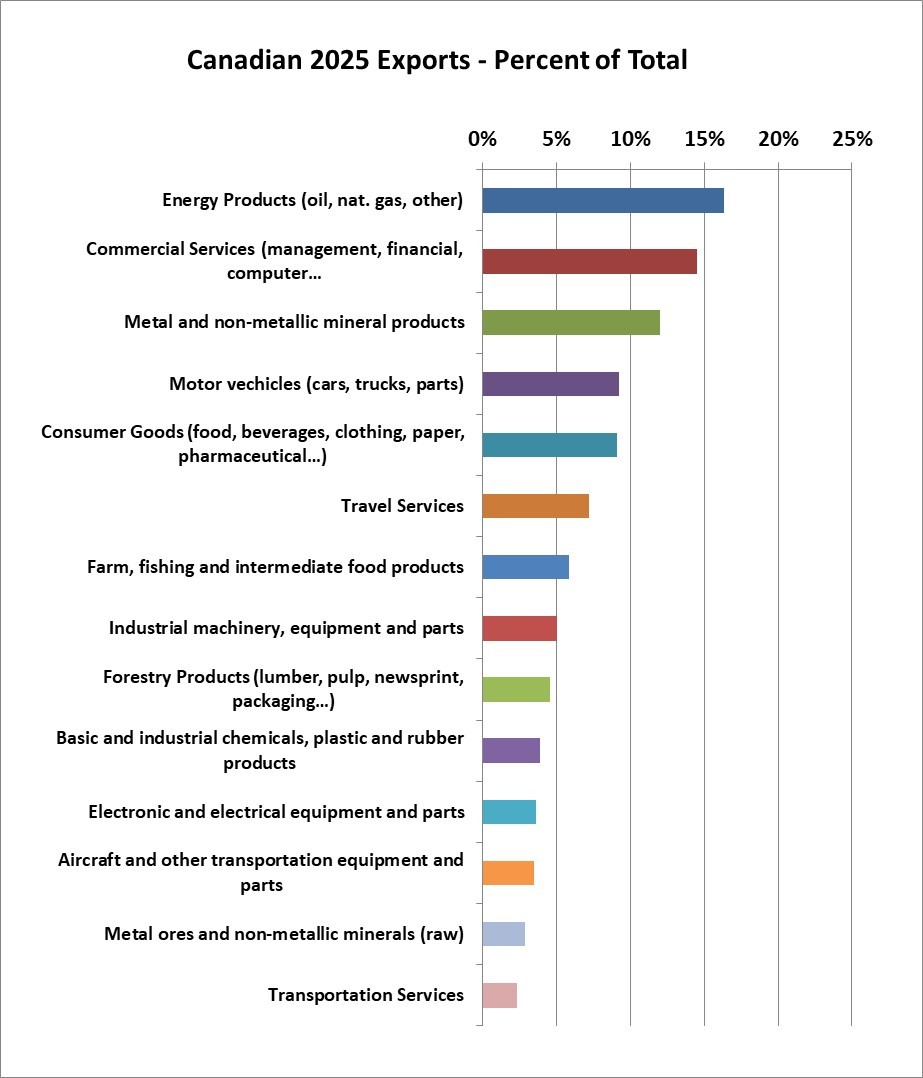
Here is a breakdown of Canada’s exports by category:
Data Source: Statistics Canada
Exports and imports of goods and services quarterly (choose current dollars, not chained 2017)
Canada’s largest category of exports is energy products at $162 billion or 16% of the total – crude oil is the great majority of this followed by natural gas then refined petroleum products and minor amounts of coal, electricity and nuclear fuel. The dollar value and percentage contribution of energy products may be noticeably higher in 2026 due to higher oil prices and due to natural gas LNG exports.
Commercial services which includes management services, financial services and information services is the second largest export category at $144 billion or 14.5% of the total. That’s not far behind energy products! Metal and non-metallic mineral finished products is the third biggest export category at $119 billion or 12%. Motor vehicles and parts are the fourth largest export segment at $92 billion or 9.2% of total exports. Consumer goods, perhaps surprisingly, is fifth largest at $91 billion or 9.1%% of the total.
Canada has a reputation for exporting relatively unprocessed natural resources. That is certainly true in regards to oil and metal and mineral ores. But most of Canada’s exports are not raw materials. For example, under forestry products, raw logs represent only 1% of that category.
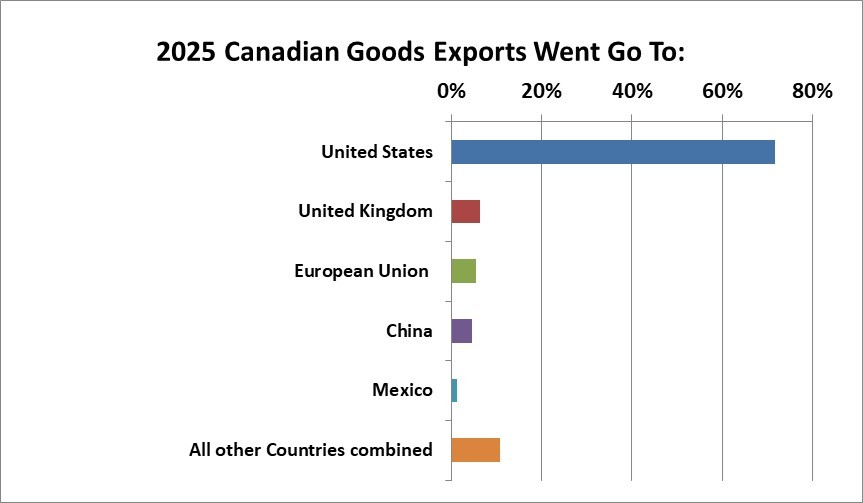
To Which Countries Does Canada Export to (Excludes Services)?
The answer to that question is alarming especially in light of the current tariff war:
Data Source, Statistics Canada
International merchandise trade for all countries and by principal trading partners, quarterly seasonally adjusted (multiply by four to annualise).
http://www.statcan.gc.ca/tables-tableaux/sum-som/l01/cst01/gblec02a-eng.htm (monthly)
Note that our data source does not include services in the exports-by-country data.
The United States accounted for the great majority of Canadian goods (merchandise) exports at $555 billion or a staggering 72% of the total. But this is down from about 75% in 2024. The United Kingdom is second at $50 billion or 6.4% of the total. The European Union collectively is the third largest export destination at $43 billion or 5.5% of the total. China at $35 billion represent about 4.5% of the total. Mexico, despite its proximity imports only about $9 billion annually of goods from Canada or 1.2% of Canada’s total exports.
Things may be changing and China is an important “customer” country for Canada. But the fact is, for now, when it comes to Canadian exports, the United States remains our number one export destination by far. Mexico, despite its proximity accounts for only $9 billion annually or 1.2%. Canada’s exports to all but a tiny handful of countries are almost insignificant. Treating the European Union collectively, you can literally count all of Canada’s important trading destination countries on the fingers of one hand. The extent of the reliance on exports to the U.S. is sobering and, given their increasing “America-First” rhetoric and policies, alarming. Some of the “other” countries may import more from Canada than Mexico does but Statistics Canada has not broken them out in our source table.
What Does Canada Import?
Canadian Imports by Category:
In 2025 Canada’s imports of goods and services at $1,044 billion were about 32% as large as its GDP.
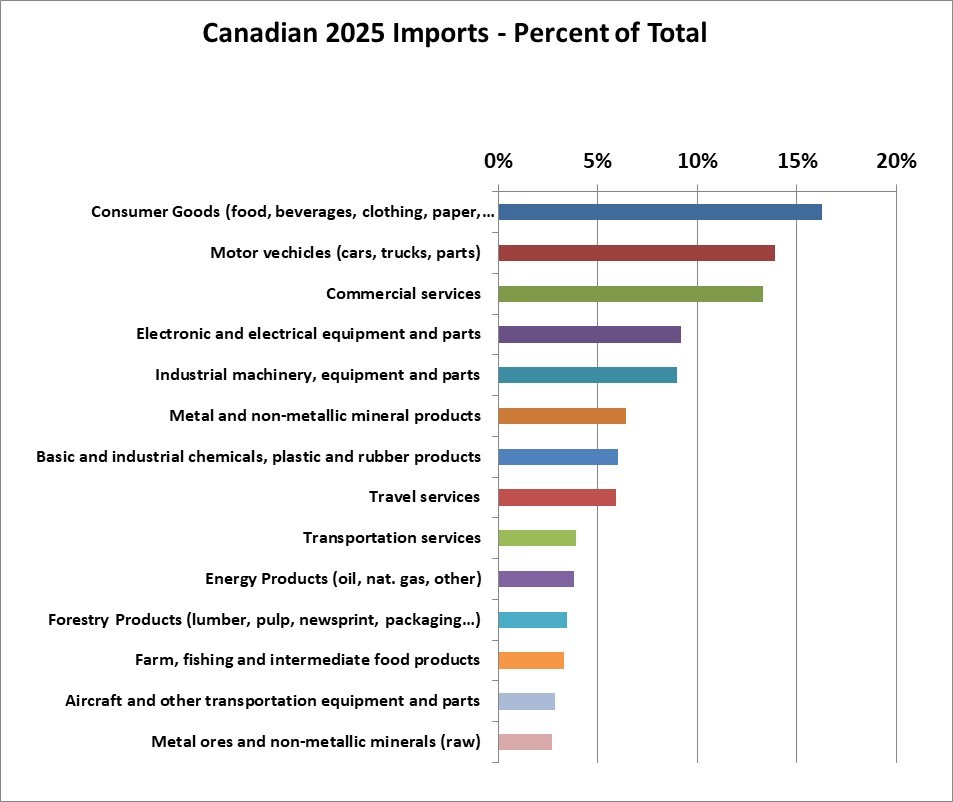
The following chart shows imports by industry segment as a percentage of total goods and services imports.
Data Source: Statistics Canada
https://www150.statcan.gc.ca/t1/tbl1/en/tv.action?pid=1210013401
The data indicates that consumer goods are Canada’s largest import category at $165 billion or 16% of the total. Motor vehicles and parts at $141 billion constituted 14% of total goods and services imports. Commercial services constituted $135 billion or 13% of the total.
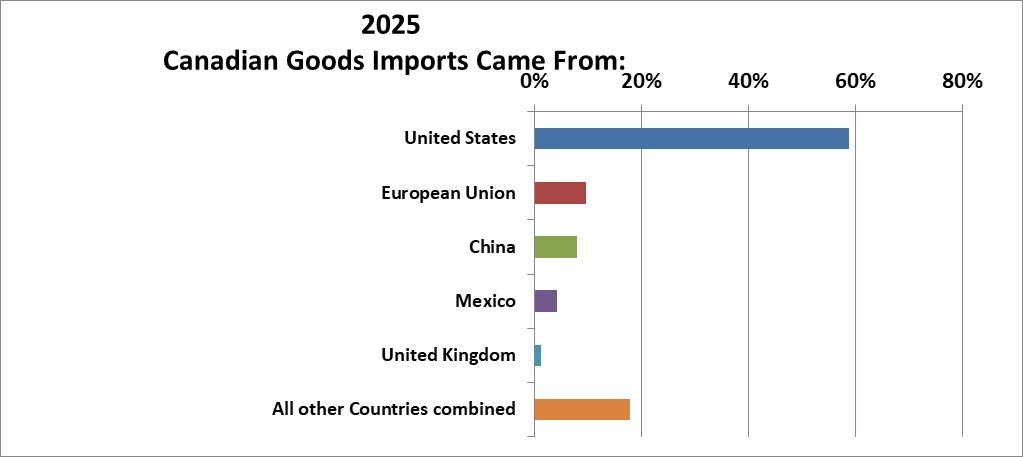
From Which Countries Does Canada Import Goods?
Data Source, Statistics Canada
International merchandise trade
Note that our data source does not include services in the imports-by-country data.
The United States accounts for $475 billion or 59% of Canada’s annual goods imports. The European Union collectively accounts for $78 billion or 9.7%. China accounts for $65 billion or just 8.1% of the total. Mexico accounts for for $35 billion or 4.3% and the U.K for $11 billion or just 1.3%. The remaining $144 billion or 18% is spread widely around the globe. Most of the other countries in the world are insignificant to Canada in terms of imports. But there may be some countries from which Canada imports more than Mexico and certainly the U.K. This is the way our data source breaks down the countries.
For Which Products and Services is Canada a Net Exporter and For Which a Net Importer?
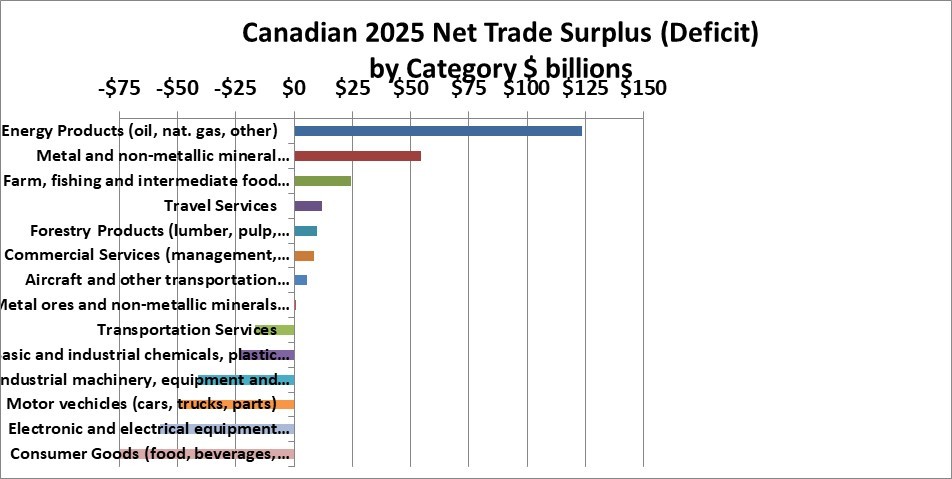
Energy – largely crude oil – is Canada’s largest NET export (exports minus imports) at $124 billion. And it’s “no contest”. That’s 2.3 times larger than the next highest net export category which is “metal and non-metallic mineral products” – which includes steel and aluminum products at $54 billion. Oil is “bringing home the bacon” to this country and in a sense provides the dollars to pay for the things that Canada imports. Metal products, farm, fishing and intermediate food as well as forestry also bring home some bacon to this country. In 2026 with higher oil prices, Oil is going to be even more so the largest net export by far.
Canada is a net exporter of commodities including notably energy products, metal & mineral products, farm, fishing & intermediate food products, and forestry products.
Canada is a net importer in most manufactured and finished goods categories including consumer goods, motor vehicles & parts, industrial machinery, and electronic & electrical equipment. Given all the support to that industry, it might be a surprise to see that motor vehicles are a large net IMPORT category for Canada.
Canadians don’t actually operate as one giant sort of “team”. But it can be argued or observed from this data that, for the country as a whole, the net exports of energy (oil) in particular and to a lesser extent other commodity products are what pay the bills to allow the country to be very much a net importer of consumer and manufactured goods.
END
Shawn Allen, CFA, CPA, MBA, P.Eng.
President, InvestorsFriend Inc.
Article originally created November 3, 2007, the latest annual update was April 22, 2026.
Another version of this article also explains Canada’s GDP by industry.
Dear reader: Consider joining our free newsletter list to keep in touch. I hope you will agree that my content is clear, trustworthy and useful. I will never abuse your email address. I only send out to this list about once a month or less.